

 Français
Micro-Entrepreneur Invoicing Example: 7 Templates for 2025
Discover 7 micro-entrepreneur invoicing examples to optimize your quotes and invoices. Master invoicing for your sole trader business today!

As a micro-entrepreneur, mastering invoicing is a non-negotiable skill. A well-drafted invoice isn’t just a payment request; it’s a mark of your professionalism, a legal proof, and an essential tool for sound management. Yet between mandatory mentions, the specifics tied to your activity (service delivery, goods sales, craftsmanship) and the VAT regime, it’s easy to get lost. This article is designed to give you concrete, immediate help.
We’re going to break down 7 invoicing examples for micro-entrepreneurs tailored to the most common situations you’ll encounter, from selling products online to providing services at a client’s home. Each template will be analyzed in detail, with strategic advice and practical tips so you can create compliant, clear, and professional invoices effortlessly. You’ll learn how to secure your revenue and project an image of reliability.
For those considering recurring revenue models, it’s also crucial to understand the legal considerations for subscriptions to ensure fully compliant recurring billing. Let’s dive into these templates to simplify your administrative management.
1. Consulting services invoice
Invoicing for consulting services is a pillar for many micro-entrepreneurs, particularly consultants, coaches, and trainers. This type of invoice must be especially clear and precise, as it translates an intellectual, often intangible, service into a concrete monetary value. A good micro-entrepreneur invoicing example for a consultant must not only comply with the law but also reinforce the trust and professionalism perceived by the client.
Analysis of the example and strategy
An effective consulting invoice goes beyond simple legal mentions. It must detail the service so that the client understands exactly what they are paying for. For example, instead of simply writing “Marketing consultation,” prefer “Complete SEO audit including technical analysis, keyword research, and strategic recommendations report.” This transparency prevents disputes and justifies your rate.
Invoicing is often the final step of a sales process that begins well upstream. Before issuing an invoice for your consulting services, it’s often useful to start with a detailed proposal. Discover consulting services proposal templates to professionalize your approach and secure the client’s agreement even before the assignment begins.
Key strategic point: The description of services on the invoice should mirror the accepted quote or business proposal. Use the same terms and the same level of detail to ensure total consistency and avoid any confusion or dispute at payment time.
Mandatory mentions and points of attention
For a consultant operating as a micro-entrepreneur, certain mentions are crucial to remain compliant. The infographic below summarizes the three most important administrative elements never to forget on your service invoices.
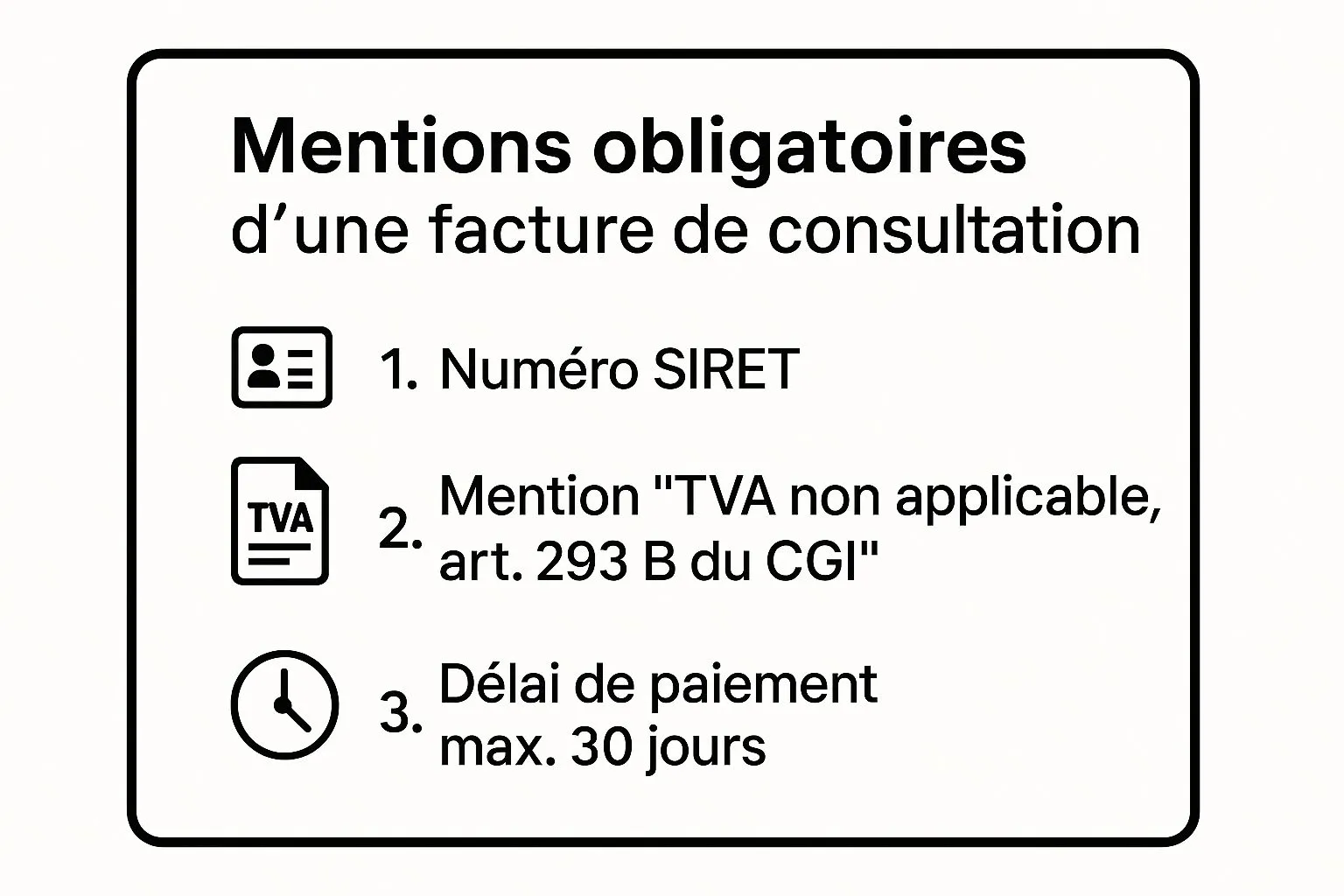
These three points are the foundation of your invoice’s validity. Omitting the SIRET number or the VAT-related mention can lead to penalties and invalidate the document in the eyes of the tax authorities.
Practical recommendations
- Detail the services: For each service, indicate the nature (e.g., coaching session), the date, the duration or volume (e.g., 1 hour), and the unit price excluding tax.
- Payment terms: Be explicit about payment deadlines (e.g., “Payment on receipt,” “Payment within 30 days”) and clearly state applicable late-payment penalties.
- Use software: A dedicated invoicing tool for micro-entrepreneurs automates the addition of legal mentions, invoice numbering, and archiving, reducing the risk of manual errors.
- Rigorous archiving: Keep a digital and/or paper copy of all your invoices and related documents (quotes, purchase orders) for a legal period of 10 years.
2. Handmade product sales invoice
For creators, artisans, and makers operating as micro-entrepreneurs, the sales invoice embodies the value of their craftsmanship. Whether it’s handmade jewelry, pottery, or custom clothing, this document is essential for business management and legal compliance. A good micro-entrepreneur invoicing example for an artisan must precisely detail the products sold, handle ancillary costs such as shipping, and reflect the professionalism of the brand.
Analysis of the example and strategy
A handmade product invoice should be as polished as the product itself. The description is paramount: instead of “Necklace,” prefer “‘Aurora’ necklace in 925 silver with moonstone pendant.” This precision not only informs the client but also justifies the price and reinforces the artisan’s brand image. Each invoice line becomes a confirmation of the quality and uniqueness of the purchase.
Managing sales of physical products involves rigorous accounting, often more complex than for services. It’s crucial to clearly distinguish revenue from sales versus revenue from services, since micro-entrepreneur thresholds differ. To master these aspects, it’s useful to learn about accounting specific to artisans to ensure sound, compliant management.
Key strategic point: Clearly separate product cost and shipping costs on the invoice. Include a distinct line for “Delivery” or “Shipping fees.” This transparency is appreciated by clients and simplifies your accounting by separating sales revenue from expense reimbursements.
Mandatory mentions and points of attention
Beyond the standard legal mentions (SIRET, identity, etc.), the invoice for goods sales must include product-specific information. The precise description, quantity, and unit price excluding tax are non-negotiable elements. For artisans under the VAT exemption scheme, the mention “VAT not applicable, art. 293 B of the French Tax Code” remains mandatory. Managing returns is also a crucial point: your general terms of sale, which the invoice can reference, must clearly govern this.
Practical recommendations
- Detailed description: For each product, mention the name, main materials, dimensions, or a unique reference (SKU) if you use one.
- Shipping costs: Bill shipping costs on a separate line. Indicate the delivery method if relevant (e.g., Colissimo, tracked letter).
- Return conditions: Briefly mention the return policy (e.g., “Returns accepted within 14 days”) and refer to your terms of sale for full details.
- Inventory management: Use invoicing to track your stock. A product code (SKU) can help automate this tracking, especially if you sell across multiple platforms.
- Visual documentation: For unique or custom pieces, attach a photo of the product to your copy of the invoice. This can be very useful in case of a dispute over the condition or conformity of the delivered item.
3. Digital services invoice (web development, graphic design)
Digital freelancers, whether web developers, graphic designers, or content creators, make up a significant share of micro-entrepreneurs. For them, a clear invoice is essential because it represents the delivery of intangible products and intellectual property rights. A micro-entrepreneur invoicing example for this sector must therefore be particularly meticulous about defining deliverables and terms of use, ensuring the protection of the provider and the satisfaction of the client.
Analysis of the example and strategy
An invoice for a digital service should leave no room for interpretation. Vague descriptions like “Website creation” or “Logo design” should be avoided. Prefer precise wording that reflects the terms of the specifications or the initial quote. For example, for a website billed at €2,500, the detail could be: “Creation of a WordPress showcase site (5 pages), including premium theme, basic SEO configuration, contact form, and two revision cycles.” This precision justifies the rate and frames the service.
Managing revisions and additional requests is a critical point. The invoice must reflect what was agreed upon beforehand. If the client requests changes outside the agreed scope, these should be the subject of an additional quote and separate billing. This professionalizes the relationship and guarantees fair compensation for any extra work.
Key strategic point: Include a clear line or mention regarding the transfer of usage rights. Specify the scope of the rights transferred (e.g., “Transfer of economic rights for web and print use, for an unlimited period”). This avoids future disputes over the use of the delivered creations.
Mandatory mentions and points of attention
For digital professions, beyond the standard legal mentions (SIRET, VAT, etc.), the description of the service lines is paramount. Each billed item must correspond to a tangible deliverable or a validated project milestone. For example, a graphic designer billing €350 for a logo could detail: “Creation of 3 logo proposals” and “Finalization of the selected logo + delivery of the simplified style guide (.ai, .eps, .png formats).”
It’s also crucial to clearly link the invoice to the service agreement or signed quote, which contains more detailed clauses on intellectual property, confidentiality, and project boundaries.
Practical recommendations
- Link the invoice to the quote: Always mention the corresponding quote number on your invoice. This creates clear administrative and legal continuity.
- Define the deliverables: Precisely list each file or service provided (e.g., “Logo in vector format,” “5 SEO-optimized blog articles of 500 words”).
- Frame the revisions: Clearly state the number of revision cycles included in the initial rate. Bill any additional request as an “Additional service.”
- Manage copyright: Use a standard contract to govern the transfer of rights and mention its main terms on the invoice as a reminder.
4. Professional training invoice
Micro-entrepreneurs entering the professional training sector are stepping into a regulated field. Invoicing doesn’t just serve to get paid—it also demonstrates the seriousness and compliance of the training organization. A micro-entrepreneur invoicing example for a training course must therefore scrupulously comply with current standards, especially if the courses are eligible for public or pooled funding such as the Personal Training Account (CPF).
Analysis of the example and strategy
A training invoice must be impeccably clear. The client, whether a business or an individual, must understand the structure of the funded training. For example, instead of a single line “Communication training,” it’s preferable to detail: “‘Public Speaking’ training program - 20 hours.” This precision is essential for funding files and reinforces your credibility as a qualified trainer.
Invoicing is part of a broader administrative management process specific to training. Even before issuing the invoice, you need to have validated enrollments and drawn up a training agreement. To go further and structure your offering, discover how to create an online course that will appeal to and meet market standards.
Key strategic point: For funded training courses, the invoice must often be issued at the end of the service, accompanied by attendance sheets and the training completion certificate. The training title on the invoice must exactly match the one mentioned on the training agreement and on funding platforms (e.g., Mon Compte Formation).
Mandatory mentions and points of attention
Beyond the mentions common to all invoices, those for professional training have their own specifics. It’s crucial to include the precise title of the training, its duration in hours, the dates it was delivered, and the name(s) of the trainee(s). If you are a certified training organization, stating so is a mark of quality.
The Qualiopi certification has become an almost indispensable requirement. It’s mandatory for your clients to be able to use public or pooled funds to finance your training courses. Obtaining it transforms your offering and legitimizes your rates.
Practical recommendations
- State your status: If you are a registered training organization, indicate your activity declaration number (NDA).
- Specify the terms: Clearly state the learning objectives, target audience, and prerequisites in the agreement that precedes the invoice.
- Keep evidence: Maintain a trainee register and carefully archive attendance sheets, evaluations, and completion certificates. These documents are essential in the event of an audit.
- Bill at the right time: Depending on the funders (OPCO, Pôle Emploi, CPF), invoicing rules vary. Check whether you need to bill before, after, or in installments (deposit/balance).
5. Home services invoice (personal services)
Invoicing for personal services (SAP) is an important specialty for micro-entrepreneurs in fields such as cleaning, gardening, minor handyman work, or home care. This type of invoice must not only comply with general invoicing rules but also include specific mentions allowing individual clients to benefit from a tax credit. A good micro-entrepreneur invoicing example for personal services is thus both a management tool and a major sales argument.
Analysis of the example and strategy
A personal services invoice must clearly identify the nature of the intervention so it qualifies for the tax credit. For example, instead of “Outdoor maintenance,” it’s preferable to detail “Hedge trimming and lawn mowing.” This precision is essential for the client when filing their tax return. Additionally, to build trust and clarity, it’s recommended to attach an annual tax certificate to the invoice summarizing all interventions for the year.
Managing personal services often involves recurring interventions, making organization crucial. Before billing, it’s essential to draw up clear quotes, especially for one-off services (minor handyman work, gardening), to avoid any misunderstanding about the scope and cost of the intervention.
Key strategic point: Highlight the tax benefit directly on the invoice. A sentence such as “Service eligible for the tax credit for employing a home-based worker (Art. 199 sexdecies of the French Tax Code)” reassures the client and adds value to your service by reminding them of the savings they achieve.
Mandatory mentions and points of attention
For a micro-entrepreneur offering personal services, additional mentions are necessary for clients to benefit from the tax advantages. It’s imperative that the activity be declared as a personal service (via a NOVA declaration). Without this declaration, your clients won’t be able to claim the tax credit, which is a major competitive disadvantage.
In addition to the standard mentions, your invoice must state the name and address of the intervention location if different from the billing address. It must also specify the total amount actually paid, as this amount is the basis for calculating your client’s tax benefit.
Practical recommendations
- Detail the interventions: For each service, note the date, type of service (e.g., “Window cleaning,” “Furniture assembly”), number of hours, and hourly rate excluding tax.
- Mention the tax benefit: Explicitly state that the client can benefit from a 50% tax credit on amounts paid, within the legal limits.
- Professional insurance: Take out and mention your Professional Liability Insurance on your documents. This is a mark of seriousness, especially for interventions at clients’ homes.
- Annual tax certificate: Send a tax certificate to your clients before March 31 of year N+1, summarizing all services paid for during year N. This is a legal obligation and a valued service.
6. E-commerce sole trader invoice
E-commerce invoicing is a discipline in its own right for the micro-entrepreneur. Unlike a service, it concerns the sale of physical or digital goods, which introduces complex variables such as inventory management, shipping costs, VAT (if applicable), and above all regulations specific to distance selling. A good micro-entrepreneur invoicing example for an e-merchant must be precise, automated, and fully compliant to ensure a smooth customer experience and avoid legal complications.
Analysis of the example and strategy
An e-commerce invoice must reflect every step of the transaction, from the product itself to its delivery. For example, an invoice for a fashion accessories shop won’t simply display “Accessory €29.” It will precisely detail: “‘Lunar Glow’ necklace - 925 silver” at a price of €29 including tax, followed by a separate line “Delivery fee - Colissimo” at €5. This clarity is essential, as it justifies every euro spent by the client and facilitates the handling of returns or complaints.
The main strategy in e-commerce is automation. Platforms like Shopify, WooCommerce, or PrestaShop automatically generate invoices as soon as an order is confirmed. This automation eliminates the risk of human error, ensures flawless sequential numbering, and guarantees that every customer receives their accounting document instantly. To go deeper into the general rules, you can consult this complete guide to sole trader invoicing which details the basic obligations.
Key strategic point: The invoice is the last transactional touchpoint with your customer. It must be impeccable and clearly incorporate your general terms of sale, particularly return and refund terms. A link to your terms of sale on the invoice is a recommended practice.
Mandatory mentions and points of attention
For an e-merchant, beyond the standard mentions (SIRET, VAT exemption, etc.), several points are specific to distance selling. The 14-day right of withdrawal is a central element of online commerce in Europe. Your invoice, or the accompanying documents, must inform the client of this. The billing address and delivery address, if they differ, must be clearly distinguished.
Managing shipping costs is another point of attention. They must appear as a separate service line on the invoice, with their own amount. If you offer free delivery (for example, for an order of organic products at €45), it’s wise to indicate this on the invoice with an amount of €0.00, reinforcing the perceived value offered to the customer.
Practical recommendations
- Automate invoicing: Use the native features of your e-commerce platform (Shopify, WooCommerce, etc.) to generate and send invoices automatically.
- Specify shipping costs: Always display delivery fees on a separate line. This simplifies your accounting and offers full transparency to the customer.
- Inform about returns: Include a reminder of return conditions on the invoice or a direct link to the corresponding page on your website.
- Rigorous tracking: Make sure the invoice number matches the order number for seamless tracking between your back office and your accounting.
7. Event services invoice
Invoicing for the events sector is a delicate exercise for micro-entrepreneurs such as photographers, DJs, caterers, or decorators. An event service often involves long-term commitments, significant equipment costs, and a strong human dimension. A good micro-entrepreneur invoicing example for this sector must therefore financially protect the provider while clarifying every detail of the service for the client, from the deposit to the final balance.

Analysis of the example and strategy
A successful event invoice must structure the service into several clear financial stages. For example, a wedding photographer billing a service at €1,200 shouldn’t just indicate the total amount. They should break down the elements: “8-hour presence package,” “Premium photo album,” “Travel expenses,” etc. This granularity justifies the rate and makes the invoice transparent.
Managing deposits is fundamental in this field. Requesting a deposit when the quote is signed not only secures the date but also finances the initial expenses incurred (equipment booking, supply purchases). The deposit invoice, then the balance invoice, are distinct but linked documents that punctuate the business and financial relationship with the client.
Key strategic point: The final invoice should explicitly reference the signed quote and the deposit already paid. Clearly state “Balance for invoice No. XXXX” and detail the calculation: Total amount excluding tax - Deposit paid = Balance due. This traceability is essential for clarity and accounting.
Mandatory mentions and points of attention
Beyond the legal mentions common to all invoices, the events sector requires particular attention to contractual terms. The video below provides clarification on managing invoices and quotes, a crucial point for service providers.
Anticipating the unexpected is key. Clear cancellation terms and clauses on overtime or last-minute requests protect your work and your revenue.
Practical recommendations
- Bill a deposit: Systematically require a deposit of 30% to 50% upon booking to secure the date and cover initial costs. Issue a dedicated deposit invoice.
- Detail the deliverables: Precisely specify what’s included. For a DJ: “5 hours of musical performance,” “Provision of sound and lighting equipment.” For a photographer: “Delivery of 300 retouched photos in HD via an online gallery.”
- Set cancellation terms: Include the terms in the event of cancellation by the client in your general terms of sale (and reiterate them on the quote) — e.g., non-refundable deposit if cancellation occurs less than 30 days before the event.
- Plan for extras: Mention the cost of overtime, travel expenses beyond a certain radius, or any other request not included in the initial package.
Comparison of 7 micro-entrepreneur invoicing examples
| Invoice type | 🔄 Implementation complexity | 💡 Resources required | ⭐ Expected results | 📊 Ideal use cases | ⚡ Key advantages |
|---|---|---|---|---|---|
| Consulting services invoice | Low – simple, standardized process | Basic invoicing software | Fast invoicing, micro-social compliance | Consultants, coaches, trainers | Simplicity, VAT exemption, quick management |
| Handmade product sales invoice | Medium – product and inventory management | Product management software and stock tracking | Sales traceability, commercial compliance | Artisans, creators, physical or online sellers | Full traceability, inventory management, compliance |
| Digital services invoice | Medium to high – deliverable specifics | Digital tools, project tracking, IP contracts | Precise, secure invoicing, easy archiving | Web developers, graphic designers, writers | Paperless process, project tracking, copyright management |
| Professional training invoice | High – numerous legal obligations | Qualiopi certification, trainee management | Value-added invoicing, CPF eligibility | Professional trainers, training organizations | High added value, promising market, recurrence |
| Home services invoice | Low to medium – specific tax mentions | Liability insurance, travel management | Client tax benefits, local relationship | Personal services, cleaning, gardening, handyman work | Client tax credit, fast payment, proximity |
| E-commerce sole trader invoice | Medium – returns management, shipping costs | E-commerce platform, invoicing automation | Order tracking, e-commerce compliance | Online sellers, e-commerce shops | Automation, broad market, easier tracking |
| Event services invoice | Medium to high – deposit and cancellation management | Detailed contracts, equipment insurance | High-value invoicing, deposit protection | Photographers, DJs, caterers, decorators | High pricing, clear terms, secure advances |
Take Action: Your Invoicing, Your Success
At the end of this detailed review, you now have much more than a simple collection of invoice examples. You have a strategic framework for understanding why and how every element of your invoicing contributes to the health and credibility of your micro-entrepreneur business. We’ve analyzed a variety of models, from consulting services to e-commerce product sales, including personal services, and for each micro-entrepreneur invoicing example, we’ve drawn out concrete tactics.
Summary of Essential Strategies
Remembering the key lessons from each model is fundamental. Every invoice is a business card, a moral contract, and a management tool.
- Clarity above all: Whether for web development services or event services, a precise description and detailed breakdown of services (hours, tasks, deliverables) eliminates any ambiguity and prevents disputes.
- Adaptation to context: An invoice for a handmade product won’t have the same specifics as an invoice for professional training. Contextualization, with the addition of mentions such as “VAT not applicable” or delivery details, is a marker of professionalism.
- Anticipation is your ally: Including clear payment terms, late-payment penalties, and deposit information is not a sign of distrust, but proof of good management. It’s the foundation of healthy cash flow.
The key strategic takeaway: An invoice is not a mere administrative formality. It’s a powerful communication tool that reflects the value of your work, secures your revenue, and builds your clients’ trust. Mastering it means mastering an essential part of your client relationships and business management.
Next Steps for Flawless Management
Knowing isn’t enough — you need to act. To turn this knowledge into tangible results, here’s your action plan:
- Audit your current invoices: Take your latest invoice template and compare it to the relevant examples in this article. Are any mandatory mentions missing? Can you clarify the description of your services?
- Create your own templates: Based on our analyses, build customized templates for each type of service you offer. Save them in a dedicated folder for quick access.
- Adopt an invoicing tool: Manual management is a source of errors and wasted time. Switching to invoicing software is the most impactful step to secure and professionalize your business. It guarantees you constant legal compliance and valuable automation.
By optimizing your invoicing, you build solid foundations. For your micro-entrepreneur business to thrive and ensure your long-term success, it’s also essential to master marketing tips for small businesses. Perfect invoicing combined with an effective marketing strategy is the winning duo for sustainable growth.
Don’t let invoicing hold you back any longer. See it as a growth lever, a way to strengthen your brand image and secure your financial future. Every invoice sent is one more stone added to the edifice of your success.
Ready to take it to the next level and automate your invoicing with total peace of mind? Bizyness is the tool designed specifically for micro-entrepreneurs, letting you create compliant quotes and invoices in just a few clicks. Simplify your administrative management and focus on your core business with Bizyness.
