Français
What's new in micro-entrepreneur tax rates for 2023
The micro-entrepreneur tax rates for 2023 have changed. Discover the new rules for declaring your revenue and anticipating the charges tied to these new 2023 tax rates.

France is known for its fiscal instability, and 2023 will be no exception, especially for sole traders! Here are the changes to micro-entrepreneur tax rates for 2023, along with the other changes you should expect, particularly for revenue and VAT thresholds.
A quick refresher on the micro-entreprise
Following the merger of two schemes in 2016, there is no longer any difference between a micro-entrepreneur and a sole trader (auto-entrepreneur). The micro-entreprise is run by a sole trader who has opted for a simplified management structure with a flat-rate scheme to pay their social security and tax contributions. As a result, they cannot deduct any expenses from their revenue!
As a sole trader, they enjoy the same rights as self-employed workers, which covers them in case of accident, illness, and maternity, while they contribute toward their pension.
What’s changing in the 2023 micro-entrepreneur tax rates?
Declaring and paying the sole trader’s social security and tax charges
Every month or every quarter, sole traders must declare their revenue on their personal URSSAF account. The amount of charges owed is calculated immediately; payment must be made before the end of the month following the month or quarter of the declaration deadline.
For example, if you declare your revenue for the first quarter, you must file your declaration and pay the charges before April 30. Self-employed workers on the actual tax regime, as well as companies, are required to pay flat-rate advance installments and then adjust based on their actual figures.
The default reporting frequency is quarterly. If you want to switch to monthly reporting, the deadline to request this on your account at autoentrepreneur.urssaf.fr is January 31 of each year, with retroactive effect from January 1. After this deadline, your change of frequency will only take effect the following year.
Note that revenue declaration remains mandatory even if your revenue is zero. In that case, you won’t owe any charges.
If you fail to declare your revenue, whatever it may be, your 2023 micro-entrepreneur tax rate won’t change, but you’ll have to pay a late penalty of €55.
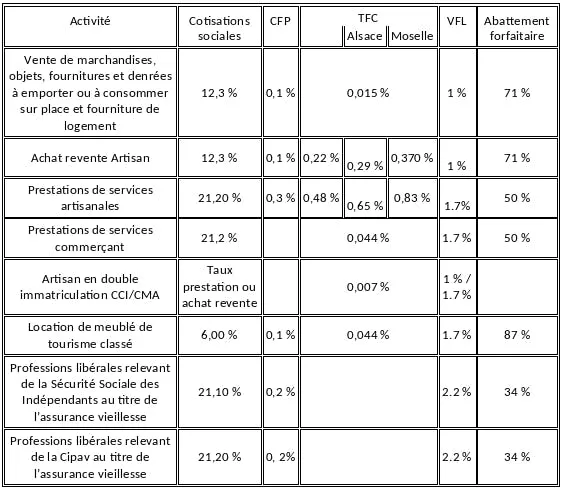
N.B. In the tables below:
- CFP = Contribution to Vocational Training;
- TFC = Chamber Fee Tax;
- VFL = Final Withholding Payment of Income Tax.
2023 micro-entrepreneur tax rates: social contribution rates in mainland France
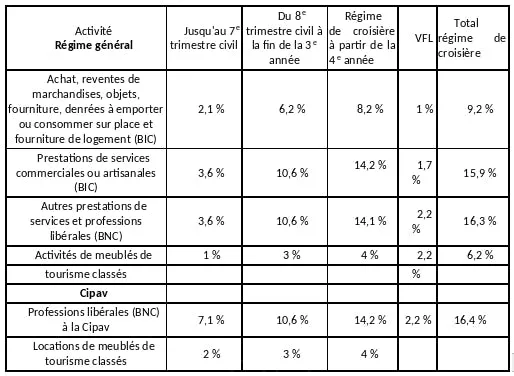
2023 micro-entrepreneur tax rates: social contribution rates overseas for micro-entrepreneurs under the general scheme and Cipav
The sole trader scheme in Mayotte is not affected by the reduction in social contribution rates.
2023 micro-entrepreneur tax rates: social contribution rates in Mayotte
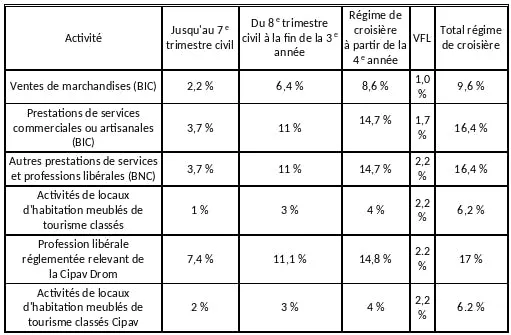
If you’re a sole trader overseas, since conditions are not identical to those in mainland France, you must make sure the VFL doesn’t work against you. To do this, you need to factor in the tax allowance of:
- 30% in Guadeloupe, Martinique, and Réunion, up to a limit of €5,100;
- 40% in Guyana and Mayotte, up to a limit of €6,700.
How the social security package is broken down
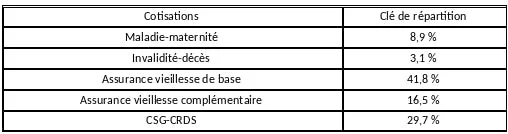
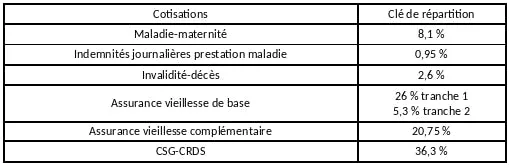
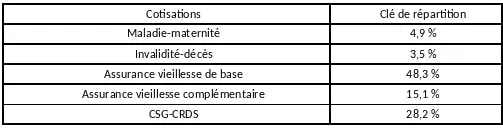
The reduction in contributions for self-employed workers, already applied in the fourth quarter of 2022, is confirmed by decree no. 2022-1529 of December 7, 2022. What’s new for 2023 micro-entrepreneur tax rates is the breakdown key for social contributions covering illness, disability, retirement, maternity, and so on.
Breakdown key for craftspeople and shopkeepers, in purchase-resale-manufacturing or service activities
Breakdown key for self-employed professionals affiliated with Cipav
Breakdown key for furnished tourist accommodation rentals
Breakdown key for self-employed professionals under the general scheme
Changes to micro-entreprise tax regime thresholds for 2023, 2024, and 2025
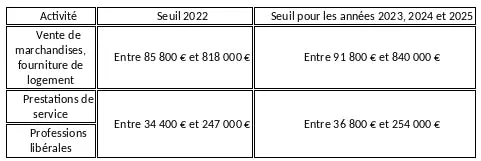
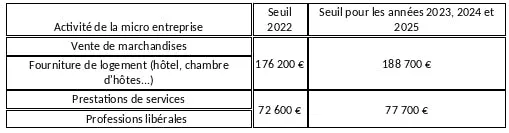
To calculate the 2023 micro-entrepreneur tax rates, you need to take into account the revenue thresholds specific to the sole trader scheme. For the next three years — 2023, 2024, and 2025 — these thresholds have been raised. The same applies to the VAT exemption thresholds, the simplified actual tax regime, and the simplified VAT regime.
Pre-tax revenue thresholds for the sole trader business
If you exceed these revised thresholds, you must switch to the sole proprietorship (entreprise individuelle) regime, which will no longer be subject to the 2023 micro-entrepreneur tax rate but will follow new rules.
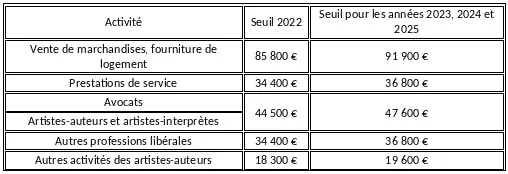
Pre-tax revenue thresholds for the VAT exemption
New VAT exemption thresholds have been set for the next three years.
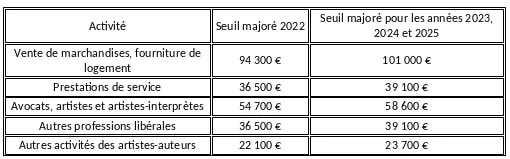
Increase to the higher threshold
Once you exceed the VAT exemption thresholds, you still benefit from higher thresholds, which have also been revised for the next three years.
Revised thresholds for the simplified actual tax regime and the simplified VAT regime
Finally, the 2023 finance law raised the thresholds for the simplified actual tax regime and the simplified VAT regime. These apply if you have opted for this regime or if your business exceeds the micro-entreprise revenue thresholds.
Simplified actual tax regime thresholds
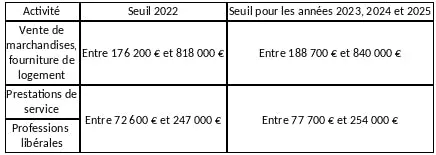
Simplified VAT regime thresholds