

 Français
Mileage Allowance for Sole Traders: Guide & Tips
Find out how to optimize your mileage allowance as a sole trader. A complete guide to calculating, invoicing and maximizing your profitability.

As a sole trader (micro-entrepreneur), you’ve probably wondered about mileage expenses. The answer might surprise you, but it’s simple: no, you can’t deduct them directly from your revenue. That’s a specific feature of the micro-tax regime, which applies a flat-rate allowance system. This allowance is meant to cover all your expenses, including your professional travel.
Mileage costs under the micro-entrepreneur regime: what you really need to understand

Picture this: you’re a photographer covering wedding shoots across the region. Or maybe you’re a consultant with regular client meetings. Either way, ignoring the real cost of your trips would be a serious management mistake. Even though you can’t deduct it, closely tracking your mileage costs as a sole trader is vital to the health of your business.
The great advantage of the micro-tax regime is its simplicity. The tax authorities assume that part of what you collect goes toward paying your expenses. That’s why they apply an automatic allowance before even calculating your taxes and social contributions.
How does the flat-rate allowance work?
Rather than requiring you to keep and justify every fuel receipt, insurance bill or garage invoice, the system grants you a lump-sum deduction. The amount of this allowance is a fixed percentage of your revenue, which varies depending on your activity:
- 71% for the sale of goods.
- 50% for commercial or craft services (BIC).
- 34% for professional/liberal activities (BNC).
In practice, the government estimates, for example, that a service provider’s business expenses represent 50% of their revenue. To dig deeper into this tax mechanism, take a look at this complete guide to mileage expenses for sole traders.
“Okay, but if we can’t deduct anything, why bother calculating it all?” That’s exactly where the trap lies. Precise tracking of your mileage isn’t just an administrative task — it’s an essential management tool for setting fair rates and, above all, for not working at a loss.
How to turn this constraint into an asset for your business
Not being able to deduct your expenses isn’t the end of the story. Think of it instead as an incentive to factor these costs more precisely into your strategy. By calculating what your trips actually cost you, you get a clear picture of the profitability of each assignment.
This knowledge gives you the legitimacy to charge travel expenses to your clients, in complete transparency. You’re not artificially inflating the bill; you’re simply covering a real expense that’s essential to delivering your service. It’s the first step toward running your micro-business with genuine strategic vision.
As a sole trader, you know it: the micro-tax regime doesn’t let you deduct your actual expenses. That’s a rule of the game you have to accept. But that doesn’t mean you have to absorb all your travel costs without saying a word. Far from it! Your best ally in this situation? The famous mileage rate scale (barème kilométrique) published every year by the tax authorities.
Think of it not as a deduction tool, but as an objective, indisputable reference. It’s the basis that lets you estimate your travel expenses fairly and professionally. No more wild guesses! By relying on this scale, you build solid quotes, protect your margins, and justify your rates transparently to your clients.
The infographic below gives you a clear picture of how the cost per kilometer changes depending on your car’s tax horsepower.
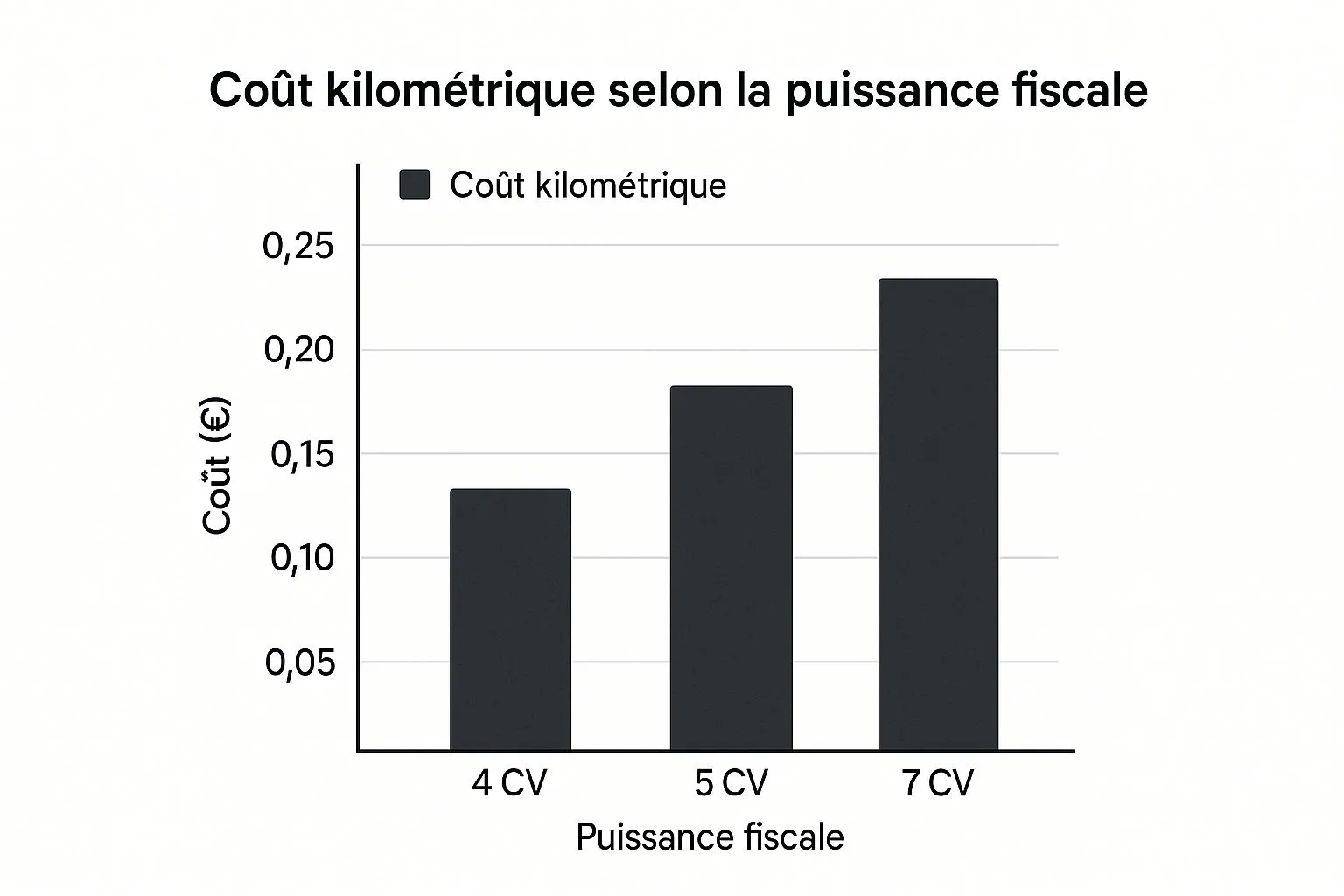
It’s clear: the more tax horsepower your vehicle has, the higher the reference rate climbs. That makes perfect sense, since it reflects higher maintenance and running costs.
How does this famous scale work?
The principle behind the scale is both simple and well thought out. It’s based on two main criteria to define the cost of your trips:
- Your vehicle’s tax horsepower (CV).
- The total distance you travel over a calendar year for your business.
By combining these two pieces of information, you get a rate per kilometer. For example, for a 4 hp car, the rate won’t be the same whether you drive 4,000 km or 22,000 km in a year. The system is designed to be degressive: the more you drive, the lower the rate per kilometer becomes. Why? Because your fixed costs, like insurance or vehicle depreciation, are spread over a greater distance.
Example scenario: Imagine you’re a consultant using a 4 hp car. To invoice a 100 km trip, you can’t simply multiply 100 by some arbitrary fixed rate. You first need an estimate of your annual mileage to find the right bracket on the scale. This method is what guarantees accurate, fair billing.
Breaking down the calculation formulas
The tax authorities leave nothing to chance and provide precise calculation formulas for each situation. To give you an idea, for a 3 to 4 hp car, the calculation for the first few thousand kilometers is based on a rate of €0.468 per kilometer. To dig deeper and see all the brackets, the simplest approach is to refer directly to the official information on the car expense scale.
This table illustrates the mileage cost calculation for a 4 hp vehicle according to the different distance brackets, in line with the official scale.
| Distance bracket (d) | Calculation formula | Example calculation (for 8,000 km) |
|---|---|---|
| Up to 5,000 km | d x €0.603 | (not applicable) |
| From 5,001 to 20,000 km | (d x €0.339) + €1,320 | (8000 x 0.339) + 1320 = €4,032 |
| Beyond 20,000 km | d x €0.405 | (not applicable) |
As you can see, for 8,000 km traveled, you fall into the second bracket. The calculation isn’t a simple multiplication, but a formula that accounts for the degressive nature of the cost.
A question that comes up often: what exactly does this scale cover? It includes most of the costs related to using your car:
- Vehicle wear and tear (depreciation)
- Maintenance and repairs
- Tires
- Fuel
- Insurance
Be careful, though: toll and parking fees are not included. You can (and should!) rebill these separately to your client, with supporting receipts.
Finally, great news for entrepreneurs who drive clean! If you use a 100% electric vehicle, the total amount of your mileage expenses calculated with the scale is increased by 20%. That’s a real financial boost. For an initial calculation of €3,000, that’s an extra €600 you can legitimately include in your invoicing.
By mastering these few rules, you turn the mileage scale into far more than just a grid of numbers. It becomes a genuine tool for managing your profitability and charging a fair price for every trip, without hurting your cash flow or your client.
How to factor travel expenses into your quotes and invoices

Knowing how to work with the mileage scale is one thing. But the real question is: how do you actually build it into your everyday invoicing? Good management of your mileage expenses as a sole trader relies on a clear, honest approach with your clients. In practice, you have two main strategies available.
The first, most direct one, is to add a dedicated line for these expenses on your quotes and invoices. It’s ideal if your trips vary a lot from one assignment to another. The other option is to fold these costs into your base rates to offer a single overall price, which can make things simpler to read for the client.
Option 1: Invoice actual expenses
Here, the idea is to precisely calculate the travel costs for a given assignment and add them in plain sight on your documents. This is by far the best approach for services that require significant travel or unusual trips.
Let’s take a concrete example: you’re a photographer based in Lyon and get booked for a wedding near Annecy. That’s a round trip of 140 km. In this situation, charging a mileage fee based on the actual distance is not only logical, it’s necessary. For a 5 hp car, based on the scale, that represents an amount well worth covering.
On your quote, it might look something like this:
- Wedding photography service: €1,200
- Travel expenses (140 km x €0.636/km): €89.04
This transparency is a real plus. Your client knows exactly what they’re paying for, which strengthens your credibility and professionalism. To make sure your invoices are fully compliant, check out our complete guide to invoicing for sole traders.
Option 2: Fold expenses into an overall rate
If your day-to-day involves lots of small, regular trips, itemizing every single one can quickly become a headache — for you and for your clients. This is typically the case for a consultant juggling appointments around town, or a craftsperson visiting several small job sites in the same day.
In that case, it’s often smarter to estimate your monthly mileage costs and factor them into your hourly or daily rate. For example, if you estimate your travel costs you about €200 a month for 20 billed hours, you simply need to raise your hourly rate by €10 (€200 / 20h). It’s simple, effective, and painless for the client.
Whichever option you choose, the key is to lay your cards on the table. Set expectations upfront, whether in your terms and conditions or when discussing the quote. It’ll save you a lot of misunderstandings and awkward conversations at payment time.
The key: a rigorous logbook
Whatever billing method you use, meticulous tracking of your professional trips is essential. No, you won’t have to present it to the tax authorities, but this data is a goldmine for you. It lets you calculate your real profitability and justify your expenses if a curious client asks about them.
A simple spreadsheet does the job perfectly. All you need is a few columns:
- Date
- Client concerned
- Purpose of the trip
- Starting and destination points
- Distance traveled
For the more tech-savvy, specialized mobile apps can even do the work for you using your phone’s GPS. They generate detailed reports and save you precious time. This tracking gives you a clear picture to fine-tune your rates or packages, based on real data rather than rough estimates.
The impact on your revenue and your caps
Rebilling your professional travel isn’t a trivial matter for your accounting. Every euro you invoice for your mileage expenses as a sole trader counts as revenue. It’s added directly to the total amount on which your social contributions and taxes are calculated.
This has real consequences, especially if you travel a lot for your business. An accumulation of travel expenses can quickly inflate your declared revenue and push you dangerously close to the micro-entrepreneur regime’s limits.
Monitoring the micro-entrepreneur revenue caps
The major advantage of sole trader status is its simplicity. But that simplicity depends on staying under certain revenue thresholds. For services, this cap is currently €77,700. Heavy mileage invoicing can push you past this threshold much faster than you’d think.
Let’s take a concrete example: a consultant who drives 10,000 km a year with a 4 hp car. Applying the tax scale (€0.468/km for this distance), that comes to €4,680 in expenses. Once rebilled to clients, this amount adds to their fees and weighs heavily in the cap calculation. For up-to-date information on these thresholds, the URSSAF portal remains the reference.
Exceeding the caps isn’t a minor formality. It takes you out of the micro-entrepreneur regime and switches you to an actual (real) tax regime. The consequence? Much more complex accounting and potentially heavier costs.
If you find that your actual expenses, particularly your travel costs, exceed the flat-rate allowance of 50%, it’s time to reconsider. A high volume of rebilled expenses is often a good sign that the actual tax regime could, in the long run, be more advantageous for you. It would let you deduct all your real expenses, though the administrative cost is different. To dig deeper, check out our guide on tax optimization for sole traders.
Balancing profitability with staying under the caps
So how do you manage this without losing money? It all comes down to strategy and anticipation. You need to find the right balance.
- Decide case by case: For a long, exceptional trip, invoicing actual mileage costs is the most logical approach. It’s transparent, and your client will understand they need to cover these specific costs.
- Adjust your base rates: For small, frequent, predictable trips (for example, visiting a regular nearby client), it’s often smarter to slightly raise your service rates. This quietly builds the costs into your price, simplifies your invoices, and avoids artificially inflating your declared revenue.
By taking this nuanced approach, you cover your costs without blowing up your revenue with endless mileage expense lines. It’s the best way to preserve the benefits of your status while getting fair compensation for your expenses.
How to better manage your daily trips
Tracking every kilometer by hand, in a little notebook… we all know that can quickly become an administrative nightmare. And yet, without rigorous tracking of your trips, there’s no way to correctly invoice your clients or get a clear picture of your profitability.
Fortunately, there are much simpler solutions to turn this chore into an almost automatic process. The idea is to stop juggling vague estimates and finally rely on reliable data. A few good habits and the right tools, and you’ll see, it changes everything.
Let technology work for you
You can forget the worn-out notebook sitting in the glovebox. Today, your smartphone is your best ally. There’s a wide range of mobile apps that use GPS to log every professional trip without you having to think about it.
Their usefulness goes beyond simply calculating distance. These apps typically let you:
- Sort your trips with a simple swipe: right for “business,” left for “personal.”
- Automatically calculate mileage allowances based on the official scale.
- Export clean monthly or annual reports, ready to send to your clients.
Picture the scenario: you leave a client’s premises, start driving, and the app logs your return trip. Once you arrive, a small notification asks you to confirm. And that’s it. Your mileage expenses as a sole trader are already calculated.
Don’t think of these apps as an expense, but as a genuine investment. Every minute you don’t spend on admin work is a minute you can devote to your clients or to growing your business.
Optimize your routes like a pro
Beyond the tools, it’s often organization that makes the biggest difference. Driving fewer unnecessary kilometers simply means less spent on fuel, less wear on your vehicle, and therefore more money in your pocket at the end of the month.
A few tried-and-tested common-sense tips:
- Plan your appointments smartly: Try to group your visits by geographic area. Scheduling three appointments in the same neighborhood on the same day avoids back-and-forth trips that cost you time and money.
- Use a route planner: Before heading out, enter all your addresses into an app like Google Maps or Waze. They’ll often suggest an optimized visiting order for the shortest route.
- Play with traffic patterns: Sometimes shifting your departure by 15 minutes is enough to avoid heavy traffic jams. That’s time and fuel saved easily.
These small habits, one after another, end up having a huge impact on your real cost per kilometer.
Keep your receipts: an essential safety net
Even though, as a sole trader, you can’t “deduct” your toll fees, parking, or garage bills, it’s essential to keep them. These documents are far more useful than you might think.
First, they’re your best defense. In the event of an audit, or if a particularly demanding client questions your invoicing, these receipts prove your trips actually happened. They’re your safety net.
Second, and this might be the most important point, they help you understand your own actual cost per kilometer. Add up these expenses (tolls, parking, maintenance…) plus your fuel and insurance costs, then divide the total by the number of kilometers traveled. You might be surprised: your real cost is often much higher than the URSSAF scale.
This information is pure gold. It lets you adjust your rates to make sure you’re covering all your costs, including vehicle wear and tear. This can also help you better set your hourly rate. If this topic interests you, our article on calculating your hourly rate as a sole trader will give you all the keys to factor this data in strategically.
Answering your questions about mileage expenses

Managing mileage expenses as a sole trader often raises plenty of questions. Even after covering the whole topic, some gray areas remain — small details that can change everything. This section is here for exactly that: answering the most frequently asked questions directly.
The idea is to give you concrete answers, the kind we all end up asking ourselves at some point out in the field. So you can manage your professional travel with more peace of mind and, above all, without making mistakes.
Can I use my personal car for my business?
Yes, of course! It’s actually the most common scenario for most sole traders. Nothing requires you to buy a vehicle in your business’s name.
The mileage scale system was designed precisely for this situation. It provides flat-rate coverage for all costs related to the professional use of your personal car, including:
- Vehicle wear and depreciation.
- Fuel used for your assignments.
- Insurance, maintenance, and repair costs…
In short, it’s a simple solution that spares you from having to keep meticulous accounts for a dedicated vehicle.
Are the mileage allowances I invoice taxable?
This is a key point to fully understand: the answer is yes, always. Every euro you receive from a client, whether for your service or to cover your travel, counts as revenue.
Watch out for this classic trap! Many people think it’s simply a tax-free expense reimbursement. Under the micro-entrepreneur regime, the rule is simple: everything you receive is revenue. You’ll therefore pay social contributions and income tax on these amounts, just as you do on your fees.
What if my actual expenses are higher than the flat-rate allowance?
That’s an excellent question. If you notice that your business expenses, particularly your travel costs, consistently exceed the flat-rate allowance (50% for services and 34% for professional/liberal activities), then the micro-entrepreneur regime may no longer be the most advantageous option for you.
When your actual expenses climb, it becomes worth considering a switch to the actual tax regime. This regime would let you deduct your expenses for their exact amount. In exchange, the accounting requirements are more demanding. It’s best to run the numbers, ideally with an expert, to be sure of your decision.
What’s the difference between mileage expenses and disbursements (débours)?
The distinction is crucial. Mileage expenses are compensation for using your own equipment (your car) and are added to your revenue.
Disbursements are something else entirely. These are amounts you advance on behalf of and in the name of your client. A typical example: you buy a train ticket for them. For this to count as a disbursement, the ticket invoice must be issued in the client’s name, and you ask for reimbursement down to the exact euro. These amounts don’t count toward your revenue. As a result, your toll or fuel costs, paid for your own vehicle, can never be considered disbursements.
Don’t let administrative work hold your business back any longer. With a tool like Bizyness, you can automate a good part of your accounting and invoicing. That way you can focus on what really matters: your craft. Discover how to simplify your daily routine on the Bizyness website.
