

 Français
Net selling price calculation: how to work out your ex-VAT price to boost profitability
Master net selling price calculation and optimize your margins with concrete methods to boost your profitability.

Calculating your net selling price (ex-VAT) is far more than simple addition. It’s the foundation your entire profitability rests on. Put simply, it’s obtained by adding your cost price (everything you spend) to the margin you’re aiming for. It’s only on this net amount that VAT is then added to arrive at the final price your customer pays.
The foundations of a pricing strategy that holds up
Working out your net selling price is a moment of truth for every entrepreneur. It’s the exercise that determines whether your business will simply tick over or truly take off. Knowing how to set a fair price — one that’s both attractive to the customer and profitable for you — is a vital skill, whether you’re a craftsperson, an e-commerce seller, or a consultant.
This process demands an honest look at your business. What are all your costs, really? What margin do you need, not just to cover these expenses, but also to invest and pay yourself properly? A good pricing strategy isn’t improvised; it rests on clear, well-understood concepts.
The pillars of your selling price
To avoid the classic pitfalls, it’s essential to clearly distinguish between the elements that make up your price. Each term has its own logic and role to play in your business model.
Here’s a quick clarification to make things clearer.
Glossary of essential financial terms
A table to quickly tell apart the fundamental concepts that determine your selling price.
| Key concept | What it means in practice | Its impact on your price |
|---|---|---|
| Cost price | The sum of all expenses (direct and indirect) needed to create and sell your product/service. Raw materials, rent, salaries, advertising… everything counts. | This is the floor. Selling below it means selling at a loss. |
| Margin | The oxygen of your business. The amount you add to the cost price to generate a profit. | It funds your development, future projects, and your own pay. It’s your net gain. |
| Net Selling Price | What your business actually pockets. It’s the cost price plus your margin. | It’s the only sound basis for assessing your performance and profitability. |
| VAT | A tax you collect on behalf of the State. It’s added to the net price, but this money never belongs to you — it merely passes through your accounts. | It raises the final price for the customer but has no impact on your direct profit. |
| Gross Selling Price (incl. VAT) | The final price paid by the consumer — the one shown on the label. | It’s the net price plus VAT. It’s the amount the customer has to pay. |
To illustrate, picture this process as a construction project. You start with the foundations (the costs) before building up the walls (the net price).
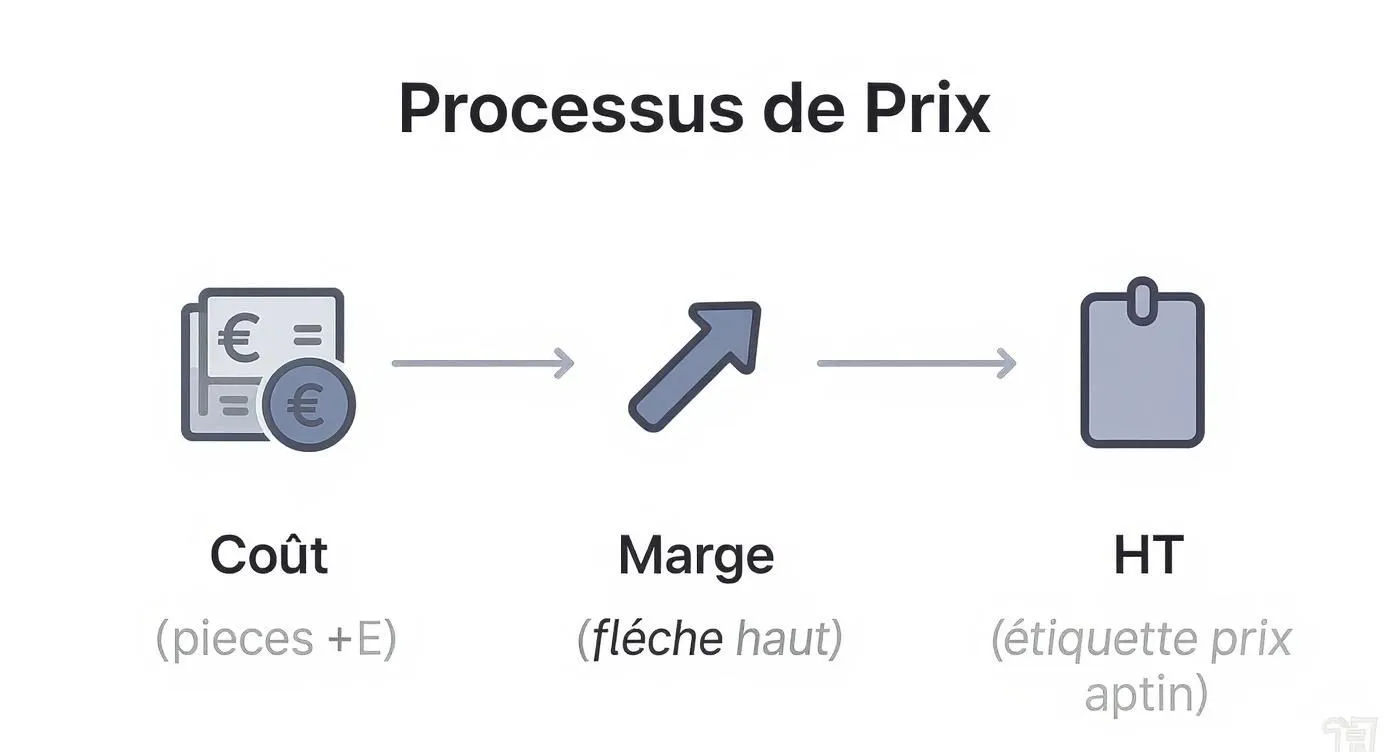
This diagram clearly shows that it’s the margin that bridges the gap between your expenses and a selling price that lets you make money.
Mastering these concepts is the first step toward sound management. Ignoring even one is a bit like navigating without a compass: you move forward, but you risk running aground. In France, taxation is a major consideration, but alternatives exist, such as setting up a company in Bulgaria where the tax rules are different.
Breaking down your costs for a fair and profitable price calculation
Even before thinking about your margin, the first building block of any net selling price calculation is tracking every last one of your expenses. This is a crucial step. A small approximation here may seem harmless, but it quietly eats away at your future profitability. The goal is simple: determine your cost price, meaning what a product or service actually costs you before it’s sold.
To picture this clearly, imagine for a moment that you’re a jewelry maker. The first, most natural reflex is to calculate the cost of the silver, the stones, the clasp… These are direct costs, the most obvious to see. But that’s only the beginning.
Direct costs: the visible part of the iceberg
Direct costs, also called variable costs, are directly tied to manufacturing a product or delivering a service. Their amount varies with your volume of activity: the more you produce or sell, the higher they climb. It’s logical.
Think of everything that’s concrete and measurable for each sale:
- Raw materials: wood for a carpenter, flour for a baker.
- Purchasing goods: the stock of products you buy to resell, typical of e-commerce.
- Direct labor: time specifically spent assembling a product (if you pay employees by the piece, for example).
- Inbound shipping costs: what you pay to receive your raw materials or goods.
Let’s take a concrete example: an online seller of t-shirts. Each t-shirt costs him €8 from his supplier. He uses specific packaging that costs €1 per shipment. His direct cost per unit is therefore €9. That’s the base of his calculation, but the house isn’t built yet.
Indirect costs: the expenses that too often get forgotten
And this is where many people trip up. Indirect costs, or fixed costs, aren’t tied to any particular sale, but they’re absolutely vital to keep your business running. These are all the expenses that fall due every month, whether you sell a single product or a thousand.
The biggest mistake made by entrepreneurs starting out is underestimating these “invisible” costs. Yet they exist, they add up, and they absolutely must be spread across every product sold so your prices reflect the real economics of your business.
Here’s a short list (far from exhaustive!) of costs you should never overlook:
- The rent for your workshop, office, or storefront.
- Subscriptions to your software: your invoicing tool, website hosting, Canva, etc.
- Your professional insurance and banking fees.
- Marketing and advertising expenses: your Facebook Ads campaigns, printing flyers…
- Salaries and social contributions, not forgetting your own pay.
- Depreciation of your equipment: wear on your computer, machinery, or vehicle.
To dig deeper into this distinction and calculation methods, our guide on direct and indirect costs is an excellent resource.
How do you spread these fixed costs across each product?
Once you have the full list of your monthly fixed costs (let’s say they add up to €2,000 in total), a question arises: how do you allocate them to each sale? The most common method is to divide this total by your average monthly sales volume.
Let’s go back to our online seller, who sells an average of 500 t-shirts per month. Each t-shirt needs to “carry” a small share of these fixed costs.
The calculation is simple: €2,000 / 500 units = €4 per t-shirt.
We can now calculate the full cost price of his t-shirt:
- Direct cost: €9
- Share of indirect costs: €4
- Total cost price: €13
This figure of €13 is your critical threshold, your floor price. It’s the amount below which you lose money on every sale. It’s from this solid base that you’ll finally be able to build your margin and set a net selling price that guarantees real profitability.
Multiplier coefficient or margin rate: which is the right choice?

Once you have a clear view of your cost price comes the crucial moment: how do you set your margin? To calculate a net selling price, two schools of thought often clash: the multiplier coefficient and the margin rate. The first has a reputation for being simple and quick, but be careful — it can turn out to be a real trap for your profitability.
The multiplier coefficient is a classic in retail. The principle couldn’t be simpler: you take the ex-VAT purchase price and multiply it by a figure, say 2 or 2.5, to get directly the price shown on the shelf, VAT included. It’s tempting, but this simplicity often hides the reality of what you’re actually earning.
Is the coefficient a false good idea?
The big problem with the coefficient is that it lumps everything together: your margin, your various costs, and VAT. By applying the same “coefficient” to all your products, you lose precision and, above all, have no clear idea of your net profit.
Let’s take a concrete example. You buy a product for €10 excl. VAT. With a coefficient of 2.5, you sell it for €25 incl. VAT. At first glance, everything looks fine. But let’s look more closely at what’s actually left:
- Net selling price: €25 / 1.2 = €20.83
- Gross margin: €20.83 - €10 = €10.83
This gross margin of €10.83 then has to cover all your fixed costs: rent, salaries, electricity, marketing… The coefficient tells you absolutely nothing about whether this amount is enough.
The margin rate: for complete control over your profitability
By contrast, working with a margin rate gives you far finer, more strategic control. The idea is to start from your full cost price (the purchase price plus your share of other costs) and consciously decide on the percentage of profit you want to achieve.
The formula is straightforward:
Net Selling Price = Cost Price x (1 + Desired Margin Rate)
Let’s say your product’s total cost price is €13. You’re aiming for a margin of 40% (i.e. 0.40) to be profitable. The calculation is simple:
€13 x (1 + 0.40) = €18.20 excl. VAT.
This approach is much healthier. It forces you to know your costs inside out and lets you set a margin that truly matches your profitability goals, product by product. You know exactly what each sale brings you.
Adopting the margin-rate calculation means moving from “gut-feel” management to precise control over your profitability. It’s a discipline that pays off in the long run by safeguarding your company’s financial health.
The choice between these two methods is therefore no trivial matter. While the coefficient can be a quick fix in sectors with very uniform costs, the margin rate remains the safest and most professional approach for any entrepreneur who cares about their results.
To explore the topic further, our full guide on margin calculation will give you more keys to fine-tune your pricing strategy.
Mastering VAT to finalize your selling price

Once you’ve firmly set your net selling price, there’s one last crucial step before displaying your final price: VAT. It’s a tax you collect on behalf of the State, but managing it can quickly turn into a headache and lead to costly mistakes. A solid understanding of VAT calculations is therefore essential to stay compliant and issue clear invoices.
Think of it this way: your net selling price is the fruit of your labor — it’s what actually comes back to your business. The VAT-inclusive price is simply the result of adding this tax on top. The classic mistake is thinking this money belongs to you. In reality, it only passes through your accounts before being paid over.
Applying the right VAT rate, without getting it wrong
In mainland France, there isn’t just one VAT rate but several. The best known is the standard rate of 20%, which applies to the vast majority of products and services. But depending on your sector, other rates may apply:
- 10% (intermediate rate): commonly found in food service, passenger transport, or certain renovation work.
- 5.5% (reduced rate): applies to essential goods, such as food, books, or electricity and gas subscriptions.
- 2.1% (special rate): much rarer, reserved for very specific cases, such as certain medicines reimbursed by Social Security.
Did you know, for example, that VAT on electricity is 5.5%? That’s well below the standard rate, and it represents on average 14.5% of the price paid by the consumer. You can consult government data to see how energy prices break down.
Your first task is therefore to identify beyond any doubt the rate that applies to your offering. A mistake can lead to a tax reassessment or cause you to charge your customers an incorrect price, which is never good for your brand image.
The two formulas to know by heart
Switching between net and gross prices should become second nature. Fortunately, the logic — and the formulas — are quite simple.
To calculate the final price your customer will pay (VAT included) from your net base:
Gross Price = Net Price x (1 + VAT Rate)
- With 20% VAT:
Net Price x 1.20 - With 10% VAT:
Net Price x 1.10 - With 5.5% VAT:
Net Price x 1.055
The reverse operation is just as important, especially for your bookkeeping when you need to isolate the amount of VAT you collected.
To find your net working base from a gross amount:
Net Price = Gross Price / (1 + VAT Rate)
- With 20% VAT:
Gross Price / 1.20 - With 10% VAT:
Gross Price / 1.10 - With 5.5% VAT:
Gross Price / 1.055
If you’d like to go further with concrete examples, take a look at our full guide on VAT calculation. Mastering these two conversions means smoother tax filings and impeccable financial management.
Adapting your calculation to your business model

When it comes to pricing, there’s no miracle recipe. Forget any one-size-fits-all formula for net selling price calculation. Your structure, your market, and how you distribute your products or services are variables that completely change the picture.
Applying a standard method without adjusting it to your reality is the surest way to watch your margins melt like snow in the sun. That’s why you absolutely must personalize your approach. A freelancer selling intellectual services doesn’t have the same costs to cover as a shopkeeper with a physical store. And it’s a different story again for a sole trader, whose specific tax rules directly shape their entire pricing strategy.
To make things clearer, let’s look at two very common scenarios.
The case of the micro-entrepreneur and the VAT exemption threshold
If you’re a micro-entrepreneur, your main distinguishing feature is the VAT exemption threshold (franchise en base de TVA). In practice, you don’t charge VAT to your customers. That’s a significant competitive advantage: for equal profitability, your final selling price will mechanically be lower than that of a standard business.
But watch out — there’s a flip side. You also can’t reclaim VAT on your own business purchases. Every expense — whether equipment, software, or raw materials — is paid VAT-included and must be factored in as such into your cost price.
Your net selling price calculation (which is also your final selling price) must be particularly rigorous. Your margin needs to be designed to absorb the full cost of your expenses, VAT included, to make up for this inability to reclaim it.
The specifics of calculation for e-commerce
Online retail comes with a whole world of specific costs, often underestimated by those starting out. These expenses, directly tied to each sale, need to be carefully broken down and factored into your calculation so they don’t distort your real profitability.
Here are the variables you absolutely cannot ignore:
- Platform commissions: whether you sell on a marketplace like Amazon or Etsy, or through your own Shopify store, you’ll pay fees on every transaction, usually as a percentage.
- Payment processing fees: every time a customer pays by card or via PayPal/Stripe, a commission is deducted. These fees, which generally run between 1.5% and 3% of the total amount, end up adding up.
- Logistics costs: packaging (boxes, bubble wrap, tape), labeling, and of course shipping costs are direct, variable expenses.
- Returns and after-sales service: handling a return has a cost (transport, product reconditioning, time spent). It’s always wise to build a small percentage into your cost price to anticipate these unforeseen events.
Beyond these calculations, your market positioning also has a say. For example, if your model fits into a sustainable consumption strategy, a premium positioning can justify higher margins. These will cover more ethical material costs or local manufacturing, and this should come through in your final price.
Common pitfalls that threaten your margin
Setting your prices is a genuine balancing act. A net selling price calculated with precision is the best life insurance for your business. Yet certain habits, which may seem logical at first glance, can lead you straight into a wall. Knowing these classic mistakes is the first step to avoiding them and protecting your profitability.
The most common pitfall by far is forgetting to put a value on your own time. I see it constantly among service providers and craftspeople. Every hour you spend on admin, prospecting, or even cleaning the workshop has a real cost. Ignoring it simply means subsidizing your customers with your time and working unpaid for part of the day.
Another classic pitfall is underestimating “small” expenses. You know, that €15 software subscription, a few banking fees here, a few euros of packaging there… Taken individually, these expenses seem trivial. But add them up over a year, and you’ll see they represent hundreds, even thousands of euros quietly eating into your margin if you don’t factor them into your cost price.
Don’t let the competition dictate your prices
Of course, you need to keep an eye on what others are doing — that’s essential for positioning yourself. But copying their prices without knowing your own cost structure is a major strategic mistake. Your competitor may not have the same rent as you, nor the same suppliers, nor the same expenses. Aligning your prices with theirs without any analysis is like flying your business blind.
- Your reality is unique: Your fixed and variable costs are yours alone. The calculation must start from YOUR figures, not your neighbor’s.
- Value isn’t just about cost: Perhaps your customer service is exceptional, your product quality is superior, or your brand inspires more trust. These elements justify a different — and often higher — price.
The fear of charging what you’re truly worth is a huge psychological barrier. We’re afraid of seeming too expensive, of scaring customers away. But experience shows that a price that’s too low often attracts the wrong customers and devalues your offering. A fair price, on the other hand, reflects quality and trust.
To outsmart these pitfalls, there’s no secret: it takes discipline. Take the time to list absolutely all your expenses, even the smallest ones. Assign an hourly value to your work and factor it into your calculations. Finally, build your pricing strategy based first on your profitability, then adjust it according to the market — not the other way around. This discipline in your net selling price calculation isn’t a constraint — it’s your freedom: the freedom to build a genuinely profitable business.
One last round: frequently asked questions
Even with the best formulas at hand, you often run into very concrete questions when it’s time to set your prices. Let’s go through the questions that come up most often to give you clear, directly actionable answers.
How do I allocate my fixed costs to a single product?
The real question here is finding an allocation key that makes sense for your business. Start by adding up all your monthly fixed costs. Let’s say you arrive at €2,000, between rent, insurance, salaries, and so on.
Next, you need to divide this total by a unit of measure that accurately represents your output.
- Are you a craftsperson? Think about the number of hours you bill each month.
- Do you run an e-commerce business? Base it on the average number of products you sell monthly.
Let’s say you turn out 1,000 products from your workshop each month. The calculation is simple: you’ll add €2 (€2,000 / 1,000) to the cost price of each item. The key is not to set this figure in stone. Recalculate it from time to time so it always reflects your business’s reality.
My supplier is raising their prices — what do I do with mine?
The answer is simple: yes, you need to raise yours too. It’s even vital to protect your margin. If you don’t, it’s as if you’re agreeing to earn less money on every sale, which can quickly become dangerous for your cash flow.
Keep a close eye on how the prices of your raw materials or goods are evolving. Get into the habit of reviewing your own prices at least once a year to adjust.
A small piece of advice: transparency is your best friend for maintaining a good customer relationship. Don’t hesitate to explain that this increase simply reflects the rise in your own costs. Honesty always pays off and builds trust.
Is a simple spreadsheet enough to manage all this?
Absolutely! It’s even an excellent way to get started and stay in control. A well-built file in Excel or Google Sheets is a genuine dashboard. You can list all your costs there, apply your coefficients or margins, and watch your net and gross prices calculate themselves.
The big advantage is that it lets you run simulations in the blink of an eye. “What if my purchase cost rises by 10%?”, “What if I want a 45% margin instead of 40%?” You get the answer instantly, giving you valuable agility to steer your strategy and make fast, informed decisions.
And when you feel ready to move from a spreadsheet to a management tool that does all this (and much more) automatically, Bizyness was built for that. Simplify your invoicing, track your profitability in real time, and free up time to focus on your growth. Discover how Bizyness can transform your bookkeeping today at bizyness.fr.
