

 Français
Mastering online VAT calculation like a pro
Discover how to master online VAT calculation. Our practical guide shows you how to apply the right rate and convert net/gross without error.

Does VAT calculation give you a headache? Rest assured, behind its complex appearance lies a fairly simple logic. Once you master the few basic formulas and, above all, know which rate to apply, everything becomes clearer. It’s a mandatory step for setting your selling prices and issuing compliant invoices.
How to calculate VAT online without making mistakes
Let’s get straight to the point. To calculate your VAT, whether you’re going from a net price (excl. VAT) to a gross price (incl. VAT) or the other way around, everything relies on a handful of formulas. The most common one lets you define your final selling price.
The basic formula to know by heart is: Net amount x (1 + VAT rate) = Gross amount.
Let’s take a concrete example: you sell a service for €100 excl. VAT. With the standard VAT rate of 20%, the calculation is: €100 x (1 + 0.20) = €120 incl. VAT. The VAT amount you collect for the State is therefore €20.
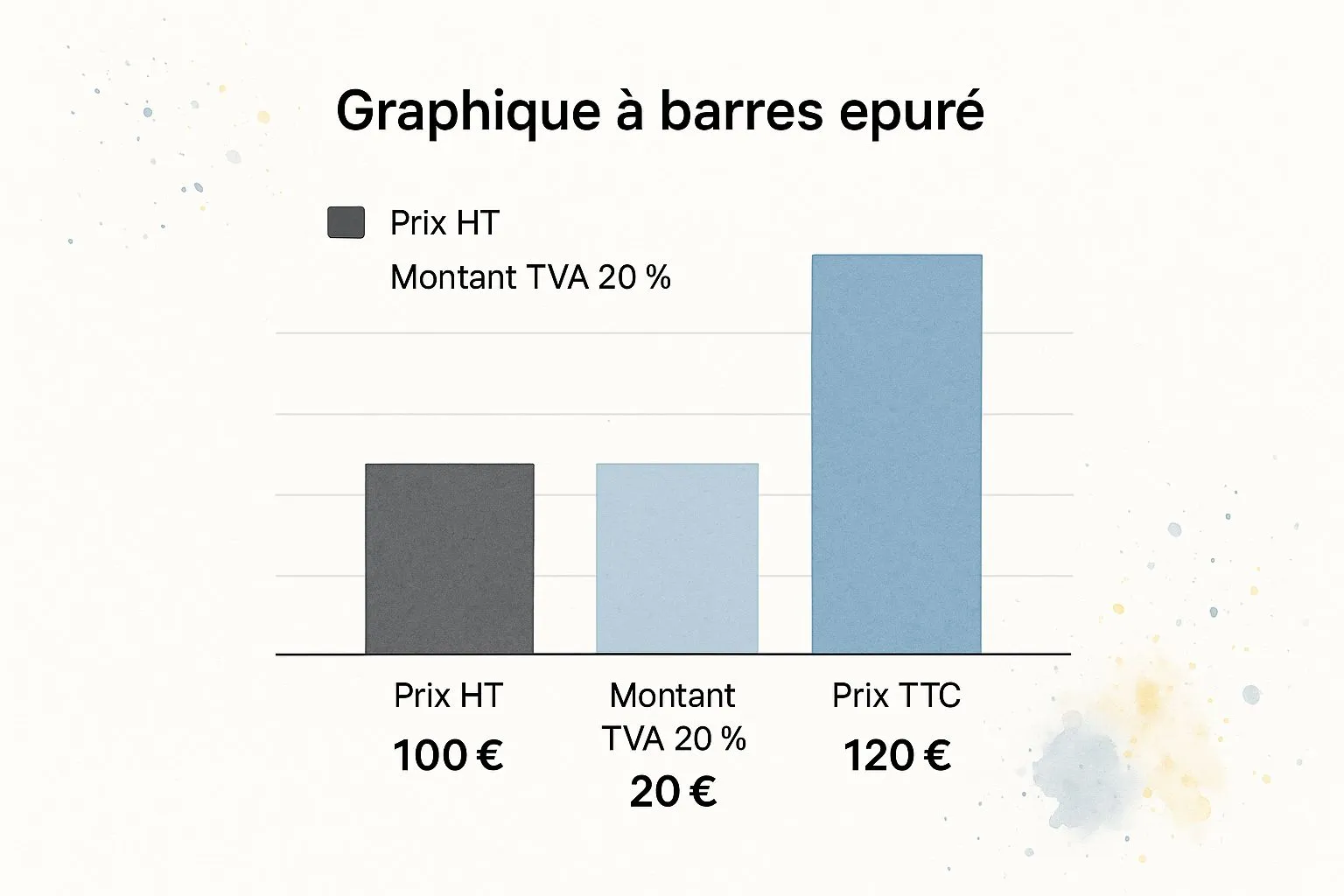
This illustration shows it clearly: the final price paid by the customer simply breaks down between the actual cost of your product or service (net) and the tax you then remit. Grasping this principle is truly the key to fair, error-free invoicing.
Identifying the right rate, a crucial step
Your calculation will only be correct if you apply the right VAT percentage. This is where things can get a bit tricky, because in France, several rates coexist. Each one applies to a specific category of goods or services.
Here’s a table to help you find your way more easily.
Summary of the main VAT rates in France
This table presents the different VAT rates applicable in France and the main products or services concerned, to help you choose the right one.
| VAT rate | Rate type | Application examples |
|---|---|---|
| 20% | Standard rate | The vast majority of sales of goods and services. |
| 10% | Intermediate rate | Restaurant services, renovation work, passenger transport. |
| 5.5% | Reduced rate | Food products, books, gas/electricity subscriptions, event ticketing. |
| 2.1% | Super-reduced rate | Medicines reimbursed by Social Security, press. |
Choosing the right rate is not an option, it’s a legal obligation that ensures the compliance of your invoices and your accounting.
From experience, I can tell you that knowing the right rate is just as important as the calculation formula itself. A simple rate error can lead to reassessments from the tax authorities and create a real headache in your management.
To go further on the subject and master all the subtleties, feel free to check out our complete guide on calculating VAT. It’s a valuable resource for securing your practices.
Choosing the right VAT rate, a crucial step
I see it every day: the most costly mistake when it comes to VAT is not a calculation error, but choosing the wrong rate. Getting the percentage wrong can quickly turn into an administrative headache, with penalties attached. A good online VAT calculation therefore always starts with a simple question: what is the right rate for my product or service?

Let’s set aside the pure theory for a moment. To really make this click, nothing beats concrete examples drawn from situations you encounter every day. It’s by mastering these nuances that you’ll avoid the pitfalls and make your calculations foolproof.
A few everyday practical cases
Let’s dive into the heart of the matter with concrete examples for different trades.
-
In the restaurant business: This is a classic. A restaurant owner has to juggle several rates. The dish your customer eats on-site is billed with VAT at 10%. However, if they buy a simple can of soda to take away, the applicable rate drops to 5.5%. A small detail, but one that makes all the difference on the bill and in your accounting.
-
For construction tradespeople: Imagine a renovation project in a home over two years old. The labor and materials you supply benefit from the intermediate rate of 10%. But be careful, if you also install a brand-new built-in oven, that equipment remains subject to the standard rate of 20%. This distinction must absolutely appear clearly on your quotes and invoices to stay compliant.
-
On the personal services side: Certain services, such as helping elderly or disabled people, benefit from the super-reduced rate of 5.5%. This is a significant tax advantage, designed to make these essential services more accessible.
My advice: always ask yourself what the precise nature and purpose of what you’re selling is. A misinterpretation happens so easily, and it can cost dearly in the event of a tax audit.
Knowing how to make these distinctions is simply fundamental for sound business management. If you want to dig deeper into the subject and secure your practices, our guide on calculating the VAT rate is there for that, with more in-depth analysis and further examples. Starting off with the right rate from the outset guarantees much smoother invoicing and tax filings.
Easily going from a net amount to a gross price
The moment of truth is when you have to present the final price to the customer. This is precisely where knowing how to calculate VAT truly matters: you go from a base price to what the customer will actually pay. Let’s set theory aside and look at this very concretely.
Let’s take a simple example. You’re a craftsperson and you sell a creation for €80 excl. VAT. The standard VAT rate of 20% applies. To get your final selling price, the process is simple:
- First, calculate the VAT amount: €80 x 0.20 = €16.
- Then, add it to the net price: €80 + €16 = €96 incl. VAT.
Your customer will therefore pay €96. Of that amount, €80 belongs to you, and the remaining €16 is collected to be remitted to the State. It’s as simple as that.
Watch out for additional fees, a classic oversight
A mistake I often see is forgetting VAT on small extras. Typically, shipping costs. These are also subject to VAT, and it’s generally the same rate as the product you’re selling.
If you charge €5 excl. VAT for delivery, you also need to apply VAT to it (€5 x 0.20 = €1). The total delivery cost for the customer will therefore be €6 incl. VAT.
Of course, understanding the logic of manual calculation is a good thing. But let’s be honest, as soon as you have several items or additional fees, it quickly becomes a source of errors and a waste of time. That’s where a good online tool changes everything.
To show you just how much simpler it is, see how the Bizyness calculator handles it in the blink of an eye.

Just enter the net amount and the right rate to instantly get the VAT amount and the gross price. No more risk of rounding errors or oversights. It’s a huge time saver and, above all, a safeguard for your invoicing.
If you want to master all the subtleties, take a look at our guide that explains in detail how to calculate from net to gross so you never get it wrong again.
Finding the net amount from a gross price
Knowing how to do the reverse calculation, that is, finding the net amount (excl. VAT) from a gross price (incl. VAT), is a key skill for properly running your business. It’s even essential for accounting for your purchases, since it’s what allows you to reclaim deductible VAT.

What may seem complicated at first is actually a simple division. The formula to remember is: Gross amount / (1 + VAT rate). To put it simply, the “1” represents your net base, and you add to it the decimal corresponding to the applicable VAT rate.
Applying the formula to a concrete case
Let’s take a situation every entrepreneur has already experienced: the receipt for a business lunch. The receipt shows a total of €44 incl. VAT. For restaurant services, as we know, the VAT rate is generally 10%.
Here’s how to proceed:
- The formula: €44 / (1 + 0.10)
- The calculation: €44 / 1.10
- The result: €40 excl. VAT
There you go! You know the meal cost €40 excl. VAT. The difference, i.e. €4, corresponds to the VAT amount you may potentially be able to reclaim.
This method works for any rate. If you have an expense of €120 incl. VAT subject to VAT at 20%, the calculation will simply be: 120 / 1.20 = €100 excl. VAT. In this case, the deductible VAT amounts to €20.
This is a fundamental skill for the accuracy of your VAT returns. Mastering this reverse calculation well means being sure you reclaim exactly what you’re entitled to and avoiding unpleasant surprises in the event of a tax audit.
Knowing how to perform this reverse online VAT calculation is therefore much more than a simple trick. It’s a reflex that lets you check your suppliers’ invoices and maintain impeccable accounting. For an entrepreneur, it’s a real source of peace of mind.
Pitfalls to avoid when calculating VAT
Even with the right formulas in mind, you’re never immune to a calculation error. Certain slip-ups are classic, but they can easily distort your invoices and complicate your tax returns. Think of this section as a kind of safety net, a reminder of the most common pitfalls so your accounting stays impeccable.
One of the most frequent mistakes, and yet the easiest to make, concerns rounding. A calculation done by hand, even with a calculator, can lead to tiny discrepancies. The problem? Accumulated over dozens of invoices, these micro-discrepancies end up creating a real gap in your accounts. This is precisely why I always recommend using a reliable online tool.
Another common oversight: not applying VAT to additional fees. Typically, delivery costs. Never forget that they’re considered a service in their own right. They must therefore be taxed, most often at the same rate as the main product you’re selling.
Watch out for recalculating on a gross amount
Here’s a more subtle mistake, but one that can cost you dearly: calculating VAT on an amount that’s already gross (incl. VAT). When juggling lots of figures, confusion happens fast. The result is a kind of double taxation that inflates both the price for your customer and the tax amount you think you owe.
For example, if you apply 20% VAT to a price shown as €120 incl. VAT, you’re making a mistake. VAT is already included in that amount. To isolate it, you absolutely need to use the reverse calculation method we saw above.
The biggest trap is often routine. You feel like you know the subject inside out, and that’s precisely when a small careless mistake slips in. Using a dedicated tool like Bizyness isn’t a sign of weakness, it’s actually a smart strategy for securing your business.
A point of caution for sole traders
If you’re a sole trader (micro-entrepreneur), you have a very specific point of caution: approaching the VAT exemption thresholds. The shift from “not liable” to “liable” status really needs to be anticipated. Waiting until the last moment can expose you to complex, and sometimes very costly, adjustments.
To sum up, here are the mistakes to absolutely avoid:
- Approximate rounding: It creates chaos between your invoices and your tax returns.
- Forgetting VAT on shipping costs: Always treat them as a taxable service.
- Calculating on a price that’s already gross: It’s the direct route to double taxation.
- Poor management of the transition to VAT liability: For sole traders, it’s a turning point not to be missed, on pain of a tax reassessment.
Keeping these few points in mind, you’ll quickly develop the right reflexes to avoid them and ensure the accuracy of your day-to-day management.
Frequently asked questions about VAT calculation
Even with the best intentions and a good calculator, certain questions about VAT persist among entrepreneurs. That’s perfectly normal. Let’s demystify a few points that can cause confusion together.
Does a sole trader have to charge VAT?
The simple answer is no… at least, at first. As a sole trader (auto-entrepreneur), you benefit from the VAT exemption scheme (franchise en base). In concrete terms, this means you don’t charge it to your customers, but you also can’t reclaim it on your business purchases. It’s a real gain in administrative simplicity.
But watch out, this advantageous scheme isn’t unlimited. It’s tied to revenue thresholds: €91,900 for the sale of goods and €36,800 for services. If you exceed these thresholds, you move into the standard VAT regime and charging VAT becomes mandatory. Keeping a close eye on your revenue is therefore essential to anticipate this change.
How do you check a VAT calculation in the blink of an eye?
To be sure your calculation is correct, the most reliable method is to work backwards. Have you just calculated a gross price from a net amount? Take that gross total and simply divide it by (1 + the rate). For example, for a 20% rate, you’d divide by 1.20. If you land back on your original net amount, well done, the numbers check out.
To completely eliminate the risk of human error, the safest reflex remains using an online VAT calculation tool. The result is instant and, above all, foolproof.
Can you have several VAT rates on the same invoice?
Of course, it’s even a fairly common scenario in certain trades. Take the example of a tradesperson carrying out renovation work for an individual, taxed at 10%. If they also supply a new household appliance, the latter will be subject to the standard rate of 20%.
In this situation, their invoice must absolutely show each service or product separately, with its net base and its own VAT rate. The gross total will then be the sum of all these amounts.
Expert advice: if you notice a VAT error on an invoice already sent, do not modify it under any circumstances! The only procedure accepted by the tax authorities is to issue a corrective invoice. This must cancel and replace the old one, clearly stating the reference of the erroneous invoice.
To stop wasting time and say goodbye to calculation errors, think of Bizyness. It’s the management tool we designed specifically for entrepreneurs like you, to simplify invoicing and accounting on a daily basis. Discover Bizyness.
