

 Français
Optimizing your sales process for smooth e-commerce growth
Discover how to structure your sales process to automate financial management, accounting, and boost your e-commerce conversions.
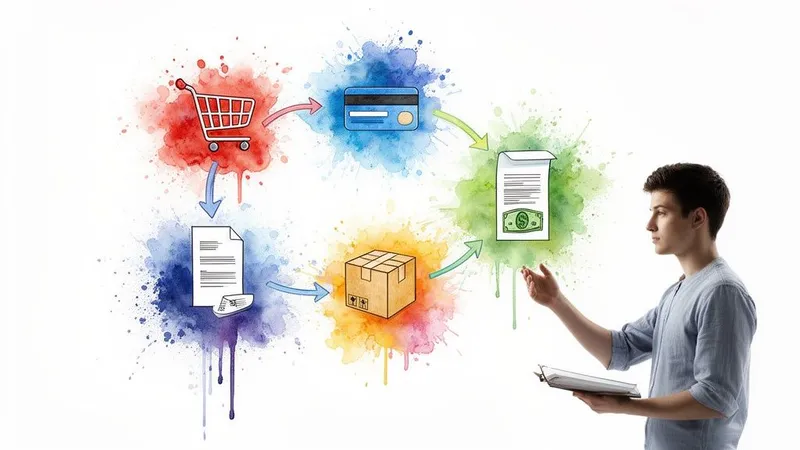
When we talk about the sales process, we’re not just talking about turning a visitor into a customer. It’s much more than that. It’s the entire chain of operations that starts with the first visit to your site and ends once the money has landed in your bank account and everything is in order in your accounting.
For an online seller, it’s the battle plan that connects marketing, logistics, and finance.
The e-commerce sales process, decoded
To really understand it, picture your online store as a restaurant running at full capacity. The sales process isn’t limited to the moment the customer pays the bill. It starts well before that: the enticing menu in the window (your marketing) attracts a curious passerby, they’re seated at a table (your website), their order is taken (the shopping cart), their dish is served (delivery), and behind the scenes, payment and accounting are handled.
Without a clear organization, chaos is guaranteed. Orders go astray, payments never get reconciled with the right sales, and financial management quickly turns into a nightmare. A well-oiled sales process is quite simply the nervous system of your e-commerce business. Every customer action triggers a precise response on your end.
From sale to accounting: a single, unified journey
The big challenge for online sellers is juggling two roles: that of the seller and that of the manager. Every sale confirmed on Shopify, Amazon, or WooCommerce triggers a cascade of operations: issuing an invoice, calculating VAT, deducting Stripe or PayPal fees, and making sure the amounts received in the bank match up.
And this complexity is only going to increase. The French e-commerce market is expected to reach nearly €200 billion by 2026, with peaks exceeding 100 orders per second. For sellers, this represents an avalanche of transactions to manage, each with its own accounting subtleties. You can check out economic projections on the topic to get a sense of the scale of the phenomenon.
A solid sales process isn’t a constraint — it’s a vital condition for growth. It’s what lets you move from stressful manual management, where every order is a source of anxiety, to a reliable system capable of absorbing growth without faltering.
This guide will break this journey down into five clear phases to help you optimize every link in the chain. By mastering this flow, you’ll discover how automation can turn what looks like a headache into a genuine competitive advantage.
The table below summarizes the five fundamental stages of the online sales cycle, from the first interaction with the customer to the accounting close.
The 5 key phases of the e-commerce sales process
| Phase | Main goal | Example action |
|---|---|---|
| 1. Attraction | Bring the right visitors to your store. | Launch a targeted advertising campaign on social media. |
| 2. Conversion | Turn a simple visitor into a paying customer. | Simplify checkout down to 3 clicks max. |
| 3. Invoicing | Generate compliant accounting documents for every sale. | Automatically issue a PDF invoice with the correct VAT. |
| 4. Delivery | Honor the promise made to the customer by shipping the product. | Send a shipment tracking email as soon as the order ships. |
| 5. Reconciliation | Make sure every euro sold actually lands in the bank account. | Reconcile Stripe payouts with the corresponding orders. |
By mastering this cycle, you go from simply selling products to building a genuine growth machine — solid and worry-free.
The key stages of your sales process
Picture your sales process as a well-oiled machine. Every part has to work in perfect harmony with the others for the engine to run at full capacity. For an online seller, this means breaking the customer journey down into several clear stages, from discovering your site to reconciling the sale in your books.
These stages aren’t independent of one another. On the contrary, they form a chain: if one link is weak, the entire customer experience suffers — and so does your profitability. Let’s walk through these five essential phases to turn your sales flow into a genuine asset.
To help visualize the whole thing, here’s an infographic that simplifies this journey, from customer acquisition to booking the transaction.
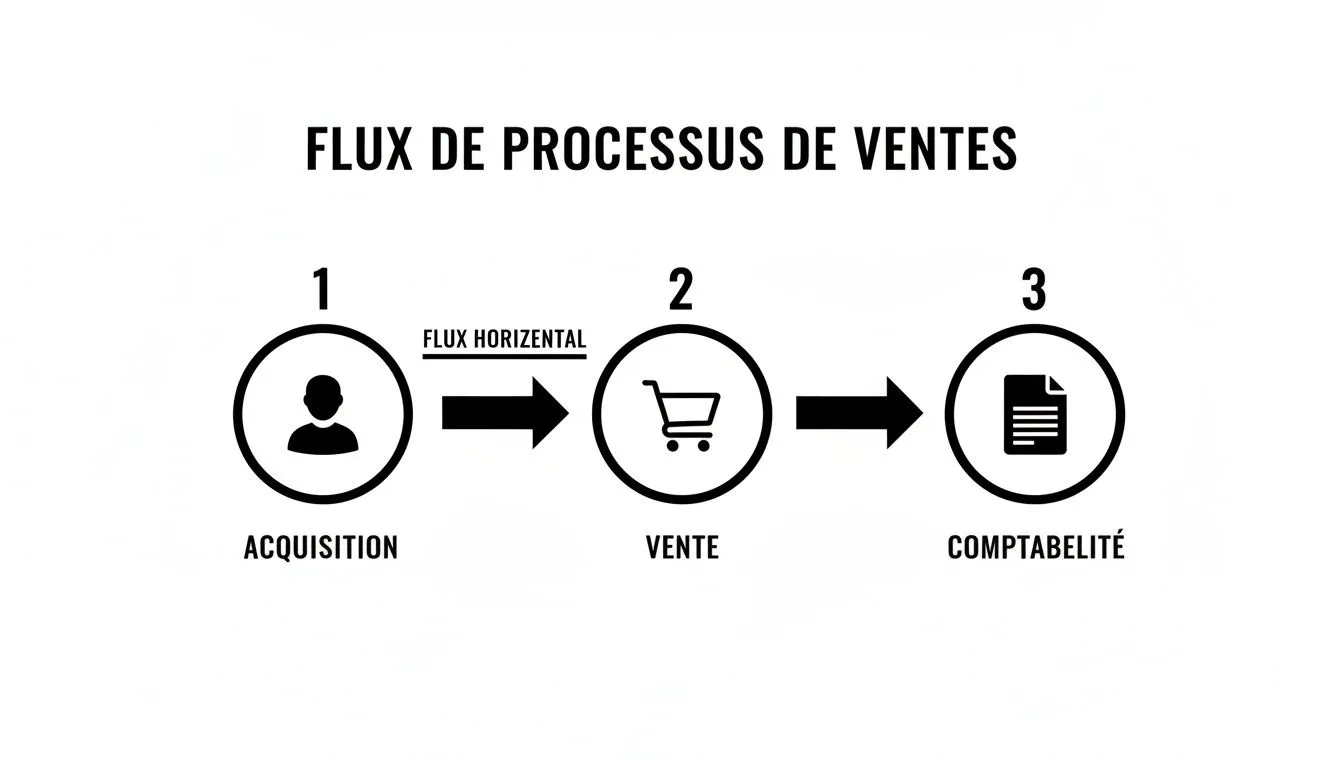
This diagram shows how acquisition, the sale, and accounting flow together to form a continuous cycle, essential to the financial health of your store.
1. Attracting the right visitors
Everything starts with acquisition. The idea isn’t to attract thousands of curious onlookers, but genuinely qualified visitors, truly interested in what you sell. Irrelevant traffic is time and money wasted on marketing for zero sales.
Several levers are available to you:
- Paid advertising: Campaigns on Google Ads or social media (Facebook, Instagram, TikTok) let you target very precise audiences.
- Content marketing: Writing blog posts, buying guides, or shooting videos that directly answer your future customers’ questions. It’s also excellent for your organic search ranking (SEO).
- Social media: Building an active community around your brand creates a strong connection and drives traffic directly to your site.
The stakes are simple: capture the attention of the right people, those whose needs perfectly match your offering. It’s the starting point for everything else.
2. Turning the visit into a purchase
Once the visitor is on your site, the conversion clock starts running. The goal? Make the buying experience so smooth and pleasant that clicking “buy” becomes a no-brainer. The slightest grain of sand in the gears can cost you a customer, even at the very last second.
To achieve this, polish the details that matter: ultra-complete product pages, quality photos and videos, and above all, a checkout tunnel with no frills. Remove unnecessary steps, offer multiple payment methods (card, PayPal, etc.), and clearly display trust and security elements.
A mistake I see all the time? A site that isn’t optimized for mobile. If browsing your store from a smartphone is a chore, you’re saying goodbye to a huge share of your potential customers. More than half of online purchases are now made on mobile.
This phase is decisive. It’s where interest in your products finally turns into revenue.
3. Securing the transaction
The moment your customer confirms their cart, you enter the invoicing phase. It tends to be neglected, yet it’s crucial for the legal and financial health of your business. Every sale must generate a proper invoice, with all the mandatory information and the correct VAT rate.
For those selling internationally, things get complicated fast. Juggling different European VAT rates and the one-stop shops (OSS/IOSS) by hand is an open door to errors and tax risk. This is precisely where a tool like Bizyness becomes essential to automate these tasks and guarantee your compliance without sacrificing your weekends.
4. Keeping the promise made to the customer
Next comes fulfillment, or more simply, delivery. This is the moment of truth, where your promise becomes tangible. After paying, the customer wants just one thing: to receive their package, quickly and in perfect condition. This stage covers order preparation, packaging, shipping, and all the communication that follows.
Be proactive in your communication — that’s the key. The customer needs to know where their order stands:
- Order confirmation: A summary email right after the purchase.
- Shipping notification: A message with the tracking number as soon as the package ships.
- Delivery tracking: Updates on the package’s journey.
This transparency reassures customers, builds trust, and drastically reduces the number of questions to your customer service. To go further on this topic, feel free to read our full article on the components of the sales cycle.
5. Closing the accounting loop
Last step, but certainly not the least important: reconciliation. This involves verifying that the money from sales has actually landed in your bank account, once payment platform commissions from Stripe or Amazon are deducted. It’s the final check to make sure the books are accurate.
For many online sellers, this is a real headache. Payouts from platforms bundle together dozens, even hundreds of transactions, making manual reconciliation with each order extremely tedious. The French market, with 41.6 million online shoppers in 2024, sees intense activity peaks, particularly in November and December, which account for 22% of annual sales. Under these conditions, manual management becomes nearly impossible without risking errors. You can also read the full study on the evolution of French e-commerce to better understand these challenges.
Automating bank reconciliation links sales, payments, and statements so that every euro is tracked to the last cent. It’s the only way to get a clear view of your cash flow and sleep soundly with healthy accounting.
Automating the financial side of your process
So far, we’ve seen that the sales process is much more than a simple transaction. But let’s be honest: it’s often on the final stretch — financial and accounting management — where online sellers stumble. Creating invoices, calculating the right VAT, reconciling payments… These manual tasks are a real headache, terribly time-consuming, and worse, a source of errors that can be costly.
This is precisely where automation comes in and changes the rules. By connecting your sales tools (Shopify, Amazon, Stripe) to a financial platform like Bizyness, you turn this obstacle course into a smooth, intelligent workflow. The goal isn’t just to save time. It’s to lock down your tax compliance and finally give you a clear, real-time view of your profitability. To truly lighten the load on your teams and boost efficiency, sales automation is a path worth exploring.
Real-world scenarios: before and after automation
To really feel the difference, nothing beats stepping into the shoes of an online seller. Let’s compare the “manual mode” that many know all too well with the “automatic mode” made possible by a solution like Bizyness.
Scenario 1: The Shopify merchant selling internationally
- Before: Every sale in Spain or Belgium triggers the same infernal ritual. He has to manually check the destination country, look up the correct VAT rate, then cobble together a compliant invoice on Excel or a disconnected invoicing tool. At the end of the month, he spends hours compiling all these sales for his VAT return via the one-stop shop (OSS), with a knot in his stomach for fear of making a mistake.
- After: His Shopify account is connected to Bizyness. As soon as a sale is confirmed, Bizyness retrieves the information, identifies the customer’s country, applies the correct European VAT rate, and generates a perfect invoice, with no intervention needed. The platform centralizes all the data for the OSS return, which ends up pre-filled and ready to send. The headache is over.
Scenario 2: The Amazon FBA seller drowning in VAT
- Before: He downloads Amazon’s overwhelming sales reports, trying to sort B2C and B2B sales and isolate the VAT collected. He spends days trying to match Amazon’s payouts (which bundle hundreds of transactions) with his sales. Generating compliant invoices for every order at this scale? A near-impossible mission.
- After: Bizyness is synced with his Amazon Seller Central account. The platform decodes the reports, automatically generates invoices for each order, handles VAT on Amazon fees, and prepares the accounting entries. Bank reconciliation becomes child’s play: Amazon’s payout is automatically matched with all the corresponding sales.

This image perfectly illustrates the result: financial data that used to be complex and scattered is now consolidated into a clear dashboard, offering an instant view of the business’s health.
The concrete benefits of financial automation
Implementing financial automation with a dedicated tool isn’t just about saving time. It’s a genuine strategic lever that brings tangible benefits at every level.
The real power of automation is turning accounting — often seen as a cost center — into an intelligent system that actively supports your e-commerce growth.
Here are the key benefits, no sugarcoating:
- Reliability and tax compliance. Errors are human, especially when juggling international VAT (OSS/IOSS) or reverse-charge rules. An automated tool applies up-to-date tax rules, drastically reducing the risk of audits and reassessments. Every invoice is guaranteed compliant.
- Total financial clarity. No more juggling spreadsheets and scattered data. By centralizing all your transactions (Shopify, Amazon, Stripe…), you get an accurate, real-time view of your revenue, margins, and cash flow. Automatic bank reconciliation ensures every euro is tracked.
- Simplified collaboration with your accountant. Instead of sending them a stack of documents at the end of the quarter, you give them direct access to clean, structured data. Bizyness generates exports, such as the Fichier des Écritures Comptables (FEC — the French standardized accounting file), ready to be imported into their software. A huge time saver for them, and therefore savings for you.
- Peace of mind for the entrepreneur. By delegating these repetitive, anxiety-inducing tasks to a reliable system, you free up your mind. You can finally focus on what really matters: improving your products, refining your marketing, pampering your customers. You’re no longer a slave to your paperwork, but the pilot of your growth. To go further on administrative management, take a look at our full guide on online invoicing.
The key metrics for tracking your performance
Having a sales process that runs smoothly is one thing. Knowing whether it’s actually performing well is another. Without reliable metrics, you’re flying blind, relying on gut feeling, which can be costly. To really take the wheel, you need to stop focusing on vanity numbers, like social media “likes” or traffic volume.
What matters are the numbers that tell the real story of your business. These famous KPIs (Key Performance Indicators) are your dashboard. They’re what tell you where you’re making money, where you’re losing it, and above all, where your next growth opportunities are hiding.
The essential business KPIs
Before even talking big numbers and accounting, you need to make sure your “sales machine” is efficient. These few key figures give you the pulse of your business and help you decode your customers’ behavior.
Here are the three indicators to keep a constant eye on:
- Customer acquisition cost (CAC): Very concretely, how much do you spend on marketing and sales efforts to convince a person to become a customer? If this cost is too high, it can literally eat away at your margins, even if you’re selling a lot.
- Conversion rate: This is the percentage of visitors who go all the way and complete their purchase on your site. A rate that’s stagnant or declining is often the sign of a grain of sand in the gears: surprise shipping fees, an overly complex checkout, a slow site…
- Average order value (AOV): The amount each customer spends on average per order. Successfully increasing this figure, for example with well-designed upsells or bundle offers, is one of the best levers to boost your revenue without blowing up your ad budget.
The real challenge is finding the right balance between these three. The idea is simple: attract customers without breaking the bank, convince them to buy, and make sure every sale is as profitable as possible.
Beyond the sale: the financial KPIs that really matter
Many online sellers stop there, at purely commercial indicators. And that’s a classic mistake. Real profitability is measured in the numbers that come after the sale. These often-overlooked figures are what tell you whether your business is viable in the long run.
Selling is good. But it’s the net margin that pays the bills at the end of the month. Knowing your real profit, once all costs are deducted, is the only true measure of success.
It’s precisely to shed light on these essential financial figures that tools like Bizyness exist. They turn raw, complex data into clear information that helps you decide. Here are the KPIs you can no longer afford to ignore:
- Real net margin: What’s left in your pocket once everything is deducted: the cost of your products, of course, but also Stripe or PayPal commissions, advertising fees, and above all, the VAT you collected on behalf of the state (which doesn’t belong to you).
- Bank reconciliation delay: The time it takes you to link a payout received from Shopify Payments or Amazon to the corresponding sales. If this delay grows, your view of your cash flow becomes blurry, and it’s harder to spot a potential payment problem.
- Invoicing error rate: The percentage of invoices that go out with an error (wrong VAT rate, missing mandatory information…). A high rate isn’t trivial: it’s a direct tax risk and can invalidate your right to deduct VAT.
To see things more clearly, it’s crucial to know how to distinguish between numbers that feel good and those that keep the business alive.
Comparing e-commerce sales metrics
This table distinguishes surface-level metrics (vanity metrics) from the metrics that reveal the real health and profitability of your online business.
| Indicator | Vanity metric (what looks good) | Actionable metric (what really matters) |
|---|---|---|
| Traffic | Number of unique visitors per month | Conversion rate by traffic source |
| Sales | Gross revenue generated | Net margin after fees and VAT |
| Finance | Total money collected through platforms | Speed and accuracy of bank reconciliation |
Steering with actionable metrics is the guarantee of making decisions based on the reality of your business, not on impressions. Doing this work is what will turn your sales process into a genuine growth engine — profitable and sustainable. To dig deeper into the topic, feel free to read our full article on sales performance indicators.
The 3 common mistakes holding back your growth
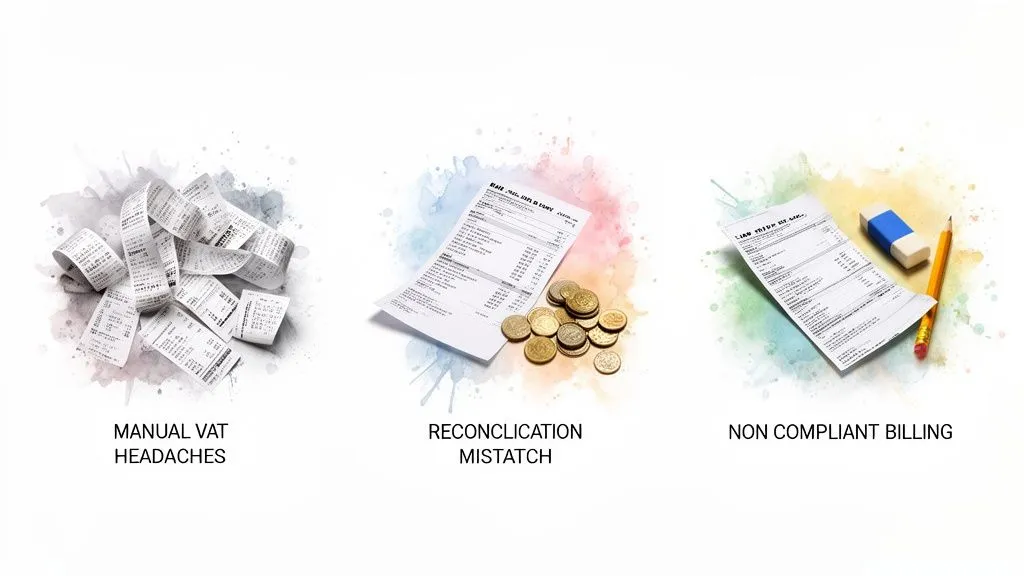
Setting up a sales process that holds up isn’t just about ticking best-practice boxes. Above all, you need to know where the traps hide that can derail the whole machine. Because even with the best product in the world and top-notch marketing, a few financial or administrative mistakes are enough to bring your development to a screeching halt.
Here, we’ll dissect the three pitfalls I see most often among online sellers. To avoid them, good communication is key — whether with your accountant, your customers, or even your tools. It’s actually the foundation of good professional communication techniques.
Mistake 1: The international VAT headache
The most common mistake, and often the costliest, is handling VAT by hand, especially once you start selling abroad.
Take Sophie’s case. She launches her Shopify store and, a few days later, celebrates her first sale in Germany. Great news! In the excitement, she applies the French VAT rate without a second thought. It’s only a few months later, once she exceeds the sales thresholds, that she discovers the one-stop shop (OSS). She then realizes that every sale should have been taxed at the German rate. The result: hours of stress to fix everything and a genuine fear of a tax audit.
For an online seller, ignoring the subtleties of international VAT is like sailing without a compass: sooner or later, you run aground. OSS/IOSS rules are a real maze, and a single mistake can be very costly.
The only way to get through this calmly is to automate. A tool like Bizyness connects to your online store, identifies each customer’s country, and applies the correct VAT rate to every order, as if by magic. Your OSS return is then pre-filled, which eliminates 99% of the risk of error and guarantees perfect compliance.
Mistake 2: Blind bank reconciliation
The second classic trap is bank reconciliation done “by feel.” Many entrepreneurs simply watch a payout from Stripe or Amazon land in their business account, without ever checking whether the amount actually matches the total sales.
This is Marc’s story, a seller on Amazon. Every two weeks, he received a payment. The amount never quite matched his sales, but he told himself it was just “the fees.” It took him months to realize that refunds were being misrecorded and that hidden fees were eating into his margin far more than expected.
This kind of approximation often masks cash flow problems and costs you don’t see. Accurate bank reconciliation is essential for:
- Seeing the real fees: Knowing exactly how much your payment platforms cost you.
- Tracking refunds: Verifying that every return is properly accounted for.
- Managing your cash flow: Knowing your available cash down to the last euro, with no bad surprises.
By automating reconciliation, every payout received is directly linked to the orders it covers. You get perfect traceability and, finally, an accurate view of your finances.
Mistake 3: Non-compliant invoicing
Finally, the third mistake I see everywhere is generating invoices that don’t comply with the law. A missing mandatory statement, a numbering sequence that skips a digit, an incorrect VAT rate…
It might seem like a minor detail, but the consequences are far from trivial. An invoice deemed invalid by the tax authorities can cost you the right to deduct VAT on your own purchases. The impact on your profitability is direct.
By connecting your sales channels to an intelligent invoicing system, you ensure that every invoice is 100% compliant. It’s correctly numbered, contains all mandatory information, and is safely archived. That’s how you protect your rights and sleep soundly.
Frequently asked questions about optimizing your sales process
You have the plan, the drive, but when it’s time to take action, very practical questions come up. That’s completely normal. We’ve gathered the most frequent questions here to help you see things more clearly and remove the last hurdles.
The idea is to demystify optimizing your sales process, especially the financial side. It’s not one more complication, but a logical, accessible evolution for your e-commerce business. Let’s get started.
When should I automate my financial management?
That’s the big question, isn’t it? Do you need to wait until you’re making hundreds of sales a month for automation to become worthwhile? In reality, the answer is much simpler.
There’s no magic number. The real signal is when the time spent on admin work — invoicing, VAT tracking, bank reconciliation — starts eating into the time you could spend growing your business. If you’re juggling spreadsheets for more than a few hours a month, it’s probably time to automate.
Automation isn’t a question of volume, but of value. Every hour spent on low-value manual tasks is one less hour for marketing or customer service. It’s a pure loss, even with just 30 sales a month.
In fact, starting early with a tool like Bizyness is a real advantage. You build on solid foundations from the start. Managing 50, 500, then 5,000 sales a month happens with the same peace of mind, without having to reinvent everything at each new growth milestone.
How can my accountant collaborate?
Many online sellers worry about the impact of a new tool on their relationship with their accountant. Will they have to learn yet another platform? The answer is no, quite the opposite.
A tool like Bizyness is designed to save them time, not waste it. Your accountant doesn’t need to become a software expert. Their job is to analyze clean, well-organized figures. And that’s exactly what the platform serves up on a silver platter.
Here’s how it works in practice:
- Direct, secure access: You can grant them read-only access to your Bizyness account. They can consult invoices, VAT reports, and bank reconciliations whenever they want, without having to chase you down for documents.
- Ready-to-use accounting exports: The platform generates perfectly formatted files for their own software, including the well-known Fichier des Écritures Comptables (FEC). All they have to do is import it. No more endless manual entry on their end.
- Reliable, traceable data: Every figure is justified and linked to a specific transaction. This puts an end to endless questions about illegible receipts or mysterious expense claims.
In short, you hand them pre-chewed, flawless work. For you, that means fewer billed hours for simple data entry, and more time for genuinely valuable advice.
Can I unify my process if I sell across multiple channels?
Absolutely. It’s even one of the biggest benefits of automation. Selling on your own Shopify site and at the same time on a marketplace like Amazon is a great strategy. But on the management side, it can quickly become a nightmare.
Without a tool to centralize everything, you end up juggling between systems that don’t talk to each other. You extract Amazon’s reports, Shopify’s data, Stripe’s statements, then try to piece it all together in a spreadsheet. The risk of errors, oversights, or duplicates is enormous.
A platform like Bizyness works as a hub. It connects to all your revenue sources and brings the data together in one place. Whether a sale comes from Shopify or Amazon, it follows the same path:
- The transaction is retrieved automatically.
- A compliant invoice is generated.
- The correct VAT rate is applied.
- The payment is matched to the corresponding bank transfer.
You get a global, reliable view of your business, without having to log into ten different dashboards. Your sales process finally becomes consistent and ready to adapt, no matter how many channels you add in the future.
Ready to turn your e-commerce’s financial complexity into a simple, automated system? With Bizyness, take back control of your accounting and free up time for what really matters: growing your business. Discover how Bizyness can simplify your daily life today.
