

 Français
Umbrella employment or freelance: choosing the best option
Umbrella employment or freelance? Discover the costs, protections and opportunities to make the right choice for your profile.

The quiet transformation of independent work in France

This screenshot, illustrating the growth of umbrella employment, reflects a significant shift in the independent labor market. The appeal of this form of work is undeniable, with a marked increase in the number of independent workers choosing this solution — a trend that confirms its growing weight in the French economy.
The world of independent work in France is undergoing a metamorphosis. Choosing between umbrella employment and freelancing is no longer just a matter of legal status. It has become a genuine reflection on one’s career, working style and aspirations. Consultants, IT professionals, trainers and others are reassessing their options. Some favor the security of umbrella employment, others the freedom of freelancing. Several factors explain this shift.
The aging of the workforce is influencing decisions. With retirement approaching, the need for robust social protection is pushing many seniors toward umbrella employment. At the same time, the digitalization of professions is making independence more accessible. Working remotely, managing a client base, choosing which assignments to take on — everything has become simpler. A digital marketing consultant, for instance, can easily juggle several projects thanks to digital tools. These shifts are redefining career paths.
Client expectations are evolving too. Companies are looking for agile experts capable of adapting and innovating. This fuels independent work and encourages professionals to pick whichever status best suits them and their clients. In France, umbrella employment has in fact seen remarkable growth. With close to 600,000 professionals in 2025 and annual growth of 20%, the trend is amplified by digitalization and the appeal of a more secure form of entrepreneurship among younger generations. Learn more about the growth of umbrella employment.
Finally, the choice between umbrella employment and freelancing goes beyond finances. It’s a life choice, a way of envisioning one’s work and building one’s future. Finding a balance between security and freedom is central. It’s up to each individual to find the solution best suited to their own goals — a quiet but profound evolution reshaping the landscape of independent work in France.
Financial anatomy: the real costs beyond appearances

Choosing between umbrella employment and freelancing calls for a financial analysis far more thorough than simple number comparisons. Beyond the visible social charges and umbrella company fees lie often-overlooked costs that are nonetheless essential to factor in when assessing the real profitability of each status.
Take continuing education, for example. Essential for staying competitive and up to date in your field, it represents a significant investment that must be included in your calculations. Likewise, professional insurance — crucial for protecting against the hazards of the job — differs considerably between freelancers and umbrella employees.
Freelancers manage their insurance individually, often at a higher cost, while umbrella employees generally benefit from pooled coverage through their umbrella company. On top of that come prospecting costs, which weigh more heavily on freelancers who must actively seek out clients, and the impact of paid leave on cash flow, which is often overlooked.
The break-even point: a key concept
A crucial element to analyze is the break-even point — the revenue level beyond which umbrella employment becomes financially more attractive than freelance status. This threshold varies and depends on many factors: your industry, your expenses, and above all your average daily rate. A consultant billing €500 a day will reach this threshold much faster than a web writer at €250. To dig deeper into taxation as a sole trader, see our dedicated guide: Read our guide to tax filing for sole traders.
Let’s illustrate these nuances with concrete examples. Picture a consultant working 8 months out of the year. Under umbrella employment, they benefit from maintained salary during inactive periods — an advantage that doesn’t exist under freelance status. Likewise, an expert alternating between short assignments and long-term projects will need to anticipate income fluctuations and adjust their financial management accordingly. For freelancers, this calls for greater discipline and forward planning.
Work rhythm and social charges: a significant impact
Work rhythm also affects profitability. A freelancer targeting 200 billable days a year will bear proportionally heavier charges than an umbrella employee working at a less intensive pace. The reason? Social charges are calculated differently — based on revenue for freelancers, and on salary for umbrella employees.
Before wrapping up, let’s look at a cost simulation for different revenue levels:
Comparison of real costs by revenue level
Detailed simulation of costs for different annual revenue levels, including social charges, management fees and final net income
| Revenue | Freelance (total charges) | Umbrella employment (total fees) | Freelance net income | Umbrella net salary |
|---|---|---|---|---|
| €30,000 | … | … | … | … |
| €50,000 | … | … | … | … |
| €70,000 | … | … | … | … |
| €100,000 | … | … | … | … |
(Please note this table is illustrative and needs to be filled in with precise data for each revenue level)
Once populated with real data, this table makes it possible to visualize concretely how charges affect net income under each status.
Ultimately, the real profitability of umbrella employment versus freelance status depends on a multitude of individual parameters. Only a personalized analysis, taking your specific situation into account, will let you make the wisest choice. Don’t settle for raw figures — dig deeper to optimize your financial situation.
Social security: the invisible investment in your future

Social security is often the neglected part of the equation when transitioning to independent work. Yet it represents a crucial investment in your future peace of mind. Forget impersonal comparison tables — what matters is grasping the real, day-to-day impact of choosing between umbrella employment and freelancing.
Consider a consultant under umbrella employment facing a chronic illness. Their status guarantees maintained salary, an essential safety net during such an ordeal. Conversely, a pregnant freelancer might find herself unprotected against the costs linked to maternity and the resulting drop in activity.
Another concrete case: a technical expert who suffers a workplace accident. Recognition of an occupational illness and access to compensation are much more straightforward under umbrella employment. This status offers protection similar to that of a traditional employee — a considerable advantage against life’s uncertainties. Umbrella employment is indeed thriving, expanding into an increasingly wide range of industries. In 2024, more than 100,000 independent workers made this choice. Learn more about key figures on umbrella employment.
Retirement: a horizon not to be overlooked
Retirement planning is just as decisive. With umbrella employment, tied to the general social security scheme, you benefit from a guarantee of regular contributions, simplifying your outlook for the future. For a freelancer, managing retirement is more complex, requiring significant discipline and foresight. Contribution amounts, based on profit, can fluctuate with revenue, making forecasting trickier.
Strategies for a secure future
For mid-career professionals, evaluating accrued retirement rights becomes essential. Buying back quarters of contributions, possible under both statuses, offers an opportunity to optimize your future pension. However, the process and costs differ. Under umbrella employment, the umbrella company generally assists the consultant with these steps, easing the administrative burden. As a freelancer, this responsibility falls entirely on the individual.
The impact of activity gaps on retirement rights is another key point to consider. Umbrella employment offers greater security through maintained contributions even during periods of inactivity — an advantage that doesn’t exist for freelancers. These periods can significantly affect pension amounts. Anticipating these fluctuations and adjusting your contribution strategy is therefore essential.
Thinking about your social protection means preparing calmly for your future. Whether you opt for umbrella employment or freelance status, a thorough analysis of your needs and situation is essential. Don’t hesitate to seek expert advice to make the wisest choice for your future.
Entrepreneurial freedom versus administrative simplicity
At the heart of the debate between umbrella employment and freelancing lies the balance between freedom and simplicity. As a freelancer, autonomy reigns supreme. You choose your clients, set your rates and manage your time. This independence comes at a cost, however: administrative management. Bookkeeping, tax filings, business development — you’re the sole captain, but also the sole one responsible. Some days disappear under a mountain of paperwork, optimizing every tax decision at the expense of your productive time.
Umbrella employment offers an alternative. Part of that freedom is traded for welcome administrative simplification. The umbrella company handles bookkeeping, social filings and invoicing. This time saved lets you focus on your core expertise. In exchange, contractual constraints and umbrella company fees apply, generally between 5% and 10% of revenue.
The impact on productivity and business development
The impact on productivity is subjective. Some freelancers, well versed in administration, fold it into their workflow and optimize it. For others, this burden eats into precious time. Umbrella employment then frees up time to focus on expertise. To streamline your administrative management as a freelancer, check out this article: Improve your administrative management as a freelancer.
Business development is also affected. Freelancers, flexible on rates and terms, can attract clients seeking cost optimization. Umbrella employees, backed by the umbrella company’s structure, inspire confidence in large corporations and gain easier access to tenders.
Digital tools and outsourced services: a new landscape
Digital tools and outsourced services are reshaping the administrative equation. Invoicing platforms, digitalized accounting firms — freelancers can now delegate part of their management. This outsourcing, often less costly than umbrella company fees, reconciles freedom with simplification, keeping control of the business while lightening the administrative load.
The psychological factor: an often-overlooked element
Beyond the practical and financial aspects, this choice affects your relationship with work. Freelancers, alone at the helm, enjoy great freedom but also face significant pressure. Umbrella employees, integrated into a structure, benefit from valuable support, especially early in their activity. This psychological factor, often underestimated, is crucial. It’s about finding the solution that matches your personality and your vision of entrepreneurship.
Business impact: how your status shapes your opportunities
The choice between umbrella employment and freelancing shapes your business approach and how clients perceive you. This status, a true reflection of your professionalism, can prove a decisive asset or, on the contrary, a barrier to your growth.
The image projected to companies is a determining factor. Large groups, attached to rigorous procedures, often favor umbrella employment. This framework, synonymous with security thanks to comprehensive social coverage and professional liability insurance, is reassuring. Clear, transparent invoicing simplifies their administrative processes.
Freelancers, for their part, appeal through agility and responsiveness. They represent an ideal solution for one-off assignments or projects requiring great adaptability. Their rates, potentially more competitive, are also a strong selling point. However, sole-trader status can sometimes raise concerns, with some companies associating it with a less durable structure. The rise of umbrella employment, with a projected 900% increase in the number of consultants between 2019 and 2025, reflects this trend. More information on the reasons behind this growth is available here.
Pricing positioning differs considerably between the two statuses. Freelancers, free to set their own prices, can adapt to the market and to competition. Umbrella employees, due to social charges and umbrella company fees, generally offer a higher daily rate.
Sales arguments must therefore be tailored accordingly. Freelancers highlight their responsiveness, availability and quick onboarding. Umbrella employees emphasize the security, transparency and durability their status provides. Turning the constraints of umbrella employment into assets is essential — the structure, sometimes seen as an added cost, then becomes a guarantee of professionalism and reliability.
Access to tenders is often easier for umbrella employees. Large companies and public institutions regularly require a solid legal status, insurance and liability guarantees, sometimes effectively excluding freelancers.
Sales cycle length is also affected. Contracting with a freelancer is generally faster. Umbrella employment, involving a third-party company, can extend timelines, but this more formal process strengthens client confidence.
Ultimately, the choice between umbrella employment and freelancing carries significant business consequences. It shapes your positioning, your market access and your client relationships. A precise analysis of your industry and target clientele is therefore essential to adopt the most relevant status and maximize your opportunities.
Typical profiles: which solution for which career path
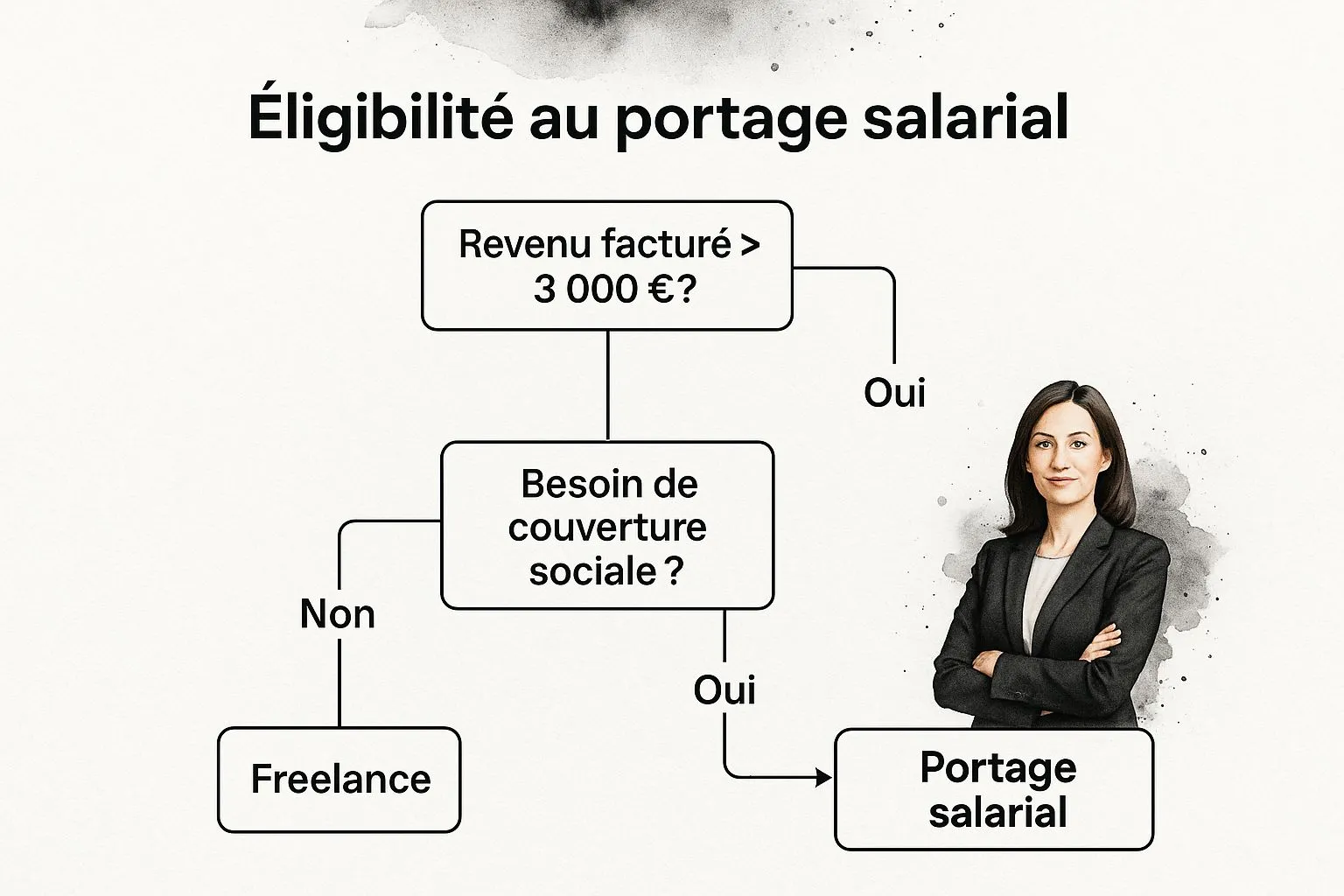
The infographic above presents a simplified decision tree. Income and the need for social coverage are the main criteria for an initial orientation. Income below €3,000 might suggest freelancing, while higher income combined with a need for social security would point toward umbrella employment. Beware, though: this is only a first approach. Analyzing individual context remains essential.
Consider a senior consultant nearing retirement. The social security of umbrella employment is an undeniable advantage. Yet with substantial income, umbrella fees become significant. The trade-off is therefore crucial: security versus financial optimization. Conversely, a young consultant just starting out might hesitate between the administrative simplicity of umbrella employment and the profitability of freelancing, particularly if her income is still modest.
Focus on specific needs
Technical experts often appreciate umbrella employment. Why? To focus on their expertise and delegate administrative tasks. Invoicing, social charges, tax filings — everything is handled. This lets them optimize their productive time. Independent sales professionals, deep in prospecting, might instead prefer the flexibility of freelancing. Controlling their rates and business terms allows for optimal adaptation and greater competitiveness.
The choice therefore depends on each person’s priorities: social protection for the senior consultant, simplicity for the junior consultant, time savings for the technical expert, and autonomy for the independent salesperson. Interested in sole-trader status? Check out our guide to becoming a sole trader.
To help with your decision, here is a matrix covering the profiles mentioned above:
Decision matrix by professional profile
Recommendation guide based on experience, industry, financial goals and personal situation
| Profile | Experience | Priority industry | Recommendation | Deciding criteria |
|---|---|---|---|---|
| Senior Consultant | Experienced | Consulting | Umbrella Employment | Social security, financial optimization |
| Junior Consultant | Entry-level | Consulting | Freelance / Umbrella | Simplicity, profitability |
| Technical Expert | Experienced | Technology | Umbrella Employment | Time savings, focus on expertise |
| Independent Salesperson | Experienced | Sales | Freelance | Autonomy, business flexibility |
This matrix summarizes the recommendations for each profile based on their specific needs. Remember that every case is unique.
Pitfalls to avoid and points of caution
Mistakes are easy to make. Senior consultants must anticipate the impact of umbrella fees on their net income. Junior consultants must carefully assess their social protection needs and revenue prospects. Technical experts should check the services and support offered by the umbrella company. Finally, independent salespeople must be ready to handle the administrative complexity of freelancing.
In conclusion, the optimal choice depends on personality, goals and financial situation. Analyzing these factors makes it possible to define key indicators to validate your choice and adjust your strategy.
Implementation: your action plan for a successful transition
After carefully weighing the pros and cons of umbrella employment and freelance status, putting your decision into practice requires a structured action plan. This change, whether it’s a transition from salaried employment to independence or from one independent status to another, involves crucial steps and an optimized timeline.
The ideal timing: when to take the leap?
The ideal time to change status is unique to each individual and situation. Several factors come into play. Take the example of an IT consultant: the end of a major assignment can be a favorable period, allowing them to begin their independent activity with relative financial security. For a trainer, the summer period, generally quieter, can be an opportunity to focus on administrative procedures.
Analyzing your industry is therefore essential. Identifying slow periods and the best moments for prospecting will help you limit risk and maximize your chances of success. An independent salesperson, for example, would do well to choose a period of strong activity in their industry to launch.
Administrative procedures: plan ahead for greater efficiency
Administrative formalities vary depending on the status chosen. Umbrella employment generally simplifies the process thanks to support from the umbrella company. Choosing a recognized and experienced umbrella company is then decisive. Freelance status, and in particular setting up as a micro-entrepreneur, involves more steps: registration, choice of tax regime, opening a professional bank account, and so on. Planning these steps ahead of time is essential to avoid delays and surprises.
Testing before committing: a cautious approach
Before making a final decision, it’s advisable to test your choice. Some umbrella companies offer trial periods or personalized simulations, letting you get a feel for how umbrella employment works and assess whether it meets your expectations. For freelancers, taking on occasional assignments alongside another activity can be an effective strategy to validate your project and limit financial risk.
The transition period: managing your finances
Moving from one status to another often creates a period of financial instability. It’s essential to anticipate this phase and put solutions in place to manage your cash flow. Building up a financial reserve before launching is an essential precaution. It will let you handle the unexpected and maintain a comfortable standard of living during the first months of activity.
Tax optimizations: levers worth exploring
Changing status can open up tax optimization opportunities. Under umbrella employment, deductible business expenses can have a positive impact on your net income. For freelancers, the choice of tax regime (micro-entrepreneur or standard regime) should be carefully weighed against your projected revenue and expenses.
Performance indicators: assessing your choice
After the transition, tracking performance indicators will help confirm your decision. The evolution of your net income, the time saved to focus on your core expertise, your stress levels, and the business opportunities that arise are all elements worth analyzing. If these indicators align with your initial goals, you’re on the right track. If not, don’t hesitate to adjust your strategy and consider other solutions.
To help manage your independent business, discover Bizyness, the essential tool for independent professionals. It will support you through every step of your journey, from invoicing to bookkeeping, including VAT filing.
