

 Français
 Preparing a balance sheet easily: our practical tips
Learn how to prepare a balance sheet easily and efficiently. Discover our tips for turning your financial data into key decisions.
The essentials of the balance sheet for beginners

Let’s forget the preconceptions: the balance sheet is not a tedious document. It is an essential tool for understanding a company’s financial health. It reflects the company’s activity, highlights its strengths and weaknesses, and enables informed decision-making.
Understanding the three pillars of the balance sheet
The balance sheet is structured around three elements: assets, liabilities, and equity. Assets represent the company’s property and rights (what it owns), such as buildings, equipment, inventory, or accounts receivable.
Liabilities, on the other hand, represent the company’s debts and obligations (what it owes), such as supplier debts or loans.
Finally, equity corresponds to the share of resources belonging to the shareholders. Picture a scale: assets on one side, liabilities and equity on the other. The balance between these two sides is fundamental.
The importance of the balance sheet for decision-making
The balance sheet offers a precise snapshot of the company’s financial situation at a given moment. It is an indispensable tool for steering the business, anticipating difficulties, and identifying opportunities.
A solid balance sheet can facilitate access to financing. It reassures banks and investors about the company’s ability to repay its debts and generate profits. Analyzing the balance sheet also helps identify performance levers and optimize resource management. For more general information, you can check out their Blog.
The balance sheet in France: a statistical overview
Preparing a balance sheet is a legal requirement for most French companies. It provides a clear view of their financial situation and contributes to market transparency.
In 2022, the net assets of companies in the industrial sector reached €3,146,808 million after depreciation and provisions. This figure shows the importance of non-financial assets, such as factories and machinery, in this sector.
Analyzing this data helps companies better understand their positioning and make strategic decisions for their growth. You can find more information on these statistics here.
Preparing a balance sheet regularly is therefore much more than a simple formality. It is a strategic tool for taking control of your financial future and making informed decisions for the sustainability of your business.
From zero to balance sheet: a step-by-step method that works
Building a balance sheet can seem intimidating, especially for beginners. However, with a well-defined method and the right tools, “preparing the balance sheet” becomes a clear and controlled process. Imagine assembling a puzzle: every piece, every financial document, finds its place to paint a complete picture of your business. Let’s see how to turn this task into an efficient routine.
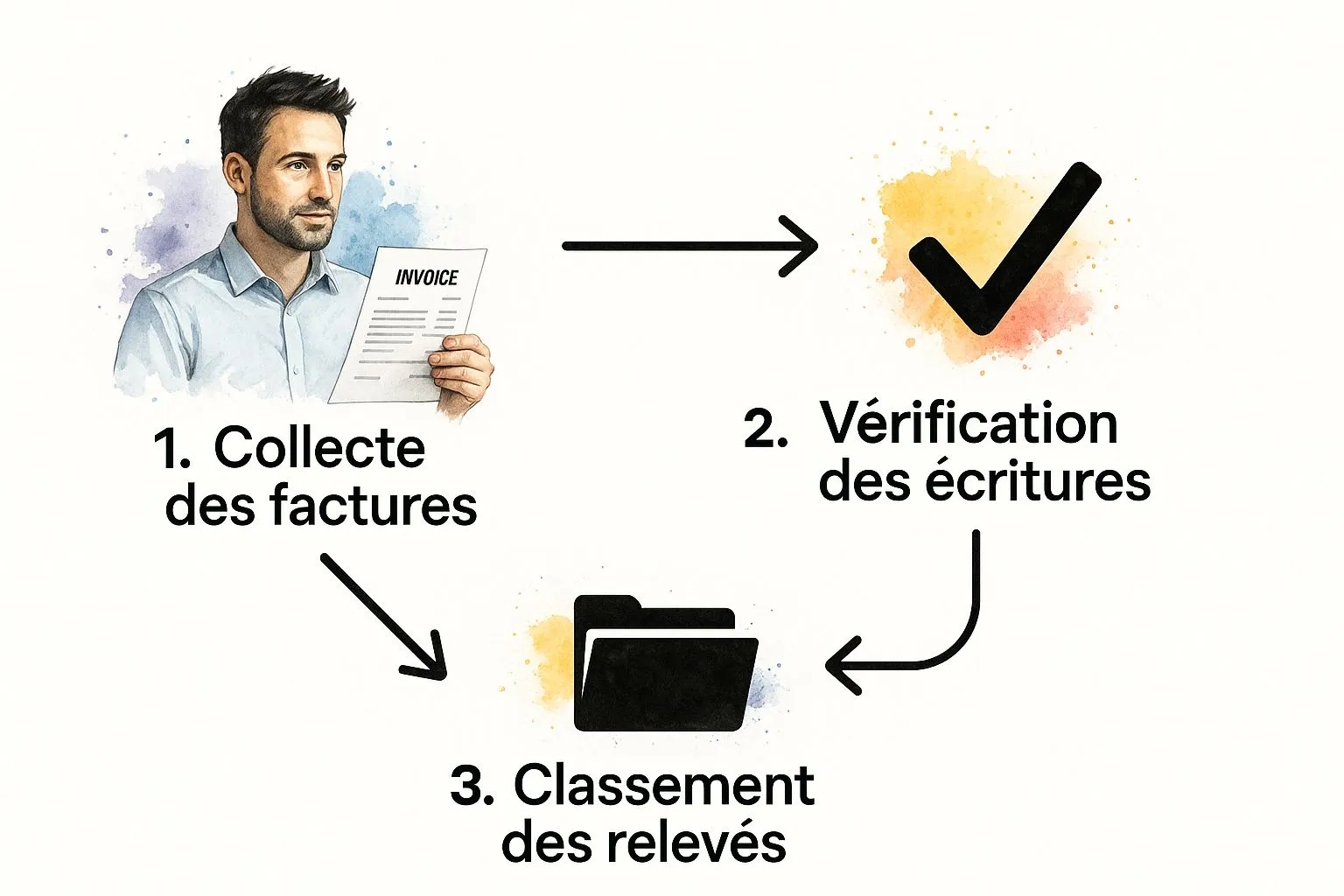
The infographic above illustrates the three fundamental steps in creating a balance sheet: collecting invoices, verifying entries, and filing statements. These steps, while distinct, are linked and form a workflow essential to rigorous bookkeeping. Following this simple process ensures the consistency and reliability of your financial data.
Collection and organization: the foundation of a successful balance sheet
The first step, arguably the most important, is to gather all relevant accounting documents. Purchase and sales invoices, bank statements, payslips, and so on, must be centralized. A clear organizational system from the outset greatly simplifies the process. Consider using binders, digital folders, or accounting software like Bizyness for optimal management.
To help you along the way, here is a summary table of the key steps for a successful balance sheet:
The 6 essential steps to a successful balance sheet
This table presents the proven methodology for preparing your balance sheet stress-free, with concrete actions and the resources needed at each stage.
| Critical phase | Concrete actions | Essential documents | Signs of success |
|---|---|---|---|
| Document collection | Gather all invoices, bank statements, and supporting documents | Purchase and sales invoices, bank statements, payslips | Complete and organized documents |
| Data verification | Check amounts, dates, and references on each document | All accounting records collected | No errors or inconsistencies |
| Filing and archiving | Organize documents logically and accessibly | Verified and validated documents | Documents easy to find and consult |
| Data analysis | Review key figures and identify important trends | Balance sheet, income statement | Clear understanding of financial performance |
| Reporting and interpretation | Present results clearly and concisely | Financial reports, dashboards | Actionable financial information for decision-making |
| Planning and corrective actions | Set objectives and implement actions to improve performance | Forecast budget, action plan | Implementation of strategies to optimize profitability |
This table gives you an overview of the steps needed to complete your balance sheet. By following these recommendations, you will gain efficiency and peace of mind.
Verification and validation: accuracy above all
Once the documents are collected, verifying the accuracy of the information is essential. Check amounts, dates, and references, and make sure there are no errors or omissions. This step, often overlooked, is nonetheless essential to guarantee the reliability of your balance sheet. Bizyness can automate part of these checks and flag inconsistencies.
Filing and archiving: planning ahead
Finally, file and archive your documents logically and accessibly. Rigorous filing makes it easier to find information in the event of a tax audit or to analyze the evolution of your business. Secure archiving is, moreover, a legal requirement. Bizyness simplifies this step with secure, compliant digital archiving. Adopting these good practices turns the balance sheet into a genuine asset for managing your business.
Decode your balance sheet like a financial strategist

The balance sheet is much more than a simple legal obligation. It is an essential tool for understanding your company’s financial health and making informed decisions. This document, a true wealth of information, allows you to evaluate your past performance, anticipate potential difficulties, and identify future growth levers. Let’s explore together how to make the most of it.
Identifying key performance indicators
Your balance sheet is a valuable source of performance indicators. Among the most important are solvency, profitability, and liquidity. Solvency assesses your company’s ability to meet its long-term debts. Profitability, in turn, measures your ability to generate profits. Finally, liquidity indicates your ability to cover your short-term expenses. These three pillars are interdependent and form the basis of a complete financial analysis.
Financial ratios: powerful analysis tools
To go further in the analysis, financial ratios are indispensable. For example, the current ratio determines whether your company has enough short-term assets to cover its short-term debts. A ratio below 1 can be a sign of upcoming financial difficulties. The debt ratio measures the share of assets financed by borrowing. A debt ratio that is too high can reveal excessive dependence on creditors. Combined analysis of these ratios offers a more precise view of the company’s financial situation.
To illustrate the importance of financial ratios, here is a summary table:
10 revealing financial ratios for your business
This table presents the essential financial indicators for analyzing your company’s health, how to calculate them, and the critical thresholds to watch.
| Key indicator | How to calculate it | What it really reveals | Alert threshold |
|---|---|---|---|
| Current ratio | (Current assets) / (Current liabilities) | Ability to pay short-term debts | < 1 |
| Debt ratio | (Total debts) / (Total assets) | Proportion of assets financed by borrowing | > 0.7 |
| Return on equity | (Net income) / (Equity) | Return on shareholder investment | Varies by sector |
| Gross margin ratio | (Revenue - Cost of goods sold) / (Revenue) | Profitability of sales | Varies by sector |
| Inventory turnover ratio | (Cost of goods sold) / (Average inventory) | Efficiency of inventory management | Varies by sector |
| Interest coverage ratio | (Earnings before interest and taxes) / (Interest expenses) | Ability to pay debt interest | < 1.5 |
| Accounts receivable turnover ratio | (Revenue) / (Average accounts receivable) | Efficiency of receivables collection | Varies by sector |
| Accounts payable turnover ratio | (Purchases) / (Average accounts payable) | Payment terms granted by suppliers | Varies by sector |
| Working capital requirement (WCR) | (Inventory + Accounts receivable) - (Accounts payable) | Financing of the operating cycle | Positive and stable |
| Net margin | (Net income) / (Revenue) | Overall profitability of the business | Varies by sector |
By analyzing these ratios, you get a more complete picture of your company’s performance.
In France, Insee provides valuable statistics on businesses, including the Ésane data. This data provides detailed information on the accounting and financial characteristics of French companies, produced since 2017 based on the economic definition of the enterprise. This enables relevant sector comparisons and the identification of areas for improvement.
Turning data into concrete actions
Analyzing the balance sheet should not be limited to simply observing the numbers. The goal is to turn this data into concrete actions. A low liquidity ratio might prompt you to renegotiate payment terms with your suppliers or optimize your inventory management. A high debt ratio might lead you to consider alternative financing solutions or reduce certain expenses.
Examples of sector-specific application
Interpreting the balance sheet differs depending on the industry. In retail, inventory turnover is a key indicator. A high rate indicates good inventory management and strong demand. In manufacturing, gross margin is a key indicator. A large gross margin reflects good control of production costs. Adapting your analysis to the sector context is essential. Tools like Bizyness can help you track these indicators and adapt your strategies.
Benchmarking: position yourself against your competitors
Once you have mastered the art of the balance sheet, the next step is to assess your position relative to your competitors. This process, called benchmarking, is crucial for identifying your strengths, weaknesses, and opportunities for improvement. It allows you to better understand the competitive landscape and adapt your strategy for optimal growth.
Sources of information for effective benchmarking
Relevant benchmarking relies on access to your competitors’ financial data. Several sources of information are available. For publicly listed companies, annual reports, accessible to the public, are full of valuable information on their financial performance.
For non-listed companies, databases such as Diane or Societe.com offer information on their balance sheets. Although paid, these platforms allow for in-depth comparative analyses.
The Banque de France also plays a key role. Its balance sheet database gathers financial data from more than 30,000 companies across around a hundred sectors. This data, accessible to the public, helps companies understand their financial situation relative to their sector. It enables them to assess the financial health of companies and identify sector trends. For more information on public data, see this link.
Analyzing data and identifying performance levers
Once the data has been collected, methodical analysis is essential. Compare your key ratios (profitability, solvency, liquidity) with those of your direct competitors. Identify performance gaps and analyze their causes. Below-average profitability compared to the sector, for example, could stem from higher production costs or a less competitive pricing policy.
Concrete examples of using benchmarking
Benchmarking helps identify concrete performance levers. Better inventory turnover among your competitors may indicate a need to optimize your own inventory management. A shorter receivables collection period among them might prompt you to speed up your collections. Tools like Bizyness offer features to automate customer follow-ups and optimize payment tracking, allowing you to “prepare your balance sheet” and act proactively.
Adapting your strategy and optimizing performance
Benchmarking is not an end in itself, but a tool for adapting your strategy and improving your performance. By identifying your weaknesses relative to the competition, you can implement targeted actions. Built into your management cycle, this ongoing process allows you to anticipate market developments and maintain your competitiveness. A tool like Bizyness can help you track your key indicators and measure the impact of your actions.
Navigating the French legal framework with confidence

Preparing a balance sheet is a legal requirement for most companies in France. Far from being a mere formality, this process fits within a precise legal framework, non-compliance with which can lead to sanctions. This section will guide you through the specific requirements, allowing you to turn these constraints into genuine opportunities for your business.
Legal obligations according to legal structure
The obligations relating to the balance sheet differ depending on the company’s legal structure. The requirements for an SARL (private limited company) are not the same as for an SA (public limited company) or an SAS (simplified joint-stock company). For example, SAs are required to publish their annual accounts, an obligation that is relaxed for micro-businesses. Accurately identifying your category is therefore essential for optimal compliance. Bizyness supports you in this process and clarifies the specifics related to your structure.
The influence of company size
Company size, determined by criteria such as revenue and headcount, also affects accounting obligations. A micro-business benefits from simplified procedures compared to an SME or a large company. These simplifications relate in particular to bookkeeping and balance sheet presentation.
Distinguishing between legal obligations and recommendations
It is essential to distinguish between what is legally mandatory and what is simply recommended. Preparing a functional balance sheet, for example, while not mandatory, represents a valuable analytical tool for your company’s financial structure. Bizyness facilitates the creation of this type of complementary balance sheet, thereby contributing to more optimized management.
The consequences of non-compliance
Failure to comply with legal obligations regarding the balance sheet can have significant consequences. Financial penalties may be applied, or even legal proceedings initiated. A non-compliant balance sheet can also damage the company’s credibility with financial institutions and potential investors.
Simplifying compliance with digital tools
Fortunately, solutions like Bizyness considerably simplify the compliance process. Automating accounting tasks minimizes the risk of errors and ensures the production of documents that comply with legislation. The app also provides resources and personalized support to guide you through the French legal framework. Don’t hesitate to make use of these tools to turn balance sheet preparation into a simple and efficient task.
Technology and tools: the balance sheet reinvented
The balance sheet, once synonymous with paperwork and complex calculations, has been profoundly modernized through digitalization. Today’s entrepreneurs benefit from a wide range of tools to simplify and optimize this process, which is essential to their company’s financial health.
SaaS solutions: flexibility and accessibility
Software as a service (SaaS), accessible online by subscription, offers unprecedented flexibility and accessibility. Available anywhere, anytime, they simplify accounting management and collaboration with your accountant.
Here are a few key benefits of SaaS solutions:
- Automatic updates for ongoing regulatory compliance.
- Predictable costs thanks to monthly or annual subscriptions.
- Simplified data access for greater responsiveness.
Bizyness perfectly illustrates this trend by offering a complete and intuitive solution for small businesses and sole traders. From invoicing to VAT management to bank synchronization, Bizyness automates many tasks.
Traditional software: power and customization
Installed directly on the computer, traditional accounting software generally offers more advanced features and greater customization options. It is particularly suited to companies with specific needs or managing a large volume of data.
It is worth noting that these solutions can represent a larger initial investment and require technical skills for installation and maintenance.
Collaborative platforms: exchange and transparency
Collaborative platforms optimize interactions between the entrepreneur and their accountant. Real-time document sharing, progress tracking, and streamlined communication improve transparency and strengthen trust.
Choosing the ideal tool: a question of needs
The ideal technology depends on each company’s specific needs. A small business with simple operations may find a SaaS solution like Bizyness sufficient. A large company with more complex needs will opt for traditional software, or even a combination of tools.
The balance sheet is an essential step in running a business. Today’s technologies simplify this process and allow you to focus on what matters most: growing your business. Using effective tools such as Bizyness saves considerable time and provides valuable information for steering your company with confidence.
Optimization strategies: beyond raw numbers
The balance sheet, a legal obligation, also represents a valuable opportunity to effectively steer your business. How can you fully leverage this document to optimize your financial structure and improve your key indicators? Let’s explore concrete, legal strategies together.
Optimizing inventory management for a stronger balance sheet
Inventory management has a direct impact on working capital requirement (WCR), an essential indicator of the functional balance sheet. Excess inventory ties up resources and generates significant storage costs. Conversely, insufficient inventory can cause supply shortages and negatively affect sales.
Optimization relies on rigorous flow management, anticipating needs, and identifying fast-moving products. Like a chef managing ingredients with precision, optimal inventory management helps avoid waste while ensuring customer satisfaction.
Financing assets: finding the right balance
Financing fixed assets (machinery, buildings, etc.) influences the structure of the balance sheet. Excessive reliance on borrowing can weaken the company in the long run, while too much self-financing can limit its growth.
It is therefore crucial to find the right balance between different sources of financing (loans, capital contributions, leasing, etc.) based on the company’s situation and growth prospects.
Structuring debt to optimize your balance sheet
Debt structuring is an important optimization lever. Renegotiating repayment schedules, consolidating loans, or choosing more suitable financing can improve debt ratios and the company’s solvency. It is about orchestrating your debts with precision to achieve financial harmony.
Improving your bank rating through an optimized balance sheet
A solid, optimized balance sheet is a major asset for improving your bank rating. A good rating facilitates access to financing and allows you to benefit from more favorable terms. It is a true reflection of the company’s financial health and its ability to meet its commitments.
Presenting your financial situation in the best light
“Preparing the balance sheet” is not limited to a simple legal obligation. It is also an opportunity to present your financial situation clearly and transparently, highlighting strengths and explaining weaknesses. Transparent communication reassures financial partners and potential investors.
In conclusion, optimizing your balance sheet is an ongoing process that requires thorough analysis and the implementation of tailored strategies. Bizyness supports you in this process by providing the tools and advice you need to run your business effectively and achieve your goals. Optimize your accounting management now!