
6 Pro Forma Invoice Examples to Download for 2025
Discover our complete guide with 6 pro forma invoice examples tailored to every industry. Downloadable templates and tips for flawless management.
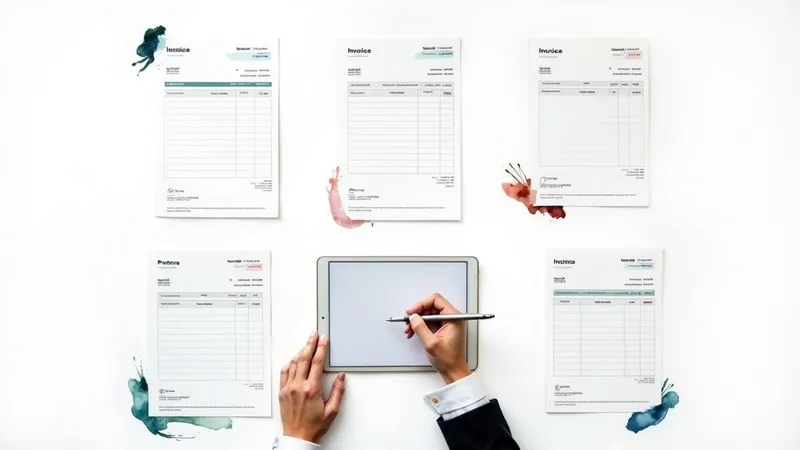
A pro forma invoice is far more than a simple quote. It’s a key commercial document that secures your transactions before they’re even finalized, acting as a formal proposal that details the terms of a future sale. Yet its structure, legal value and specific applications are often misunderstood, which can lead to delays and misunderstandings with clients.
This article aims to demystify this essential tool. We’ll provide you with not one, but six pro forma invoice examples, each tailored to a distinct industry: from international export to professional services, through construction and e-commerce. Each template comes with a strategic breakdown, practical tips and clear explanations of the mandatory mentions and fields specific to your field.
You’ll discover how to structure a pro forma invoice example that is both compliant and compelling, how to avoid common mistakes that can hurt your credibility, and how to use this document to build trust and speed up the sales cycle. Whether you’re a freelancer, an SME manager or an exporter, you’ll find concrete strategies here to professionalize your business exchanges and secure your operations.
1. International Export Pro Forma Invoice
The international export pro forma invoice is a crucial commercial document that acts as a preliminary sales offer and a declaration of value for customs. Unlike a final commercial invoice, it doesn’t require immediate payment. Its main role is to inform the buyer of the details of the upcoming transaction and to provide customs authorities with all the information needed to clear the goods.
This document is essential for any business selling goods beyond its national borders, whether exporting industrial machinery to Africa or French luxury products to Asia. It establishes an agreement in principle between the seller and the buyer, clearly defining the products, their value, and the transport and payment terms.
Strategic analysis: Key elements of customs compliance
A well-drafted export pro forma invoice is your passport to a smooth international transaction. It must contain much more detailed information than a domestic pro forma.
- Precise identification of the parties: Full name, address and contact details of the exporter and importer.
- Detailed description of the goods: Include not only the product name, but also the weight, dimensions, materials and, above all, the Harmonized System (HS) code. This code is essential for customs classification and calculating duties and taxes.
- Sale and delivery terms: This is where Incoterms come into play. They define the buyer’s and seller’s responsibilities regarding transport. In the context of international transactions, understanding Incoterms such as FOB is essential when drafting your export pro forma invoice.
- Financial details: State the transaction currency, unit price, total amount and payment terms (e.g., bank transfer, letter of credit).
This infographic illustrates the three fundamental steps for preparing your export document.
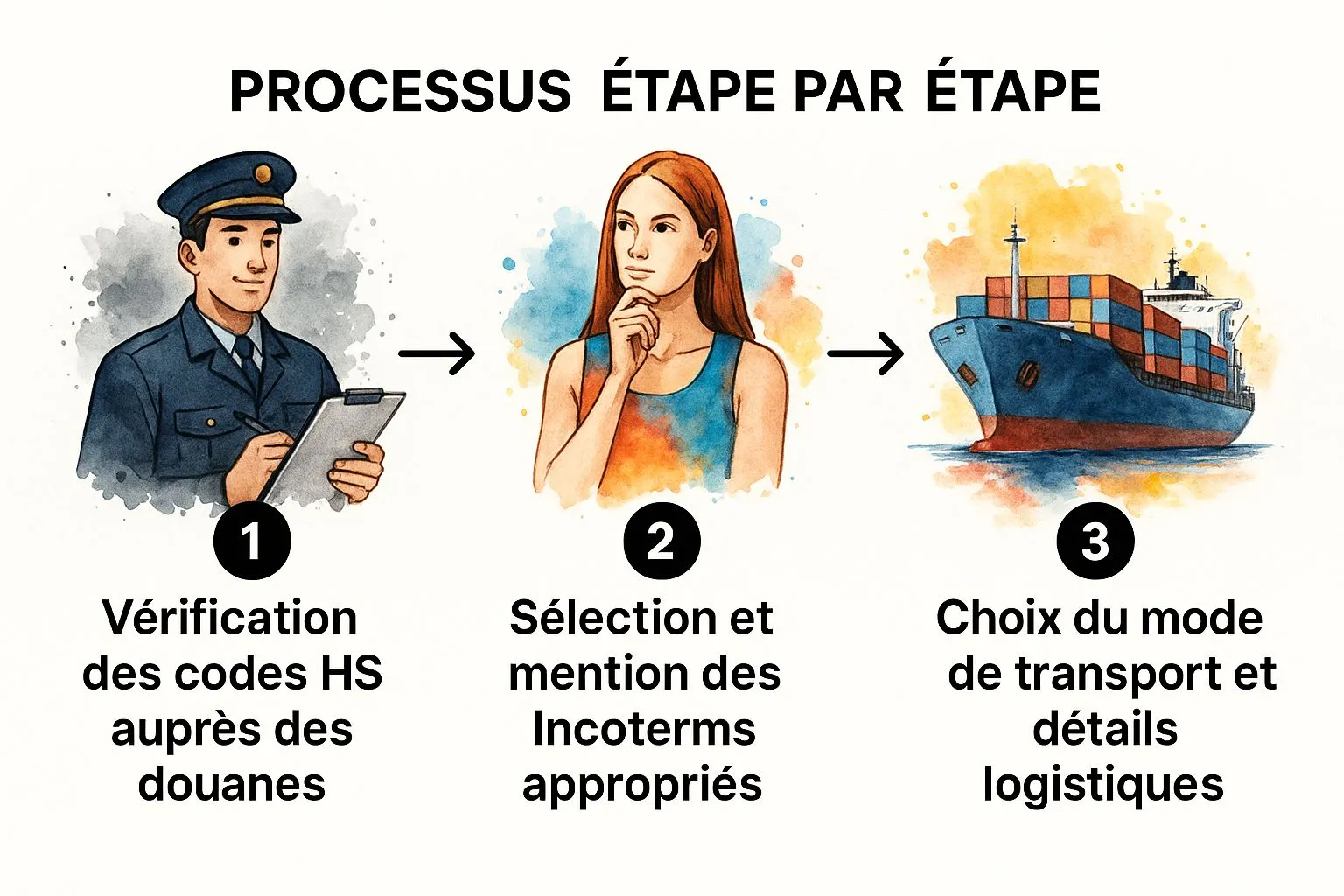
Following this sequence ensures that logistical and regulatory aspects are handled in a logical order, minimizing the risk of delays or customs penalties.
Practical application and tips
To fully grasp the nuances of this document, the video below offers visual explanations and concrete examples.
To succeed with your exports, follow these tips:
- Check the HS codes: Use online customs tools or consult a freight forwarder to ensure the codes are accurate. An error can lead to incorrect taxes and shipment blocks.
- State the origin of the goods: A certificate of origin may be required to benefit from preferential trade agreements.
- Be precise: Any ambiguity can be interpreted against you by the authorities. Specify if the invoice is “for customs purposes only” and not a request for payment.
2. Professional Services Pro Forma Invoice
The professional services pro forma invoice is an essential document for consultants, trainers and other experts who sell their expertise. It formalizes an offer of intellectual services before a contract is signed or a final invoice issued. Its purpose is to precisely detail the nature of the assignments, deliverables, timelines and associated costs, thereby establishing a framework of trust and transparency with the client.
This type of document is a must for consulting firms, marketing agencies or freelancers taking on complex projects. It ensures both parties share a common understanding of the scope of the engagement, the objectives to be achieved and the financial terms, well before the work actually begins. It’s a moral commitment that sets the stage for a successful partnership.
Strategic analysis: Key elements of a clear engagement
A well-structured pro forma invoice for professional services is the foundation of a solid client relationship. It must go beyond a simple price list to become a genuine project roadmap.
- Breakdown of services: Don’t settle for a vague title like “Consulting assignment”. Break the engagement down into distinct phases or specific deliverables (e.g., initial audit, brainstorming workshop, drafting of specifications, training session).
- Pricing terms: Clearly state whether your rate is hourly, daily, or a flat fee. For a flat fee, specify what’s included and what could be billed separately.
- Projected timeline: Mention key dates or important milestones. This allows the client to visualize how the project will unfold and when their approval will be required.
- Payment terms: Specify the payment schedule (deposit on order, balance on delivery, installments) to avoid any future ambiguity.
This document should reflect your professionalism and expertise, showing the client that you have a structured vision of the upcoming assignment.
Practical application and tips
For service providers, especially independents, the clarity of the pro forma is a mark of credibility. It prevents misunderstandings and secures the transaction.
To succeed with your service proposals, follow these tips:
- Specify the expected deliverables: For each phase, clearly state what the client will actually receive (an audit report, a mockup, training materials, etc.).
- Include cancellation or modification terms: Specify what happens if the scope of the engagement changes along the way.
- Mention exclusions: Be transparent about what isn’t included in your service to manage the client’s expectations (e.g., travel expenses, software license purchases).
- Facilitate future invoicing: A well-detailed pro forma serves as the basis for the final invoice. For sole traders, understanding the rules of invoicing is essential for sound and compliant management.
3. Construction Pro Forma Invoice
In the construction industry, the pro forma invoice is far more than a simple estimate; it’s the cornerstone of the contractual relationship between the business and its client. This detailed document serves as a binding quote, precisely describing the scope of work, the materials needed, labor, and the projected timeline. It’s a formal commitment that precedes the signing of the final contract and the start of the job.
This type of invoice is essential for projects of any scale, whether building a single-family home, renovating a commercial building, or earthworks. It offers a clear and transparent view of costs, timelines and technical specifications, protecting both parties against misunderstandings and potential disputes.

Strategic analysis: Key elements for a solid quote
A pro forma invoice in construction must be meticulously prepared to anticipate every phase of the project and secure the transaction. Its precision is a mark of professionalism and an essential project management tool.
- Breakdown of work: Each line item must be listed with a clear description. Rather than “bathroom renovation”, detail: removal of old fixtures, surface preparation, tiling (m²), plumbing installation, etc.
- Quantities and unit prices: Link each service to a unit (m², linear meter, flat rate, hour) and a pre-tax unit price. Transparency on material and labor costs is crucial.
- Payment terms: Specify the payment schedule, which is often tied to work progress (e.g., 30% on order, 40% at completion of the shell, 30% on handover).
- Timeline and projected schedule: Indicate an estimated start date and an approximate duration for the work. It’s good practice to mention conditions that could affect this schedule (weather, supplier delivery delays).
The complexity of invoicing in this sector makes using dedicated tools almost mandatory. For optimized management, it’s recommended to explore invoicing software specialized for construction that can automate the creation of compliant quotes and invoices.
Practical application and tips
For a construction pro forma invoice to become a genuine document of trust, it’s essential to include elements that demonstrate your expertise and anticipate on-site realities.
To ensure your document is clear and compliant, follow these tips:
- Include a price revision clause: In a context of fluctuating material costs, this clause protects you by allowing prices to be adjusted according to reference indices (such as the BT01 index).
- Detail the technical specifications: Mention the brands and references of the main materials, as well as the construction standards followed (e.g., DTU, NF standards).
- Plan for contingencies: Including a contingency provision (typically 10-15%) or noting that additional work will be subject to a priced amendment can help avoid conflicts.
- Check compliance: Make sure all mandatory legal mentions are present, including your insurance information (ten-year structural warranty).
4. E-commerce Pro Forma Invoice
The e-commerce pro forma invoice is an optimized version of the standard document, designed to fit the fast, automated dynamics of online selling. It serves as a preliminary commercial offer and formal quote before order confirmation and payment. Its role is to give the customer a clear overview of the selected products, associated costs such as shipping fees, and the terms of the transaction before they finalize their purchase.
This document is essential for online stores on Shopify or PrestaShop, sellers on marketplaces like Amazon, and industrial B2B platforms. It allows a purchase intent to be formalized, particularly for large or customized orders, and secures the transaction by precisely informing the buyer of the upcoming commitments.

Strategic analysis: Key elements of automation
An effective e-commerce pro forma invoice must be generated automatically and account for the specifics of remote selling. The goal is to reduce friction in the purchase journey while ensuring administrative compliance.
- Integration with the shopping cart: The pro forma should be generated dynamically from the information in the customer’s cart, including products, quantities and selected options (color, size, etc.).
- Automated calculation of additional costs: Shipping fees should be calculated in real time based on the delivery address and the carrier option selected by the customer. Applicable taxes (VAT) should also adjust automatically.
- Clear sales terms: Explicitly mention the return policy, estimated delivery times and product warranty information. Transparency is a key trust factor for online buyers.
- Personalization and branding: The pro forma invoice should reflect your brand’s visual identity (logo, colors) to reinforce professionalism and recognition.
Incorporating these elements ensures a smooth, professional customer experience while laying the groundwork for rigorous accounting management.
Practical application and tips
For online sellers, automation is key. The video below shows how to set up commercial documents on a popular e-commerce platform.
To optimize your e-commerce pro forma invoices, follow these tips:
- Automate sending: Configure your management system (CMS or ERP) to automatically email the pro forma invoice as soon as a customer requests a quote or abandons a cart with high-value items.
- Optimize for mobile: Make sure the document is readable and clear on a smartphone screen, since a large share of online purchases happen on mobile devices.
- Include a call to action: Add a clickable link or button (“Pay now”, “Complete my order”) that takes the customer directly to the payment page to convert the offer into a sale.
- Manage compliance: Accounting management for an e-commerce business has its own rules, particularly regarding cross-border VAT. Make sure your system is up to date.
5. Industrial Equipment Pro Forma Invoice
The industrial equipment pro forma invoice is a highly precise technical and commercial document, used in complex transactions such as the sale of machine tools or automated production systems. Far more than a simple offer, it serves as a preliminary contractual specification, detailing not only the price but also the technical specifications, performance guarantees, and associated services like installation or training. It’s often a key piece in responses to industrial tenders.
This document is fundamental for companies like Siemens or Schneider Electric when they propose integrated solutions. It allows the industrial client to understand the full scope of the offering: the machine itself, the terms of its commissioning, delivery times and maintenance commitments. It’s an assurance that the equipment will meet the specified production requirements.
Strategic analysis: Key elements of the technical proposal
An effective industrial equipment pro forma invoice is one that leaves no room for ambiguity. It must merge commercial and technical aspects with absolute rigor to secure the transaction.
- Detailed technical specifications: Beyond the model name, it’s essential to include production capacities (e.g., units/hour), energy consumption, dimensions, weight, and construction materials. References to attached technical drawings or plans are common.
- Associated services terms: This section is crucial. It must detail the costs and schedule for installation, commissioning, operator training and preventive maintenance contracts.
- Performance guarantees and acceptance clauses: The document must clearly state the equipment’s expected performance. It should also describe the test and acceptance protocols (e.g., factory acceptance tests - FAT) that will validate the machine’s compliance before shipment.
- Timelines and logistics: Specifying manufacturing, delivery (using appropriate Incoterms) and installation timelines is essential for the client’s project planning.
This granular approach turns the pro forma into a genuine project management and risk mitigation tool for both parties.
Practical application and tips
For such a document to achieve its purpose, clarity and thoroughness are paramount.
To succeed with your industrial equipment proposals, follow these tips:
- Attach technical documentation: Always include relevant data sheets, plans and diagrams with your pro forma invoice. This builds your credibility and allows for thorough technical review by the client.
- Quantify performance: Use concrete figures to describe guaranteed performance (e.g., “production rate of 1,200 units/hour with a tolerance of +/- 2%”).
- Break down the costs: Present a clear breakdown of costs: equipment price, installation cost, training fees, and maintenance contract options. This transparency makes the buyer’s decision easier.
6. Training and Education Pro Forma Invoice
The pro forma invoice for training or an educational program is an essential document that formalizes a pedagogical and financial proposal. It’s aimed at businesses or individuals who want to commit to training costs, often to obtain funding from third-party organizations such as a skills operator (OPCO) or to use their personal training account (CPF). This document serves as a detailed quote and preliminary supporting document to unlock the necessary funds.
This type of pro forma invoice goes well beyond a simple price list. It must detail the educational content, objectives, methods and targeted certifications, acting as a document of trust between the training organization and the future learner or their funder. It’s an indispensable tool for entities such as AFPA, private universities, or certifying training centers that need to prove the relevance and quality of their programs.
Strategic analysis: Key elements for funding validation
A well-built training pro forma invoice is a major lever for convincing funders and securing enrollment. It must be flawless in both substance and form to avoid any delay or refusal of funding.
- Clear identification of the training: Exact program title, training code if applicable (e.g., CPF code), and total duration in hours.
- Detailed educational content: This is the heart of the document. It should list the learning objectives (targeted skills), the detailed program by module, the teaching methods (in-person, e-learning, blended) and the materials provided.
- Assessment and certification methods: Specify how skills will be assessed (final exam, continuous assessment, project) and mention the certification or diploma obtained at the end of the training (e.g., RNCP title, Qualiopi certification of the organization).
- Specific financial details: The cost should be broken down: tuition fees, registration fees, material costs, certification fees. It’s crucial to clearly state the pre-tax amount, the applicable VAT rate (or exemption if the organization is eligible) and the total amount including tax.
Practical application and tips
For a pro forma invoice example in the education sector to be effective, it must be seen as a genuine funding application file. Clarity and completeness are your best assets.
Here are some tips to optimize your documents:
- Mention your accreditations: Prominently display your activity declaration number and your Qualiopi certification. This is a mandatory mark of quality for many public and pooled funding schemes.
- Specify the prerequisites: State the level or skills required to take the training. This demonstrates the seriousness of your selection process and justifies the program’s relevance for the candidate.
- Include cancellation terms: Clearly define the terms for postponement or cancellation, for both the trainee and the organization. This transparency is appreciated by funders and protects both parties.
- Personalize for the funder: Slightly adapt the wording or highlight the skills most sought after by the industry of the company or the relevant OPCO.
Comparison of the 6 pro forma invoice examples
| Type of Pro Forma Invoice | 🔄 Implementation Complexity | 💡 Resources Required | 📊 Expected Results | 💡 Ideal Use Cases | ⭐ Key Benefits |
|---|---|---|---|---|---|
| International Export Pro Forma Invoice | High (strict customs regulations) | Regulatory knowledge, logistics support | Eases customs clearance, secures transactions | Complex international exports | Simplifies licensing, calculates customs duties |
| Professional Services Pro Forma Invoice | Medium (service breakdown & negotiations) | Business expertise, planning | Pricing transparency, clear legal framework | Consulting, training, expert assignments | Easier budgeting, upfront negotiations |
| Construction Pro Forma Invoice | High (technical and regulatory) | Technical and legal skills | Cost transparency, protection against overruns | Building, public works | Solid contractual basis, funding approval |
| E-commerce Pro Forma Invoice | Medium to high (technical integration) | IT development, ongoing maintenance | Automation, improved customer experience | E-commerce sites, marketplaces | Process automation, fewer disputes |
| Industrial Equipment Pro Forma Invoice | High (technical and lengthy validation) | Technical expertise, complete documentation | Secured investments, offer comparison | Sale of heavy equipment, tenders | Includes associated services, extended warranties |
| Training and Education Pro Forma Invoice | Medium (administrative and pedagogical) | Regulatory training knowledge | Facilitates funding, showcases certifications | Training organizations, educational institutions | Educational transparency, quality compliance |
Take Action: Create Your Pro Forma Invoices Efficiently
You’ve explored a varied range of templates, from the pro forma invoice for international export to the one intended for online training. Every pro forma invoice example detailed in this article has highlighted a fundamental principle: a pro forma is not just an administrative formality, but a powerful tool for communication, negotiation and professionalism. By mastering its subtleties, you turn a simple proposal into a solid foundation for a trusted business relationship.
We’ve seen that clarity, precision and adaptation are the pillars of a successful pro forma invoice. Whether it’s detailing Incoterms for an international sale, breaking down the phases of a construction project, or specifying the terms of access to a digital product, every well-completed field reduces friction and speeds up your client’s decision-making. Personalization, such as adding your logo and clear terms, strengthens your brand image and builds your credibility from the very first exchanges.
Your Next Strategic Steps
To turn this knowledge into concrete results, here’s a simple, actionable roadmap:
- Choose the right template: Identify the pro forma invoice example that best matches your main activity among those presented. Use it as a starting point.
- Adapt and personalize: Don’t just copy and paste. Incorporate your visual identity, adjust the fields to precisely reflect your offerings, and add mentions specific to your industry (warranties, payment terms, etc.).
- Automate for efficiency: Time spent on administrative tasks is time not spent on your core business. Using a dedicated invoicing tool is the key to systematizing this process, ensuring compliance and eliminating human error.
- Analyze and optimize: Think of your pro formas as a customer touchpoint. If a certain type of pro forma achieves a higher conversion rate, analyze why. Is it the clarity of the terms, the structure of the offer? Learn from it to refine your future proposals.
Ultimately, mastering the pro forma invoice is a direct investment in the smoothness of your sales cycle. It’s the assurance that every proposal sent is not only compliant, but also optimized to convince. By adopting these best practices, you no longer just manage documents — you actively drive your business growth.
Ready to move from example to practice, effortlessly? Bizyness is designed specifically for freelancers and small businesses in France, automating the creation of compliant quotes and pro forma invoices in just a few clicks. Simplify your management and focus on what really matters by trying Bizyness today.
