
Your ready-to-use proforma invoice example
Get a ready-to-use proforma invoice example. Download our free template and follow our tips for a professional, compliant document.
A proforma invoice example is a business document that looks strikingly similar to a standard invoice, but serves an entirely different purpose. It’s a kind of “invoice for the record,” presenting a detailed offer for goods or services before the sale is actually concluded. The key difference? It has no accounting or legal value. It’s therefore not a request for payment, but rather a way to put the terms of a future transaction in writing.
Understanding the role of the proforma invoice
Far from being a mere formality, the proforma invoice is a genuine business tool. It lays the groundwork for a sound transaction by clarifying all the terms before any commitment is made. It’s crucial not to confuse it with a quote or a final invoice, as their legal and commercial implications are radically different.
Think of the proforma as the “official draft” of the final invoice. It gives your client a precise, detailed view of what they’re about to purchase and at what price, without tying them to immediate payment. It’s a document that exudes professionalism and reassures both parties.
When this tool becomes essential
In many cases, the proforma invoice isn’t just an option — it’s essential. Its use varies, but its purpose remains the same: securing and clarifying exchanges.
Here are a few concrete situations where it will save the day:
- International transactions: It’s the key that unlocks customs. Customs authorities often require it to declare the value of goods before shipment, which considerably smooths the border crossing.
- Financing requests: A bank or lender will almost always ask you for a proforma to justify the amount of a loan intended for purchasing equipment or financing a project.
- Securing a deposit: For sizable projects, it serves as a solid basis for requesting an initial payment before starting the service or production.
- Internal validation: In large companies, the purchasing department uses it to get management’s approval before generating the official purchase order.
A key document for distinguishing roles
Confusing the proforma, the quote, and the final invoice is a classic mistake. Each has its own place and function. The quote is a commercial proposal, the proforma is a simulated invoice, and the final invoice is a payment order.
To make things clearer, here’s a table summarizing the fundamental differences between these three documents.
Proforma vs Quote vs Final Invoice: the key differences
This table highlights the fundamental differences in terms of legal value, commitment, payment obligation, and main use.
| Criterion | Proforma Invoice | Quote | Final Invoice |
|---|---|---|---|
| Legal value | None | Commits the seller to the offer | Legal and accounting document |
| Client commitment | None | None (becomes a contract if signed) | Payment obligation |
| Main use | Inform, export, financing | Propose a commercial offer | Prove the sale, request payment |
This table clearly shows that each document comes into play at a different stage of the business relationship. Using the right document at the right time is a mark of clarity and professionalism.
The common mistake? Treating the proforma as just an upgraded quote. Although neither obliges the client to pay, the proforma adopts the formal structure of a real invoice. This “seriousness” gives it more weight in formal contexts such as banking procedures or exports.
To master all the nuances, you can explore our complete guide to the proforma invoice.
The essential information on your proforma invoice
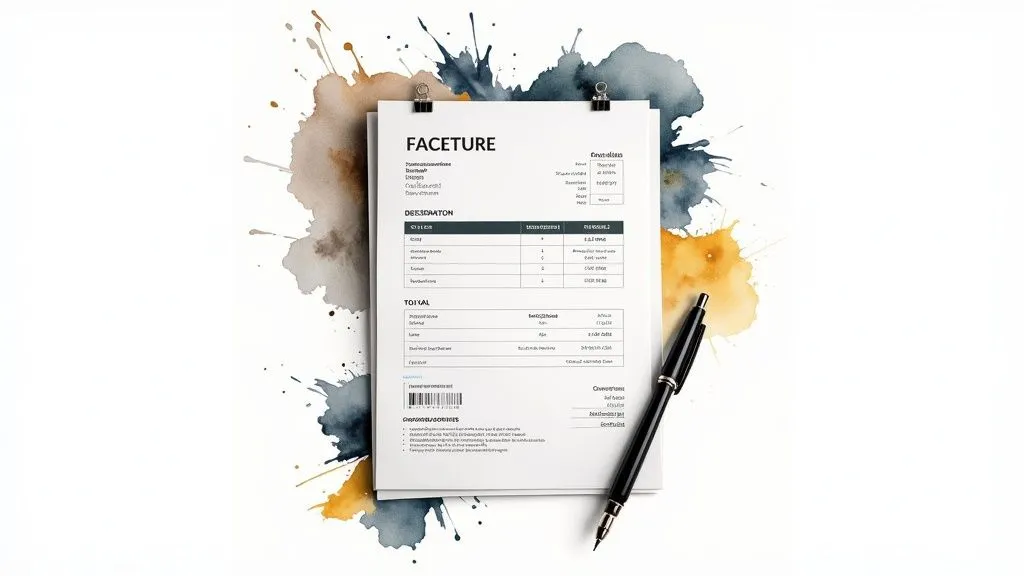
For a proforma invoice to truly be taken seriously, it must be flawless in both substance and form. Even though it doesn’t have the accounting value of a standard invoice, it is its official draft. Its structure therefore draws heavily on that of a real invoice. The goal is to reassure your prospect and lay solid groundwork for the future transaction.
Forgetting a piece of information, even a small one, can create misunderstandings or weaken your offer. Keep in mind: every detail counts. The goal is to provide a document so clear and complete that your client won’t have any lingering questions about the proposed terms.
Clearly identify who’s who
This is the basis of everything. Before even talking about products or prices, the sender and recipient must be perfectly identified. This is the foundation of any serious business relationship.
On your company’s side (the seller), be sure to include:
- Your business name (or your first and last name if you’re a sole proprietor).
- The address of your registered office.
- Your SIREN number.
- Your intra-community VAT number, even if you’re not subject to it.
For the client (the buyer), you’ll need at minimum their name or business name and billing address. If the delivery address is different, it’s an excellent idea to add it right away. It will prevent a lot of misunderstandings later on.
Describe the transaction in full detail
This is where things get real. This is the section where you’ll precisely describe what you’re selling. A simple list of products isn’t enough; you need to turn that list into a transparent, engaging offer.
First point, non-negotiable: the mention “Proforma Invoice” must stand out clearly, generally in the header. This is crucial to avoid confusion with a final invoice, which triggers a payment obligation. Also remember to give it a unique number — it will greatly simplify your tracking.
Then, for each product or service, detail:
- A clear description, free of internal jargon.
- The exact quantity.
- The unit price excluding tax (net of VAT).
- The total net amount for the corresponding line.
Pro tip: Be as precise as possible in the description. Instead of “Consulting service,” write something like “SEO consulting engagement - 10h - Technical audit and keyword research.” This precision prevents disputes and, between us, it immediately looks more professional.
Finalize with terms and amounts
This is the home stretch, the part that formalizes the financial aspects and terms of your offer. This is a critical moment: clarity here is essential so your client fully understands what they would be committing to.
You must therefore clearly state:
- The totals: the total amount excluding VAT, the VAT breakdown (with the different rates if applicable), and of course, the total amount including VAT.
- The transaction currency: EUR, USD, etc.
- The validity period of your offer: generally between 30 and 90 days.
- The payment terms you’re offering: deposit, payment within 30 days, bank transfer, etc.
- The delivery or completion timeline for the service.
By taking care of these elements, your proforma becomes a genuine, solid, and reassuring commercial proposal. A well-completed proforma invoice example is a mark of seriousness that builds your client’s confidence and paves the way for a successful collaboration.
Time to put it into practice: our proforma invoice template
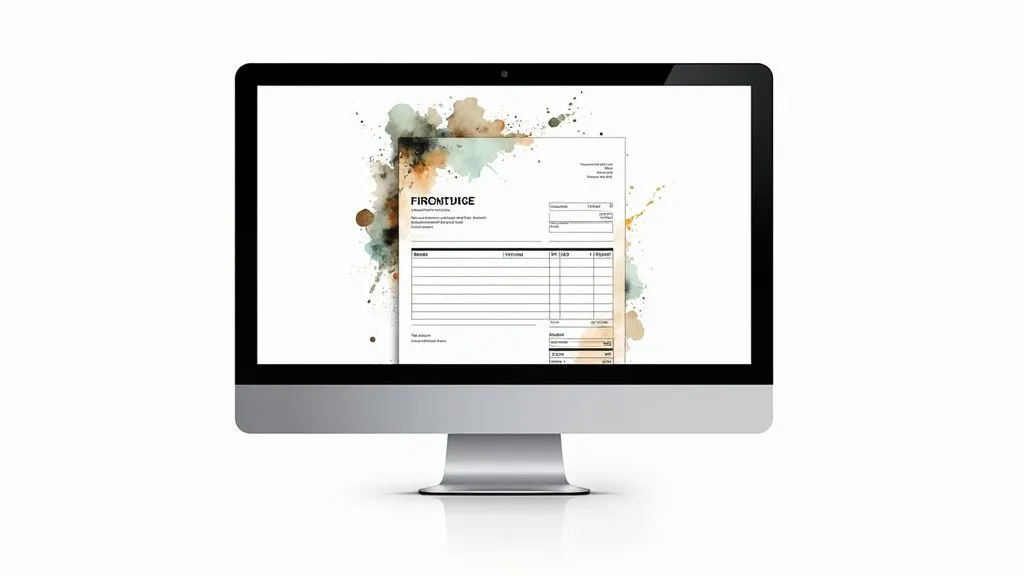
Theory is good, but nothing beats a good tool to get started. Knowing what a proforma invoice should contain is one thing; starting from a blank page is another. That’s why we’ve prepared a ready-to-use proforma invoice example.
This template is designed to save you precious time and, above all, to ensure you don’t forget any legally required information. Just download it and customize it with your details. To go further, you’ll find a downloadable proforma invoice template and more tips in our full article.
How to properly fill out your document
A good template is an excellent starting point. But the real secret to a professional document is the rigor with which you fill it out. Every field matters so your offer is perfectly clear.
Here’s how to approach the key sections of your proforma:
- Contact details (yours and the client’s): This is the starting point. Double-check business names, addresses, and SIREN numbers. A simple typo here can block or delay the entire transaction.
- Description of products or services: Precision is your best ally. Rather than writing “Web development,” detail it: “Homepage creation (wireframing, integration, responsive design) - 15 hours.” This transparency prevents misunderstandings and demonstrates your seriousness.
- Quantities and unit prices: Each item or service must have its own line, with its unit price excluding tax. It’s a sign of trust for your client.
By structuring the information this way, you leave no room for doubt. Your prospect knows exactly what you’re offering them.
Never forget that the quality of your proforma reflects the care you’ll put into the engagement. A clear, precise, error-free document sends a strong signal to your future client.
A concrete example to make it clearer
Sometimes an example is worth a thousand words. Imagine you’re selling IT equipment to another company. What would a well-completed proforma invoice look like in this context?
Here’s an illustration showing what the finalized document might concretely look like.
This visual highlights the clarity of the product lines, the clear distinction between net and gross amounts, as well as the presence of all essential information about the sender and recipient.
Handling special cases, particularly VAT
Managing Value Added Tax (VAT) can quickly become a headache, especially if you’re invoicing products or services subject to different rates. Your template needs to be flexible.
If this is your case, make sure your document properly handles:
- Lines with different VAT rates (for example, 20% for new equipment and 10% for an associated service).
- A clear summary of totals for each VAT rate.
- A total amount including VAT that is the exact sum of all line items.
And if you’re a sole trader (micro-entrepreneur) under the VAT exemption scheme, don’t forget to add the required legal notice: “VAT not applicable, art. 293 B of the French Tax Code (CGI).” This is mandatory, and it avoids any confusion for your client. Using an easily editable proforma invoice example is therefore crucial to staying agile and compliant.
When and why to use a proforma invoice?
Knowing how to fill out a proforma invoice template is good. Knowing when to use it is even better. This document isn’t just another piece of paper in your admin work. It’s a genuine strategic tool, essential in certain situations where a standard invoice simply doesn’t belong.
Think of it as a written agreement in principle. Unlike a final invoice, the proforma doesn’t obligate anyone to pay. Its role? To lay the groundwork for a transaction, formalize an offer, and secure exchanges before things get serious. Let’s look together at the situations where it becomes your best ally.
Essential for exports and customs clearance
This is probably its best-known and most critical role. If you sell goods outside the European Union, customs will almost certainly ask you for a proforma invoice. This document is their only reference for estimating the value of what you’re shipping, especially if it’s not a direct sale (such as a free sample or equipment return).
Specifically, it’s essential for:
- Declaring customs value: Import duties and taxes will be calculated on this basis. An error here, and the bill can quickly climb for your client.
- Obtaining import licenses: In some countries, your client can’t even import your products without presenting this document to local authorities.
- Speeding up customs clearance: A well-completed document guarantees smooth transit. Without it, expect delays, questions, or even a complete hold on the shipment.
Not having one means risking your shipment getting stuck at the border. The result? Storage fees, unhappy clients, and a lot of unnecessary stress.
A powerful asset for a financing request
Planning a big investment and need a loan? Your banker won’t settle for promises. They’ll want facts, figures, proof. The proforma invoice is exactly what they need.
By presenting a detailed proforma from your future supplier, you’re no longer asking for a random amount. You’re precisely justifying every euro needed for your project.
In a bank’s eyes, a proforma is worth much more than a simple quote. It proves your project is solid, that you’ve already negotiated prices, and that your financing request is serious and well put together. It’s a detail that can clearly tip the scales in your favor.
The perfect document for confirming an order or a deposit
Sometimes, between a verbal agreement with a client and receiving their official purchase order, time can pass — especially with large companies. The proforma invoice fills exactly this gap.
It puts the terms of your agreement in writing and becomes the ideal support for requesting a deposit payment. Legally, you can’t issue a standard deposit invoice before you’ve started working or delivering. The proforma, however, allows you to do so. It describes the entire future service and perfectly justifies this initial payment request. It’s an excellent way to secure your cash flow and engage your client more formally.
Better managing your proformas with today’s tools
https://www.youtube.com/embed/HL1hsFwjzmE
Even today, many entrepreneurs create their proforma invoice example by hand, often in a simple spreadsheet. We get it — it seems like a quick method at first glance. But in practice, it’s a waste of time and an open door to small errors that can quickly tarnish your professionalism.
Fortunately, tools have come a long way. Automation is no longer a luxury reserved for large companies; it’s changing the game for everyone, making administrative paperwork much simpler.
Why automation is your best ally
Imagine: instead of copying and pasting information and checking every line, you select a client, add your products or services, and your proforma is ready. That’s exactly what modern invoicing software allows. It draws on your existing data to generate a perfect document in just a few clicks.
The benefits are felt immediately:
- No more typos: data entry errors are practically eliminated. Your documents are reliable.
- Huge time savings: you can finally focus on tasks that really matter for your growth.
- A more professional image: clear, consistent, error-free documents reassure your clients and partners.
But the real comfort is the smoothness it brings. Your client accepts the offer? With one click, the proforma turns into an official invoice. And just like that, it’s integrated into your accounting. The sales cycle runs smoothly.
This image nicely illustrates the key moments when the proforma invoice comes into play, situations perfectly handled by a good tool.
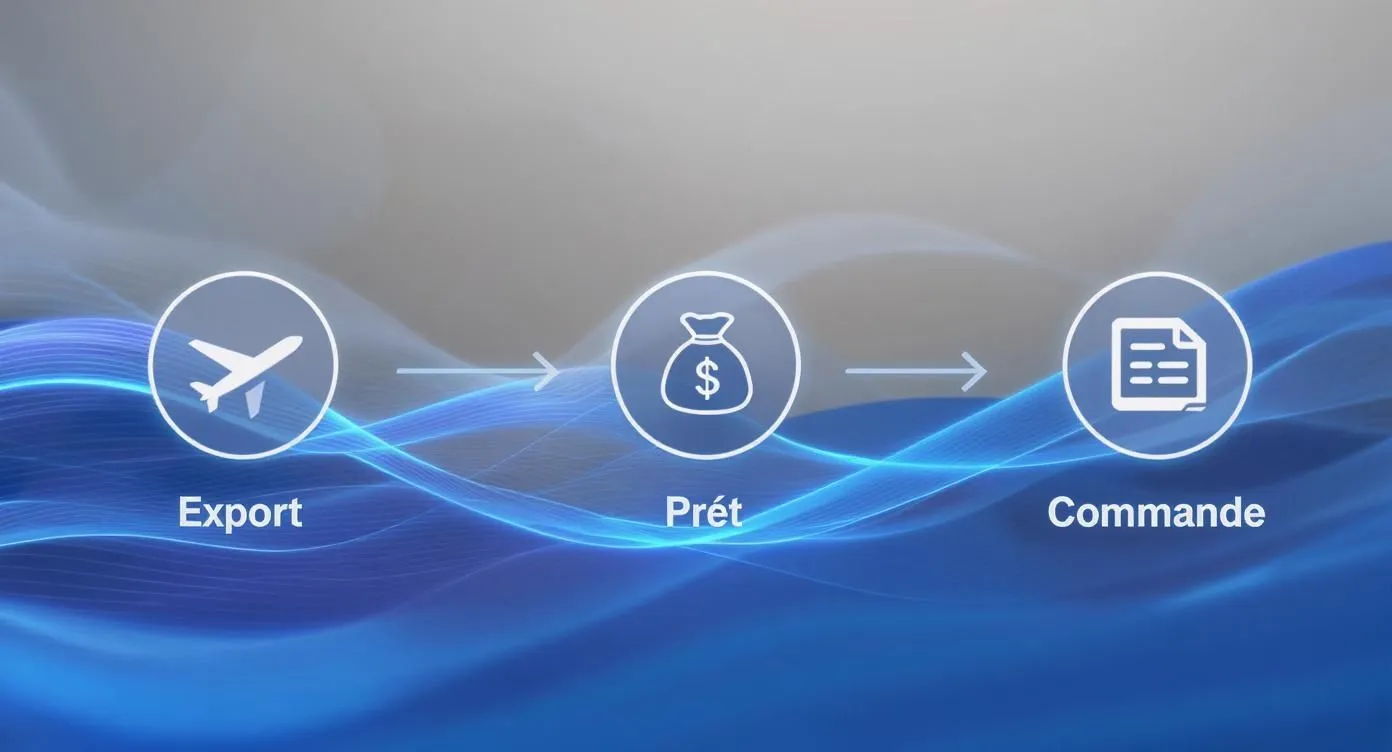
We clearly see its crucial role in various operations such as exports, a financing request, or simply confirming an order.
A step ahead on mandatory e-invoicing
Going digital with your proformas is no longer just a matter of productivity. It’s a smart way to get ahead of the future. The major e-invoicing reform is coming, and it will require electronic invoice exchange between all companies in France.
Even though the proforma isn’t an invoice in the accounting sense, it’s part of the same ecosystem. The tools that help you create proformas today will be the ones managing your electronic invoices tomorrow.
The shift has actually already begun. Did you know that nearly 31% of French companies already use structured electronic invoices? That figure climbs to 54% for companies with more than 250 employees. This is no longer a niche — it’s a genuine long-term trend.
By equipping yourself now, you’re getting ahead of the curve. You ensure you’re ready for this transition, smoothly and without last-minute stress. To simplify all this management, take a look at the benefits of online invoicing software.
Your questions, our answers on the proforma invoice
To wrap things up, let’s go through the questions that come up most often in the field. The goal is to clear up any remaining doubts so you can handle the proforma with confidence.
What is the legal value of a proforma invoice?
Let’s be clear: a proforma invoice has no legal or accounting value. It does not obligate the client to pay in any way and cannot serve as proof of a debt claim. It’s best seen as a highly detailed commercial proposal, a sort of “official draft” of what the final invoice will be.
Its role is purely informational. It lays the groundwork for a future transaction, without a firm commitment.
The crucial point to remember is that the proforma never, ever replaces a final invoice. The latter is the official, legal, and tax document — the one that triggers the payment obligation and belongs in your accounting.
Can a proforma invoice be modified or canceled?
Yes, of course! It’s even one of its main advantages. Since it’s not a binding document, you can modify or cancel it at any time.
Ideally, any change is made by mutual agreement with your client. If quantities, prices, or timelines change, it’s even recommended to issue a new, updated version. This is good practice to make sure everyone is on the same page before moving forward with the real deal.
Does a proforma invoice need to be numbered?
The law doesn’t require it, unlike standard invoices, which must follow an unbroken chronological sequence. That said, I strongly recommend giving each proforma invoice example a unique number.
It’s a simple habit that will greatly ease your internal tracking. It lets you link it to a quote, a purchase order, and avoid getting lost in your files.
And what about e-invoicing in all this?
Even though the proforma isn’t a “real” invoice, it’s directly affected by the digitalization of exchanges. The major e-invoicing reform, set for September 1, 2026, will shake up our habits. It’s really important to prepare for it, as non-compliance penalties can reach up to €75,000. To dig deeper into the topic, the best resource is the official information on the French administration’s portal.
Good invoicing software is already ready. It lets you create a proforma, then turn it into an electronic invoice (in Factur-X format, for example) in one click. This bridge ensures a seamless continuity between sales and accounting, and guarantees you’ll be compliant on day one, without the stress.
Ready to create your proforma invoices without the hassle and approach the digital transition with peace of mind? With Bizyness, you can generate professional documents in a few clicks, convert them into compliant invoices, and automate a good part of your management. Discover how Bizyness can save you time starting today.
