

 Français
6 Proforma Invoice Examples for 2025 — Complete Guide
Discover 6 proforma invoice examples to simplify your processes in 2025. Download our easy-to-use proforma invoice templates.
A proforma invoice is much more than a simple quote. It is a fundamental commercial document that establishes a sales intention, secures transactions, and clarifies expectations between seller and buyer before any financial commitment. Often seen as a formality, it actually plays a crucial role in international trade, complex service delivery, and large-scale project planning.
This document sets the terms of a future transaction: description of goods or services, price, quantity, and delivery conditions, all without the accounting and legal value of a final invoice. Its main purpose is to inform the client of the precise details of the offer so they can, for example, obtain financing or an import authorization.
This guide aims to present 6 concrete examples. For each proforma invoice example, we will analyze in detail the structure, mandatory information, and key elements specific to different sectors, from international goods sales to software project management. You will discover how each template addresses precise needs and how tools like Bizyness can radically simplify their creation and management. Get ready to turn your invoicing process into a genuine strategic asset.
1. Proforma Invoice Example for International Trade
The proforma invoice for international trade is a fundamental document that acts as a detailed commercial offer and official quote before goods are shipped abroad. Unlike a final commercial invoice, it does not require immediate payment. Its role is to give the buyer a precise and complete cost estimate, allowing them to arrange financing, obtain the necessary import licenses, and prepare customs clearance.
This type of document is essential for cross-border transactions, as it aligns expectations between exporter and importer on crucial points such as product specifications, prices, currency, shipping terms, and each party’s responsibilities. This is a proforma invoice example that minimizes the risk of costly misunderstandings.
When and why to use it?
Use this template from the very start of negotiations with an international client. It is particularly crucial for:
- Clarifying costs: It details not only the product price, but also shipping fees, insurance, and an estimate of customs duties.
- Facilitating customs clearance: Customs authorities use it to assess the value of goods and calculate applicable taxes.
- Obtaining financing: Banks and financial institutions often require it to approve letters of credit or other forms of trade financing.
- Securing the transaction: By clearly defining the terms, it prevents potential disputes related to delivery or payment.
Analysis of key elements
To be effective, an international proforma invoice must include specific information. The visual summary below highlights the three pillars of a successful proforma invoice for export.
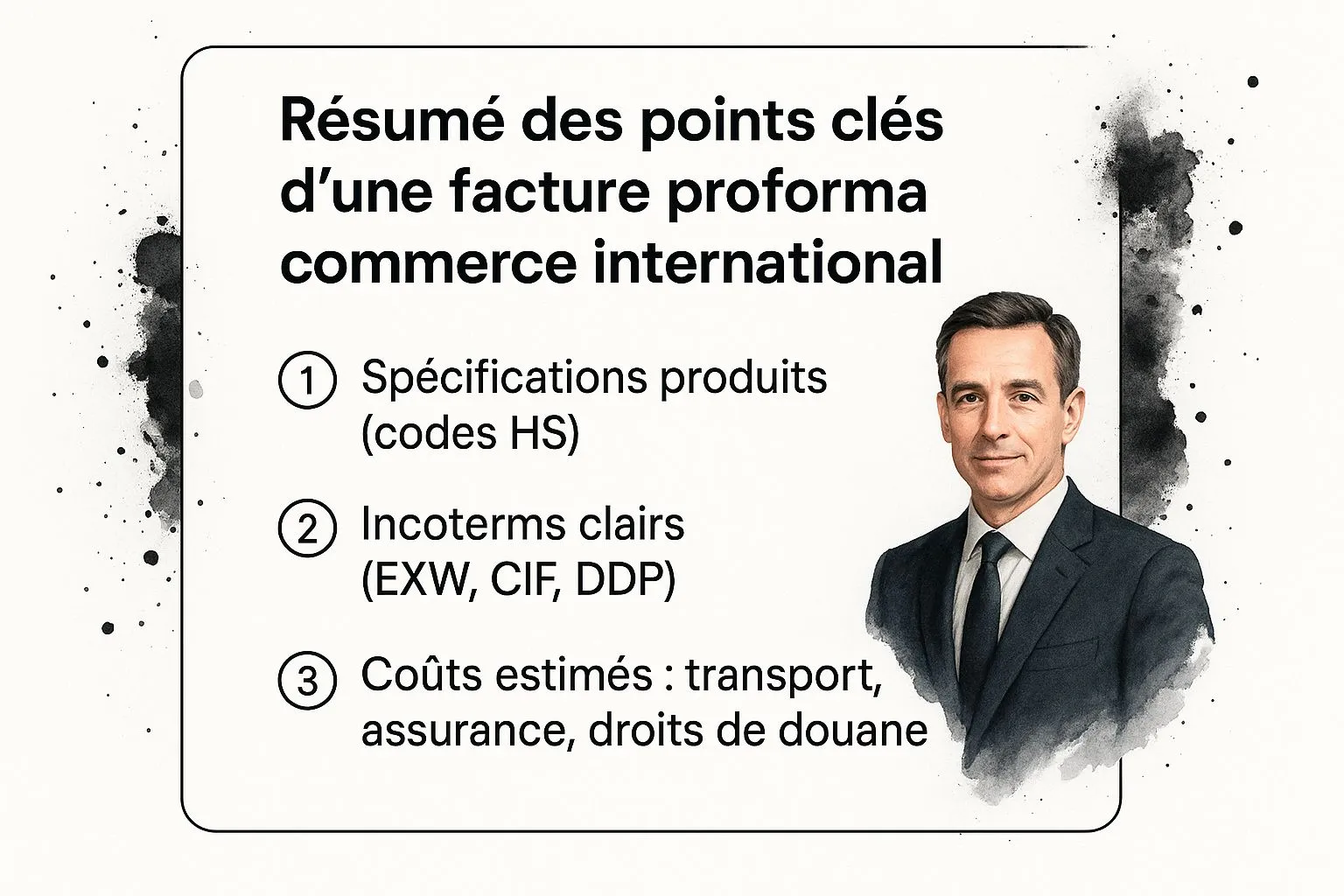
These elements are non-negotiable to ensure a smooth transaction and avoid unexpected delays or costs at customs.
Strategic tips and key takeaways
To optimize your international proforma invoices:
- HS Codes (Harmonized System): Always indicate the correct HS code for each product. A classification error can lead to customs penalties and significant delays.
- Incoterms® 2020: Specify the applicable Incoterm (for example, EXW, FOB, CIF, DDP). This unambiguously defines who pays for shipping and insurance costs, and at what point the risk transfers from shipper to recipient.
- Offer validity: Mention an expiration date for your offer. Exchange rates and shipping costs can fluctuate, so it’s essential to protect your margin.
- Language and currency: Write the document in a language understood by your client (English is often the standard) and clearly state the transaction currency to avoid any confusion.
2. Proforma Invoice Example for a Service Delivery
The proforma invoice for a service delivery is an essential document for consultants, agencies, and freelancers. It acts as a detailed commercial proposal, describing the scope of work, expected deliverables, timelines, and costs before the official start of the assignment. Unlike a standard quote, it formalizes the offer by adopting a structure almost identical to that of a final invoice.
This document is crucial for building trust and clarity. It allows the client to understand precisely what they are paying for and the provider to define the boundaries of their engagement. This is a proforma invoice example that turns a discussion into a clear agreement in principle, laying the groundwork for a successful professional collaboration.
When and why to use it?
Use this template for any assignment before signing a formal contract. It is particularly useful for:
- Defining the project scope: It breaks down complex services into clear phases or deliverables, thereby avoiding “scope creep.”
- Validating a budget: It gives the client a precise, structured cost estimate, which is essential for their internal budget approval process.
- Aligning expectations: By listing assumptions, exclusions, and limits (for example, the number of revisions), it prevents misunderstandings.
- Serving as a basis for the contract: The terms agreed upon in the proforma invoice are often carried over directly into the service agreement.
Analysis of key elements
An effective service proforma invoice relies on clarity and precision. It should go beyond simple pricing lines to detail the value delivered. The crucial elements are the breakdown of services, the projected schedule, and the payment terms.
- Service breakdown: Each service should be described with action verbs (e.g., “Design of 5 visuals,” “Writing of 10 SEO-optimized articles”).
- Delivery schedule: Link each deliverable to an estimated delivery date or week.
- Payment terms: Clearly specify the deposit required to start the assignment and the following payment deadlines, often tied to milestone completion.
This information turns a simple offer into a genuine action plan for your client. For sole traders, mastering this document is a mark of professionalism; to learn more about managing invoicing as a sole trader, dedicated resources are available.
Strategic tips and key takeaways
To make your service proforma invoices genuine conversion tools:
- Break it down by phases: Divide complex projects into logical phases (e.g., Phase 1: Audit and Strategy, Phase 2: Creation, Phase 3: Deployment). This makes the offer easier to digest and better justifies the overall price.
- Include “exclusions”: Explicitly state what is not included in the offer (e.g., “Font purchases,” “Advertising campaign costs”). This prevents out-of-scope requests.
- Specify limits: Indicate the number of revision cycles included for each deliverable. Mention the hourly or flat rate for any additional change requests.
- Define payment terms: Clearly state the deposit amount (often 30% or 50%) needed to secure your schedule and start work. Also indicate the payment deadline for the balance.
3. Proforma Invoice Example for Custom Manufacturing
The proforma invoice for manufacturing is an essential technical and commercial document used by manufacturers to detail the costs associated with producing custom products. More than a simple quote, it breaks down the various expense items: raw materials, labor, specific tooling, and production timelines. This document gives the client full transparency into the manufacturing process and cost structure.
This type of invoice is fundamental in industry, as it establishes a clear contractual basis before significant investments in materials or tooling development are made. This is a proforma invoice example that secures the relationship between manufacturer and buyer, aligning expectations on precise technical specifications and financial commitments.
When and why to use it?
Use this template as soon as a client requests a quote for custom parts or a production run. It is particularly crucial for:
- Detailing production costs: It offers a full breakdown of expenses (materials, labor, tooling depreciation) to justify the final price.
- Validating technical specifications: It allows the client to confirm that all technical aspects, such as material quality or tolerances, are correct before launching production.
- Planning production: By indicating manufacturing and delivery timelines, it helps the buyer integrate the order into their own supply chain.
- Justifying investments: For orders requiring new tooling (molds, dies), the proforma invoice formalizes the client’s financial commitment to these initial costs.
Analysis of key elements
To be robust, a manufacturing proforma invoice must include specific technical and logistical information. These details are crucial to avoid misunderstandings and ensure the final product exactly matches the client’s expectations. Clarity on setup costs, minimum quantities, and material specifications is non-negotiable.
These elements structure a transparent and professional offer, building the trust essential for complex manufacturing projects.
Strategic tips and key takeaways
To optimize your manufacturing proforma invoices:
- Material specifications: Precisely state the quality, standard, or exact reference of the raw materials used (for example, “Aluminum 6061-T6” or “ABS-PC/V0 plastic”). This avoids any ambiguity about the final product’s performance.
- Tooling depreciation: Clarify how tooling costs are billed. Are they paid in full at the start of the project or amortized over a certain number of parts? This transparency is essential.
- Minimum order quantity (MOQ): Clearly state the minimum quantity required to launch production. This justifies the cost structure and helps the client plan their orders.
- Price revision clauses: For long-term contracts, consider including price indexation clauses based on fluctuations in raw material or energy costs to protect your margins.
4. Proforma Invoice Example for E-commerce
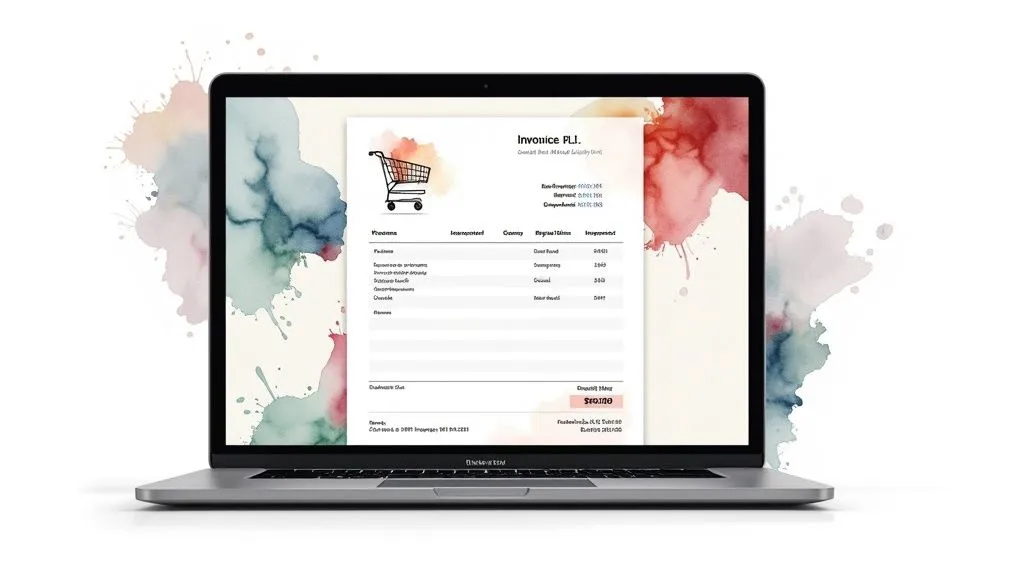
The proforma invoice for e-commerce is a digital version designed for online sellers, acting as a detailed purchase summary before payment is finalized. This modern document integrates directly into shopping carts and payment systems to streamline the customer experience. Unlike a standard invoice sent after payment, it gives the client a clear overview of products, delivery costs, and applicable taxes, encouraging them to confirm their order.
This type of document is essential for online stores, particularly in B2B, for customizable products, or for subscription services. This proforma invoice example turns a simple cart summary into an almost formal commercial offer, reinforcing trust and transparency before the financial commitment.
When and why to use it?
Use this template to formalize complex or high-value transactions directly on your e-commerce platform. It is particularly suited for:
- Validating bulk purchases (B2B): Allows business clients to receive a formal quote for internal approval before proceeding with payment.
- Configuring custom products: For items with multiple options, the proforma invoice confirms the exact configuration and final price before manufacturing.
- Managing subscriptions: Sends a detailed summary before a renewal or new subscription, clarifying the services included and the costs.
- Recovering abandoned carts: Can be sent automatically as a structured reminder, offering a clear summary and a direct link to complete the purchase.
Analysis of key elements
An effective e-commerce proforma invoice must be optimized for fast, clear digital interaction. It should merge transactional information with user-interface elements to guide the client toward action. The pillars of this document are clarity of information, ease of reading on mobile, and an obvious call to action to convert the proposal into a sale.
The success of this format, popularized by platforms like Shopify or Magento, relies on its ability to integrate natively into the customer journey, making the transition from product selection to payment as seamless as possible.
Strategic tips and key takeaways
To optimize your e-commerce proforma invoices:
- Mobile optimization: Make sure the design is fully responsive. Most clients will view the document on a smartphone, so it must be readable without zooming or excessive scrolling.
- Call-to-action (CTA) buttons: Include clearly visible buttons such as “Pay now,” “Confirm order,” or “Accept quote.” These CTAs should lead directly to a secure payment page to minimize friction.
- CRM integration: Connect proforma invoice generation to your customer relationship management (CRM) system. This enables automated tracking and personalized follow-ups for offers that haven’t converted.
- Dynamic personalization: Use client data to personalize the document. Including the client’s name, order history, or product recommendations can significantly increase conversion rates.
5. Proforma Invoice Example for Building and Construction
The proforma invoice in the building and construction sector is an essential forecasting document that details all costs, materials, labor, and stages of a project before work even begins. It acts as a comprehensive quote, giving the client a clear and transparent view of the financial and logistical scale of the site. This document is far more than a simple estimate; it is a commitment in principle that secures the relationship between contractor and client.
Unlike other sectors, a proforma invoice example for construction is complex, as it must anticipate the variables and unforeseen events specific to a building site. Its role is to formalize a detailed offer, allowing the client to obtain financing, plan their budget, and validate every aspect of the project before signing a final contract. It is the cornerstone of project management in construction.

When and why to use it?
This type of proforma invoice should be issued during the bidding phase for construction or renovation projects. It is essential for:
- Detailing the overall cost: It breaks down costs by category: materials, labor, equipment rental, building permits, etc.
- Securing financing: Banks almost always require it to grant a home improvement loan or mortgage.
- Defining the project scope: The document precisely lists the services included, avoiding “gray areas” and potential disputes.
- Planning deadlines: It can include a projected schedule of the various construction phases and associated payments.
Analysis of key elements
A construction proforma invoice must be meticulous to inspire trust and professionalism. Crucial elements include the cost breakdown by phase (structural work, second-fix work, finishing), precise material descriptions (brand, quality, reference), and a timeline estimate.
The goal is to leave no room for interpretation. This level of detail demonstrates the contractor’s expertise and allows the client to make an informed decision, understanding exactly what they are paying for. For professionals in the sector, using suitable construction invoicing software is often recommended to manage this complexity.
Strategic tips and key takeaways
To make your construction proforma invoices more effective:
- Breakdown by phases: Break down the total cost by major stages (e.g., Demolition, Masonry, Plumbing, Electrical). This makes tracking easier for the client and allows for staggered payments.
- Specify materials: Don’t just write “tile,” specify “Porcelain stoneware tile, brand X, model Y, dimensions 60x60 cm.” This avoids unpleasant surprises about quality.
- Include a contingency clause: Include a provision for unforeseen events (generally 5-10% of the total cost) to cover unexpected discoveries (e.g., an unplanned load-bearing wall, a moisture issue).
- Mention permits and administrative timelines: Specify the timeframes for obtaining building permits or authorizations, and note that the project schedule depends on them.
6. Proforma Invoice Example for a Software License
The proforma invoice for a software license is a crucial commercial document used by technology companies to detail a proposal before signing a formal contract. It acts as a binding quote that clarifies costs, license terms, associated services, and support options for solutions such as ERPs, SaaS applications, or other specialized software.
This document is far more than a simple price estimate. It allows the prospective client to understand the total investment (Total Cost of Ownership) by including all aspects of the deployment. For the vendor, this proforma invoice example formalizes the offer and serves as a basis for negotiation, ensuring both parties share a clear vision of the service before any contractual commitment.
When and why to use it?
This type of proforma invoice is essential as soon as a company considers acquiring or subscribing to a complex software solution. It is particularly useful for:
- Detailing the total cost: It breaks down costs between the subscription, implementation fees, data migration, and training.
- Clarifying license terms: The document specifies the number of users, access levels, and the length of the commitment.
- Facilitating the budget decision: It gives financial decision-makers a complete view for budget approval and expense planning.
- Serving as a basis for the contract: The elements defined in the proforma are often carried over into the final service contract (SLA).
Analysis of key elements
A software proforma invoice must be exceptionally precise to avoid any ambiguity. It should clearly break down the value proposition into several distinct components.
- License details: Specify the type of license (for example, per user, per seat, usage-based), the number of units, and the unit price. Scalability options (adding future users) should also be mentioned.
- Professional services: This section should list all one-off services such as installation, customization, integration with other systems, and data migration. Each service should be priced separately.
- Support and maintenance: It is essential to describe the different support tiers (for example, Standard, Premium, 24/7), what they include (updates, technical assistance), and their annual or monthly cost.
Strategic tips and key takeaways
To make your software proforma invoices more effective and professional:
- Define user types: Clearly distinguish between the different access levels (for example, administrator, standard user, read-only) and assign a cost to each type.
- Present scalability options: Show the client how pricing can evolve as they grow. Include pricing tiers for larger user volumes.
- Be transparent about one-off costs: Clearly separate recurring fees (subscriptions) from one-time fees (implementation, training). This helps the client better understand their initial investment.
- Specify the validity period: As with any commercial offer, set a deadline for your proposal to protect yourself against changes in pricing or project scope.
For optimal management of this type of document, check out our tips on invoicing for IT companies.
Comparison of the 6 types of proforma invoice
| Type of Proforma Invoice | 🔄 Implementation Complexity | 💡 Resources Required | 📊 Expected Results | 🎯 Ideal Use Case | ⭐ Key Benefits |
|---|---|---|---|---|---|
| International Trade Proforma Invoice | Medium to High (international regulations) | HS code and Incoterms expertise, translation | Facilitates customs and total cost calculation | Exporters (electronics, agriculture, automotive) | Reduces disputes and facilitates import licenses |
| Service Proforma Invoice | Medium (project management and phases) | Detailed service description, time management | Defines scope and avoids disputes | Marketing agencies, IT consultants, law firms | Clarifies expectations and budget, builds client trust |
| Manufacturing Proforma Invoice | High (detailed costs, complex calculations) | Material, labor, tooling details | Cost transparency and supply chain planning | Plastic injection, metalworking, electronics manufacturers | Informed decisions, optimized planning |
| E-commerce Proforma Invoice | Medium to High (technical integration) | Platform integration, tax and shipping calculations | Reduces cart abandonment and improves conversion | E-commerce platforms, B2B marketplaces, subscriptions | Simplifies payments and price transparency |
| Construction Proforma Invoice | High (multiple costs and variables) | Materials, labor, permit management | Full cost visibility and financing | Residential building, commercial projects, infrastructure | Protects against overruns, secures financing |
| Software License Proforma Invoice | Medium to High (complex license structures) | License, support, and integration definition | Clarifies total costs and IT budget plan | Software vendors, SaaS, vertical suppliers | Supports purchasing decisions and IT cost management |
Summary: Make the Proforma Invoice Your Best Commercial Ally
Throughout this article, we have explored six distinct facets of the proforma invoice, demonstrating that it is much more than a simple estimate. Whether navigating customs complexities, scoping a service project, detailing a complex manufacturing process, or selling a software solution, the proforma proves to be an essential strategic tool.
Its true strength lies in its ability to establish clarity from the outset. It manages client expectations, secures both parties, and builds a solid foundation of trust even before the first financial transaction takes place. It is your first formal commitment, a promise of value and professionalism.
Key Lessons from the Examples Analyzed
Each proforma invoice example analyzed highlighted a fundamental principle: a successful proforma is one that is precise, transparent, and perfectly suited to its context.
- For international trade, the accuracy of HS codes and Incoterms is non-negotiable to avoid customs holdups.
- For services, detailing deliverables and timelines prevents misunderstandings and scope creep.
- For manufacturing, breaking down material and labor costs demonstrates a firm grasp of your production chain.
- For software, clarity on license terms and support levels justifies the value of your solution.
The key is to stop viewing it as a burdensome administrative task. See it instead as an opportunity for proactive communication, a chance to demonstrate your expertise and reassure your client about their choice to work with you.
Strategic point: The proforma invoice is not the end of a negotiation, but the beginning of a transparent collaboration. It turns a commercial discussion into a clear, documented agreement in principle, reducing future friction.
From Theory to Effective Action
To apply these strategies without spending excessive time, using the right tool is essential. This is where technology becomes your best ally. Modern invoicing software can automate the creation, customization, and tracking of these crucial documents.
Bizyness was designed specifically to meet the needs of entrepreneurs, freelancers, and small businesses in France. It lets you generate, in just a few clicks, each of the proforma invoice types we’ve covered, while guaranteeing legal compliance. By automating document creation and making it easy to convert them into final invoices, Bizyness frees up valuable time. This lets you focus on your core business: growing your activity, all while having the assurance of flawless commercial and financial management.
Adopt the best practices we’ve detailed, choose the right tools, and turn every proforma invoice example into a solid step toward the success of your projects.
Ready to create professional, compliant proforma invoices effortlessly? Discover how Bizyness can automate your commercial management, from proforma to final invoice. Try our solution today to simplify your administration and strengthen your clients’ trust: Bizyness.
