

 Français
 6 Effective Prospecting Plan Examples for 2025
Discover 6 prospecting plan examples to boost your sales. Adapt our concrete strategies with this effective prospecting plan example.

Building an effective sales prospecting strategy is often seen as a complex task, reserved for large sales teams. Yet whether you’re a freelancer, running a small business, or leading a fast-growing startup, structure is the key to success. A well-defined plan turns scattered actions into a machine that generates qualified leads. The goal isn’t to find a single rigid template, but to understand the core mechanics driving the best-performing strategies so you can build your own.
This article goes beyond theory by offering a detailed analysis of several concrete prospecting plan examples. For each model, we’ll break down the underlying strategy, the specific tactics to implement, and the results you can expect. You’ll discover a range of approaches, from content marketing (Inbound) and Social Selling on LinkedIn to Account-Based Marketing (ABM) for high-value targets. The idea is to give you clear, adaptable frameworks so you can choose, combine, and customize the methods that truly fit your business, your resources, and your growth goals.
1. BANT Prospecting Plan (Budget, Authority, Need, Timeline)
The BANT model is one of the pillars of lead qualification. Developed by IBM in the 1950s, this structured framework remains an excellent prospecting plan example for sales teams looking to prioritize their efforts and focus resources on the most promising opportunities. It allows quick filtering of leads based on four fundamental criteria.
The BANT approach evaluates a prospect based on:
- Budget: Does the prospect have the financial means to buy your solution?
- Authority: Does the person you’re talking to have the power to make the purchasing decision?
- Need: Does the prospect have a real, clearly identified need that your product or service can address?
- Timeline: What is their timeframe for implementing a solution?
By answering these questions, a salesperson can quickly assess a lead’s maturity and decide whether it deserves immediate attention or should be placed into a longer-term nurturing cycle.
Strategic analysis and application
BANT’s effectiveness lies in its simplicity and its ability to structure the discovery conversation. Instead of an unguided discussion, the salesperson follows a logical thread to qualify the prospect.
Key strategic point: BANT is not a rigid checklist to follow in order. A good salesperson weaves these questions naturally into the conversation to build trust while gathering critical information.
Giants like Microsoft and Salesforce have built adapted versions of BANT into their CRM processes, proving its lasting relevance. For a small business or freelancer, the application is even more direct: it prevents wasting time on prospects who aren’t ready to buy.
The infographic below visualizes the BANT qualification flow, showing how each criterion progressively filters prospects to identify the most qualified ones.
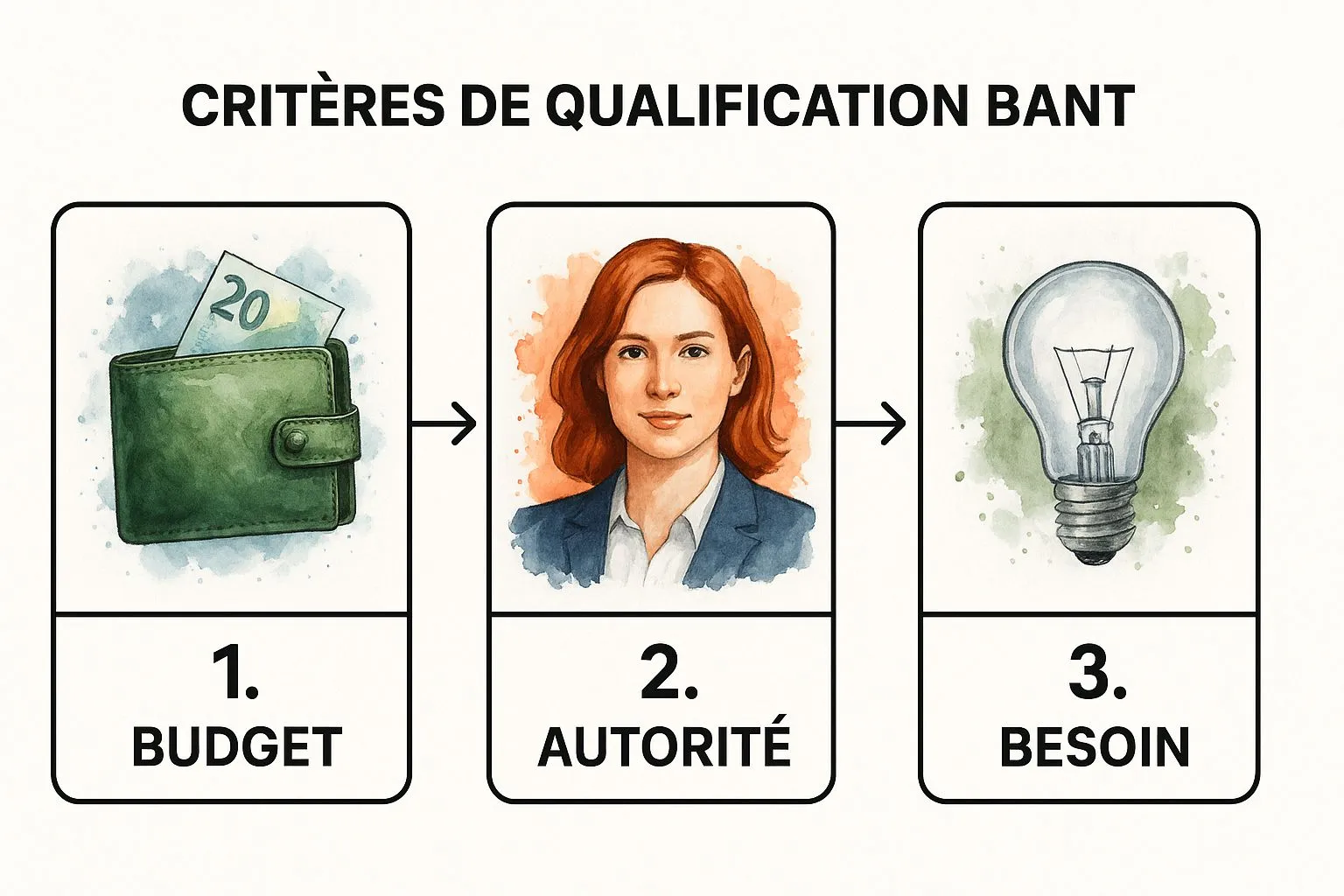
This diagram illustrates that qualification is a sequential process, where each step refines the understanding of the prospect’s commercial potential.
Practical tips for implementing BANT
To get the most out of this model, here are some concrete actions:
- Adapt the criteria: Define what “sufficient budget” or “short timeline” means for your business. A 6-month project might be “short” for a complex solution but “long” for a standard product.
- Train your team: Coach salespeople to ask open-ended questions to uncover BANT information. For example, instead of “Do you have the budget?”, ask “How are projects like this usually funded at your company?”.
- Use a CRM: Create custom fields in your CRM to track each BANT criterion. This lets you score leads and prioritize them automatically. This method also helps refine your sales forecasting techniques.
2. Inbound Marketing Prospecting Plan
Unlike traditional methods that push a message toward the customer (outbound), the Inbound Marketing prospecting plan aims to naturally attract prospects to the company. This strategy relies on creating valuable content that answers the questions and needs of your target audience. It’s an excellent prospecting plan example for companies looking to build sustainable growth and generate qualified leads continuously.
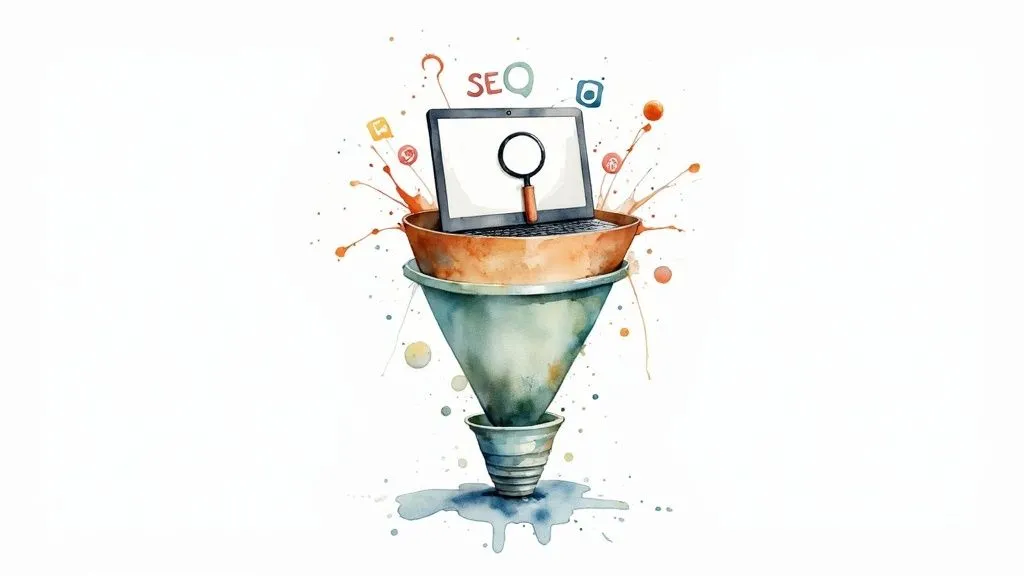
The Inbound Marketing approach is built around four key stages:
- Attract: Capture the attention of qualified visitors through blog posts, SEO, and social media.
- Convert: Turn these visitors into leads by offering premium content (white papers, webinars) in exchange for their contact details.
- Close: Turn leads into customers through lead nurturing, emailing, and marketing automation.
- Delight: Turn customers into brand ambassadors through exceptional service and personalized content.
This methodology, popularized by pioneers like Brian Halligan (HubSpot) and Seth Godin, builds a relationship of trust with prospects even before the first sales contact.
Strategic analysis and application
Inbound’s effectiveness lies in its ability to reverse the sales dynamic: customers come to you. This positions your company as an authority in its field and considerably reduces friction in the sales cycle. Prospects are already educated and interested in your solutions by the time they contact the sales team.
Key strategic point: The success of Inbound Marketing depends on perfect alignment between the content created and the real pain points of your “buyer personas.” Generic content will only attract unqualified traffic.
Companies like HubSpot built their empire on this strategy, offering a wealth of free resources to attract their target audience. Similarly, Shopify uses an extremely rich blog to capture e-commerce entrepreneurs long before they choose a platform. To strengthen the effectiveness of your Inbound Marketing strategy and turn visitors into qualified prospects, integrating well-designed lead capture forms is essential.
Practical tips for implementing Inbound Marketing
To roll out an effective inbound strategy, here are some concrete actions:
- Build detailed buyer personas: Go beyond demographic data. Understand their goals, challenges, and motivations to create content that truly resonates.
- Build an editorial calendar: Plan your content production (articles, videos, podcasts) over several months to ensure consistency and cover every stage of the customer journey.
- Optimize your conversion funnel: Every piece of content should have a clear goal, whether it’s subscribing to a newsletter, downloading an e-book, or requesting a demo. Analyze and optimize every touchpoint.
- Align marketing and sales teams: Marketing generates leads, sales converts them. Smooth communication and shared goals (SLA - Service Level Agreement) are essential to maximize ROI.
3. Referral Program Prospecting Plan
The referral prospecting plan is a powerful strategy that turns your satisfied customers and partners into a proactive sales force. This approach capitalizes on trust — the most powerful lever in business — to generate a steady stream of highly qualified prospects. It’s a prospecting plan example that’s particularly effective because it leverages existing networks to attract leads already pre-convinced by a personal recommendation.

The idea is simple: structure and encourage word of mouth. Instead of passively waiting for customers to recommend you, you set up an incentive system that actively motivates them to do so. Prospects from this channel often have a higher conversion rate and a lower acquisition cost.
This plan rests on three pillars:
- Identification: Spot the customers, partners, or influencers most likely to become effective ambassadors.
- Incentive: Offer a clear, attractive reward (discount, commission, gift) for each qualified prospect or converted customer.
- Simplification: Make the referral process as simple as possible, often via a unique link or dedicated form.
By systematizing referrals, you create a predictable, profitable growth source fueled by your biggest fans.
Strategic analysis and application
The major advantage of referral prospecting is that it short-circuits initial skepticism. A referred prospect arrives with a positive bias, which considerably shortens the sales cycle. Companies like Dropbox built their explosive growth on this model, offering extra storage space for every friend referred.
Key strategic point: The value of referrals lies not only in acquiring new customers but also in retaining ambassadors. By rewarding and valuing your referrers, you strengthen their loyalty and engagement with your brand.
American Express’s program, which has existed for decades, or Tesla’s, which reportedly generates a significant share of its sales through this channel, prove that this strategy is durable and adaptable to every sector, from SaaS to luxury goods. For a freelancer or small business, it’s a low-cost way to compete with larger players by leveraging service quality.
Practical tips for implementing a referral program
To launch an effective referral program, follow these steps:
- Identify your ambassadors: Don’t just solicit all your customers. Target those who have expressed high satisfaction (via NPS surveys, positive reviews) or who have already recommended your business spontaneously.
- Create attractive incentives: The reward must be motivating for the referrer and profitable for you. It can be monetary (commission), non-monetary (exclusive access, free product), or two-sided (a reward for the referrer and a discount for the referred person).
- Simplify the process as much as possible: Give your ambassadors a unique referral link, pre-written messages to share, and a dashboard to track their rewards. The less friction, the higher the participation rate.
- Communicate and thank: Actively promote your program to your customers. Above all, systematically thank every referrer, even if the referred prospect doesn’t convert. Recognition is a powerful motivator.
4. ABM (Account-Based Marketing) Prospecting Plan
Account-Based Marketing (ABM) flips the traditional prospecting model. Instead of casting a wide net to catch many leads (the classic funnel), ABM focuses on a limited number of high-value strategic accounts, treated as markets in their own right. This prospecting plan example is a surgical approach where marketing and sales teams collaborate closely to create fully personalized campaigns for each target account.

ABM involves:
- Identifying: Selecting high-potential target accounts based on precise criteria (industry, size, revenue, growth potential).
- Personalizing: Developing messages, content, and offers specific to the unique challenges of each account.
- Engaging: Deploying coordinated multichannel campaigns to reach key decision-makers within those accounts.
- Measuring: Tracking engagement at the account level rather than the individual lead level, focusing on metrics like account coverage and pipeline velocity.
Strategic analysis and application
ABM is particularly effective for B2B companies with long, complex sales cycles and high customer value. It’s about shifting from a volume logic to a value logic, maximizing the return on prospecting efforts.
Key strategic point: ABM’s success relies on perfect alignment between marketing and sales teams (“Smarketing”). Both must collaborate on account selection, content creation, and campaign orchestration to present a unified front to the prospect.
Companies like Adobe use ABM to target large retailers with personalized solutions, while Salesforce tailors its demos and proposals to the specific industries of its strategic accounts. For an SME or a high-end service provider, this method allows limited resources to be focused on the most lucrative opportunities.
Practical tips for implementing ABM
To set up an effective ABM strategy, follow these concrete steps:
- Rigorously select your accounts: Define your ideal customer profile (ICP) and choose a small number of accounts (between 10 and 50 to start) that fit perfectly. Involve sales in this selection.
- Create tailor-made content: Don’t just slap a logo on a presentation. Conduct in-depth research into the account’s challenges and create case studies, webinars, or white papers that speak directly to their issues.
- Involve all internal stakeholders: ABM prospecting isn’t just a sales matter. Marketing, customer service, and even leadership can be mobilized to create a coherent, personalized customer experience.
- Measure overall account engagement: Use tools to track how different contacts within the same account interact with your content. The goal isn’t to convert a single lead, but to move the entire account forward in the sales cycle.
5. Social Selling Prospecting Plan
Social selling is a modern approach that turns professional social networks, primarily LinkedIn, into a powerful prospecting lever. This prospecting plan example doesn’t rely on aggressive selling, but on building authentic relationships and sharing high-value content. The goal is to establish credibility and become a trusted resource for prospects even before initiating a sales conversation.
The social selling approach is built around four pillars:
- Build a professional brand: Optimize your profile to attract and reassure prospects.
- Identify the right people: Use search tools to precisely target decision-makers.
- Exchange insights: Share relevant content to engage your community and demonstrate your expertise.
- Build trusted relationships: Interact in a personalized, authentic way to build a lasting rapport.
This method reverses the traditional paradigm: instead of “pushing” a product, the salesperson “attracts” customers by positioning themselves as an expert solving their problems.
Strategic analysis and application
The effectiveness of social selling rests on authenticity and patience. It’s a marathon, not a sprint. The key is to build an online presence that inspires trust and competence. Companies like Adobe and Oracle understand this well, training their sales teams to use LinkedIn not as a directory, but as a platform for dialogue and influence.
Key strategic point: Social selling isn’t simply broadcasting promotional messages. The most effective strategy is to apply the 80/20 rule: 80% useful content for your audience (advice, analysis, trends) and only 20% content directly tied to your offers.
This approach is particularly relevant in complex B2B sectors where sales cycles are long and trust-based. To deepen your mastery, it’s worth exploring various social selling strategies for B2B sales to adapt your plan to your specific market.
Practical tips for implementing social selling
To effectively integrate social selling into your routine, here are some concrete actions:
- Optimize your LinkedIn profile: Your profile isn’t a resume, it’s a sales page. Use a professional banner, a quality photo, and a headline that clearly explains the value you bring to your clients.
- Share valuable content: Regularly publish articles, case studies, or analyses that address your audience’s pain points. Engage with others’ posts to gain visibility.
- Personalize every approach: Forget generic connection messages. Mention a recent post, a shared interest, or a mutual contact to show you’ve done your homework.
- Use the tools available to you: Tools like LinkedIn Sales Navigator enable ultra-targeted prospect searches and efficient interaction tracking. For independents, these methods are crucial for knowing how to find clients as a freelancer.
6. Automated Email Marketing Prospecting Plan
The automated email marketing prospecting plan is a powerful strategy that uses email sequences to guide prospects through the conversion funnel without constant manual intervention. This prospecting plan example combines volume, personalization at scale, and nurturing to turn cold contacts into qualified customers. It’s particularly effective for companies managing a large number of leads and looking to optimize their sales team’s time.
The automated email approach relies on:
- Segmentation: Dividing your audience into homogeneous groups based on their behavior, demographics, or interests.
- Personalization: Using collected data to send relevant, specific messages to each segment.
- Triggers: Automatically sending emails in response to a specific prospect action (e.g., downloading a white paper, visiting a pricing page).
- Nurturing: “Nurturing” prospects with valuable content to mature them and prepare them for purchase.
By creating predefined scenarios (workflows), this method ensures consistent, relevant follow-up for each prospect, increasing the chances of conversion.
Strategic analysis and application
The effectiveness of this plan lies in its ability to maintain a relationship with hundreds or thousands of prospects simultaneously, delivering the right message at the right time. Platforms like ActiveCampaign or ConvertKit built their success on this approach, showing how automation can generate predictable growth.
Key strategic point: The success of automation doesn’t lie in mass-sending generic emails, but in creating hyper-personalized journeys. The quality of segmentation and the relevance of content matter more than the technology itself.
For freelancers or small businesses, automated email lets you compete with larger companies by building a prospecting machine that works 24/7. This frees up valuable time that can be reinvested in closing sales or delivering services. To fully master this approach, Cold Email Automation strategies are essential for improving response rates.
Practical tips for implementing automated email
To roll out an effective email prospecting plan, follow these steps:
- Finely segment your audiences: Don’t settle for a single list. Create segments based on lead source, engagement level, or the pages visited on your site.
- Continuously test and optimize: Set up A/B tests on your subject lines, calls to action (CTAs), and content to identify what resonates best with each segment.
- Clean your lists regularly: Remove inactive contacts or invalid addresses to maintain a good deliverability rate and protect your sender reputation.
- Comply with GDPR: Make sure you’ve obtained explicit consent from your contacts and offer a clear, simple opt-out option in every email.
- Integrate with your CRM: Connect your emailing tool to your CRM to automatically surface the “hottest” leads to your sales team and avoid having to automate administrative tasks manually.
Comparison of the 6 prospecting plans
| Prospecting Method | 🔄 Implementation Complexity | 💡 Resources Required | ⭐ Expected Results | 📊 Ideal Use Case | ⚡ Key Advantages |
|---|---|---|---|---|---|
| BANT Prospecting Plan | Structured, rigid process | Sales training, CRM for scoring | Precise qualification, optimized conversion rate | Complex B2B sales, enterprise solutions | Efficient prioritization, shorter sales cycle |
| Inbound Marketing Prospecting Plan | Complex, requires long-term investment | Content creation, SEO technical skills | Continuous qualified leads, measurable ROI | Digital ecosystems, organic growth | Low acquisition cost, high scalability |
| Referral Prospecting Plan | Simple to moderate, requires rigorous follow-up | Incentive program, tracking tools | Very high conversion rate, stable prospect flow | Satisfied customers, trusted networks | High conversion, potential viral effect |
| ABM Prospecting Plan | Very complex, requires strong coordination | Marketing/sales resources, qualitative data | High ROI on large accounts, shortened cycles | Large high-value accounts (>€100K) | Deep personalization, team alignment |
| Social Selling Prospecting Plan | Moderate, often time-consuming without automation | Social network management, social CRM | Direct engagement, access to decision-makers | Professional social networks (especially LinkedIn) | Lower cost, advanced research, authentic relationship |
| Automated Email Marketing Prospecting Plan | Medium complexity, automation required | Segmentation, CRM, email automation tools | Significant scalability, mass personalization | Large-scale prospecting | Competitive cost per lead, precise measurability |
Conclusion: How to Combine These Examples to Create Your Ideal Prospecting Plan
At the end of this detailed analysis of several approaches, it’s clear that there’s no single prospecting plan example universally superior to the others. The real strength lies in your ability to select, combine, and adapt elements from each strategy to build a tailor-made prospecting machine, perfectly aligned with your offer, your market, and your resources. The examples we’ve broken down, from BANT to Social Selling, aren’t rigid roadmaps, but rather a strategic toolbox.
The common thread running through all these high-performing models is a deep understanding of the ideal customer. Whether you adopt the surgical precision of ABM for high-value accounts or the magnetic approach of Inbound Marketing to attract a broad audience, success depends on the relevance of your message and the timing of your outreach. Modern prospecting is no longer a matter of volume, but of value and relevance.
Summary of Strategies and Possible Synergies
To turn these concepts into action, consider how these strategies can reinforce one another. A hybrid plan is often the most effective solution.
- Inbound + Social Selling: Use your Inbound content (blog posts, case studies) as fuel for your LinkedIn conversations. Share a useful resource to spark a dialogue, rather than reaching out directly to pitch.
- ABM + Automated Emailing: Once your key accounts are identified through ABM, deploy ultra-personalized email sequences for each decision-maker within the target company. Automation ensures consistency, while ABM personalization guarantees impact.
- BANT + Referral: Use the BANT method to qualify prospects coming from your referral program. This ensures that referrals, often warm, also correspond to a concrete, immediate business opportunity.
The goal isn’t to do everything, but to do the right things, consistently. Each prospecting plan example presented offers a unique philosophy: BANT focuses on qualification, Inbound on attraction, and ABM on focus. Your role is to become the architect of your own system.
Your Next Concrete Steps
Don’t let this article remain just a read. Put this knowledge into practice today by following these steps:
- Audit your current situation: What plan are you using, even informally? What’s working? What’s failing? Be honest.
- Choose a “pillar” strategy: Select the model that best fits your business. A B2B freelancer might favor Social Selling, while a SaaS software publisher might start with Inbound Marketing.
- Integrate an element from another strategy: Enhance your pillar plan. If you choose Inbound, add automated email sequences to better nurture your leads. If you go with ABM, use Social Selling techniques to connect with decision-makers.
- Define 3 KPIs (Key Performance Indicators): Measure what matters. This could be the number of qualified meetings, the conversion rate per channel, or the customer acquisition cost.
- Iterate and optimize: Your prospecting plan isn’t set in stone. Review your KPIs every month and don’t hesitate to adjust your approach based on results. Prospecting is a marathon, not a sprint. By mastering the art of combining these approaches, you’ll no longer just be looking for customers — you’ll be building a predictable, scalable system to fuel your company’s growth.
Once your prospects have become customers, the administrative work begins. To effectively turn your prospecting efforts into revenue without drowning in paperwork, a simple and powerful invoicing and management tool is essential. Bizyness lets you create professional quotes and invoices in just a few clicks, track your payments, and keep a clear view of your financial health, giving you more time for what you do best: growing your business.
