

 Français
Sales cycle: Optimize the sales cycle for your e-commerce business
Optimize every stage of the sales cycle for your e-commerce business: prospecting, conversion and retention, to boost growth and profitability.
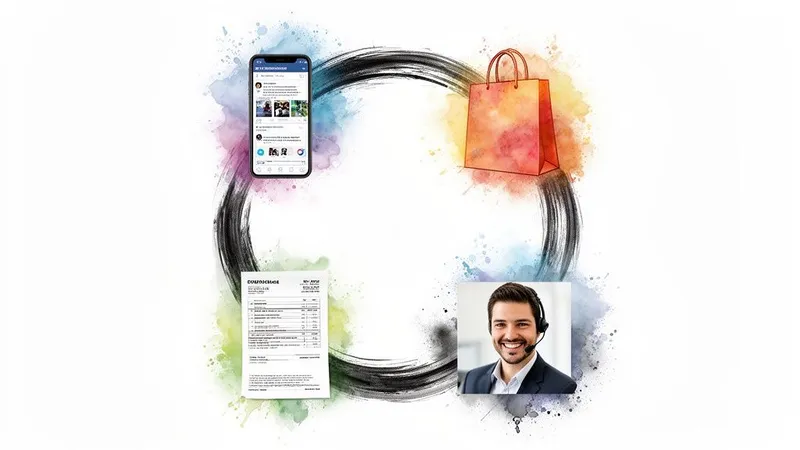
When people talk about the sales cycle in e-commerce, they often picture the moment a customer clicks “Buy”. But in reality, it’s much more than that. It’s the entire journey a simple visitor takes to become a loyal customer, from their very first interaction with your brand all the way to after-sales service. Think of it as a complete process that spans every touchpoint, from discovering a product to receiving its invoice.
Breaking down the e-commerce sales cycle
Your customer’s journey isn’t a straight line that stops dead after payment. Think of it instead as a loop, a virtuous circle that continuously feeds your business. That’s the heart of the sales cycle in e-commerce: an ecosystem where every stage is a chance to strengthen your business.
This cycle starts well before anyone adds an item to their cart. The very first step is raising awareness of your business and capturing the attention of potential customers. Whether through a well-targeted Instagram ad, a Google search, or word of mouth, this discovery phase is the starting point of the entire relationship.
What sets it apart from traditional sales
The e-commerce sales cycle is very different from its B2B cousin, which is often long and built on human relationships. Here, the rules of the game change radically:
- Speed: The purchase decision can be made in just a few minutes. A frictionless journey is therefore absolutely essential.
- Volume: You’re not managing a handful of customers, but hundreds, even thousands of transactions. Automation is no longer optional — it’s a necessity.
- Automation: Tasks like sending invoices or tracking orders need to run on their own to handle that kind of volume.
A sales cycle on a Shopify or Amazon store is therefore designed to be ultra-efficient and fast. Every click matters, and the slightest obstacle can derail a sale and lead to cart abandonment.
The e-commerce sales cycle is a continuous flow. It doesn’t stop at payment; it extends well beyond, through support, delivery tracking and returns management. That’s precisely when loyalty is earned.
This post-purchase stage is too often neglected. Yet clear order tracking, responsive customer service and a simple return policy are incredible assets for turning an occasional buyer into a loyal customer. To dig deeper into integrating administrative management into this journey, our guide on e-commerce accounting will give you some very useful pointers.
Ultimately, mastering your sales cycle means being able to spot every moment where you can make the customer experience better. From the ad that caught their attention to the invoice that lands in their inbox, every detail counts for your brand image and the financial health of your e-commerce business.
The key stages of the e-commerce customer journey
The sales cycle in e-commerce is a bit like a story where your customer is the hero. For that story to end well — for them and for you — you need to master every chapter. From the first spark of interest to the relationship that builds long after the purchase, every phase is a golden opportunity to improve the experience and strengthen your business.
This simple diagram perfectly sums up the three big moments of this journey: discovery, purchase, and everything that happens afterward.
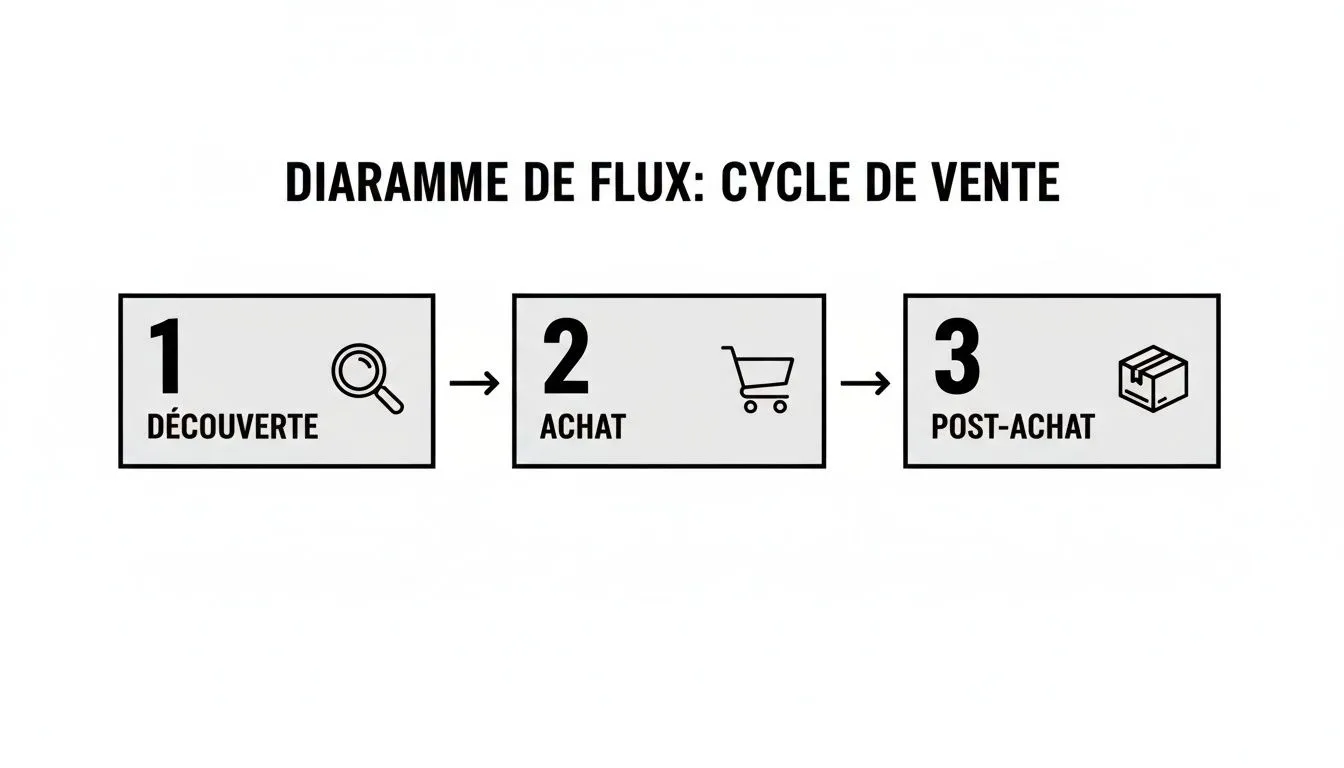
It’s clear the journey doesn’t stop at payment. In fact, it’s often what happens afterward that determines whether a customer stays loyal.
Stage 1: Discovery
It all starts here. At this stage, your future customer doesn’t know you and isn’t even looking for you. They’re browsing social media, scrolling through a blog, or watching videos. And then they stumble upon your product. Maybe through a well-targeted Facebook ad, an influencer post, or an article that ranks on Google.
The goal isn’t to sell at all costs, but to spark curiosity. It’s the “Hey, we exist, and we might have just what you need” moment. It’s a very fragile phase: one bad first impression, and the journey stops right there.
Stage 2: Consideration
The contact is made. Your prospect now knows you exist and shifts into active research mode. They’ll compare your offer to the competition, pore over customer reviews, and look for photos or videos showing the product “in real life”. They’re asking themselves: “Is this product right for me?” or “Can I trust this brand?”.
Your mission at this exact moment is to reassure them and help them picture themselves using it. Ultra-detailed product sheets, high-quality photos from every angle, and a well-thought-out FAQ are your best allies. Every positive review acts like a friend’s recommendation — and that changes everything.
Stage 3: Decision and payment
The moment of truth. Convinced, the prospect adds your product to their cart. The sales cycle reaches its peak. Watch out — this is where the slightest hiccup can derail everything. A checkout process that’s too long, shipping fees that appear at the last second, or a lack of payment options… and there’s an abandoned cart.
To convert that interest into a purchase, the experience needs to be as smooth as possible.
- Simplicity above all: Ask for the bare minimum of information. No one likes filling out endless forms.
- Play the transparency card: Show shipping costs as early as possible — no last-minute surprises.
- Inspire trust: Offer recognized payment methods like PayPal, Stripe (for card payments) or Apple Pay.
Once the order is confirmed, the work isn’t over. You immediately need to generate a clear, compliant invoice with the right tax mentions. A tool like Bizyness is a lifesaver here, automating this step. Every sale is thus accompanied by a professional document, without you having to lift a finger. It’s reassuring for the customer, and essential for your accounting.
Today, customers do their own research independently. Every touchpoint is therefore decisive, since a single bad experience can make them walk away.
Buyer behavior has changed radically, and so has the sales cycle. Studies show that 91% of unhappy customers never come back, and only 4% of them bother to complain. To dig deeper into the topic, feel free to check out the latest analyses from Sales Odyssey.
Stage 4: Post-purchase and retention
The sale is done, congratulations! But the cycle keeps going. This final stage is your best chance to turn a one-time buyer into a loyal customer, and maybe even a brand ambassador. The quality of the post-purchase experience is absolutely crucial.
Here are the points you must not neglect:
- Proactive communication: Send clear notifications for order confirmation, shipping and package tracking. Customers love knowing where their order stands.
- Responsive customer support: Make sure your customer service is easy to reach and, above all, effective at solving problems.
- Hassle-free returns management: A simple, clear return policy is hugely reassuring and encourages people to order without worry.
This is where long-term trust is built. A customer satisfied with both the product and the service that comes with it is very likely to come back and talk about you to others. And there you have it, the loop closes: that word of mouth becomes a new source of “discovery” for other customers.
Track your performance with the right metrics
Trying to improve your sales cycle blindly? Mission impossible. To truly optimize it, you first need to measure it. Sticking to your overall conversion rate is a bit like looking at a football match’s final score without analyzing the game: you know if you won, but not at all why.
It’s therefore crucial to go beyond surface-level numbers. The right key performance indicators (KPIs) act as a real dashboard. They shed light on every stage of your customers’ journey and show you precisely where to step in.
The metrics that tell a story
Each KPI is a piece of the puzzle. On its own, it gives you one piece of information. Put together, they reveal the real health of your business. The true secret is connecting these operational metrics to your financial data for a 360° view of your profitability.
Here are the indicators every online seller should keep an eye on to break down their sales cycle:
- Customer Acquisition Cost (CAC): How much are you really spending on marketing and sales to convince someone to become a customer? If this cost is too high relative to your average order value, your profitability is at risk.
- Cart abandonment rate: A rate that’s climbing (nearly 70% on average in e-commerce!) almost always signals friction in the checkout funnel. Surprise shipping fees, an overly long form, a lack of payment options… there are plenty of culprits.
- Customer Lifetime Value (LTV): This indicator estimates the total revenue a customer will generate for as long as they keep buying from you. A rising LTV is the best sign of successful retention.
Your main goal? Making sure your LTV is well above your CAC. An LTV/CAC ratio of 3:1 is often seen as an excellent balance, proving that your efforts to acquire customers pay off in the long run.
Turning data into strategic actions
Tracking these numbers is pointless if they just sit in a dashboard. Every KPI should be a signal that triggers a question, then an optimization action.
To make things clearer, a simple table can help you link each stage of the cycle to its key indicator, its objective, and the action to take if results fall short.
Essential KPIs for each stage of the sales cycle
This table maps each stage of the sales cycle to the key performance indicators (KPIs) to track, the main objective, and an example of a corrective action.
| Sales cycle stage | Main KPI to track | Objective | Example optimization action |
|---|---|---|---|
| Acquisition | Customer Acquisition Cost (CAC) | Keep an acquisition cost that stays profitable. | If CAC is too high, analyze and cut the least-performing advertising channels. |
| Conversion | Cart abandonment rate | Reduce friction before checkout. | Simplify the order form and offer several options like PayPal or Apple Pay. |
| Payment | Payment success rate | Ensure a smooth, secure transaction. | If failures occur, check your payment gateway configuration and contact support. |
| Retention | Customer Lifetime Value (LTV) | Increase retention and repeat purchases. | Launch a loyalty program or personalized email campaigns right after a purchase. |
By adopting this analytical approach, you stop enduring your sales cycle and start steering it.
A metric isn’t just a number, it’s a diagnosis. A low conversion rate isn’t inevitable; it’s the symptom of a customer journey that needs improving.
Every piece of data then becomes a lever to fine-tune your strategy, improve the customer experience and, ultimately, boost your profitability. Measuring is how you truly progress. For those who want to dig deeper, our dedicated article explains how to choose the right sales performance indicators.
Adapting to new consumption trends
A high-performing sales cycle is never set in stone. Think of it as a living organism: it needs to breathe at the same pace as your customers, whose expectations and habits keep changing. If you ignored that, your customer journey would quickly become disconnected from market reality — a relic of the past.
Today, two major trends are reshaping purchase journeys: the pursuit of sustainability through the circular economy, and the explosion of the secondhand market. These aren’t just passing fads, but a genuine deep shift in how we consume.
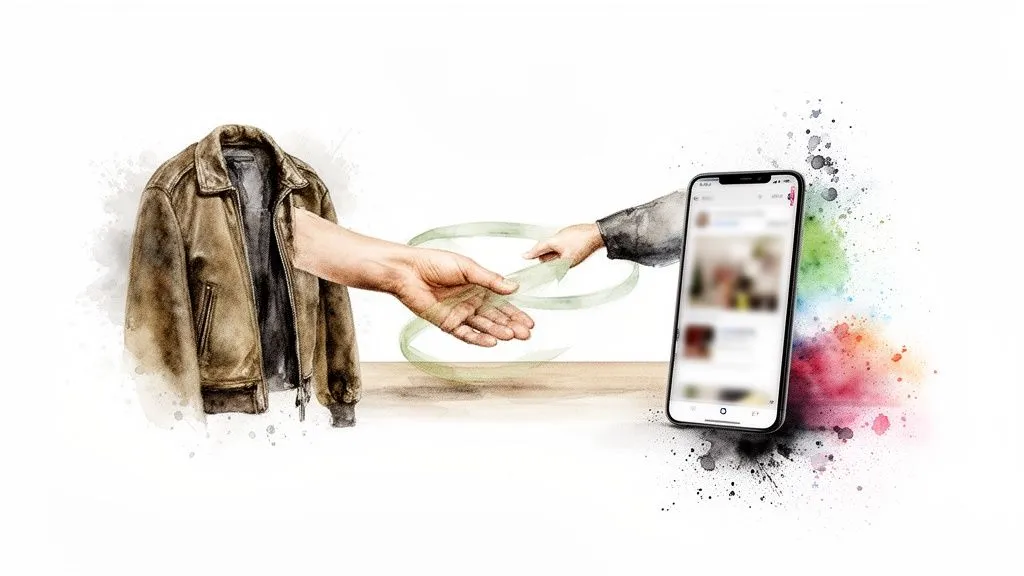
For an online seller, ignoring this deep shift would be a strategic mistake. Adapting to it, on the other hand, can open doors to unexpected growth and strengthen customer loyalty.
The rise of secondhand: an opportunity not to be missed
The appeal of secondhand goods is no longer a small niche market. It’s a genuine mass phenomenon transforming commerce. The French secondhand market is a perfect illustration: it reached 7 billion euros in 2024 after growing by 12%. And that’s not all. This global trend is expected to be worth 77 billion dollars by 2025, forcing online sellers to rethink their approach. If these figures interest you, you can explore analyses of the secondhand market on Origami Marketplace to dig deeper into the topic.
So, concretely, what should you do? Adding secondhand products alongside your new items is an excellent approach. You reach a new customer base, more mindful of their budget or their environmental footprint, while giving a second life to your own products or those of your customers.
Integrating secondhand isn’t just a simple extension of your catalog. It’s creating a parallel revenue stream, with its own rules. It deeply reshapes the very structure of your sales cycle.
Indeed, this forces you to imagine an entirely new customer journey, from buying back the item to putting it up for sale again.
The operational challenges of secondhand
Integrating secondhand into your sales cycle comes with its own set of very concrete challenges. It’s not enough to simply list new products online; you need to manage new complexity on several levels.
- Much more complex inventory management: Unlike new items, every secondhand item is unique. You’re juggling an inventory of one-of-a-kind items (unique SKUs), each with its own condition, price and photos.
- A dynamic pricing strategy: The price of a secondhand product depends on its condition, rarity and current demand. You’ll need a flexible, but above all fair, pricing grid.
- Reverse logistics: You need to set up an entire process to collect, inspect, refurbish and store the products you buy back. It’s a logistics flow completely different from that of new items.
These operational challenges have a direct consequence on your finances, particularly on the tax side.
Tax and accounting complexity
The real headache is often financial management. Selling new and secondhand items at the same time forces you to juggle two very different revenue models, with major tax implications.
The main issue is margin VAT. For secondhand products, VAT doesn’t apply to the total sale price, but only to the margin you make (the difference between your selling price and your purchase price). This requires impeccable accounting, and above all, clearly separated by product type.
This is where a tool like Bizyness becomes a real ally. It’s designed to handle these subtleties, automatically breaking down revenue from new and secondhand items. It applies the right VAT rules to each transaction and generates clear financial reports. You thus turn tax complexity into a competitive advantage, managing both revenue streams calmly without drowning in admin work.
Automating the financial side of your sales cycle
You can optimize every stage of the customer journey, but a sales cycle is only truly complete once the administrative and financial paperwork is settled. It’s often the least glamorous step, but it’s where the most friction, costly errors and wasted time hide. Fortunately, it’s also where automation can become your best ally.
Moving from commercial strategy to an actual, recorded sale requires tools that secure and streamline your money flows. That’s exactly the role of a platform like Bizyness: turning every confirmed order into a flawless accounting process, without you having to lift a finger.
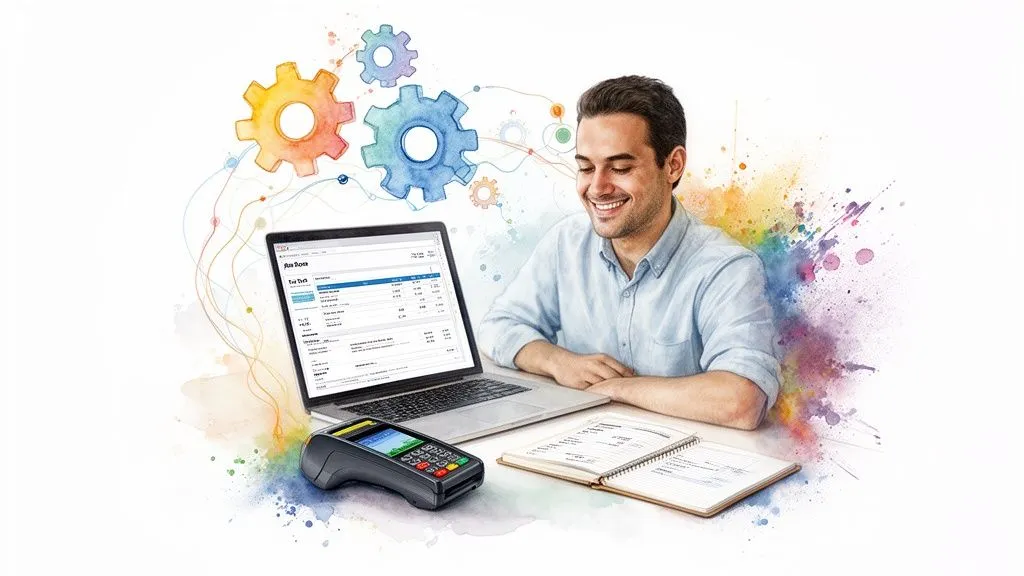
The image above sums up this idea well: a calm online seller, because the complex gears of finance are turning on their own in the background. They can finally focus on what really matters: their business.
From sale to perfect invoice, in a single click
Picture a classic scenario: you make a sale on your Shopify store. The customer lives in New York and paid in dollars via Stripe. How do you handle the invoice, the currency conversion and export VAT? Without automation, it’s a real manual headache, and an open door to errors.
With a financial automation tool, the process is radically different. As soon as the order is confirmed, the platform:
- Instantly retrieves all the sale’s information.
- Identifies the customer’s country and the applicable tax rules.
- Generates a 100% compliant invoice, with the right legal mentions and the correct VAT rate (or exemption).
- Archives the document and, if needed, automatically sends it to the customer.
What used to take long minutes (and just as many risks of error) is now handled in seconds. Reliably, for hundreds of orders a day. To properly automate the financial side of your sales cycle, mastering the invoicing process is essential. If you want to dig deeper into the topic, this practical guide to invoicing a customer is an excellent resource.
Financial automation isn’t just a time-saver. It’s insurance against compliance errors that can be very costly and shake your customers’ trust.
A customer who receives an incorrect invoice is a customer who doubts your professionalism. By locking down this final stage of the sales cycle, you leave an impeccable final impression that makes people want to come back.
Your checklist for a successful rollout
Getting started with financial automation is much simpler than it looks. Just follow a clear roadmap to connect the different tools in your sales ecosystem.
Here’s a simple checklist for integrating a solution like Bizyness and letting the magic happen:
-
Step 1: Connect your sales channels The first thing to do is plug in your revenue sources. Link your stores (Shopify, WooCommerce, etc.) and your marketplaces (Amazon, Etsy) to the platform. This lets you centralize all your sales data in one place.
-
Step 2: Integrate your payment accounts Next, connect your payment processors like Stripe, PayPal or Paddle. This step is crucial for linking received payments to placed orders, and thus automating bank reconciliation.
-
Step 3: Define your tax rules Set up your business’s basic information and your VAT regimes. The tool will use this to automatically apply the right rates, whether you sell in France, in the EU (with OSS/IOSS management) or internationally. You can also learn more about optimizing this process in our article on online invoicing.
-
Step 4: Customize your documents Add your logo and customize your invoice or quote templates to match your brand image. Polished financial communication strengthens your credibility.
-
Step 5: Turn on automation Once everything is connected, all that’s left is to activate the workflows. Let the platform generate invoices, categorize transactions and prepare your accounting reports while you focus on what matters most: selling more, and better.
The benefit is twofold. On one hand, you say goodbye to repetitive manual tasks and human errors, which secures your tax compliance. On the other, you free up precious time, an invaluable resource for any entrepreneur looking to grow their business.
Frequently asked questions about the e-commerce sales cycle
Do you have questions about managing your sales cycle? That’s perfectly normal. Here are direct, concrete answers, based on real-world experience, to help you see things more clearly.
What’s the biggest difference between a B2B and B2C sales cycle?
The main difference comes down to two words: speed and volume. In B2C e-commerce, the sales cycle is incredibly short. We’re sometimes talking about a few minutes, or a few hours at most. The result? A very large number of orders, but with a fairly low average order value.
The B2B world is the exact opposite. The sales process can drag on for weeks or months, with several stakeholders to convince. In the end, few contracts are signed, but each one represents a much larger amount.
For you, as an online seller, this distinction changes everything. The smallest hiccup in your checkout funnel can have a huge impact on your sales. In a high-volume context, automating invoicing and tracking is no longer a nice-to-have; it’s a matter of survival for handling the flow without losing your sanity.
How can I actually reduce my cart abandonment?
To tackle cart abandonment, remember these two words: transparency and simplicity. Nothing annoys a customer more than a bad surprise or a drawn-out process right before they pull out their card.
The number one cause of abandonment is often unexpected friction right before payment. By removing these obstacles, you get one of the fastest and easiest conversion wins available.
Here are a few immediate action points:
- Play it straight on costs: Shipping fees and taxes? Show them as early as possible. No one likes discovering them at the very last second.
- Offer familiar payment methods: Integrate the solutions your customers know and trust. Think PayPal, Apple Pay or Stripe for cards.
- Lighten your forms: Ask only for what’s strictly necessary. Every extra field is an invitation to leave the page.
- Automate follow-ups: Setting up a small email sequence for abandoned carts is one of the most profitable techniques in e-commerce.
How does accounting automation really influence my sales?
Accounting automation is the finishing touch that makes the customer experience flawless. It’s an essential link in your sales cycle. When invoicing is handled automatically by a tool like Bizyness, you say goodbye to VAT errors or lost invoices.
These small administrative hiccups may seem trivial, but they create frustration and erode trust. By locking down this final stage, you leave an ultra-professional image that makes people want to order from you again.
And there’s another, more personal benefit: it frees your mind. Knowing that all the paperwork is handled flawlessly lets you focus on what really matters to grow your store: marketing, product, and the relationship with your customers.
With Bizyness, automate the financial side of your sales cycle to focus on your growth. Discover how to turn every sale into a flawless accounting flow.
