

 Français
Building an effective service pricing guide
Learn how to build a service pricing guide that maximizes your profits with our expert guide. Easy-to-apply strategies.

The fundamentals of a pricing guide that inspires confidence
A pricing guide for your services is far more than a simple price list. It reflects your expertise and is the first impression you give potential clients. Well designed, it becomes an essential tool for communicating the value of your work, attracting the right clients and ensuring your business’s profitability. It justifies your rates and highlights your professionalism.
Clarity and transparency: the pillars of trust
To build trust, your pricing guide must be simple and accessible. Banish technical jargon and ambiguous terms. Favor clear, precise language. Carefully detail the content of each service. For example, for a consulting service, state the number of hours included, the type of deliverables provided and the follow-up terms.
Transparency is equally essential. Be clear about your rates and payment terms. Justify your prices by explaining your expertise, the complexity of the tasks and the added value you offer. You can draw inspiration from the approach of Gepetto AI and its various packages to structure your own offers.
Structuring your pricing guide for smooth reading
A well-thought-out structure makes your offers easier to read and understand. Use clear headings, bullet points and tables to organize information. Present your services logically, for example from simplest to most complex, or from cheapest to most expensive.
Adapting to your clients’ needs is a key success factor. Offer different plans or packages to meet a variety of budgets and expectations. A “discovery” plan for small projects, a “standard” plan for common needs and a “premium” plan for full support could, for example, be considered.
Highlighting the value of your services
Your pricing guide must highlight the benefits your clients can expect from your services. Emphasize concrete, measurable results, such as time saved, increased revenue or improved visibility. Adding client testimonials can strengthen the credibility of your claims.
The services producer price index (IPSE) tracks the evolution of service prices in France. In the third quarter of 2021, for example, the IPSE recorded a rise of 1.7%, after +0.9% the previous quarter. This information, useful for understanding price trends, reflects changes in production costs and inflationary pressures in the sector.
A well-built pricing guide is a genuine asset for your business. It strengthens your brand image and attracts quality clients. By refining its presentation and content, you turn a simple document into a powerful communication and persuasion tool.
Calculating your rates like a financial strategist
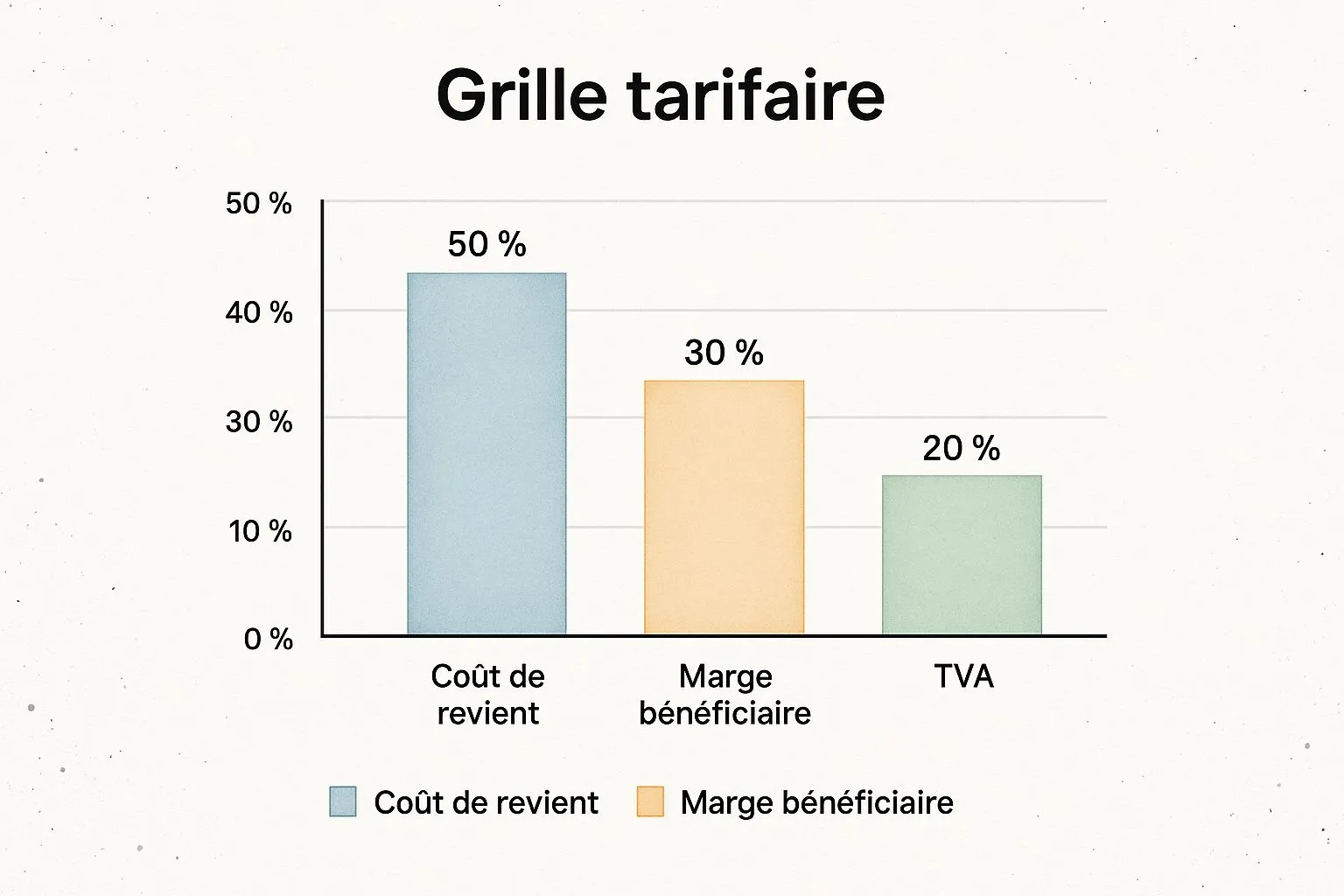
The chart above illustrates the composition of a standard pricing guide. Cost price represents 50% of the final price, followed by profit margin, then VAT. An accurate assessment of costs is therefore essential for profitable pricing.
Defining your cost price: the cornerstone
Cost price includes all expenses related to your service: your working time, travel, software, supplies and communication. For an accurate calculation, each element must be quantified.
Take the example of a freelance graphic designer. Their cost price will include the depreciation of their computer, subscriptions to stock image libraries and their internet subscription.
Determining your profit margin: aiming for profitability
Profit margin is the difference between the selling price and the cost price. It covers your compensation, indirect expenses (rent, insurance…) and generates a profit for investment.
Its calculation depends on your expertise, the complexity of the service and competitors’ prices. A senior consultant will have a larger margin than a beginner.
Including VAT: an unavoidable obligation
VAT is added to the price excluding tax. The rate varies depending on the service. Invoicing software like Bizyness automates this calculation and ensures compliance. This lets you focus on the quality of your services and client satisfaction.
Choosing the right pricing method
Several methods exist for determining your rates. Cost-plus hourly pricing calculates your hourly cost, to which your margin is added. Flat-rate pricing offers a fixed price for a given service. Value-based pricing, meanwhile, is based on the benefits to the client. Select the method that best suits your business and your clientele.
To better understand the nuances between these methods and their applications, see the comparison table below:
Pricing methodologies that make a difference
This table compares the various pricing approaches and their impact on client perception, profitability and the optimal situations for each method.
| Pricing method | Core principle | Competitive advantages | Pitfalls to avoid | Ideal for which profile |
|---|---|---|---|---|
| Cost-plus hourly pricing | Hourly cost calculation + profit margin | Simple and transparent for the client | Difficulty estimating time accurately | Short, well-defined services |
| Flat-rate pricing | Fixed price for a defined service | Cost predictability for the client | Requires rigorous work assessment | Projects with a clear scope |
| Value-based pricing | Price based on value perceived by the client | Higher margin potential | Justifying the price to the client | Consultants, experts, high-value-added services |
This table highlights the importance of choosing a pricing method aligned with your goals and the nature of your services.
Anticipating fluctuations and downturns in activity
Build a safety margin into your pricing guide to handle unforeseen events and changing costs. If your expenses rise, you’ll be able to adjust your rates without affecting your profitability. Also plan for slow periods, such as holidays or seasonal fluctuations, in your calculations.
Adapting your rates to economic realities

Maintaining profitability in a fluctuating economic context is a major challenge for any service provider. Adapting your pricing guide then becomes essential. It’s not simply about raising prices, but about adopting a thoughtful, transparent strategy. This helps preserve your margins while keeping your clients’ trust.
Adjusting your rates without losing clients: a balancing strategy
Rising costs for raw materials, energy and wages have a direct impact on service production costs. To stay competitive, it’s essential to pass these increases on, at least partially, to the rates you charge. A sudden increase, however, can put clients off. It’s therefore advisable to opt for gradual adjustments and clearly explain the reasons for these changes. When calculating your rates, it can be useful to refer to benchmarks. For example, see this guide on pest control pricing.
Communicating effectively about price changes
Transparency is essential for maintaining a relationship of trust with your clients. Clearly explain the reasons behind your rate changes. Highlight the rise in your costs and its impact on your business. Also emphasize the quality of your services and the added value they represent. In the second quarter of 2024, service production prices in France rose 1.5% quarter-on-quarter and 2.3% year-on-year, according to Insee. This data can support your argument and justify your pricing decisions.
Using economic data to justify your choices
Using relevant economic data strengthens the credibility of your arguments. Don’t hesitate to present precise figures on price trends in your sector. Compare your rates with those of competitors. Show how your price adjustments allow you to maintain the quality of your services and stay competitive. This information reassures your clients and legitimizes your decisions.
Examples of pricing adaptation strategies
- Rate indexing: Link your rates to a relevant economic index, such as the consumer price index, for automatic adjustment to inflation.
- Packaged offers: Offer bundled packages with tiered pricing to encourage clients to choose more comprehensive services, which are also more profitable for you.
- Contract negotiation: Negotiate long-term contracts with your suppliers to stabilize your costs and limit the impact of economic fluctuations.
Adapting your pricing guide to economic realities is an ongoing process. By being proactive, transparent and communicating effectively, you can navigate periods of economic uncertainty without impacting your profitability.
Structuring offers that maximize conversion
Forget classic price lists! Optimizing your service pricing guide requires a strategic approach. Effective service providers structure their offers to subtly guide clients toward the most profitable options. They use psychological principles to influence purchasing decisions and maximize their conversion rates.
The anchoring effect: influencing the perception of value
The anchoring effect is a powerful technique that involves presenting a first offer at a high price. This price, even if the offer isn’t selected, serves as a reference point for subsequent offers. It influences the perceived value of the other options. For example, if a consultant offers a premium service at €2,000, a €1,000 offer will then seem more affordable and appealing.
Here’s how to make the most of the anchoring effect:
- Start by presenting your most complete, most expensive offer.
- Highlight the exceptional value and benefits of this premium offer.
- Then present your more accessible offers, subtly comparing them to the anchor offer.
The rule of three: simplifying the choice for the client
The rule of three is a proven marketing technique. It involves offering three distinct pricing options:
- An economy option, with basic services for tight budgets.
- A standard option, offering a balance between price and services, often the most profitable for the provider.
- A premium option, including all services and high-end offerings for an exclusive experience.
This clear structure meets different needs and budgets, while nudging the client toward the standard offer, perceived as the best compromise.
To illustrate the rule of three in practice, take the example of a photographer:
- Basic plan: One-hour session, 10 retouched photos (€200)
- Standard plan: Two-hour session, 20 retouched photos, photo album included (€400)
- Premium plan: Half-day session, all photos retouched, premium photo album, large-format print (€800)
The “Standard” offer stands out as the most balanced choice.
To better understand the structuring of high-performing offers, here is a summary table:
Three-tier offer architecture that converts
This table presents a pricing structure optimized to guide clients toward the main offer, with the strategic elements to include at each tier and the presentation techniques that influence purchasing decisions.
| Offer tier | Key elements to include | Strategic positioning | Ideal client profile | Conversion technique |
|---|---|---|---|---|
| Economy | Basic services | Attractive price | Clients with a limited budget | Create a need for higher-tier options |
| Standard | Essential services + attractive options | Best value for money | Majority of clients | Highlight value and benefits |
| Premium | Full services + high-end offerings | Exclusive experience | Clients seeking the best quality | Justify the price through exceptional added value |
In conclusion, strategically structuring your offers influences purchasing decisions, improves your conversion rates and maximizes your profitability. Invoicing software like Bizyness simplifies managing your offers and ensures flawless invoicing, letting you focus on client satisfaction.
Navigating legal obligations without paralyzing your prices

Defining an effective service pricing guide requires a delicate balance between commercial appeal and legal compliance. This guide presents the essential regulations for building a solid pricing policy without compromising your growth potential.
Understanding the key regulations
French law regulates service pricing, emphasizing transparency and non-discrimination in order to protect consumers. Price display, for example, must be clear and indicate all mandatory taxes and fees. Specific rules also exist for certain sectors, such as trades or transport.
The municipal council is generally responsible for setting the rates for local public services, a power it can delegate to the mayor. Pricing for services such as water or electricity is therefore determined locally, influenced by public policies and sustainable development goals. For more information, see this document on local public service pricing.
Making the most of available flexibility
Despite a strict legal framework, solutions exist for adapting your rates. Price revision clauses allow you to adjust your prices based on changes in the cost of raw materials or labor. Precise wording is essential to avoid disputes.
Conditional discounts offer commercial flexibility. They allow you to offer reductions for loyalty, purchase volume or early payment. The justification for these discounts must be objective and transparent.
Concrete adaptation examples
A web agency, for example, can offer a 10% discount for signing an annual contract. An independent consultant can index their rates to inflation using the consumer price index as a reference.
The importance of compliant documents
Using compliant contract and quote templates is essential. These documents protect your interests and prevent misunderstandings. Consulting a specialized lawyer can guarantee the validity of your documents.
Bizyness: an ally for compliance
Invoicing software like Bizyness simplifies the management of your pricing guide and ensures your invoices are compliant. Automated VAT calculation and generating professional documents in a few clicks save you time and let you focus on your core business.
By mastering the legal aspects, you can create a competitive, compliant service pricing guide — an essential asset for the long-term success of your business.
Presenting your rates with confidence that inspires trust
Presenting your rates is a key moment in the client relationship. This is the stage where the value of your offer is truly assessed. How do you turn this sometimes delicate moment into an opportunity to convince and close a sale? The answer lies in a polished presentation that inspires confidence and justifies your prices.
Timing: when to talk about price
Raising the question of price at the right time is essential to maximize your chances of success. Revealing your prices too early, before demonstrating the value of your offer, is a common mistake. Conversely, waiting too long can frustrate the client. The ideal approach is to present your rates after understanding the client’s needs and demonstrating how your services precisely address them.
Visual aids: clarity in the service of persuasion
A clear, well-presented pricing guide reinforces your professionalism. Several formats can be used, depending on your industry. A comparison table is effective for presenting different offers and their specifics. A PDF document allows for more detailed information. During an in-person presentation, a concise, easy-to-understand visual aid is preferable. The goal is to simplify comparison and understanding for the client.
Language: the art of showcasing your offer
Word choice is crucial for shaping how your offer is perceived. Avoid negatively connoted terms such as “cost” or “expense”. Favor positive vocabulary that highlights benefits, such as “investment”, “added value” or “return on investment”. For example, instead of saying “The cost of this service is €500”, prefer “For an investment of €500, you’ll benefit from…”.
Handling objections: anticipating tough questions
Price objections are normal. Anticipate them by preparing clear, well-argued responses. Justify your rates by detailing what they’re made up of: your expertise, the time invested, the resources used and, above all, the concrete results for the client. Be ready to clearly explain what sets your offers apart from those of your competitors.
Training your team: harmonized communication
If you work as a team, make sure all members are trained to present rates with the same confidence and the same arguments. Role-playing exercises and simulated scenarios can prepare them for different situations and possible objections. Consistent, well-controlled communication strengthens your company’s credibility.
Measuring effectiveness: analyzing and optimizing
Regularly analyzing your sales performance lets you identify the strengths and weaknesses of your pricing presentation. Track your conversion rates, the number of objections and the reasons for refusals. This data is valuable for adjusting your approach and optimizing your presentation techniques. Don’t hesitate to use invoicing software like Bizyness to simplify managing your pricing guide.
