

 Français
Free and easy service quote template
Download our service quote template to simplify your invoicing and win over your clients faster.

A service quote template is much more than a simple price list. It’s a document that lays the groundwork for a collaboration: it details your commercial offer, from the exact nature of the services proposed to the pricing terms. It’s essentially your first formal commitment with a client, a document that serves as a sales tool, a reference framework, and legal protection, all before the project even begins.
Why a well-crafted quote is your best sales asset

We often tend to see the quote as an administrative chore. Big mistake! A well-designed quote reflects your professionalism. It’s the first tangible impression you leave with a prospect, and this document has the power to turn a simple inquiry into a signed contract.
A truly effective service quote goes well beyond a simple price proposal. It plays several crucial roles for the health of your business and, of course, for client satisfaction.
Legal protection and a clear framework
The first advantage, and not the least, of a detailed quote is that it defines the scope of your work in black and white. Every task, every deliverable, every condition is specified. This transparency is your best ally for avoiding misunderstandings that can quickly poison a project.
By clearly setting expectations from the start, the quote minimizes the risk of disputes. Think of it as a shared roadmap that ensures you and your client are looking in the same direction before getting started.
This clarity is all the more essential given that French law requires a written quote in many situations. It becomes mandatory, for example, for any service exceeding €1,500, for personal services above €100 per month, or for most building work. Ignoring it exposes you to fines. In fact, an analysis by the French Ministry of the Economy reveals that more than 60% of disputes arise from a misunderstanding of the listed services.
A powerful persuasion tool
Never underestimate the commercial impact of a polished document. A well-structured quote template, free of spelling mistakes and carrying your visual identity, immediately inspires confidence. You show your potential client that you handle details seriously, which reassures them about your ability to manage their project.
A few key elements to reinforce this trust:
- Clear descriptions: Forget technical jargon. Speak your client’s language and highlight the benefits they’ll get from your service.
- A clean, spacious layout: A document that’s easy to read and understand is much more likely to be approved quickly.
- A personal touch: Mentioning the client’s name or briefly referencing your previous exchanges shows that you’ve paid attention to their specific needs.
Ultimately, your quote is nothing more than the extension of your sales pitch. To go further on this topic, feel free to check out our full guide on how to create a quote that truly converts.
The essential information for a compliant quote
For a service quote template to be more than just a commercial proposal, it must follow a certain formal structure. This is what turns it into a genuine legal document, one that commits you just as much as your client. Omitting a crucial piece of information doesn’t just weaken your position in a dispute — it can also undermine your credibility from the outset.
Think of these details as the foundations of your offer: they guarantee transparency and security for everyone involved.
Clearly identifying both parties
The first golden rule is to remove all ambiguity. Who is making the offer? Who is receiving it? Your quote must be crystal clear on this point.
For you, the service provider, this means including:
- Your company name (or your first and last name if you’re a sole trader, adding the mention “EI” or “Entrepreneur Individuel”).
- The full address of your registered office.
- Your direct contact details (phone, email) so your client can reach you easily.
- Your SIRET number (or SIREN), which is essentially your business’s ID card.
- Your intra-community VAT number, if you have one.
On the client’s side, whether an individual or a business, you must include their full name (or company name) as well as their address. This detail matters greatly for the document’s legal validity once signed.
Framing the offer in time and scope
A commercial offer isn’t meant to last forever. Setting a clear time frame protects you, particularly against changes in your own costs.
Two dates are therefore essential:
- The quote’s issue date: This marks the starting point of your proposal.
- The offer’s validity period: It’s up to you to determine this. Most service providers opt for 30 days, but nothing stops you from shortening it to 15 days or extending it depending on your industry. Once this period has passed, you’re no longer bound by the terms you proposed.
Another essential point: each quote must carry a unique number. Best practice is to adopt a chronological, continuous numbering system (for example, DEV-2024-001, DEV-2024-002…). This greatly simplifies your administrative management and ensures perfect traceability for your bookkeeping.
The infographic below gives you a quick overview of the details you must never forget.
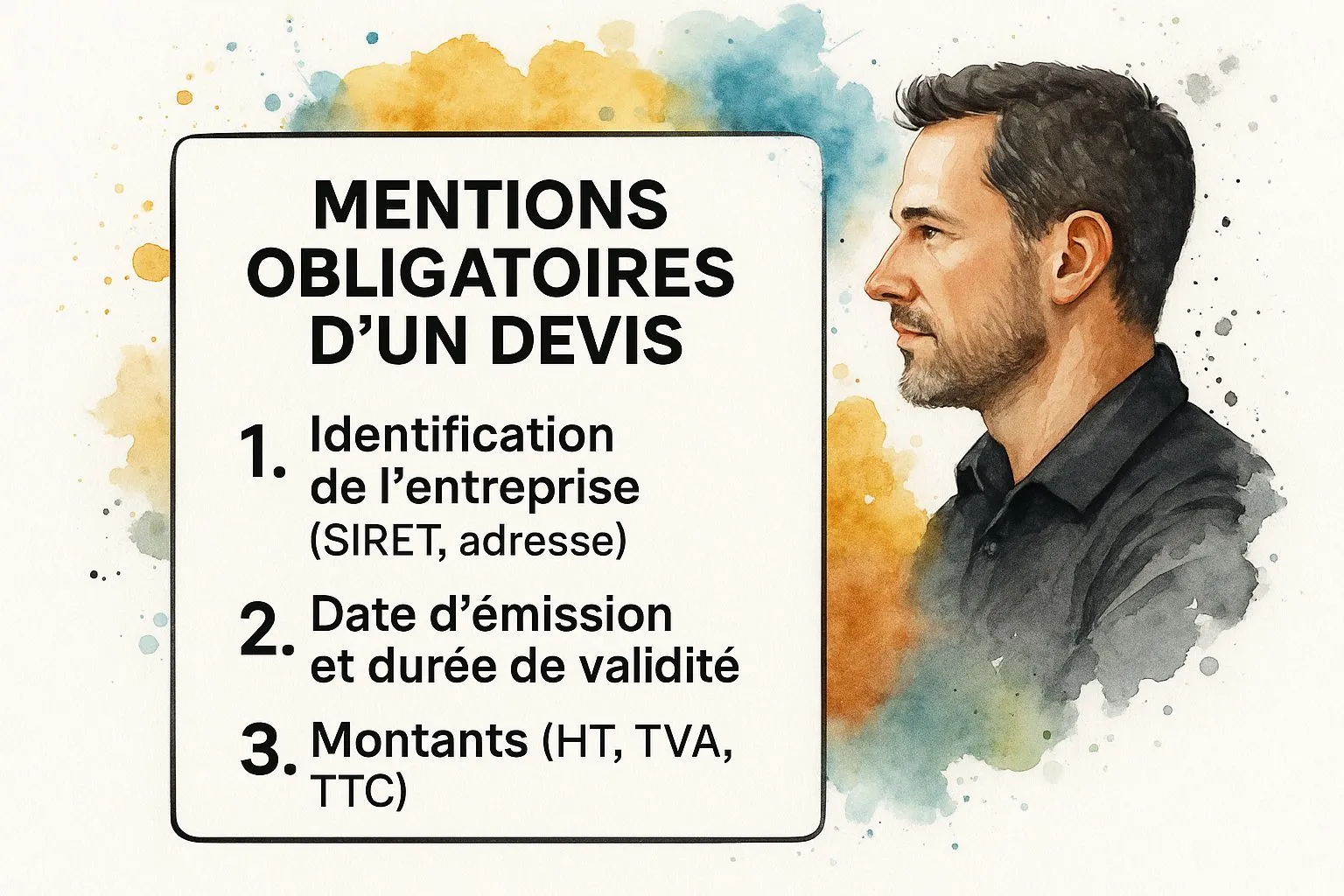
As you can see, everything rests on three pillars: identifying the parties, the time frame, and financial clarity.
To help you not miss anything, here’s a handy summary table.
Checklist of mandatory details on a quote
A practical summary of the legal and commercial information you must never forget for a compliant quote.
| Category | Mandatory detail | Example or clarification |
|---|---|---|
| Service provider’s identity | Company name, address, SIRET, VAT number (if applicable) | SARL Ma Boîte, 12 rue du Commerce 75001 Paris, SIRET 123 456 789 00012 |
| Client’s identity | Full name or company name, address | Mr. John Doe, 25 avenue de la République 69002 Lyon |
| Quote information | Unique number, issue date, validity period | No. DEV-2024-042, issued on 05/15/2024, valid 30 days |
| Description | Detail of each service (quantity, unit price excl. VAT) | SEO consulting engagement - 5 days - €500/day excl. VAT |
| Financial | Total excl. VAT, VAT rate and amount, total incl. VAT | Total excl. VAT: €2,500, VAT (20%): €500, Total incl. VAT: €3,000 |
| Payment | Terms (deposit, balance), deadlines, late penalties | 30% deposit on order, balance due 30 days end of month. |
This table is an excellent safeguard for quickly checking the compliance of your quotes before sending them.
Detailing the services and financial terms
This is the heart of your quote, the part where trust is won (or lost). Precision is your best ally. For each service or product line, you must state the quantity (in hours, days, units…) and the unit price excluding VAT.
Avoid vague labels like “Consulting services” at all costs. Be specific. Prefer a phrasing like: “Strategic marketing support (4 sessions of 2h)” so there’s no room for interpretation.
At the bottom of the quote, the totals must appear distinctly:
- The total amount excluding VAT.
- The applicable VAT rate(s) and the total tax amount.
- The total amount including all taxes, which corresponds to the final sum your client will have to pay.
Finally, don’t neglect the payment terms. They’re vital for protecting your cash flow. Spell out the terms in black and white (for example, a 30% deposit upon signature, the balance upon delivery), the payment deadlines, and the penalties in case of late payment.
For a complete, in-depth analysis, we’ve prepared a guide on all the mandatory details on a quote.
Personalizing your quote to sell your services better
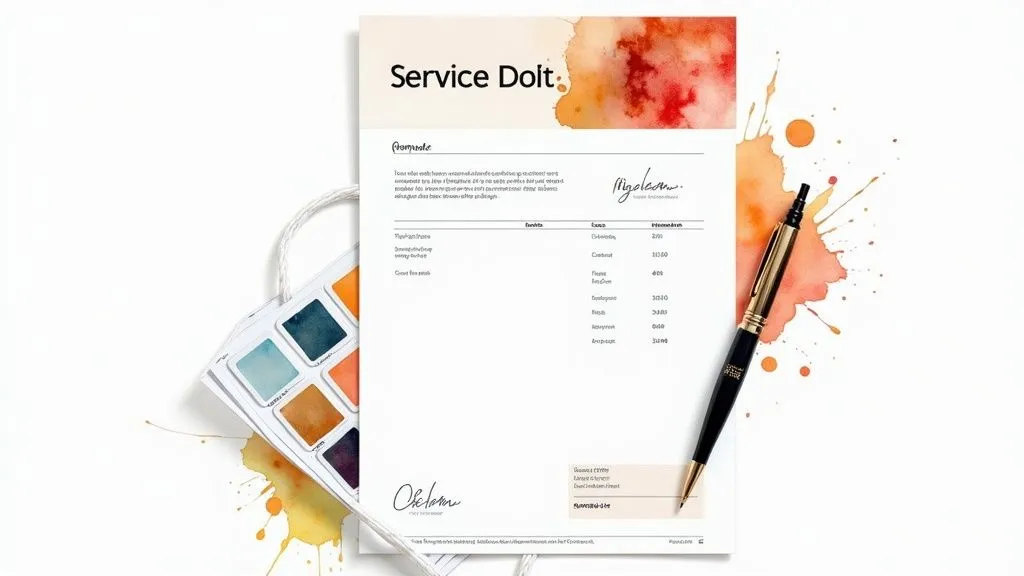
A quote that ticks every legal box is good. That’s the baseline. But to truly stand out, your service quote template must become your best salesperson. The idea is to turn it from a simple administrative document into a genuine persuasion tool that works for you.
The first point, often underestimated, is visual identity. Incorporating your logo, using your brand’s colors and fonts… these aren’t designer whims. These details immediately anchor your professionalism in the client’s mind and reinforce brand recognition. It’s the first message you send: you are a serious, consistent business that leaves nothing to chance.
Structuring information to convince
Clarity is everything. A messy, cluttered quote where you have to squint to find the total is nearly a guaranteed “no.” Think “readability” above all. Clear headings, subtotals to group related services, and, above all, space. Let your document breathe.
A spacious quote is a quote that reads effortlessly. Your client should understand your offer at a glance, without having to hunt for key information. The less friction there is, the closer you are to a signature.
Rather than dumping a plain list of tasks, why not organize your offer into major phases or objectives? Imagine a website creation project:
- Phase 1: Design & Concept (mockups, art direction, etc.)
- Phase 2: Technical Development (integration, feature development…)
- Phase 3: Launch & Training (deployment, onboarding support…)
This approach has a double advantage: it shows you have a comprehensive vision of the project and helps the client picture how things will unfold. It’s immediately more concrete.
Writing descriptions that speak to the client
This is where you can make all the difference. Forget technical jargon and cold descriptions. Nobody buys “features,” people buy “benefits.” Your client doesn’t dream at night about “5 hours of SEO consulting.” What they want is to “boost their visibility on Google to attract more customers.”
The nuance is subtle, but it changes everything. You need to shift from “what I’m going to do” to “what you’re going to get.”
| Instead of… | Prefer… |
|---|---|
| Creation of 5 web pages | A professional showcase website to present your services and generate qualified leads. |
| Installation of a security plugin | Peace of mind with a site protected 24/7 against cyberattacks. |
| Writing 4 blog articles | Expert content to attract your ideal customers and establish your authority in the market. |
By phrasing your services this way, you connect directly with your client’s goals. Your proposal then becomes an obvious solution to their problem.
Adding reassurance elements
Even with the best offer in the world, your prospect may still hesitate. That’s only human. Your quote is the perfect place to dispel their remaining doubts. Adding a few “social proof” elements can tip the scales.
Consider adding, discreetly but visibly (in the footer, for example):
- A short, impactful client testimonial.
- Logos of your certifications or important partners.
- A direct link to your portfolio or a case study similar to the project.
These small additions cost nothing but are remarkably effective. They build trust, reinforce your credibility, and validate your prospect’s decision. By personalizing your service quote template this way, you’re no longer just sending a price — you’re sending a promise of value that makes people want to say “yes.”
What tools should you use to create your quotes? The showdown
We’ve all started there: the classic quote cobbled together in Word or Excel. It’s convenient at first, but you quickly hit the limits. Between calculation errors slipping into formulas, tracking becoming a real headache, and a result that sometimes lacks professionalism, you lose precious time.
For an entrepreneur looking to grow, it’s time to get properly equipped. Modern tools are no longer a luxury — they’re a lever for simplifying management and standing out.
Invoicing software: the royal road
Let’s be clear: for creating and managing your quotes professionally, nothing beats online invoicing software. Platforms like Bizyness were designed specifically for freelancers and small businesses. The benefits are almost immediate.
At a glance, you can see the advantage of a clear, centralized interface like Bizyness’s.
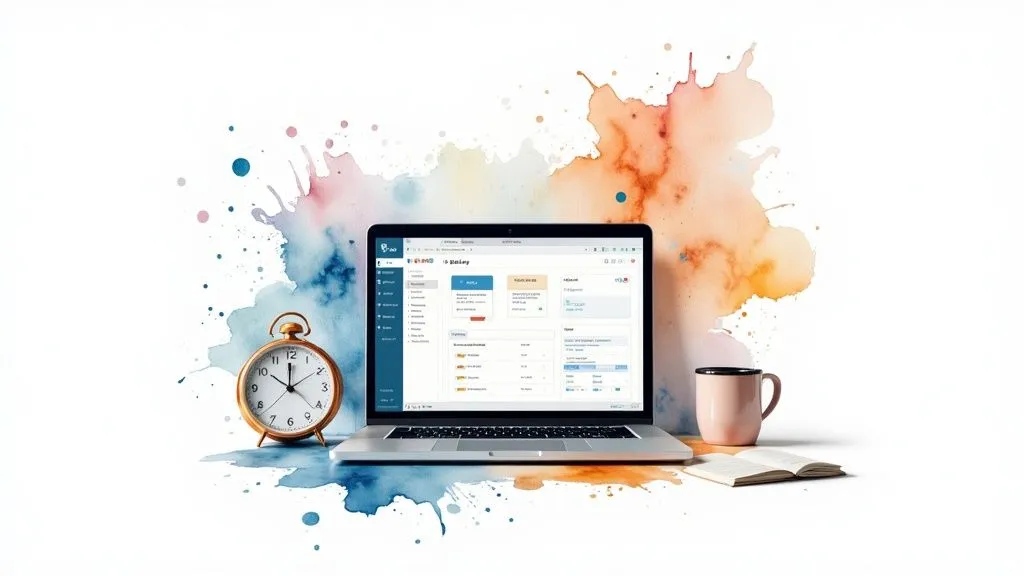
Tracking your commercial documents becomes crystal clear, with everything in one place.
Automation is truly at the core of it all. No more triple-checking VAT calculations, mandatory legal notices are inserted automatically, and, above all, you know in real time where each quote stands: sent, read by the client, accepted, or declined. This visibility changes everything for your follow-ups.
The real time-saver? An accepted quote turns into an invoice in a single click. No more double data entry and no risk of missing a line between the two documents. It’s simple, efficient, and it saves you plenty of headaches.
This is no longer a niche practice. In France, nearly 70% of small and medium-sized businesses have already adopted online tools for their quotes. Creation time drops from 30 minutes to under 10 minutes on average. For micro-entrepreneurs, it’s also a guarantee of staying compliant, for example with the automatic addition of the mention “VAT not applicable, Article 293 B of the French Tax Code.”
Other options on the table
Of course, other solutions exist — less integrated, but they can help depending on your needs.
- Design tools (Canva, Figma): If your priority is a visually flawless, unique quote, this is an interesting route. The big downside is that everything is manual. You’ll have to do the calculations yourself and fill in every piece of information by hand.
- Spreadsheets (Excel, Google Sheets): They have the advantage of allowing a few formulas to automate calculations. On the other hand, tracking multiple quotes quickly becomes a nightmare, and the final result often stays fairly… basic.
Ultimately, it all depends on what you’re looking for: efficiency and professionalism on one hand, or creative freedom on the other. If you’re just starting out and want to try a full solution without committing, taking a look at a free invoicing software is probably the best entry point for modernizing your management.
Managing quote follow-up, from signature to payment
There you go, your service quote template has been sent. Well done! But make no mistake, the bulk of the work often starts now. You need to turn this proposal into a signed contract, then into a paid invoice. It’s a delicate phase that requires a subtle blend of diplomacy and persistence.
A well-handled follow-up is anything but aggressive. On the contrary, it’s proof of your professionalism and the interest you take in your client’s project. Trust me, passively waiting for the phone to ring is rarely the best strategy.
How to follow up with a prospect without being pushy
A prospect’s silence can mean all sorts of things: they’re swamped, they simply forgot, they’re waiting on other offers… Your job is to stay top of mind without ever tipping into harassment.
For this, a somewhat structured approach works best. A good practice, for example, is to plan a first follow-up 3 to 5 days after sending the quote, then a second one a week later if needed.
The goal isn’t to demand an answer, but to restart the conversation. Favor open-ended questions: “Have you had a chance to look at my proposal?” or “Are there any points that might need clarifying together?”
Here’s a short example of an effective follow-up email:
Subject: Following up on our proposal for [Project name]
Hello [Client name],
I hope you’re doing well. I’m simply following up regarding the quote I sent you on [Date].
Have you had a chance to look at it? I’m of course available if you have any questions or would like to discuss any adjustments.
Have a great day, [Your name]
Handling negotiations and adjustments
It’s very common for a client to want to discuss certain points or negotiate the price. Above all, don’t take it personally. It’s a perfectly normal step in the sales process. The idea is to stay flexible while keeping a watchful eye on your profitability.
Be ready to defend every line of your quote. Don’t talk only about cost, but about the value you bring. If you’re asked for a discount, see if it’s possible to remove a less critical service to lighten the bill, rather than simply undercutting your own work.
From electronic signature to deposit payment
Once you’ve reached an agreement, it’s time to make it official. Electronic signature is a valuable ally here. It saves a huge amount of time, holds real legal value, and spares you the back-and-forth of printing and scanning.
The quote is signed? Great. The next step is the deposit payment. It’s an essential guarantee that secures the commitment on both sides and gives you an initial cash inflow. Be sure to clearly state in your terms that the work will only begin once this first payment has been received. That’s the key to starting the collaboration on solid, worry-free footing.
Answering your questions about quotes
Getting started with a service quote template raises plenty of questions, whether practical or legal. To help you see things more clearly and manage your quotes with confidence, we’ve compiled the questions that come up most often.
The idea is to give you clear, direct answers to demystify certain points that can seem complex. That way, you can focus on what you do best: your job.
Does a signed quote really count as a contract?
Yes, and it’s a crucial point to understand. The moment your client signs the quote, adding the well-known mention “Approved” or “Approved for work,” the document changes status. It’s no longer a simple proposal, but a genuine contractual commitment.
Specifically, this agreement binds you both:
- On your side: You commit to performing the service as described, respecting the prices and deadlines announced.
- On the client’s side: They firmly commit to paying the agreed amount, under the terms you set.
Keep this in mind: in case of a problem or disagreement, this signed quote will be your best protection for asserting your rights.
Can I charge for drawing up a quote?
As a general rule, a quote is considered a commercial courtesy, and is therefore free. But as is often the case, there are exceptions.
You’re fully entitled to charge for a quote if producing it requires significant investment on your part. Think, for example, of an in-depth technical study, travel to the other end of the region, or a detailed analysis that takes up a lot of your time and expertise.
The key word here is transparency. It’s absolutely essential to inform your client that the quote will be chargeable before you even start working on it. You must get their clear agreement. A well-regarded practice is to offer to deduct the cost of this quote from the final invoice if the client decides to work with you.
What validity period should I put on my quotes?
The law doesn’t impose anything specific, which gives you some flexibility. In practice, you’ll most often see periods ranging from 15 days to 3 months.
Setting this period is more than a mere formality — it’s a safeguard for you. It protects you if the cost of your raw materials rises or if your own suppliers’ rates change. Once the date has passed, you’re no longer bound by the terms of the offer. If the client gets back to you late, you can then offer them a new, updated quote.
My client signed the quote but isn’t paying, what should I do?
A signed quote is a payment commitment. If your client isn’t holding up their end, the first thing to do is always to follow up amicably. It’s often surprising how a simple phone call or reminder email is enough to resolve an oversight.
If this friendly approach doesn’t work, it’s time to step things up. The next step is sending a formal notice letter by registered mail with acknowledgment of receipt. This official letter sets a final deadline for payment and, importantly, is a mandatory legal step before considering more serious collection proceedings. In this case, your signed quote will be the centerpiece of your file.
Now that the theory is clearer, how about putting it into action? To create professional quotes in just a few clicks, take a look at Bizyness. Our tool is designed to save you time by automating the creation, tracking, and conversion of your quotes into invoices. That leaves you more time to focus on growing your business. Try it for free at https://www.bizyness.fr.
