

 Français
 Service Quote Template — Create Professional Proposals
Download our service quote template to build clear, effective proposals and easily win over your clients.

A service quote template isn’t just a price list you dash off. It’s much more than that. Think of it as your first real contact with a future client, the first building block of your collaboration. This document is your professional business card, a contract of trust that binds you both once signed. A polished, precise quote is your best argument for turning a curious prospect into a convinced client.
Why a simple quote isn’t enough anymore
Too many entrepreneurs still think a quote boils down to a price line. That’s a classic mistake, and it can cost you dearly. In reality, this document is a genuine strategic tool. It doesn’t just put a figure on a service; it shapes how prospects perceive the value of your work.
Think of it first as your legal safety net. A well-crafted quote clearly outlines the scope of your engagement, the deadlines to meet, and the payment terms. Every detail, every clause, protects you from misunderstandings and disputes that could arise later. Without that framework, the infamous “gray areas” quickly become sources of conflict.
The impact on your professional credibility
The look and clarity of your quote speak for you. A sloppy document, riddled with mistakes or missing information, sends a very bad signal. Conversely, a well-structured quote, free of typos, that shows you understood the client’s need, instantly demonstrates your seriousness and attention to detail.
This is your very first chance to prove your expertise, even before the work begins. A client who receives a clear, professional quote immediately feels reassured and is far more likely to say “yes.”
This first impression is often the one that sticks. It positions you not as a mere contractor, but as a reliable, competent partner. And that justifies your rates much better.
When a quote becomes a legal obligation
In many cases, providing a quote isn’t just good business practice — it’s a legal obligation in France. Ignoring it exposes you to penalties.
This obligation varies depending on your industry and the amount of the service. To give you an idea, a quote is mandatory as soon as the amount exceeds 150 euros for personal services, or 1,500 euros for other types of services. Failing to comply with this rule can cost you dearly, with fines of up to 3,000 euros for an individual. If you want to dig deeper, you’ll find more information on quotes for services by consulting specialized resources.
Ultimately, taking the time to refine your service quote template is never wasted time. It’s a smart investment that secures your contracts, builds your credibility, and simply helps your business grow.
The essential information for a rock-solid quote
A service quote template isn’t just a formality. To be truly effective, it must be legally airtight. The slightest missing piece of information can weaken your agreement or, in the worst case, render the document void. Let’s look together at how to build a solid foundation for every offer you send your clients.
Every quote must start by clearly identifying who is offering what, and to whom. It may seem obvious, but it’s a frequent source of costly errors. Think of your quote as a genuine identity card for the transaction.
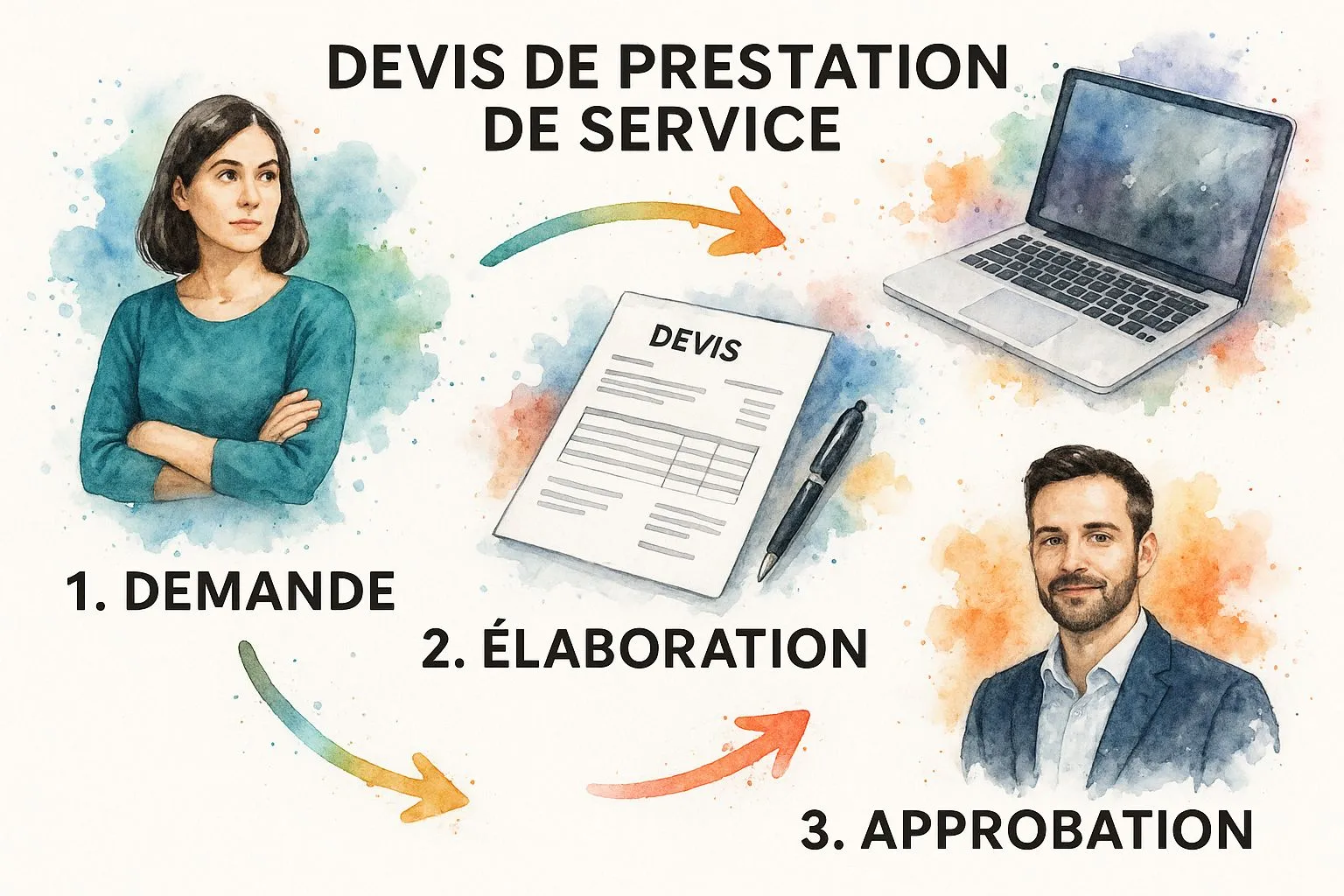
This image summarizes the lifecycle of a quote well: from its creation to its validation. Each checkpoint is essential to guarantee its legal compliance and protect you.
Who are you, and who are you addressing?
The very first thing to do is state your professional identity. This is non-negotiable and proves your business legally exists.
- Your full identity: State your company name, headquarters address, a phone number, and an email address.
- Your registration: The SIREN/SIRET number is absolutely essential. For companies, don’t forget to mention the legal structure (SAS, SARL, etc.) and the amount of share capital.
- For sole traders: Be sure to add the mention “EI” or “Entrepreneur Individuel” next to your name. If you’re VAT-exempt, the mention “TVA non applicable, art. 293 B du CGI” must appear on the quote.
Of course, your client’s details must be just as precise. Note their full name or company name, as well as their address. A small typo here could seriously complicate matters in the event of a dispute.
A compliant quote is a bit like a puzzle. Every mandatory mention is an essential piece. If you forget the SIRET number, the detailed description of the service, or the payment terms, you risk a fine of up to 1,500 euros. That’s not nothing.
Before moving on, here’s a handy recap of the mentions you must never forget so your quotes remain valid at all times.
Checklist of mandatory mentions on a quote
| Category | Mandatory mention | Example or detail |
|---|---|---|
| Business identification | Company name, address, SIRET/SIREN, legal structure. | For a sole trader: “EI” or “Entrepreneur Individuel”. |
| Client identification | Full name or company name, address. | Be precise to avoid any confusion. |
| Document details | Date the quote was issued. | Date on which you created and sent the document. |
| Document details | Quote number. | Use a logical sequence (e.g., DEV-2024-001). |
| Service description | Detailed description of each service or product. | ”Writing 4 articles” rather than “Content creation”. |
| Financial terms | Unit price excl. VAT, quantity, VAT rate, total excl. and incl. VAT. | If not applicable, mention “TVA non applicable, art. 293 B du CGI”. |
| Offer validity | Validity period of the quote. | Often 15 or 30 days to protect you from cost increases. |
| Signature | ”Bon pour accord” mention and space for the client’s signature. | Essential to turn the quote into a contract. |
This list is your safety net. Follow it to the letter and you’ll minimize risk and professionalize your sales approach.
The heart of your commercial offer
Once identities are settled, it’s time to get to the core of it: what you’re actually proposing. This is where you must turn a simple list of tasks into a crystal-clear solution for your client.
The description of each service must be perfectly clear. Rather than jotting down a vague “Content creation,” be far more specific: “Writing 4 blog articles of 800 words on topic X, including keyword research and proofreading.” The more precise you are, the less room there is for interpretation or misunderstandings.
Next, detail your pricing structure. Each line of the quote should include its unit price (hourly, flat-rate, etc.) and the associated quantity. Always be sure to clearly display totals excluding VAT and including all taxes, specifying the VAT rate that applies to each service.
Finally, two time-related elements are crucial: the issue date of the quote and its validity period. Setting a validity period, often 15 or 30 days, protects you if your own costs rise in the meantime, and it encourages your client to make a decision.
To go further, feel free to read our full article on mandatory mentions on a quote. By strictly following these rules, you’ll start each new collaboration on solid, secure footing.
How to structure a quote that converts
A quote that meets legal requirements is the baseline. Essential. But between us, that’s not enough to land a contract. For a prospect to truly become a client, your document must be far more than a simple price list. It’s a genuine sales tool. How you arrange the information can completely transform how your offer is perceived.
It all starts with the header, the first thing your prospect will see. It’s crucial that your logo is crisp and your contact details stand out. This professional first impression immediately builds trust and lays the groundwork for your credibility.
Next, we get to the heart of the matter: your proposal. And here, the watchword is clarity.
Break it down to win
I still see this mistake far too often: a complex service summed up in a single vague line like “Website creation.” For the client, that’s total fog. They don’t understand the scope of the work and, naturally, they don’t see the value behind your price.
The right approach is to break everything down. Split your service into several distinct lines, each corresponding to a clear step or a specific deliverable.
Let’s imagine this website creation project. Instead of a single block, break it down into:
- Graphic mockup design (UI/UX): The client immediately sees that you care about their future visitors’ experience.
- Theme development and integration: This highlights the more technical side of your expertise.
- Setting up 5 main pages (Home, About, Services, etc.): This is concrete, measurable. The client knows exactly what they’re getting.
- Contact form setup and basic SEO: You show that you’re not just building a “pretty website,” but a tool designed for their business goals.
This method is doubly effective. On one hand, it justifies your price by showing the scale of the task. On the other, it reassures the client, who understands exactly where their money is going. If you’re looking for concrete examples, our guide on how to write a quote will give you plenty of ideas.
Write to be understood, not to impress
How you describe each line of your quote has a huge impact. Drop the technical jargon. Focus on what really interests your client: the benefits they’ll get. In short, don’t sell features, sell solutions.
Instead of writing “Installing a caching plugin,” try “Optimizing loading speed for a better user experience.” The first phrase is obscure to a non-expert. The second speaks to a direct, tangible benefit.
It’s a small nuance, but it changes everything. Your quote goes from a simple accounting document to a compelling sales pitch.
Finally, the conclusion of your document should be an open door to collaboration. Clearly display your payment and sales terms. Don’t hesitate to add a simple, direct call to action, such as “To confirm this proposal, simply sign and send this document back to us.” This guides the client to the next step.
An expert tip: why not offer one or two complementary options at the end of the quote? It’s an excellent way to increase the potential value of your contract.
Personalizing your quote to make it yours with Bizyness
Starting from a service quote template that follows the rules is good. It’s the baseline. But to truly stand out and win over a client, that quote has to carry your signature, your identity. A document that looks generic doesn’t convey the same image of professionalism as a polished quote, designed for your brand. That’s where a tool like Bizyness changes the game: personalization becomes a genuine sales lever.
The idea is to move from a simple administrative paper to a real communication medium. Your logo, your colors, your typeface… every small visual detail works for you. It reinforces brand recognition and, above all, it starts building a bond of trust with your prospect before they’ve even read the first line of the service description.
Integrate your visual identity
The very first thing to do is stamp your mark on the document. Your logo is the face of your business, so it needs to be clearly visible. On Bizyness, adding it takes literally a few seconds. This way you’re sure it will appear crisp and professional on all your quotes and invoices.
Next, think about colors. Matching the quote’s colors to your brand guidelines isn’t just about aesthetics. A cohesive color palette makes the document much more pleasant to read and anchors your brand image in the client’s mind.
- Upload your logo: it will appear at the top of every document, non-negotiable.
- Choose your colors: use them for headings and the elements you want to stand out.
- Refine the layout: give it room to breathe. A clear quote, where important information stands out, is a quote that’s more likely to be read and understood.
This visual consistency isn’t a gimmick. It sends a strong message: you pay attention to detail in your presentation. The client will rightly conclude that you’ll show the same attention to detail in delivering their service.

It’s not rocket science, but it makes all the difference.
Automate tasks to save huge amounts of time
Personalization isn’t just about looks. The real gain, the one that truly changes your life as an entrepreneur, is automating the tasks that keep coming up. Do you often offer the same services? Then stop retyping them every time and save them instead.
Let’s take a concrete example. Say you’re a consultant and you regularly sell an “Initial SEO Audit.” Instead of digging through an old quote for the exact description and price, you save it once and for all in Bizyness. Next time, you just select it from your catalog, and there you go: description, price, VAT rate, everything is already there.
A seasoned tip: don’t stop at services. Also save your default payment terms. Setting a standard 30% deposit upon signature and the balance upon delivery saves you from having to think about it and write it out every time. It’s an automatic habit that protects your cash flow.
In the same vein, you can prepare email templates to accompany your quotes. No more haphazard copy-pasting from your inbox. Write a professional, friendly message once, and it will be sent along with your quote directly from the platform. Communication becomes smoother, more consistent, more professional.
By combining all these elements, you’ll go from “writing a quote” to “sending a compelling sales proposal.” And that, in just a few minutes. You free up precious time to focus on what really matters: your expertise and your relationships with clients. It’s the optimization of these “small” details that, added together, makes a business more efficient and more profitable.
How to turn your quotes into signed contracts faster
Sending a service quote template is a first step, but the real work starts afterward. The goal of the game is to get a signature. Unfortunately, I too often see quotes gather dust for weeks, putting needless pressure on cash flow and scheduling. Fortunately, with a bit of method, you can really speed things up.

The first thing to do is set a validity date for your offer. A short but realistic period. From experience, an offer valid for 15 days is far more effective than one left open for 3 months. It creates a slight sense of urgency that pushes your client to make a decision, and along the way, it protects you if your own costs rise in the meantime.
Set up smart, human follow-up
Waiting for the phone to ring isn’t a strategy. Good follow-up, proactive without being pushy, can change everything. The idea isn’t to hound your prospect, but to gently remind them that you’re there and keep their interest in your proposal alive.
A first follow-up email after 7 days is generally the right timing. No need to overdo it. A simple, direct message is enough: “Hello [client name], I wanted to follow up. Have you had a chance to review my quote for the [project name] project? Feel free to reach out if you have any questions.”
Radio silence doesn’t necessarily mean no. Very often, your prospect is just swamped. A friendly little follow-up is often enough to move your quote back to the top of their priority list.
Still no news a few days later? You can try a second contact. This time, try to bring something extra to the table. Offer, for example, a brief call to discuss any points that might be unclear or to clarify an aspect of your offer. It’s often much appreciated.
Make it easy for your client: signature and payment
Every extra step, every unnecessary click, is a risk of losing your client along the way. The key is to make the validation process as simple as possible. On this front, electronic signature has completely changed the game. Gone are the days of printing, signing, scanning, and sending the document back.
Modern tools now let your clients approve your offer in a single click. It’s a huge time saver for both of you, and it gives your business a far more professional image. The winning combo? Pairing electronic signature with online payment of the deposit.
To streamline all of this, here’s what I recommend:
- Adopt a tool that integrates electronic signature directly into sending your quotes.
- Add a link to pay the deposit online immediately after signing.
- Take the time to present the quote in person, by phone or video call, to answer questions live.
I use this last approach systematically for larger projects. A direct conversation lets you address objections on the spot, adjust a detail if needed, and above all, build genuine trust. It significantly increases the chances of closing the deal quickly.
A few frequently asked questions about your service quotes
Getting started with creating quotes often raises quite a few questions. Between legal obligations and industry best practices, it’s easy to feel a bit lost at first. Let’s go over the most common questions together to clear things up.
What’s the difference between a quote and an invoice?
It’s a basic question, but an essential one. Put simply, a quote is a commercial proposal. You send it before starting anything. It precisely describes what you’re offering, the boundaries of your engagement and, of course, the price. Once signed, it becomes a contract binding you and your client.
An invoice is something else entirely. It arrives after the work is completed. It’s the official document that requests payment and confirms that your client owes you money.
Does a signed quote have real legal value?
Yes, and this is a point never to forget. As soon as your client signs, often with the handwritten mention “Bon pour accord,” your quote becomes a proper contract. From that point on, you’re committed to delivering the described service, and your client is committed to paying you under the agreed terms.
A signed quote isn’t just a piece of paper. It’s your legal protection in case of a problem. It clearly spells out each party’s obligations. Never skip this signature, even for a small project between friends.
This document is your shield if a client were to dispute the work or refuse to pay the bill. Take it from experience — it’s what will save you the day a dispute rears its head.
Can you modify a quote that’s already been signed?
Of course, projects evolve. But be careful, you can’t do it unilaterally. If your client asks for an addition, or if something unexpected comes up, best practice is to draft an amendment to the initial quote.
This supplementary document must be dated and signed by both parties. It must clearly list the changes, their impact on the final price and on delivery timelines. It’s the only way to keep the relationship clear and professional.
How long should a quote remain valid?
The law doesn’t set a mandatory duration, but common practice is to offer a validity period of 15 to 30 days. It’s good practice. On one hand, it protects you if your own costs (suppliers, raw materials…) rise in the meantime. On the other, it gently encourages your prospect to make a decision.
To go further on this topic, I recommend taking a look at our full article on the validity period of a quote. Starting from a good service quote template, you’ll be able to set this duration once and for all.
Ready to move up a gear? With Bizyness, you can create clear, professional quotes in the blink of an eye. Personalize, send, and track the status of your proposals to turn prospects into clients. Simplify your management today.
