

 Français
 Sole trader tax return: a stress-free guide
Master your sole trader tax return with our proven strategies. Discover expert tips to simplify and optimize your taxes.

The essentials of sole trader taxation

Sole trader (micro-entrepreneur) taxation can seem complex at first glance. Yet the micro-fiscal regime, which applies to sole traders, rests on fairly simple principles. It offers considerable administrative simplification for filing your tax return. One fundamental point sets the sole trader apart from an employee: tax is not withheld at source. This means income management and filing work differently.
The micro-fiscal regime: benefits worth understanding
The main advantage of the micro-fiscal regime is its simplified calculation method. Your taxes and social contributions are calculated based on your revenue. Lighter than the standard regime, this system spares you the complexities of traditional bookkeeping.
Still, it’s essential to understand how it works in order to optimize your return and avoid mistakes. The micro-entreprise tax regime has undergone several reforms in recent years, so you need to stay alert to changes, for example to the revenue threshold or the income tax brackets. Learn more about reforms to the micro-fiscal regime.
Filing your income: mandatory, even without activity
Filing your income is a legal obligation for all sole traders, even when there’s no revenue at all. This declaration, made monthly or quarterly depending on your choice, lets the tax authorities track your business activity.
It’s done online via form 2042-C-PRO, dedicated to non-salaried professions. Even with the withholding tax option (versement libératoire), where tax is collected alongside your contributions, filing remains mandatory.
Revenue: a central factor for sole traders
Revenue sits at the heart of sole trader taxation. It represents the total amount collected for your services or sales. Be careful not to confuse it with profit, which is revenue after deducting expenses.
Under the micro-fiscal regime, you declare revenue, not profit. Flat-rate allowances are applied to determine taxable income. These allowances, which vary depending on your activity (sales, services, liberal professions), are a significant tax advantage.
A stress-free return: the importance of planning ahead
Good organization is essential for a stress-free tax return. Keep all supporting documents for your income and expenses. Regularly tracking your revenue will let you anticipate your tax amount and manage your cash flow.
Don’t hesitate to use online tools to simplify your administrative tasks. Mastering these basics will help you manage your tax obligations with peace of mind and focus on growing your business.
Mastering allowances, your biggest tax asset
One of the major advantages of the micro-fiscal regime for sole traders is the system of flat-rate allowances. These allowances reduce the base used to calculate your taxes and social contributions. You are therefore not taxed on the entirety of your income — a considerable tax advantage. Let’s look at how these allowances work and their concrete impact on your return.
A fixed percentage, which varies depending on your activity, is deducted from your revenue to determine your taxable base. This allowance is 50% for BIC (industrial and commercial profits) services, 71% for buy-resell activities, and 34% for BNC (non-commercial profits) liberal professions. This system accounts for expenses without requiring detailed justification.
Take the example of a sole trader providing services with revenue of €40,000. The 50% allowance reduces their taxable base to €20,000 (€40,000 x 50%). Taxes and contributions are calculated on this amount.
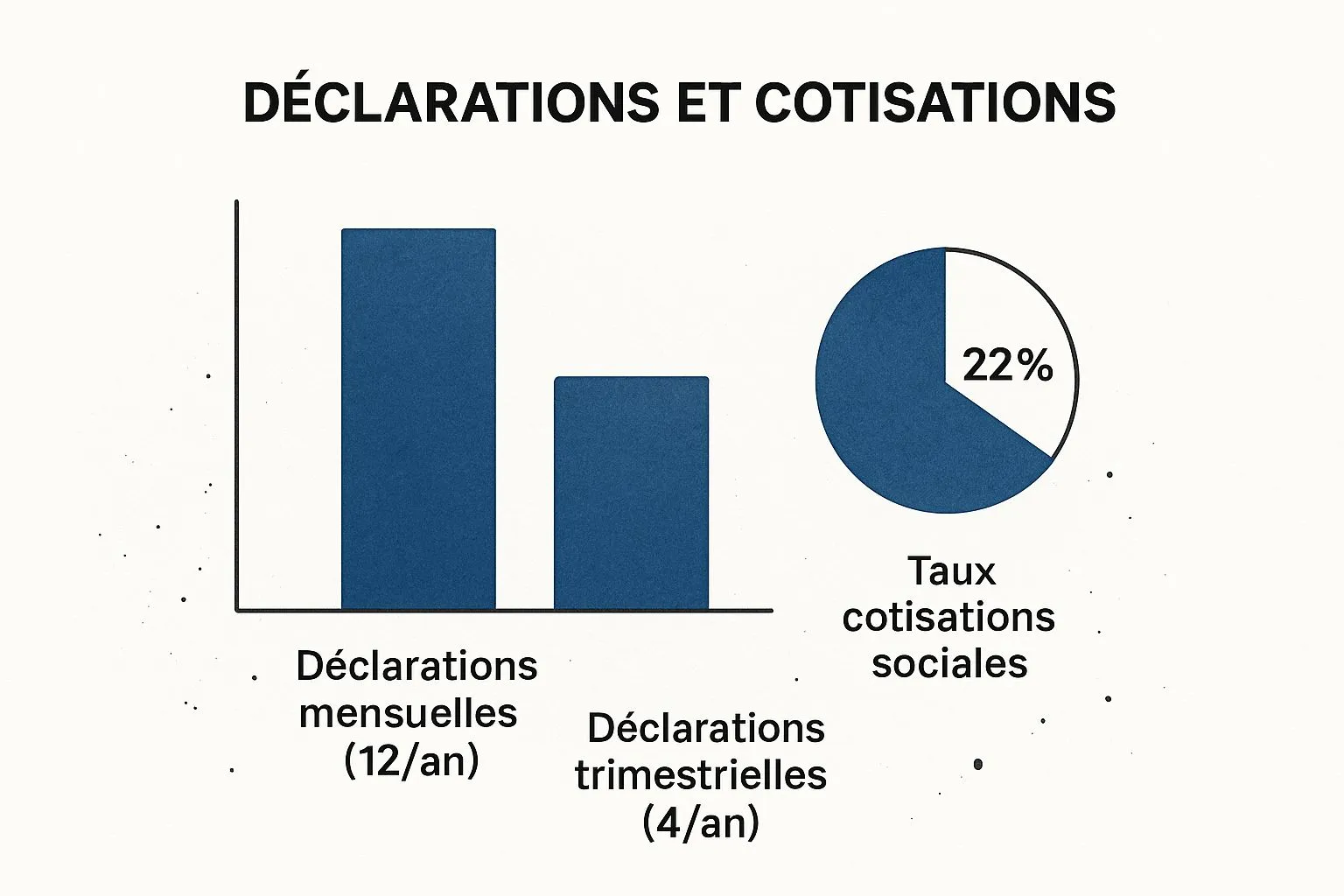
This chart illustrates filing frequencies (monthly or quarterly) and social contribution rates, key elements in calculating a sole trader’s tax. The allowance significantly reduces the base on which contributions and tax are applied.
The impact of allowances on your taxation
Allowances are essential for lightening your tax burden. They reduce your taxable base and, as a result, the amount of income tax and social contributions due. Taxable income is calculated after applying the allowance. For instance, the allowance is 71% for buy-resell activities and 50% for BIC services. This taxable income is then subject to the progressive income tax scale. Staying within the micro-fiscal regime’s revenue thresholds is equally essential. Learn more about declaring sole trader income
To better understand how allowances apply, here is a summary table:
Tax allowances by type of activity
This table shows the different tax allowance rates applicable depending on the nature of the activity carried out as a sole trader, along with the corresponding revenue thresholds.
| Type of activity | Allowance rate | Maximum revenue threshold | Example of taxable income (revenue of €40,000) |
|---|---|---|---|
| Services (BIC) | 50% | €20,000 | |
| Buy/Resell (BIC) | 71% | €11,600 | |
| Liberal professions (BNC) | 34% | €26,400 |
This table highlights how the allowance rate affects taxable income, and therefore the final tax amount.
Legally maximizing the effect of allowances
Correctly identifying your activity is crucial to benefiting from the best allowance. A classification error can lead to financial losses. For mixed activities (sales and services), it’s important to distinguish income from each activity in order to apply the correct allowance.
Managing your expenses efficiently, even though they aren’t deductible under the micro-fiscal regime, optimizes your tax situation. Keeping your costs under control maximizes the share of your revenue benefiting from the allowance, positively impacting your net income.
Assessing whether the micro-fiscal regime still fits
Despite the benefit of allowances, regularly check whether the micro-fiscal regime remains suited to your situation. Exceeding the revenue thresholds may make the simplified actual regime (régime réel simplifié) more advantageous, thanks to the deduction of actual expenses.
In conclusion, flat-rate allowances are a valuable asset for sole traders. Understanding and using them correctly helps optimize your return and maximize your income.
Filing your return without taking risks

Filing taxes as a sole trader may seem complex. However, by following a precise method and understanding the key points, this task becomes much simpler. This guide will walk you through it step by step for a calm, error-free tax return.
The key boxes on form 2042-C-PRO
Form 2042-C-PRO is essential for declaring your sole trader income. Available on impots.gouv.fr, it’s automatically included with your main return (form 2042) if you declare non-salaried income. It’s crucial to identify the boxes specific to your activity.
For BIC (industrial and commercial profits), such as selling products or providing craft and commercial services, use boxes 5KO (sales) and 5KP (services). If you’ve chosen the withholding tax option, use boxes 5TA and 5TB. For BNC (non-commercial profits), from a liberal activity, use box 5HQ (or 5TE with the withholding tax option). Enter your annual revenue in the corresponding box without deducting the allowance — the flat-rate allowance will be calculated automatically by the tax authorities.
Common mistakes to avoid
Mistakes, often due to misreading the form or a lack of attention, can complicate the process. Confusing revenue with profit, forgetting to file when there’s no income, or picking the wrong activity category (BIC or BNC) are common examples. Filling in box 5HY (social contributions) is also a frequent mistake, since Urssaf already collects these contributions directly.
Before submitting, carefully review your return. Consult online resources such as guides and tutorials. If in doubt, don’t hesitate to contact the tax office or a chartered accountant.
The importance of documentation in case of an audit
A tax audit, while rare, is always possible. Keep all supporting documents for your income: invoices, bank statements, contracts… These documents justify your declared revenue and the allowances applied. Good documentation protects you in case of a dispute and simplifies the management of your business. Tools like Bizyness can simplify managing your invoices and transactions, making it easier to prepare your return.
Advice from experienced sole traders
Experienced sole traders who have already gone through tax audits recommend keeping a record of income and expenses, even though it isn’t mandatory under the micro-fiscal regime. A clear, detailed record makes exchanges with the tax authorities easier. It’s also important to stay informed about changes to the micro-fiscal regime and to regularly check the consistency between declared revenue and social contributions paid to Urssaf. Good organization and rigorous preparation are essential for a worry-free tax return.
Navigating the tax calendar with confidence
Meeting your tax deadlines is essential for properly running a sole proprietorship. More than a mere obligation, it’s a genuine tool for optimizing your cash flow and steering your business effectively. This guide will help you turn these constraints into opportunities.
Filing frequency: choosing the right rhythm
One of the first decisions to make concerns the frequency of your revenue declaration. Monthly or quarterly? The choice depends on your activity and how regular your income is.
Monthly filing offers a precise view and better control. It lets you anticipate cash flow variations and adjust your forecasts.
However, it can be time-consuming. Quarterly filing, more flexible, suits activities with irregular income. It simplifies administrative management but requires more planning ahead for paying contributions. The right rhythm depends on your organization and the nature of your activity.
Anticipating deadlines: managing with peace of mind
To avoid the stress of deadlines, planning ahead is essential. Many sole traders use reminder systems: calendars, phone alerts, or management software like Bizyness, which automates these processes.
Automating invoicing and syncing with your bank account simplify tracking your revenue. Setting aside a monthly provision, an estimate of your contributions, ensures cash is available when payment is due. This proactive approach frees your mind to focus on your core business.
The tax calendar: a management tool
Beyond the legal aspect, the tax calendar gives you a valuable overview of your business’s financial health. Regularly analyzing your filings helps identify periods of strong activity and potential slowdowns.
This data helps you adapt your business strategy, anticipate financing needs, and make informed decisions for your business’s growth.
To help you visualize the key deadlines, here is a summary table:
Tax deadline calendar for sole traders
This table summarizes the main dates to remember to meet your tax and social obligations as a sole trader.
| Period | Type of declaration | Deadline | Filing method |
|---|---|---|---|
| Monthly/Quarterly | Revenue | Varies by month/quarter | Online at impots.gouv.fr or via approved software |
| Annual | Income tax (2042-C-PRO) | May/June (varies by region) | Online at impots.gouv.fr |
This table is an example and dates may vary. Check the official tax website for exact dates.
In conclusion, mastering the tax calendar is a major asset for the success of your sole proprietorship. A proactive approach and the right tools turn these obligations into opportunities for optimized financial management and sustainable growth.
Ethical and effective tax optimization strategies
As a sole trader, optimizing your taxes is a perfectly legitimate concern. It’s not about bypassing the law, but about intelligently using existing legal mechanisms to minimize your taxes. Let’s explore a few effective, ethical strategies to achieve this.
Structuring your activity: a key first step
The structure of your activity has a direct impact on your taxation. Choosing the right tax regime, between micro-fiscal and the simplified actual regime, is crucial. The simplified actual regime can be more advantageous if your revenue exceeds certain thresholds or if your expenses are significant.
Timing your expenses: an optimization factor
When you make your business expenses also affects your taxation. Planning certain investments, such as equipment purchases, toward the end of the year can help reduce your taxable base. This strategy requires good planning and a thorough understanding of your business.
Tax mechanisms: levers worth using
Many tax mechanisms exist to support sole traders. The flat-rate allowances of the micro-fiscal regime, for example, reduce the taxable amount. Understanding these mechanisms and using them is essential. Other mechanisms, such as the tax credit for management training, may also be relevant.
Concrete examples of optimization
Take the example of a sole trader planning a major equipment purchase. By making this expense before the end of the tax year, they reduce their taxable profit and therefore their tax. Another example: a sole trader with a mixed activity (sales and services). Distinguishing between these two activities and applying the corresponding allowances optimizes their return. A tool like Bizyness can simplify categorizing income and expenses, making optimization easier.
Tailored solutions for every sole trader
There’s no miracle recipe. Tax optimization strategies must be tailored to each situation: sector of activity, revenue, plans. A sole trader just starting out won’t have the same needs as one with an established business.
Working with a chartered accountant: a worthwhile investment
Tax optimization is complex. Getting support from a chartered accountant is highly recommended. This professional guides your choices and helps you put the most relevant strategies in place, in compliance with the law. They also keep you informed of legislative changes and help you anticipate them. Even though it comes at a cost, their expertise can be very worthwhile in the long run.
In conclusion, optimizing your taxes as a sole trader is both a right and a legal practice. It simply requires a strategic approach, a good knowledge of existing mechanisms, and guidance from qualified professionals. Transparency and rule-following are the keys to ethical, sustainable tax optimization.
Costly mistakes and how to avoid them
The sole trader journey is full of pitfalls, particularly on the tax front. Mistakes, often due to a lack of familiarity with the rules or a lack of rigor, can lead to significant financial consequences. This guide reviews the most common mistakes, identified by tax experts and sole traders themselves, and offers solutions to avoid them.
Common mistakes when filing your tax return
Filing your tax return is a key step for sole traders. Several mistakes can occur, such as confusing revenue with profit. It’s worth remembering that a sole trader declares revenue, to which a flat-rate allowance is then applied. Declaring profit directly is a classic mistake. Forgetting to declare revenue, even when it’s zero, or picking the wrong box on form 2042-C-PRO are also recurring errors. Choosing the wrong activity category (BIC or BNC) also affects the tax calculation. Finally, many sole traders fill in box 5HY for social contributions, even though these are collected directly by Urssaf.
Situations that can trigger a tax audit
Certain behaviors can draw the attention of the tax authorities. Inconsistencies between declared revenue and bank account movements, business expenses that are excessive relative to the activity, or a lifestyle that doesn’t match declared income are all warning signs. Failing to respond to a request for justification from the tax authorities can also lead to penalties.
How to handle an audit or a request for justification
A tax audit doesn’t necessarily mean there’s a problem. If you’re audited or asked for justification, it’s essential to stay calm and cooperative. You’ll need to provide all the necessary supporting documents: invoices, bank statements, contracts… Good organization and rigorous documentation are your best assets. Management software like Bizyness lets you centralize invoices and transactions, making it easier to justify your revenue. In more complex situations, working with a chartered accountant is recommended.
Setting up practices for a transparent business
Adopting simple practices minimizes the risk of errors and audits. Keeping an accurate record of income and expenses, carefully filing supporting documents, and regularly checking the consistency between declared revenue and social contributions are essential habits. Using a management tool like Bizyness helps automate certain tasks and gain peace of mind. Staying informed about changes to the micro-fiscal regime and seeking professional help when in doubt are also important. Planning ahead and staying organized let you approach your tax obligations with confidence and peace of mind.
Tools and resources for friction-free tax management
Managing your tax filings can seem like a complex task for a sole trader. Fortunately, many solutions exist to simplify this process and save you time. This guide explores the various tools and resources available, from mobile apps to expert advice.
Apps and software: your allies for simplified management
Several apps and software programs are specifically designed to help sole traders manage their taxes. They automate tasks such as tracking income and expenses, creating compliant invoices, and calculating social contributions. Some platforms even offer tax simulations to help you anticipate the amounts due.
-
Cash flow tracking apps: Visualize your financial flows in real time for better budget management and more accurate anticipation of your tax deadlines.
-
Tax simulation platforms: Estimate your tax amount based on your revenue and sector of activity. A valuable asset for avoiding bad surprises and optimizing your cash flow.
-
Invoicing software: Simplify creating compliant invoices and tracking payments. An essential tool for any sole trader. Available software includes Facture.net.
Human expertise: an asset for optimized management
While digital tools are undeniably effective, working with a chartered accountant remains a major asset in certain situations. For sole traders with a complex business or a high volume of transactions, a chartered accountant can identify tax optimization opportunities and save you time.
When should you turn to a chartered accountant?
Whether to use a chartered accountant depends on several factors, such as your revenue, the complexity of your business, and your comfort with administrative management. For some, working with a chartered accountant is a worthwhile investment from the very start of their business. For others, the need arises as their business grows. A thorough analysis of your needs and resources will help you make the best decision.
Combining digital tools and human expertise: a hybrid solution
Many sole traders opt for a hybrid approach, combining the use of digital tools for day-to-day tasks with occasional support from a chartered accountant for strategic advice or more complex situations. This strategy lets you benefit from both the speed of digital tools and the expertise of a professional. For example, using invoicing software daily and consulting a chartered accountant for tax optimization questions. A common mistake is poor expense management. Even though this article covers tax tools, expense management is a related topic covered in the article Désinsectisation cafard combien de temps.
Choosing the right tools: the key to a simplified tax return
Filing your taxes shouldn’t be a source of stress. By using the right tools and getting support from a chartered accountant when needed, you can simplify this process and focus on growing your business. Bizyness is an all-in-one platform that supports sole traders in their management, from invoicing to tax filing to cash flow tracking. Save time and make your life easier with Bizyness.