

 Français
 Tax certificate for sole traders: the official guide
The complete guide to obtaining your tax certificate as a sole trader. Understand its role, follow the steps on URSSAF and avoid common mistakes.

As a sole trader (auto-entrepreneur), you juggle plenty of paperwork. But if there’s one document that deserves your full attention, it’s the tax certificate. It’s essentially the centerpiece that officially proves the amount of revenue you declared over the past year. In practical terms, it’s irrefutable proof of your professional income, a passport for a whole host of administrative and financial procedures.
Decoding your tax certificate
Think of your tax certificate as the official health record of your micro-business. It doesn’t just line up numbers; it tells a story — the story of your reliability and good faith toward third parties. Whether you’re dealing with a bank, a landlord or a major future client, this document proves that you’re a serious economic player who is up to date with their obligations.
Far from being a simple formality to file away and forget, the tax certificate for sole traders is a genuine passport to your credibility. It turns your revenue declarations into solid, recognized proof, capable of opening doors that would otherwise stay closed.
This is your number one proof of income. Without it, it’s next to impossible to convince anyone of the financial health of your business for projects as significant as a mortgage or renting an apartment.
A document with many facets
The usefulness of this certificate goes far beyond a simple declaration. It’s a direct reflection of how rigorously you manage your business. Every declaration you make, whether monthly or quarterly, to URSSAF adds to the credibility of this final document.
To really grasp its role, here’s what it concretely lets you do:
- Prove your income: This is its main purpose. It’s almost always requested for a loan, a rental application, and even for certain social benefits.
- Build trust: Presenting this document to a partner or a major client sends a strong signal of seriousness and stability.
- Simplify your procedures: Having it on hand will save you precious time whenever you need to put together an administrative file.
- Prove your compliance: It certifies that you’ve properly fulfilled your tax declaration duty — a crucial point, especially in the event of an audit.
This tool is therefore absolutely central to the toolkit of any sole trader who cares about their image and growth.
The sole trader tax certificate in brief
To help you quickly visualize its characteristics, the table below summarizes the key points. This table sums up the essential features and functions of the tax certificate for a quick understanding.
| Characteristic | Description | Practical use |
|---|---|---|
| Nature of the document | Official certificate summarizing the annual revenue you declared. | Proof of income for banks, landlords and government agencies. |
| Issuing body | The Individual Tax Office (SIP) or URSSAF. | Guarantees the authenticity and reliability of the information it contains. |
| When to obtain it | After your annual income tax return, generally available in summer. | Essential for closing a contract or financing deal after the tax filing period. |
| Requirement to obtain it | Being fully up to date with your revenue and income declarations. | Proves sound and rigorous administrative and tax management. |
In short, understanding the ins and outs of your sole trader tax certificate is not optional, it’s a necessity. It’s the cornerstone that underpins your credibility and facilitates the growth of your business.
Why this document is an asset for your business

Far from being a simple administrative formality, the tax certificate for sole traders is a genuine passport to your credibility. Think of it as a strategic tool that proves the seriousness and good health of your business. It’s not just a piece of paper — it’s tangible proof that you manage your business responsibly.
This image of reliability is essential, especially in a world where trust makes all the difference. Whether you’ve just started out or your business is already well established, this document reassures the people you deal with. Managing it carefully is therefore not wasted time; it’s a direct investment in the future of your micro-business.
Securing contracts with large accounts
When trying to work with bigger companies, paperwork is no longer optional — it’s a requirement. These organizations are subject to a duty of vigilance: the law obliges them to verify that their partners and subcontractors are properly compliant on tax and social security matters.
Why such rigor? To avoid becoming complicit, even unintentionally, in undeclared work. For any contract exceeding €5,000 excluding VAT, your client will therefore almost always ask you for a certificate of vigilance (attestation de vigilance), issued by URSSAF.
The tax certificate complements this winning duo. One (the vigilance certificate) proves that you pay your contributions, the other (the tax certificate) that you correctly declare your income to the tax authorities. For a large account, a freelancer able to provide both documents without delay is a reliable partner. And against the competition, that can change everything.
A key to your personal and professional projects
But the usefulness of the tax certificate doesn’t stop at your clients’ door. It’s also a key document for many of your everyday procedures, since it serves as an official proof of income for the self-employed.
Here are a few very concrete situations where you’ll be asked for it:
- Getting a bank loan: Whether to buy property, finance a project or get a business loan, the bank will want to make sure your income is solid. The tax certificate is the centerpiece to prove it.
- Renting a home: Landlords and real estate agencies need reassurance about your ability to pay rent. Your tax certificate, along with your latest tax notices, will be at the heart of your application.
- Responding to tenders: To win public or private contracts, you need to show you’re above board. The tax certificate is almost always part of the list of mandatory documents for your bid to be considered.
Planning ahead so you don’t miss out
Not being able to provide this document quickly means risking an important contract or personal project slipping through your fingers. Imagine missing a golden opportunity just because of paperwork you didn’t anticipate… That’s exactly the kind of scenario proactive management helps you avoid.
Being able to present an up-to-date sole trader tax certificate at any time makes you a well-organized, trustworthy professional. It smooths out your procedures and strengthens your reputation. To master all your documents, our advice on invoicing for sole traders is an excellent complement. Ultimately, good administrative management is simply the foundation of a business that runs smoothly.
Understanding the legal and tax framework behind your certificate
To really grasp how important your sole trader tax certificate is, you need to look behind the scenes. This document isn’t just another piece of admin paper; it’s the logical outcome of your management and your compliance with the rules of the game. Think of it as your micro-business’s certificate of good conduct.
The basic principle is simple: transparency. Your tax certificate is a faithful reflection of the revenue you declared, whether monthly or quarterly. Every euro declared to URSSAF is a building block toward a solid, credible tax record.
The direct link between your declarations and the certificate
As a sole trader, your administrative life runs on clear deadlines. Every revenue declaration you make to URSSAF is not just a matter of paying contributions. It’s also crucial information that gets shared with the tax authorities. URSSAF and your local Individual Tax Office (SIP) are connected and communicate with each other.
This communication between the two bodies ensures that your file is consistent. The amounts you declare throughout the year must absolutely match what you report on your annual income tax return. It’s this perfect match that allows an accurate, uncontestable tax certificate to be generated.
The tax certificate is official proof that your revenue declarations to URSSAF and your income tax return are properly aligned. The slightest inconsistency can block its issuance or call its validity into question.
Concepts such as revenue thresholds or the VAT exemption threshold are directly involved. Compliance with these thresholds is what determines your tax and social security regime. For example, if you exceed the micro-business thresholds, you change regime, and your tax certificate will reflect this new situation.
A regulatory framework that keeps tightening
The reliability of the sole trader tax certificate is so essential that the authorities have decided to strengthen checks. This is particularly visible with the growing involvement of digital platforms such as marketplaces or freelance sites.
Since January 1, 2024, these platforms have been required to automatically report the revenue of the micro-entrepreneurs who use them to the tax authorities. The idea is to bring more clarity and make it easier to spot potential discrepancies. For more on this topic, you can check the details of this new regulation.
And this is just the beginning. The change will continue:
- In 2026: Platforms will become formally responsible for declaring revenue for each micro-entrepreneur.
- From 2027: They will pay social security contributions directly to URSSAF on your behalf, making collection even more rigorous.
This gradual automation shows just how vital rigorous income management has become. The goal isn’t to make things more complicated for you — quite the opposite. The objective is to simplify compliance. If your declarations are accurate and made on time, obtaining your certificate will remain a formality. Good management is key, and if you want to master all the levers available to you, discover our strategies for tax optimization as a sole trader.
In short, the legal framework guides you toward sound, transparent management. By understanding these mechanisms well and staying diligent with your declarations, you ensure you stay compliant, but above all that you can obtain this precious document, without a hitch, to grow your business.
Step-by-step guide to obtaining your tax certificate
Obtaining your sole trader tax certificate may seem like an obstacle course, but in reality the process is quite simple and entirely done online. Follow the guide — I’ll walk you through it step by step, whether you need this document for your clients or for the authorities.
Before going any further, it’s crucial to clearly distinguish between the two main certificates you’ll need to use. This is the starting point to avoid mistakes and provide the right document to the right person.
- The certificate of vigilance (attestation de vigilance): Issued by URSSAF. It simply proves that you’re up to date with paying your social security contributions. Your clients will ask you for it for any contract exceeding €5,000 excluding VAT. This is a legal obligation for them — their “duty of vigilance.”
- The annual tax certificate: This comes from the tax authorities (or from URSSAF if you’ve chosen the flat-rate withholding option). It certifies the total revenue you declared for the year. Think of it as your official proof of income.
To obtain either of these keys, there’s one golden rule: being fully up to date with your declarations and payments. This is the non-negotiable prerequisite.
Getting your certificate of vigilance on the URSSAF website
When a client asks you for this famous document, don’t panic! The process is very quick and is done directly from your personal account on the URSSAF website.
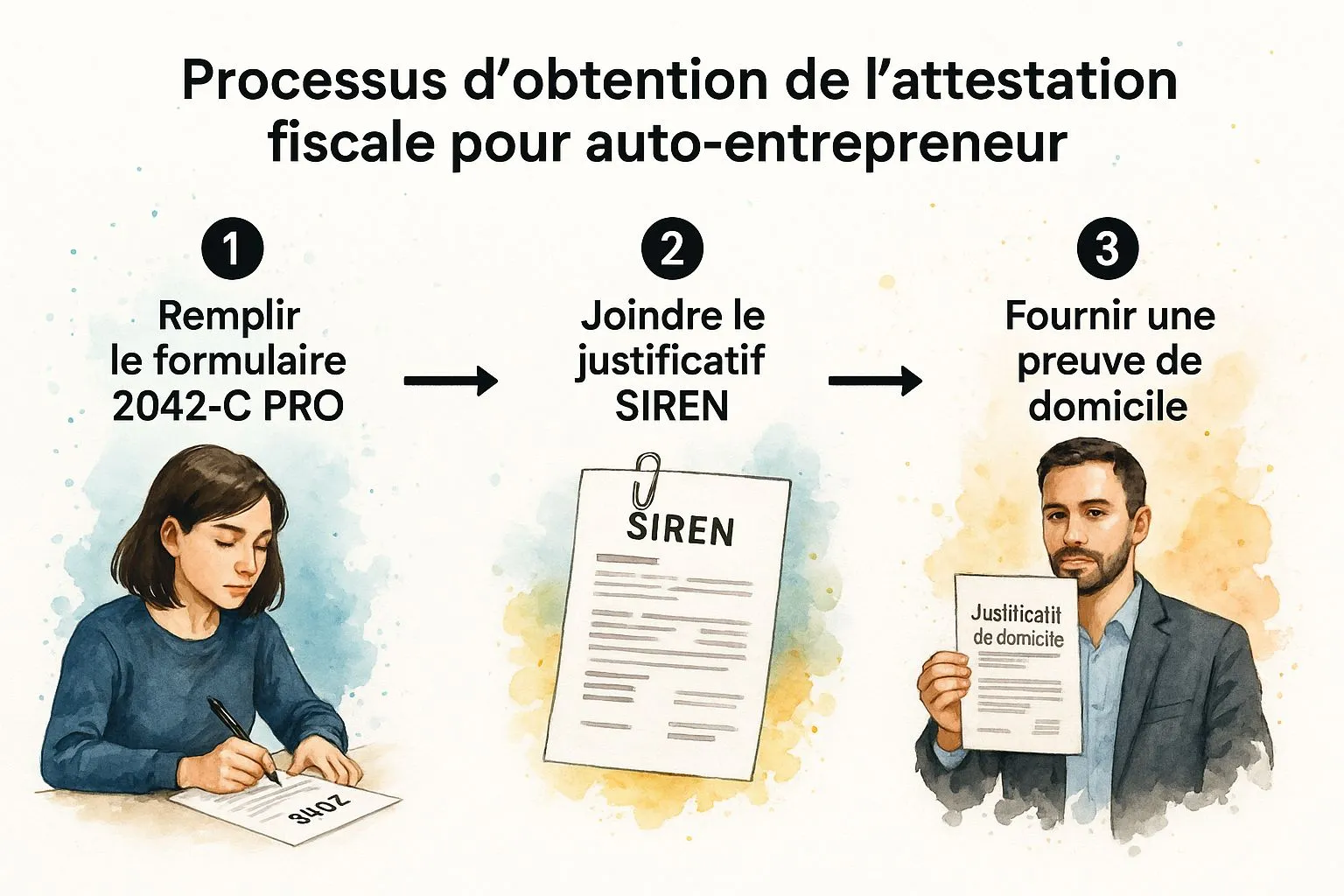
Once you’re logged into your account, the path is clearly marked:
- Go to the “Mes documents” (My documents) section.
- Click on “Mes attestations” (My certificates).
- Select “Demander une attestation de vigilance” (Request a certificate of vigilance).
If everything is in order on your end (declarations made, contributions paid), the certificate is generated instantly in PDF format. All that’s left is to download it and send it to your client. Simple as that.
Retrieving your tax certificate after your income tax return
The sole trader tax certificate, meanwhile, is directly tied to your income tax return. This is the document you’ll present to your banker for a loan or to a landlord to rent an apartment.
To get it, you must first have completed your annual income tax return on the impots.gouv.fr website. This is an unavoidable step.
Once your return is validated, you’ll need to wait a little. The certificate is generally available a few weeks later, often in the middle of summer. You’ll find it in your personal account on impots.gouv.fr, in the “Mes documents” section, right next to your tax assessment notice.
To help you find your way through the maze of tax filing, feel free to check out our full article on income tax returns for sole traders.
My expert tip: Plan ahead! Don’t wait until you’re under pressure to download your certificates. Get into the habit of retrieving them as soon as they’re available. That way, you always have an up-to-date version on hand, ready to use.
Finally, don’t forget that your obligations don’t stop at income tax. Keep in mind the Corporate Property Contribution (CFE) and your social security contributions (which run around 22% to 23% of your revenue). The good news is that you can be exempt from CFE if your annual revenue is below €5,000.
With these pointers, obtaining your sole trader tax certificate should be a breeze.
Common mistakes and how to fix them
Navigating administrative formalities can quickly turn into an obstacle course. One small mistake, one small oversight, and the door opens to trouble. Obtaining your precious sole trader tax certificate can end up blocked, putting you in an awkward position with a client or your bank. Fortunately, most of these pitfalls are well known, and once identified, you can avoid or fix them without too much stress.
The goal here is to give you the keys to anticipate these common problems. By understanding the most classic mistakes, you’ll be much better equipped to keep your administrative situation spotless and obtain your documents without a hitch.
Don’t confuse the certificate of vigilance with the tax certificate
This is probably the most common mistake. You might think they’re the same thing, but not at all! Even though both documents prove sound management, they don’t come from the same body and don’t serve the same purpose. Mixing them up can create real confusion with the people you deal with.
To keep it simple and never get it wrong again:
- The certificate of vigilance is given to you by URSSAF. It proves that you’re up to date with paying your social security contributions. This is the document your client will ask for on any contract exceeding €5,000 excluding VAT.
- The tax certificate, on the other hand, is issued by the tax authorities. It certifies the amount of revenue you declared over the past year. It’s your official proof of income.
The solution is dead simple: whenever someone asks you for a certificate, get into the habit of asking exactly which one. When in doubt, send both — that way you’re sure to hit the mark.
Forgetting to declare zero revenue
“I didn’t collect anything this month, so I have nothing to declare.” That’s a logical thought, but unfortunately the authorities don’t see it that way. Even if your revenue is zero euros for a month or a quarter, you absolutely must still file your declaration with URSSAF.
Failing to do so, even for a zero amount, puts you in an irregular situation. URSSAF will consider that you’re behind on your declarations, which will automatically block the generation of your certificate of vigilance.
If you forgot a declaration, don’t panic, but don’t drag your feet either. Log into your URSSAF account and sort out the situation as quickly as possible. Once your declaration (even at €0) is recorded, everything falls back into place and you’ll be able to download your certificates again.
Handling a late payment or exceeding a threshold
A financial setback can happen to anyone. If you find yourself behind on paying your contributions, above all, don’t bury your head in the sand. URSSAF is often more accommodating than you might think, as long as you’re transparent and proactive.
The best thing to do is contact them directly through the messaging system in your online account to explain the situation. It’s very often possible to negotiate a payment plan to spread your debt over several months. As long as you stick to this agreement, you’ll be considered up to date with your obligations and will be able to obtain your certificates.
Another major point to watch is exceeding revenue thresholds. Sole trader status is subject to well-defined caps. In 2025, the main thresholds are €188,700 for commercial activities and €77,700 for service provision. These are the total amounts collected, before any deductions. To fully understand the nuances, feel free to explore the finer points of sole trader revenue thresholds.
If you exceed these thresholds two years in a row, or the VAT tolerance threshold, your regime changes. You’re no longer VAT-exempt and must start charging it. This is a new responsibility to manage rigorously so that the information on your future sole trader tax certificate stays accurate. Anticipating this transition is key to making it go smoothly.
Your frequently asked questions about the tax certificate
Even with the best explanations, a few practical questions often remain. Here are clear, direct answers to shed light on the most common situations and help you see things more clearly.
Certificate of vigilance or tax certificate: which one do I need?
They’re often confused, yet these two documents don’t serve the same purpose at all. It’s important to tell them apart clearly.
- The certificate of vigilance is your proof of good social security standing. It’s issued by URSSAF, and it certifies that you’ve properly paid all your contributions. Your clients will absolutely need it for any contract exceeding €5,000 excluding VAT.
- The tax certificate, on the other hand, comes from the tax authorities (or from URSSAF in the case of the flat-rate withholding option). It officially proves the revenue you declared. This is the document your banker or future landlord will ask you for to verify your income.
Think of them as two facets of your professional credibility: one proves you’re compliant on social security, the other on tax.
I’ve just started out — what can I give my client?
This is the classic case: you’ve just created your micro-business and, naturally, haven’t yet filed a declaration. So it’s impossible to obtain a certificate of vigilance.
In that case, play the transparency card. It’s always the best strategy. Give your client your URSSAF affiliation certificate. This document proves that your business genuinely exists. You can also attach a sworn statement, specifying that you’ll send the official certificate as soon as you’re able to obtain it.
This simple, honest approach is an excellent way to show your professionalism and put your client at ease.
My tax certificate contains an error — what should I do?
Spotted a mistake on your sole trader tax certificate? Don’t let it sit — you need to act quickly.
If the problem comes from a certificate issued by URSSAF, the simplest thing is to contact them directly through the messaging system in your online account to request a correction.
If the error (a wrong revenue amount, incorrect personal information…) appears on the tax certificate from the tax authorities, it’s likely a sign of an error in your income tax return. No need to panic — simply file an amended return from your account on impots.gouv.fr.
Manage all your invoicing and administrative paperwork without the headache, with Bizyness. Free yourself from admin management to focus on your real job. Discover Bizyness today.
