

 Français
Tax return package (liasse fiscale) definition: the complete guide for e-commerce in 2026
Discover our guide on the tax return package (liasse fiscale) definition and obligations. Simplify your e-commerce accounting and automate its preparation with Bizyness.
Tackling accounting can quickly give you cold sweats, especially when you hear the term “liasse fiscale” (tax return package). For an online seller, though, this isn’t an insurmountable obstacle. Think of it instead as your company’s annual financial health record, the document that translates your thousands of transactions into a language the tax authorities can understand. This guide is here to show you how to turn this obligation into a simple formality.
Demystifying the tax return package for e-commerce entrepreneurs

Let’s be clear: if the term “liasse fiscale” conjures up a mountain of indigestible paperwork, it’s time to change your outlook. Think of it as your online store’s complete year-end statement. Every sale on Shopify, every payment collected via Stripe, and every parcel shipped from Amazon tells a financial story. The tax return package is simply the document that turns this story into numbers.
Its purpose is actually twofold:
- For the tax authorities: it’s the basis for calculating the tax your company owes. In short, it’s the official document that justifies your taxable result for the year.
- For you and your partners: it’s a genuine management tool. A bank, an investor, or even a key supplier may want to review it to assess the soundness and performance of your business.
So it’s not just an administrative constraint, it’s also a goldmine of valuable information about your own business.
A vision beyond the constraint
Preparing your tax return package is a golden opportunity. It’s the perfect moment to step back, analyze what worked well over the past year, and identify your next growth levers. And this is precisely where technology completely changes the game.
Gone are the days of spending weeks manually compiling bank statements and invoices. Today, modern tools can handle this tedious process for you.
A platform like Bizyness, for example, can automate a large part of the work. It connects directly to your sales channels (Shopify, Amazon) and your payment solutions (Stripe, PayPal) to instantly translate every transaction into an accounting entry.
This approach saves you precious time, considerably reduces the risk of errors, and lets you focus on what really matters: growing your store. This guide is designed to walk you through it step by step, without unnecessary jargon, so you can master this essential document. Get ready to take back control.
Understanding what the tax return package really is
Let’s talk about the tax return package. Far from being a simple form, it’s actually your company’s ultra-detailed annual health record. Think of it as the complete file you’d present to your banker, but intended for the tax authorities. It compiles and translates all of your accounting activity into a standardized format that the tax office can understand.
This document primarily serves to bridge two key concepts: the accounting result and the taxable result.
- The accounting result is simple: it’s the difference between what you earned (your income) and what you spent (your expenses). It reflects the raw performance of your e-commerce business.
- The taxable result is the basis on which tax is actually calculated. It’s often different, because the French General Tax Code has its own set of rules.
It’s precisely this shift from one to the other that defines the purpose of the tax return package. It formalizes the necessary adjustments, such as adding back certain non-deductible expenses (a fine, for example) or applying specific deductions.
The official translator of your accounting
More than just a document, the tax return package is a set of Cerfa forms that break down your finances. Every company subject to an actual taxation regime (whether for corporate tax or income tax) must comply with it. Its role is to turn the raw figures from your balance sheet and income statement into a coherent declaration for the tax authorities.
For these figures to make sense, it’s essential to grasp the mechanisms behind them, in particular the principles of accounting entries. This is the foundation for sound, surprise-free financial management.
The tax return package is much more than an obligation. It’s a strategic document that attests to your company’s financial health to key partners such as banks and investors. A clear, precise file is a mark of credibility and seriousness.
Beyond the tax office, a financial business card
With the exception of micro-businesses, producing this document is mandatory. Neglecting it not only exposes you to penalties, but above all deprives you of a powerful analysis tool for the real performance of your business.
Mastering the ins and outs of your tax return package lets you have more constructive discussions with your accountant and make informed decisions. It’s an unavoidable step, whether you’re under the simplified or standard actual taxation regime. To go further, feel free to check out our complete guide on e-commerce accounting.
Anatomy of the tax return package: the forms decoded
To stop seeing the tax return package as an intimidating stack of paper, the best approach is to break it down. Picture it as a large file organized into two parts: on one side, the result declaration, which is the centerpiece, and on the other, a series of supporting schedules. Together, they tell the complete financial story of your company over a year.
Each form has a very specific role and sheds light on one facet of your business. Understanding what each document is for is what gives you a truly clear picture of your e-commerce performance.
Here’s a simple diagram to visualize how your accounting connects to your tax obligations.
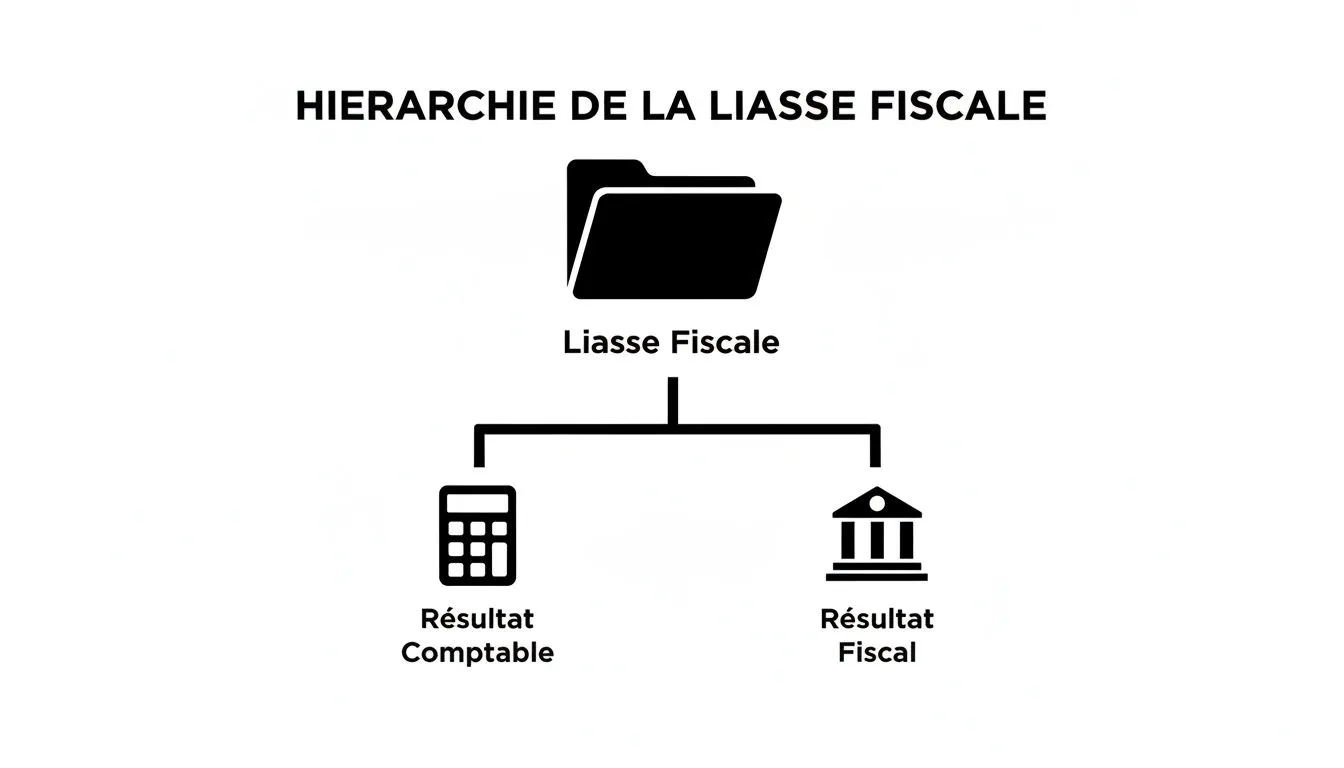
This diagram perfectly illustrates the role of the tax return package: it bridges the accounting result (the real performance of your business) and the taxable result (the basis on which your tax is calculated). And take it from experience, these two results are rarely identical!
The main forms to know
The tax return package is built around a handful of key documents, whose Cerfa numbers can seem daunting at first glance. In reality, their logic is fairly simple.
This table summarizes the essential Cerfa forms that make up the tax return package, their function, and what they reveal about your e-commerce business.
| Form number (Cerfa) | Document name | Main function | Example for an online seller |
|---|---|---|---|
| 2065 or 2031 | Result declaration | Summarizes the calculation of the final taxable result, the basis for tax (corporate or income tax). | Shows whether your online store is profitable or running a loss after all tax adjustments. |
| 2050 & 2051 | Balance sheet (Assets & Liabilities) | Presents a snapshot of the company’s assets at the close of the fiscal year. | Assets show the value of your product stock; liabilities show the amount you owe suppliers. |
| 2052 & 2053 | Income statement | Details the “story” of the year by listing income and expenses to explain the profit or loss. | Reveals whether your sales revenue properly covers your costs (purchases, advertising, salaries…). |
| 2054 & 2055 | Fixed assets & Depreciation | Records durable assets (computers, software) and calculates their annual loss in value (deductible). | Lets you deduct for tax purposes the wear of your IT equipment or your website’s development costs. |
| 2056 | Provisions | Lists probable future expenses the company sets aside to cover itself. | A provision for a customer who might not pay for a large order. |
| 2057 | Statement of receivables and payables | Breaks down debts and receivables by due date. | Gives a clear view of unpaid customer invoices and supplier invoices still to be settled. |
These documents form a coherent whole that gives an accurate picture of your business’s financial health. This is why they are scrutinized not only by the tax authorities, but also by banks or potential investors.
The supporting schedules that add context
But that’s not all. Beyond the main documents, other schedules provide essential details to justify the figures you put forward.
For example, the fixed assets and depreciation schedule (2054 and 2055) is crucial for an online seller. It records your durable investments (computers, software, warehouse fittings) and details their annual loss in value, an expense you can deduct from your result.
Similarly, the provisions schedule (2056) allows you to anticipate risks, such as a dispute with a customer, while the statement of receivables and payables (2057) gives a precise view of your short-term cash position.
Each form fits together with the others, a bit like the parts of an engine. In fact, the tax return package is closely tied to another essential document: the Accounting Entries File (FEC). To fully understand how they work together, we recommend reading our guide explaining what the FEC file is.
Who is affected by the tax return package, and by what deadlines
So, this famous tax return package — does everyone have to deal with it? The answer depends entirely on your taxation regime. If you’re a micro-entrepreneur, you can breathe easy: your ultra-simplified regime exempts you from this formality. One less thing to worry about!
For most other businesses, however, it’s an unavoidable step. This applies to companies (SAS, SARL, SA) and sole proprietorships under the actual taxation regime, whether standard or simplified.
Whether you’re subject to income tax (IR) under the BIC category (industrial and commercial profits) or to corporate tax (IS), the rule is the same. As soon as you move beyond the micro-business framework, the tax return package becomes a mandatory annual appointment.
Who must file a tax return package?
To make things clearer, here’s who is actually on the hook when it comes to preparing the tax return package:
- Capital companies: this is systematic for SAS, SASU, SARL, EURL, and SA structures. By default, they are subject to corporate tax (IS), which makes the tax return package mandatory.
- Sole proprietorships (EI) under the actual regime: if you’ve made this choice, or if your revenue has exceeded the micro-business thresholds, you are required to produce a tax return package.
- Partnerships: even though it’s the partners who pay tax on their share of the profits (IR), the company itself must still prepare its own tax return package to determine the amount of profit to be distributed.
By the way, an important point: even if your company is running a loss, you’re not exempt from filing. It’s actually crucial, because this document formalizes the loss. This loss can then be carried forward to reduce your tax on profits in future years. A calculation not to be overlooked!
Made up of the result declaration and its supporting schedules, the tax return package is therefore an unavoidable step for most businesses, with the exception of micro-businesses, which, to give an idea of scale, represented around 15% of business structures in France in 2026. Its role is to precisely calculate the tax owed, as detailed in form 2065-SD. For those who want to dig deeper into the topic, detailed analyses of tax forms on tgs-france.fr can provide additional insight.
Knowing the deadlines to avoid penalties
With the tax authorities, the calendar is king. A simple delay or omission can quickly become costly: tax surcharges, late payment interest… The bill can even climb up to 80% of the tax amount in cases deemed fraudulent.
The filing deadline is directly tied to your fiscal year-end date. The only winning strategy is to plan ahead. It will spare you the last-minute stress and the errors that can come with it.
Here are the key deadlines to keep in mind for 2026:
- For a fiscal year ending on December 31: the deadline is set at the second business day following May 1 of the following year.
- For a fiscal year ending mid-year: you have a three-month window after your closing date to submit your tax return package.
This is precisely where a platform like Bizyness shows its full potential. By automating the entry and preparation of your accounting data throughout the year, meeting these deadlines no longer feels like a race against the clock, but rather a smooth, well-oiled formality.
How to automate the preparation of your tax return package
For many entrepreneurs, manually preparing the tax return package is a real annual nightmare. Imagine no longer having to spend days compiling hundreds, even thousands, of transactions. That’s exactly the promise of automation: turning this chore into a smooth process, built into your everyday routine.
The basic idea is fairly simple. You connect your everyday tools to a smart platform that handles the repetitive tasks. For an online seller, this means directly plugging your stores (Shopify, Amazon, WooCommerce) and your payment solutions (Stripe, PayPal) into a central system.
Thanks to this connection, every transaction is captured instantly. No more end-of-year data chaos to sort through. Every sale is immediately turned into a clean, well-structured accounting entry. The time savings are obvious, but the real benefit is the reliability of the information.
Turning raw data into usable accounting
Automation goes well beyond simple data collection. The best platforms, like Bizyness, are designed to decode the intricacies of e-commerce.
Concretely, here’s how it works:
- Automatic invoicing: every order triggers the creation of a compliant invoice, with the correct legal wording and the appropriate VAT rate.
- European VAT management: selling across Europe? The system identifies the buyer’s country, applies the local VAT rate, and prepares your declaration for the One-Stop Shop (OSS/IOSS).
- Continuous bank reconciliation: the platform links movements on your bank accounts with recorded sales or expenses. Everything must match, down to the cent.
- Expense categorization: your stock purchases, advertising costs, or subscriptions are automatically sorted into the right accounting categories.
This ongoing groundwork, carried out continuously, forms day after day the basis of your tax return package: the famous Accounting Entries File (FEC). This document, essential for the tax authorities, is thus always ready and accurate. To go further, learning how to automate the generation of your income statement, a key piece of the tax return package, is another excellent way to save time.
A new kind of collaboration with your accountant
Automation completely redefines the relationship with your accountant. Instead of bringing them the traditional “shoebox” full of invoices, you give them access to accounting that’s already prepared, clean, and organized.
Your accountant’s role changes entirely. They spend far less time on data entry, a low-value task, and can focus on strategic work instead: tax optimization, management advice, and of course, the final review of your accounts.
The result? A risk of error that tends toward zero, much more peace of mind around tax compliance, and a far more efficient collaboration. Automation isn’t just a time-saver. It’s a real investment in peace of mind and the strength of your business. And if you want to go even further, discover how to automate other administrative tasks.
A few frequently asked questions about the tax return package
The tax return package… just the name can be a bit intimidating. That’s normal. For many online sellers, it’s a somewhat fuzzy topic that gets mixed up with other accounting obligations. So let’s take a moment to answer the questions that come up most often in practice.
The goal here is simple: clear, direct answers, without unnecessary jargon. The idea is for the tax return package to no longer be a source of anxiety, but simply a formality you understand and plan for calmly.
What’s the difference between the tax return package and the balance sheet?
This is probably the most common confusion, but the difference is actually fairly easy to visualize.
Picture the balance sheet as a snapshot, a photo taken the instant your fiscal year ends. On one side, you see everything your company owns (its assets: product stock, cash in the bank, equipment). On the other, you see everything it owes (its liabilities: supplier invoices, a bank loan). It’s a static view of your assets at a given moment.
The tax return package is much more than that. It’s the complete file you submit to the tax authorities. It naturally contains this “photo” (the balance sheet), but also the entire “story” of the year: the income statement. This tells how you earned (or lost) money. And around that, a multitude of schedules detail and justify each line.
To put it simply, the balance sheet is a key document within the tax return package, but it’s only one piece of the puzzle. The tax return package is the entire puzzle, giving the tax authorities a complete, detailed view of your business’s health.
Can I prepare my tax return package myself, without an accountant?
Legally, the answer is yes. Nothing requires otherwise. Now, is it a good idea? For a non-specialist, honestly, it’s a very high-risk undertaking.
E-commerce taxation is full of pitfalls: managing different VAT rates across countries, provisions for product returns, depreciating a website… A misinterpretation, an oversight, or an approximate calculation can quickly lead to a tax audit adjustment. And the bill can be steep, between penalties and late payment interest.
The best approach is often a collaborative one:
- You take charge of your data with a tool like Bizyness, which automatically sorts and organizes all your transactions on an ongoing basis.
- Your accountant works from a clean foundation. They no longer waste hours on manual data entry. They focus where their value is highest: reviewing, optimizing your tax position, and ensuring the filing goes smoothly.
This method has a double benefit: it drastically reduces your accountant’s bill while reinforcing the reliability of your declaration. You combine the power of day-to-day automation with the security of professional expertise for the crucial moment of filing.
My company is running a loss. Do I still need to file a tax return package?
Yes, without a shadow of a doubt. It’s actually mandatory. All companies under the actual taxation regime must file a tax return package, whether they’re profitable or running a loss. Thinking you can skip it because you didn’t make money would be a mistake.
First, you’d risk penalties for not filing. But more importantly, you’d miss out on a very significant financial lever. A declared loss is never wasted. It’s what’s known as “carry-forward” eligible.
In concrete terms, this means the loss will be set aside and can be deducted from your future profits. The day your store takes off and becomes profitable, you’ll pay less tax thanks to the past losses you officially declared. The tax return package is therefore the act that registers this right for the future. It’s an essential management tool, even in tough times.
Ready to turn accounting management into a simple, automated process? Bizyness is the platform built specifically for online sellers who want to focus on their growth, not their paperwork. Discover how Bizyness can prepare your accounting in real time and streamline collaboration with your accountant.
