

 Français
Unpaid invoice payment reminders: the guide to getting paid stress-free
Your guide to unpaid invoice payment reminders. Discover concrete methods and templates to recover your money while preserving the client relationship.
Dealing with an unpaid invoice is not just an administrative task. It’s an essential step for your business’s survival. Setting up a structured payment reminder strategy is, in fact, your best protection to secure your cash flow and ensure the longevity of your business.
Why rigorous reminder management is vital for your cash flow
A late payment is never trivial. For a freelancer or a small business, every euro counts. A single unpaid invoice can quickly snowball: difficulties paying your suppliers, your expenses, and sometimes even your own pay. The stakes go far beyond a simple accounting line.
The numbers speak for themselves. In France, the reality of late payments is quite striking. A recent study showed that over the past 12 months, 86% of French companies experienced late payments, with an average delay approaching 50 days. For more than half of micro-businesses, the impact is even described as “critical,” directly threatening their financial balance. You can dig deeper into the topic by reading the study on payment behaviors in France on Coface.fr.
Turning payment reminders into proof of professionalism
Many entrepreneurs dread chasing their clients for payment. The fear of seeming too pushy or straining the business relationship is real. Yet this is a misconception. Proactively managing unpaid invoices is, on the contrary, a sign of seriousness and organization.
A good payment reminder strategy for an unpaid invoice brings you several benefits:
- Securing your cash flow: This is the number one goal. You simply make sure the work you delivered gets paid on time.
- Maintaining healthy relationships: Transparent, prompt communication defuses many misunderstandings. Often, a simple friendly reminder is enough to fix an oversight.
- Educating your clients: By systematically enforcing your payment terms, you build good habits and show that you take your deadlines seriously.
An unpaid invoice is not inevitable. It’s a signal that calls for an organized response. By approaching payment reminders methodically, you turn a source of stress into a controlled process that strengthens your business.
A gradual approach to maximize your chances
The secret to an effective reminder process is progressiveness. There’s no need to bring out the heavy artillery on day one. The idea is to follow an action plan that escalates gradually, starting with a simple courteous reminder before the due date, up to formal notice if necessary.
This guide is designed to give you the keys to act at the right time, in the right way. By adopting this proactive approach, you will not only significantly reduce your payment delays, but you’ll also gain peace of mind, knowing your cash flow is much better protected.
Building a reminder schedule that actually works
When an invoice remains unpaid, time works against you. Following up too early can annoy your client; too late, and your chances of recovering your money shrink. The key to success? A gradual, well-paced approach that protects your business relationship while firmly defending your cash flow.
The idea is not to enter into conflict, but to handle what is often a simple oversight or a temporary difficulty. A good reminder strategy turns a potentially tense situation into a controlled, professional process. It’s the mark of a well-organized business.
The process is ultimately quite simple: an unpaid invoice arises, a series of structured reminders kicks in, and the payment is secured.
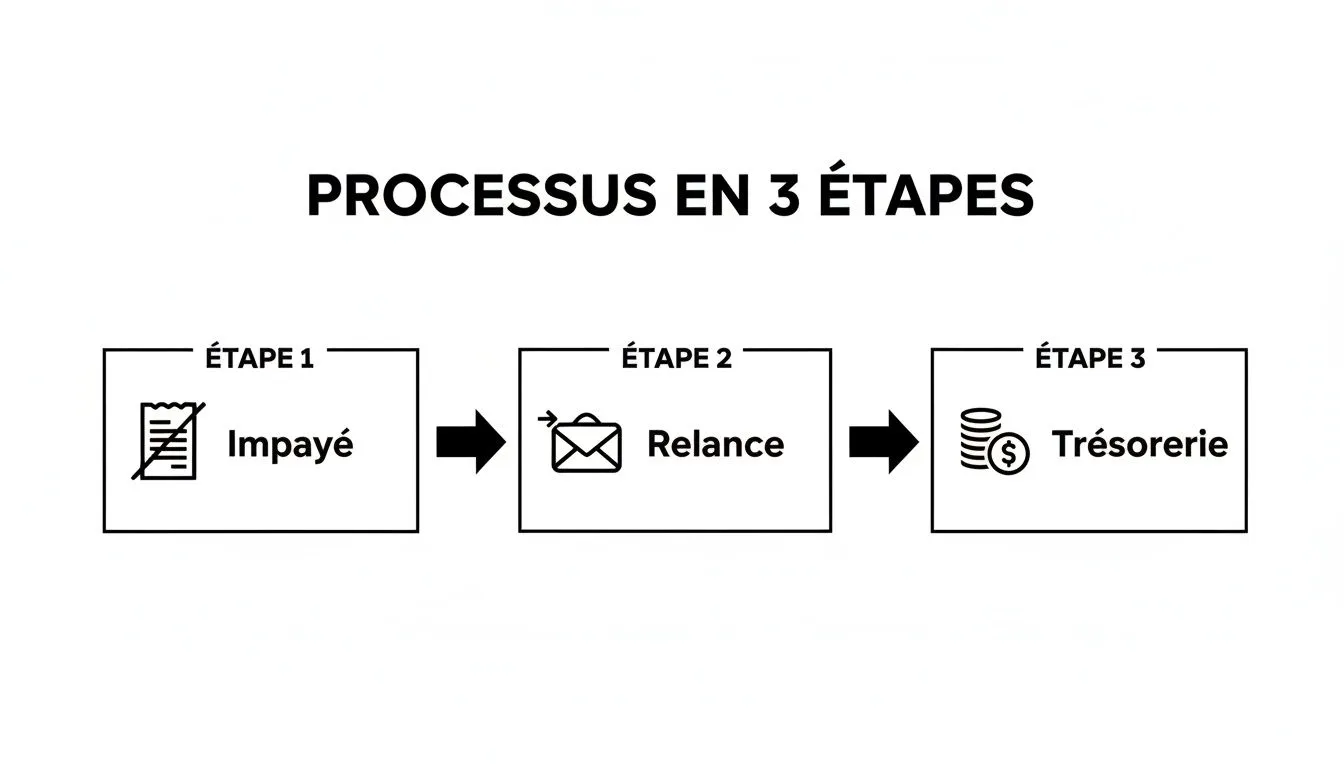
The payment reminder is what connects the problem (the outstanding invoice) to its solution (the money in your account).
To clearly visualize the steps, here is a typical schedule you can adapt. It shows how to gradually and professionally ramp up the pressure.
Typical schedule of reminder actions for an unpaid invoice
This table presents a schedule of progressive actions for following up on an unpaid invoice, from a friendly reminder to formal notice.
| Step | Timing (after due date) | Communication channel | Tone and objective |
|---|---|---|---|
| Preventive reminder | D-5 to D-3 | Courteous and preventive. Remind of the imminent due date, make sure everything is in order. | |
| 1st friendly reminder | D+2 to D+5 | Friendly and informative. Assume it’s an oversight. Remind of the payment due. | |
| Phone follow-up | D+7 | Phone | Direct and personal. Understand the reason for the delay, obtain a payment commitment. |
| 2nd written reminder | D+15 | Firmer, but professional. Reference previous contacts and mention penalties. | |
| Formal notice | D+30 | Registered letter with acknowledgment of receipt | Formal and legal. Final warning before initiating debt collection proceedings. |
Following this type of structured schedule not only clarifies the situation for your client, but also builds a solid case file should things get complicated.
The preventive reminder: the gesture that changes everything
Even before the invoice is officially overdue, a small proactive action can save you a lot of trouble. Send a simple courtesy email 3 to 5 days before the due date. This isn’t yet a reminder for an unpaid invoice, just a friendly heads-up.
This small gesture is incredibly effective. It allows you to:
- Politely remind of the approaching due date.
- Make sure your client actually received the invoice (and that it isn’t stuck in their spam folder).
- Give them the opportunity to flag a potential upcoming payment difficulty.
This is a healthy business practice that defuses delays caused by simple oversights.
The first friendly reminder: right after the due date
The deadline has passed, and still nothing. It’s time to act, but gently. Your first reminder, sent between 2 and 5 days after the due date, should always assume good faith and forgetfulness.
The tone should remain friendly. The goal is simple: point out the existence of this invoice while assuming it’s a simple omission. The email should be short, clear, and always include the invoice as an attachment to make your client’s life easier.
Get straight to the point: mention the invoice number, its date, its amount, and note that the due date has now passed. Close on an open note, inviting your client to reach out if they have any questions.
Phone follow-up: a more human approach
Your email went unanswered after a few days? Around D+7, a phone call can often unblock the situation. It’s a much more direct channel that lets you immediately understand where the problem lies.
Prepare before you dial: have all the invoice details in front of you and a clear goal in mind. Do you want simple confirmation that payment is on its way, or a firm payment date?
Stay calm and professional. Introduce yourself, explain the purpose of your call, then listen. This exchange often reveals a misunderstanding (invoice never received, error in the amount) that a simple email wouldn’t have uncovered.
The second written reminder: stepping it up
Another week has passed (you’re approaching D+15), payment is still pending, and your call didn’t resolve anything. It’s time to send a second written reminder. This time, the tone hardens slightly, while remaining perfectly courteous.
In this new email, explicitly reference your previous contacts. For example: “Following our email of [date] and our phone conversation of [date], we note that invoice #XXX remains unpaid.” This shows you are tracking the matter rigorously.
Experience shows that a methodical, gradual approach pays off. A well-executed reminder strategy can increase the recovery rate by 20 to 30%. To learn more on this topic, feel free to check out effective reminder strategies on dreki-france.fr.
This is also the right time to mention, for the first time, that late payment penalties may apply, as provided for in your terms and conditions of sale. It’s a clear signal that the situation must be resolved without delay. If this attempt fails, the next step will be formal notice, a much more formal act.
Charging late payment penalties and the €40 compensation fee
When friendly reminders are no longer enough to unlock payment of an invoice, the law gives you cards to play. Applying late payment penalties and the flat-rate compensation fee isn’t aggression — it’s a right that protects your cash flow and sends a clear signal to your client.
This is a step that shows you know your rights and are serious about your collection efforts. Properly used, these penalties are a formidable tool for prompting action.
What does the law say about penalties?
It’s very simple: any invoice unpaid at its due date between businesses automatically triggers late payment penalties. This is an absolute right. You don’t even need to send a reminder for them to be owed.
They start accruing the day after the payment date stated on the invoice. The only condition for claiming them is that you clearly stated their calculation terms in your terms and conditions of sale and on your invoices.
Think of it this way: late payment penalties are not a favor you grant, but a right the law gives you. Stating them on your documents is not just a legal obligation — it’s your best armor against bad payers.
How to calculate late payment penalties
The calculation is nothing complicated. The formula is straightforward:
(Invoice amount including VAT x penalty rate) x (number of days late / 365)
The crucial point here is the famous penalty rate. You have a choice, but within a well-defined framework.
- The default rate: If you haven’t specified anything in your terms and conditions, the law imposes the European Central Bank (ECB) refinancing rate plus 10 points.
- Your own rate: This is the option I recommend. You can set your own rate, provided it is not lower than 3 times the legal interest rate. It’s much more of a deterrent.
Let’s take a concrete example. An invoice for €1,500 including VAT has been unpaid for 30 days. Your penalty rate, clearly stated in your terms and conditions, is 12% per year.
The calculation gives: (€1,500 x 12%) x (30 / 365) = €14.79.
This amount may seem small, but it adds to the debt and keeps climbing every passing day. For more on this point, our guide on late payment penalties on an invoice with a calculation example will give you all the keys.
Don’t forget the €40 flat-rate compensation
In addition to these penalties, the law provides another protection: a flat-rate compensation of €40 to cover your collection costs. This is a fixed amount, owed automatically from the first day of delay, without you having to justify anything.
It is always added on top of the penalties. In our example, your client therefore owes you the €14.79 in penalties, plus this €40. The total additional cost then comes to €54.79.
If your actual costs to recover your money (for example, if you use a collection agency) exceed this €40, you are entitled to claim additional reimbursement, provided you supply the supporting documents.
Applying penalties: a matter of timing and strategy
Having the right to apply these penalties is one thing. Doing so at the right time is another. Should you charge them from the very first day of delay? Certainly not. It’s all a matter of tact and relationship management.
For a long-standing client who simply has their mind elsewhere, a simple polite reminder will be more than enough. On the other hand, starting to mention penalties in your second or third written reminder is an excellent way to gently ramp up the pressure. It shows that you are closely tracking the matter and that your patience has limits.
Facing a client who goes silent or acts in bad faith, formally applying the penalties in the formal notice letter becomes essential. It’s the strong signal that officializes the debt and gives weight to your approach before considering more serious action, such as legal proceedings. It’s a powerful lever to unlock your unpaid invoice and assert your determination.
Writing an effective formal notice letter

When emails and calls go unanswered, it’s time to shift gears. The formal notice is not just another reminder; it’s the final warning before moving to the next level. This highly formal legal act marks a real turning point in your efforts to recover the funds of an unpaid invoice. It’s the clear signal that your patience has limits.
Far more than a simple letter, the formal notice has legal value. It officially records the payment delay, starts the calculation of late interest (default interest), and, above all, is often a required prerequisite before you can take a case to court. In short, it’s your best card to prove that you tried everything amicably first.
The legal mentions you must not forget
For a formal notice letter to be legally valid, it must absolutely contain certain information. Leave out just one of these elements, and it could be considered void. It’s a bit like a recipe: if a key ingredient is missing, the dish is ruined.
Your letter must therefore include:
- Full identification of both parties: Your details (name, address, business registration number) and those of your client. Be precise.
- The date and place of drafting: Essential to mark the starting point of the procedure.
- The wording “Formal notice”: It must appear clearly, ideally in the subject line of the letter, so there is no ambiguity.
- A summary of the dispute: Briefly recall the origin of the debt (which service, which product) and mention the friendly reminders already sent.
- The exact breakdown of the debt owed: State the amount of the original invoice, add the late payment penalties you calculated, and don’t forget the €40 flat-rate compensation for collection costs.
Documenting each step is essential. In France, where 62.6% of companies have recently faced unpaid invoices, a gradual, well-archived process is key to success. It paves the way for legal action and strengthens your position. To better grasp the scale of the problem, the data on the surge in late payments compiled by GPOmag.fr is very insightful.
Setting a deadline and stating the consequences
Once the total amount is fully detailed, you must give your client one final period to settle the situation. This period should be reasonable but firm. In practice, a period of 8 to 15 days is generally considered sufficient.
Expert tip: Be precise about the deadline. Instead of a vague “within a week,” write “before [specific date].” It’s much clearer and leaves no room for interpretation.
The most important part comes next: clearly state what will happen if payment is not made within the given period. Specify that, once this date has passed, you reserve the right to initiate judicial debt collection proceedings (such as an order to pay) to obtain forced settlement of your unpaid invoice. The message must be unambiguous.
A formal notice template to adapt
To make sure you don’t leave out any information, you can use this template as inspiration. Simply personalize it with your own details.
[Your full contact details]
[Debtor client’s contact details]
[Place], [Date]
Registered letter with acknowledgment of receipt
Subject: Formal notice to pay invoice #[Invoice number]
Dear Sir or Madam,
Despite our previous reminders dated [dates of reminders], we note that invoice #[Invoice number], issued on [Invoice date] for an amount of [Amount including VAT] €, remains unpaid to date.
In accordance with our terms and conditions of sale, late payment penalties at a rate of [Your rate]% therefore apply. These amount to [Penalty amount] €, to which is added the flat-rate compensation for collection costs of €40. The total amount owed is therefore [Total amount] €.
By this letter, we formally give you notice to pay the sum of [Total amount] € within 8 days of receipt of this letter, that is before [Deadline date].
Failing payment on your part within this period, we will be forced to bring the matter before the competent court in order to obtain forced collection of our claim, along with all associated costs.
Yours faithfully,
[Your name and signature]
Remember: sending it as a registered letter with acknowledgment of receipt is the only method that will give you irrefutable legal proof that your client actually received this letter. This is the small piece of paper that will open the doors of the court should the situation require it.
Exploring judicial debt collection options
When your formal notice goes unanswered, your client’s silence isn’t the end of the road. It’s simply the signal that it’s time to shift gears and move to the next, more formal step: judicial debt collection.
We often imagine a complex, lengthy, and costly procedure, reserved for large companies. That’s a misconception. In reality, the justice system offers surprisingly agile and affordable solutions, perfectly suited to small businesses and freelancers.
See legal action not as a failure, but as the ultimate tool at your disposal to assert your rights. You did the work, you delivered your product or service. You deserve to be paid. It’s as simple as that, and the justice system is there to restore that balance.
The order to pay: the fast and affordable route
For the vast majority of undisputed commercial debts, the order to pay (injonction de payer) is the best option. It’s a so-called “non-adversarial” procedure, meaning it takes place without a hearing, and therefore without your debtor being present. Its advantage is huge: it’s fast, inexpensive, and you don’t even need a lawyer to start it.
Concretely, how does it work?
- Build your case file: Gather all the evidence you have on hand. The signed quote, the purchase order, the invoice, and of course the formal notice with its acknowledgment of receipt.
- File the request: Simply fill out a dedicated official form and submit it to the clerk’s office of the commercial court.
- Wait for the decision: The judge reviews your file. If they find your claim justified, they issue an “order to pay” (ordonnance portant injonction de payer).
Once you have this order, you must have it formally served to your debtor by a bailiff. From that point, your client has one month to object. If they don’t, great! You ask the clerk’s office to affix the “enforceability clause” (formule exécutoire) to the order. This document then becomes an enforceable title, the ultimate weapon that allows the bailiff to seize funds to recover your money, for example directly from the client’s bank account.
The interim payment order for undisputable debts
Another very effective avenue is the interim payment order (référé-provision). This procedure is a bit different, as it requires a hearing, but it remains extremely fast. It’s ideal when your claim is “not seriously disputable.” In plain terms: when it’s obvious that your client owes you money and has no valid excuse.
In this case, the judge can order your debtor to pay you an advance — a “provision” — on the total amount owed. The big advantage is that this decision is immediately enforceable, even if your client decides to appeal. It’s a formidable way to recover a good portion of what you’re owed without waiting for the end of a trial that could drag on.
Legal action, collection agency… which to choose?
Before diving headfirst into a legal procedure, you might be tempted to hire a collection agency or a bailiff. Each option has its strengths and weaknesses. It’s crucial to carefully weigh the pros and cons to choose the wisest strategy for your unpaid invoice.
A well-prepared file is a half-won case. Before taking action, make sure everything is perfectly documented, from the order to the last reminder. This rigor is what will give weight to your approach, whether amicable or judicial.
To help you see things more clearly, here is a brief comparison of the different approaches.
| Option | Costs | Effectiveness and timeline | Ideal for… |
|---|---|---|---|
| Collection agency | Commission on amounts recovered (15-25%). No fee if it fails. | Variable effectiveness. Can be fast if the client is cooperative, but with no legal power of enforcement. | Handling several small claims, or if you lack the time to manage reminders yourself. |
| Bailiff (amicable) | Fixed fees for formal acts (payment demand, reminders). | The psychological effect is often strong. The bailiff can also negotiate a payment plan. | Applying official pressure before launching legal proceedings. Intervention by a public officer can unblock many situations. |
| Legal proceedings | Court fees, bailiff fees, and potentially lawyer fees if things get complicated. | Slower, but the goal is to obtain an enforceable title to force payment (seizure). Effectiveness is almost guaranteed if you win. | Debts of a significant amount, or when facing a bad-faith client who ignores all your amicable attempts. |
Your final choice will depend on the amount at stake, your client’s profile, and how much energy you want to invest. There’s no miracle recipe. To dig deeper into the topic, feel free to check out our full guide on customer debt collection strategies — it will help you build a real action plan. The key is to never stay passive and to view these options as normal tools in the life of a business.
Automate your invoice tracking and regain peace of mind
Chasing after an unpaid invoice is a waste of time and a huge source of stress. Every minute spent following up with a client is a minute not spent on your core business. Fortunately, there are now tools, like Bizyness, that turn this chore into an almost invisible process.
Automation isn’t just a technology gadget. It’s a true strategic ally for the health of your cash flow. Imagine a system that works for you, behind the scenes. You set up your reminder schedule just once, and that’s it: a small courteous reminder at D+5, a slightly more formal email at D+15, and a final notification before things get serious. No need to think about it anymore.
Get a clear view of your cash flow again
The real power of these tools is the dashboard. At a glance, you know exactly where you stand: which invoice has been sent, opened, and above all, which one is overdue. This visibility is essential to anticipate difficult end-of-month periods and steer your business with the right information.
It’s much more than a simple list. It’s a true control center for your cash flow.
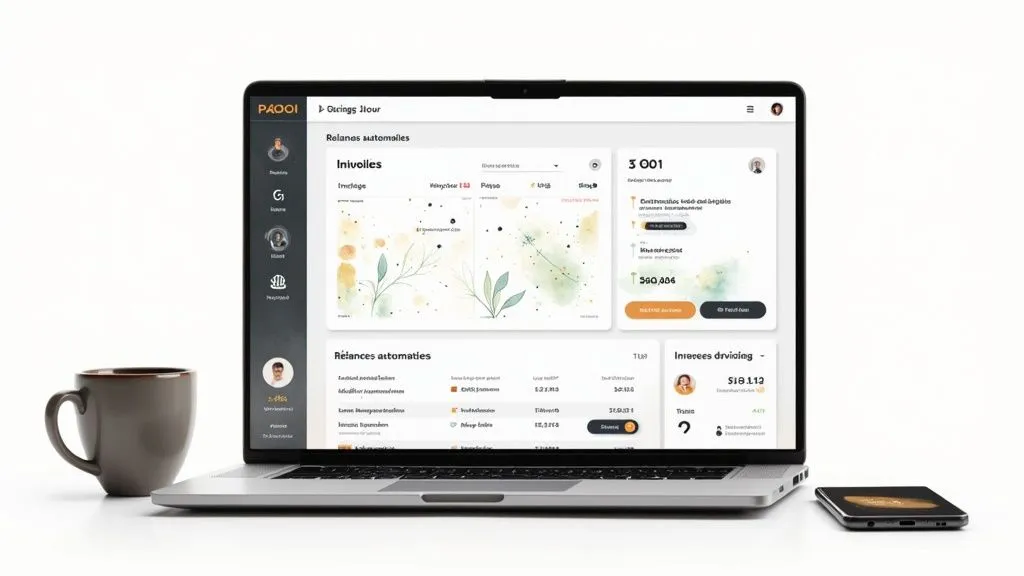
Thanks to this overview, you immediately spot the clients who need special attention and can act without delay.
The benefits become noticeable very quickly:
- Significant time savings: You free your mind from manual reminders. The system takes care of it.
- Shorter payment delays: Systematic, professional reminders show that you are organized and encourage your clients to pay you faster.
- A more professional image: Rigorous financial management, even when it comes to reminders, builds trust and your credibility.
By adopting this kind of solution, you’re not just chasing down unpaid invoices. You’re establishing a healthier, more efficient way of working. To go further, discover how you can automate your administrative tasks and finally focus on what really matters.
Frequently asked questions about unpaid invoice payment reminders
Managing an unpaid invoice always raises a fair share of questions. That’s normal. To help you see things clearly and act quickly (and correctly!), here are direct answers to the most common questions.
How long do I have to claim what I’m owed?
This is a question of the statute of limitations, and time works against you. For an invoice between businesses, the limitation period is 5 years. If your client is an individual consumer, be careful, this period is much shorter: only 2 years.
Once this date has passed, it will be impossible for you to take legal action to recover your money. My advice: never wait until the last moment to act.
The client isn’t paying — can I stop everything?
Yes, you can suspend your service. This is a right, known as the “exception of non-performance” (exception d’inexécution). If your client fails to meet their payment obligation, you are entitled to pause yours, whether it’s a delivery or a service.
But be careful, this shouldn’t be done on a whim. This decision must remain proportionate to the client’s failure. Above all, you must have officially warned them via a formal notice that went unanswered. Without this precaution, your client could turn the situation against you.
Suspending a service is a powerful lever, but it must be handled with care. Make sure the non-payment is established and that you have a formal written record of your warnings.
Is it worth going to court for a small invoice?
That’s an excellent question, and it’s all a matter of calculation. Launching a standard legal procedure for a few hundred euros often seems unreasonable given the costs involved.
Fortunately, more suitable solutions exist. The order to pay procedure, for example, is much simpler and more affordable. It’s the perfect tool for small claims that the client doesn’t dispute.
Also don’t forget the deterrent effect. Sometimes, simply starting the process, even for a small amount, is enough to show your seriousness and unlock the situation. Always weigh the cost of taking action against what you stand to gain.
Don’t let unpaid invoices put your cash flow at risk any longer. With Bizyness, you can automate your payment reminders, track every payment at a glance, and take back control. Try Bizyness for free and simplify your management starting today.
