

 Français
 Unpaid invoice: what to do — a quick, practical guide
Unpaid invoice: what to do? Discover effective methods for reminders, debt collection and prevention to protect your cash flow.
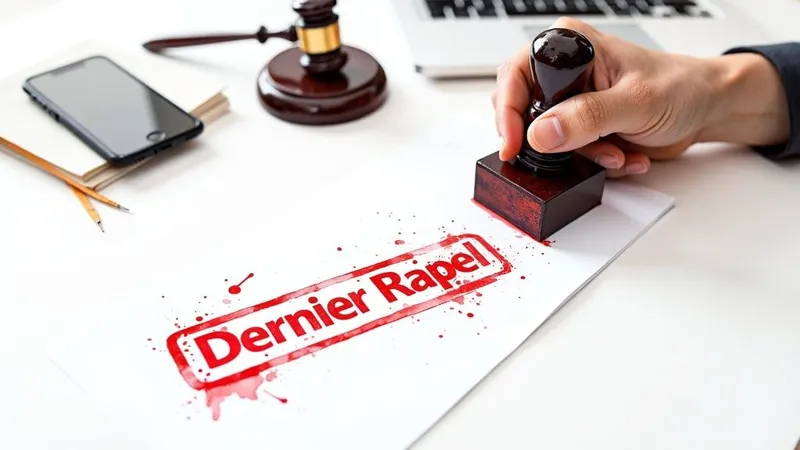
When an invoice goes unpaid, the first thing to do is send a friendly reminder. It’s simple, quick, professional, and it’s often enough to resolve a simple oversight without upsetting your client. If that doesn’t work, you step things up with a formal notice (mise en demeure). This is a more formal step that shows you mean business, just before considering legal action.
The impact of unpaid invoices on your business
An outstanding invoice isn’t just a pending line in your books. It’s a real threat to your company’s financial health, especially if you’re a small business or freelancer. Every euro that doesn’t arrive on time weakens your working capital, and things can quickly spiral.
The most direct problem is, of course, a cash flow gap. Without that liquidity, how do you pay your suppliers, expenses, or salaries? You end up having to rely on emergency solutions, like an overdraft, which are costly and eat into your profits. If this concerns you, take a look at our complete guide on managing business cash flow to learn how to better anticipate these tough spots.
The hidden consequences of late payments
But the damage doesn’t stop there. It’s often deeper and more insidious. A cash flow that yo-yos undermines your entire growth potential.
- Slowed growth: without available cash, you’re forced to postpone important investments. Buying new equipment, launching an ad campaign, or hiring that rare talent — all of it gets shelved.
- Wasted time and energy: every minute spent chasing bad payers is a minute you’re not spending on your actual job, innovating, or finding new clients.
- Constant stress: this financial uncertainty is a huge source of anxiety for an entrepreneur. It weighs on your decisions, your morale, and your day-to-day well-being.
An unpaid invoice is never “just an invoice.” It’s a brake on your ambition, an obstacle on your path, and a source of stress you don’t need. Managing this risk proactively is simply essential for the survival of your business.
A scourge that affects everyone
If you’re in this situation, know that you’re not alone. Far from it. It’s an affliction eating away at our entire economic ecosystem. In fact, nearly 9 out of 10 French companies (86%) say they’ve experienced late payments over the past 12 months. It affects everyone, but the smallest businesses are hit hardest: for more than half of them, the impact on cash flow has become “critical.” For more insight, the study on payment behavior in France is very enlightening. These figures show just how vital it is to have a clear action plan as soon as a payment deadline is missed.
Mastering friendly debt collection to preserve your relationships
An unpaid invoice? The first rule is: don’t panic. It’s easy to imagine the worst, but the reality is often much simpler. Before bringing out the heavy artillery, a well-conducted friendly approach resolves the vast majority of cases. The most common cause is a simple oversight or a minor administrative hiccup on your client’s end. So the goal is twofold: recover what you’re owed, of course, but also and above all preserve a good business relationship.
By handling the situation calmly and methodically, you demonstrate your professionalism. You’re both courteous and firm about your rights. Remember to keep records of everything: every email, every call. These records will become crucial if things unfortunately get complicated.
The first contact: playing it gently
Your very first reminder should be light and, above all, not accusatory. Assume it’s an oversight. There’s no need to put your client on the defensive right away.
A simple email, sent a few days after the due date, is often enough. The goal is just to jog their memory, nothing more.
- A subject line that goes straight to the point: Mention the invoice number and the word “Reminder.” For example: “Reminder regarding our invoice no. 2024-058.” Clear and direct.
- A neutral, conciliatory tone: A phrase like “Unless we’re mistaken…” defuses any potential tension.
- All the information at hand: Restate the amount, the due date, and, above all, attach the invoice again. You’re making it easy for them.
This first step is fundamental. It shows that you’re a partner who values dialogue.
The friendly approach isn’t a sign of weakness — it’s a display of business intelligence. It resolves more than 90% of late payments without making waves, which is essential for the health of your business.
The phone call to unblock the situation
Your first email has gone unanswered for a week? It’s time to pick up the phone. Direct contact is often much more effective for understanding what’s holding things up. A good call takes preparation.
Before dialing, make sure you have the file in front of you: the invoice, the date it was sent, the amount. Stay calm and stick to the facts.
- Introduce yourself clearly, along with the purpose of your call.
- Simply ask if your client received your previous reminder email.
- Listen carefully to their response. If they admit to a temporary difficulty, why not propose a small payment schedule? That can unblock everything.
- Conclude the call by confirming what was said in writing. An email like: “Following our conversation, I confirm that payment of invoice XXX will be made by…” is perfect.
This written record is essential. It turns a simple conversation into a concrete commitment.
The chart below clearly illustrates the domino effect unpaid invoices can have on a business.
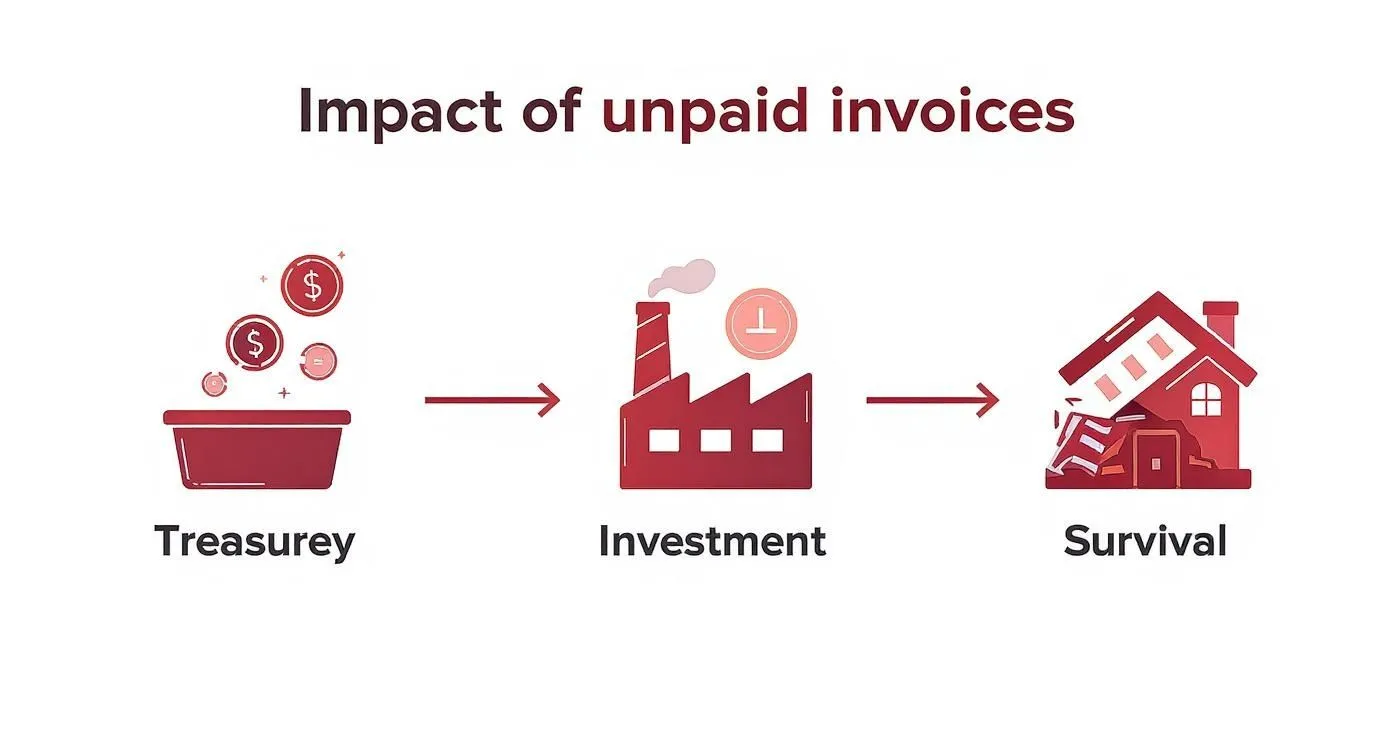
You can clearly see how an initial cash flow problem can quickly freeze projects and, ultimately, endanger the business if nothing is done.
The reminder letter: stepping it up a notch
Despite your email and your call, still nothing. Now you need to adopt a more formal tone. The reminder letter, sent about 15 days after the due date, marks an additional step in your process.
The tone becomes firmer, but remains impeccable in form. This letter is a second warning that clearly signals you’re not letting go.
Here’s what your letter absolutely must include:
- Full references: invoice number, date, amount.
- A brief history: recall the sending of your first email and your call.
- A new, clear deadline: allow between 8 and 15 days more, no more.
- Mention of late payment penalties: this is the moment to politely remind them that your terms and conditions and the law provide for penalties.
To make sure you’re using a template that’s both effective and compliant, take a look at our complete guide on how to write a reminder letter for an unpaid invoice. You can send it by email, but a physical letter often carries a bit more weight. And of course, keep a copy.
To make things clearer, here’s a short summary of the steps to follow.
Timeline of an effective friendly reminder process
This table presents an organized sequence of actions to take during the friendly reminder phase, with recommended timeframes and objectives for each step.
| Step | Timeframe after due date | Recommended action | Main objective |
|---|---|---|---|
| Reminder 1 | D+5 to D+7 | Courteous reminder email with invoice attached | Check whether it’s a simple oversight and make payment easier. |
| Reminder 2 | D+10 to D+15 | Direct, factual phone call | Understand the reason for the delay and get a verbal commitment. |
| Reminder 3 | D+15 to D+20 | More formal reminder letter (email or mail) | Set a new firm deadline and mention penalties. |
| Warning | D+30 | Last contact before formal notice | Inform that without payment, the next step will be legal. |
By following this logical progression, you maximize your chances of recovering your money while showing your client that you’ve explored every friendly avenue. This is the foundation of sound management, essential for protecting your cash flow.
When and how to send a formal notice
Your friendly reminders got you nowhere? Still radio silence? It’s time to toughen up. You move from a business discussion to a much more official process: the formal notice to pay (mise en demeure).
Be careful, this isn’t just another reminder. It’s a legal act that changes everything. It’s the very last warning before knocking on the courthouse door. You’re clearly signaling to your client that the joke has gone on long enough and that you’re ready to go further to recover your money.

Why the formal notice is an essential step
Sending this letter isn’t trivial — it has very concrete consequences. First, on the legal front. This is the document that officially starts the clock on late payment interest, if it hadn’t already started. It’s also very often a mandatory prerequisite for going to court. There’s no getting around it.
Then there’s the psychological impact. Receiving a registered letter with acknowledgment of receipt always makes an impression. It’s a very strong signal that often prompts bad payers to finally act. Faced with the real threat of a lawsuit, with the costs and hassle that entails, many ultimately prefer to settle what they owe.
Finally, this letter becomes a key piece of evidence in your file. If the matter ends up before a judge, the formal notice proves that you did everything possible to find an amicable solution. It’s proof of your good faith and seriousness.
The mandatory details for an ironclad letter
For your formal notice to be legally valid, it must be flawless in form. A single omission and it could be invalidated. So take the time to check that your letter includes all of the following elements:
- Who’s who? Your full details (name, address, business registration number…) and those of your client. Be precise.
- The date of writing: essential for all subsequent deadline calculations.
- The magic words: the subject of your letter must clearly state “Formal notice” (mise en demeure). No room for doubt.
- The history of the issue: a brief recap of the facts. Mention the invoice number, its date, the service concerned, and your previous reminder attempts.
- The itemized claim: state the exact amount your client owes you, distinguishing the principal from any late payment penalties already calculated.
- A clear ultimatum: set a new payment deadline that must be short and precise. Generally, that’s 8 to 15 days. Give a firm cutoff date.
- The final threat: state in black and white what will happen if payment isn’t made within the given deadline: referral to the competent court.
Precision is your best ally. Every element must be factual and verifiable. A vague or incomplete formal notice loses all its effectiveness and could even backfire on you.
The only sending method that counts
Here, there’s no room for debate. Forget emails, calls, or regular mail. To be unchallengeable, a formal notice must be sent by registered letter with acknowledgment of receipt.
Why? It’s the only method that gives you legal proof of the sending date and, more importantly, the date your client received the letter. This acknowledgment of receipt, signed by your debtor, is pure gold. It proves they were properly notified and can’t claim ignorance. Keep it carefully along with a copy of your letter.
Keep in mind that the economic context pushes many companies to play games with their suppliers’ cash flow. In France, the average late payment on an invoice runs to 19 days. To better arm yourself, don’t hesitate to learn more about payment terms in France and current trends.
A formal notice template to adapt
To save you time, here’s a sample structure. Be sure to personalize it with the specific details of your situation. Always remain factual and professional, even if the frustration is real.
[Your Full Details]
[Your Client’s Details]
Done at [Your City], on [Date]
Subject: Formal notice to pay invoice no. [Invoice Number]
Registered letter with acknowledgment of receipt
Dear Sir or Madam,
Despite our reminders of [Date(s) of your reminders], we note that as of today, invoice no. [Invoice Number], for an amount of [Amount] €, due on [Due Date], has still not been paid.
We hereby formally give you notice to pay us the sum of [Amount] € within 8 days of receipt of this letter.
Failing full payment within this period, we will have no choice but to refer the matter to the competent court to obtain forced recovery of our claim, without further notice. This legal procedure will incur additional costs, which will be borne by you.
Awaiting a prompt settlement, we remain, Sir or Madam, yours sincerely.
[Your Name and Signature]
When the formal notice goes unanswered, it’s time to shift gears. The discussion has gone on long enough; it’s time to act and assert your rights before the courts. Rest assured, you don’t need to be a legal expert to launch proceedings. Several options exist, more or less fast and costly, to finally recover what you’re owed.
The right procedure will depend on your situation: does your client dispute the invoice? Is the amount at stake significant? Is your cash flow on the verge of collapse? Let’s go over the three main legal routes to help you see things more clearly.
The order for payment (injonction de payer): the simple, effective option
For many entrepreneurs, the order for payment is the first weapon of choice. And for good reason: it’s a fast, low-cost procedure that doesn’t require a lawyer. It’s perfectly suited when the debt is clear and your client doesn’t dispute it. In other words, if they know they owe you money but are simply turning a deaf ear, this is ideal.
The process is fairly straightforward:
- You fill out a request, a form easily found online, and file it with the registry of the competent court (usually the commercial court if your client is a business).
- You attach a solid file: the invoice, the signed quote, delivery notes, your reminder emails, and, above all, the formal notice with its acknowledgment of receipt.
- The judge reviews your file’s documents, without even needing to summon your client. If everything is in order, they issue an “order for payment.”
From there, your debtor has one month to object. If they don’t, the order becomes final. You then simply need to ask the court registry to affix the “enforcement clause.” With this in hand, a bailiff can initiate forced recovery, for example via a seizure of the client’s bank account.
This is a “non-adversarial” procedure, which explains its speed. The judge rules solely based on the elements you provide. It’s pure efficiency for debts that leave no room for discussion.
This fast route is all the more relevant given that trust in the justice system can sometimes be lacking. As shown by a survey from the Institut pour la Justice, 81% of French people believe the justice system is too lenient, a perception that can discourage some from pursuing more complex procedures.
The interim payment order (référé-provision): when there’s urgency
Another fast-track procedure exists: the référé-provision. The key difference is that it’s “adversarial,” meaning your client will be summoned to a hearing. This is the solution to favor if an unpaid invoice is endangering your cash flow and the claim is “not seriously disputable.”
What does that mean? Simply that your client has no valid argument to refuse payment. The invoice is clear-cut, the work was done, and there’s no dispute over quality.
The main advantage of the référé is its speed. You can get a hearing within just a few weeks. The judge won’t dive into the merits of the case; they’ll simply note the obvious existence of the debt. If convinced, they can order your debtor to immediately pay you a “provision,” which often corresponds to the full invoice amount. This decision is enforceable immediately, even if the client decides to appeal.
To help you compare, here’s a quick summary:
| Feature | Order for payment | Interim payment order (référé-provision) |
|---|---|---|
| Speed | Very fast (a few weeks) | Fast (a few weeks) |
| Cost | Low (about €35 in court registry fees) | Higher (bailiff fees and potentially lawyer fees) |
| Adversarial | No | Yes (hearing) |
| Use case | Undisputed debt, no urgent cash need | Obvious debt, urgent cash need for your business |
This is an excellent option if you feel your client is playing for time.
The formal summons to pay (assignation en paiement): for tougher cases
When the situation truly becomes complicated, you need to move up to the formal summons to pay. This is the “classic” legal procedure. It’s longer, more expensive, and hiring a lawyer becomes almost mandatory.
This route is necessary in the following cases:
- Your client seriously disputes what they owe you (they claim the work is poorly done, for example).
- The amount at stake is very significant and justifies a thorough examination.
- Your previous attempts (order for payment or référé) were rejected.
At this point, you’re entering a genuine trial. The judge will examine the case in depth, with written exchanges of arguments between lawyers and a hearing for pleadings. It’s a marathon, not a sprint; the procedure can stretch over several months, or even more than a year.
It’s a heavy commitment, but sometimes it’s the only way to win against a debtor acting in bad faith who has built up a semblance of an argument. For an overview of the strategy to put in place, our complete guide on collecting outstanding customer debts can help clarify things. Choosing the right procedure isn’t a minor detail — it’s a strategic decision that directly affects your chances of success.
Developing a preventive strategy against unpaid invoices
Instead of waiting for the problem to arise and then wondering “unpaid invoice, what do I do?”, the smartest approach is always to act upstream. Putting safeguards in place to protect your cash flow is by far the best strategy for minimizing risk. Believe me, prevention costs far less and generates much less stress than any collection procedure.
A good preventive strategy doesn’t start when you send the invoice — it starts well before. It needs to be woven into your everyday business practices, from choosing your clients to drafting your contracts.
Assessing the creditworthiness of your future clients
Before diving into a new collaboration, take the time to research your prospect. It’s a simple step, but one that can save you a lot of trouble down the line. A little research is often enough to get a sense of a potential partner’s financial reliability.
You can easily check publicly available information online to verify a company’s health. Specialized websites give you access to valuable data: financial statements, any past insolvency proceedings, or even general reputation. This is a simple habit that should become systematic, especially before signing a major contract.
Rock-solid terms and conditions of sale
Your terms and conditions of sale are your first line of defense. They must be clear, complete, and systematically attached to your quotes. This is the document that sets the rules of the game between you and your client.
Make sure your terms and conditions include clear, unambiguous clauses on the following points:
- Payment deadlines: state the due date in black and white (for example, 30 days net from invoice receipt).
- Late payment penalties: mention the applicable rate and the conditions for its application, starting from the first day of delay.
- The flat-rate collection cost compensation: don’t forget to include this legal compensation of €40, which is owed automatically and without justification.
Well-drafted terms and conditions are more than just an administrative formality. They have real deterrent power and considerably strengthen your position in the event of a dispute.
Effective prevention isn’t about distrusting everyone. It’s about putting in place processes that protect your business against predictable risks. It’s a sign of great professionalism, not suspicion.
The impact of unpaid invoices is too often underestimated, but the numbers speak for themselves. The risk of business failure increases by 25 to 40% because of unpaid invoices. As some analyses on the real cost of unpaid invoices for businesses point out, careful client selection and proactive management are your best assets.
Securing payments with a deposit
Here’s another formidably effective business tactic: systematically requesting a deposit before starting any work. A deposit, generally 30% to 50% of the total amount, offers a dual advantage.
On one hand, it immediately secures part of your revenue and covers your initial costs. On the other, it acts as an excellent test of your client’s seriousness and creditworthiness. A prospect who balks at or refuses to pay a deposit? That’s a warning sign you should never ignore.
Outsourcing the risk for greater peace of mind
For businesses managing many clients or high-stakes contracts, more structured solutions exist to fully outsource the risk of non-payment.
- Credit insurance: this is insurance that compensates you if one of your clients defaults. It assesses your prospects’ creditworthiness upfront and gives you a payment guarantee.
- Invoice factoring: this solution involves transferring your invoices to a specialized company (a “factor”) that immediately advances you the amount, for a commission. The factor then handles collection from your client themselves.
Of course, these tools come at a cost. But they offer invaluable peace of mind by guaranteeing a stable, predictable cash flow. That lets you focus calmly on what you do best: your core business.
Frequently asked questions about unpaid invoices
An overdue invoice, and suddenly there’s a cascade of questions. Is it serious? Can I charge penalties? At what point should I hand it off? Let’s set the record straight with direct, field-tested answers to help you react quickly and effectively.
How long do I have to claim what I’m owed?
The law gives you some leeway, but make no mistake: time is working against you. The statute of limitations for an invoice between businesses is 5 years from its due date. That’s the deadline for launching legal action.
If your client is an individual, the clock is tighter: you only have 2 years.
A word of advice: never wait. The older a debt gets, the harder it becomes to collect. Even if you’re within the legal deadline, an invoice forgotten for months has very little chance of being paid spontaneously.
Late payment penalties: can I really apply them?
Yes, without hesitation! It’s a right, and above all an excellent deterrent. The only condition is that it must be clearly stated in your terms and conditions of sale, on your quote, or in the signed contract.
Starting the day after the due date, you’re entitled to apply them, without even needing to send a reminder. On top of these penalties, the law allows you to claim a flat-rate compensation of €40 to cover your costs. Don’t hold back — it professionalizes your approach and shows that you’re not joking around with deadlines.
Debt collection agency or lawyer: when should I call in a professional?
It all depends on the situation and whether your client is acting in bad faith. Honestly, you can handle the entire first phase — from the polite reminder to the formal notice — yourself. In most cases, that’s enough to unblock the situation.
But if the dialogue has broken down, it’s time to hand things off:
- A debt collection agency is ideal for the “pre-legal” phase. It will take over the reminders, with a firmer, more official tone, which is often enough to get the debtor to react without further involvement on your part.
- A lawyer becomes essential as soon as you need to go to court. They’re your best ally if the case is complex, if the amounts are significant, or if your client disputes the invoice.
What if my client files for bankruptcy?
This is where things get tricky, but you must not give up. Your first and only move: file your claim. You need to immediately send a registered letter with acknowledgment of receipt to the court-appointed administrator (mandataire judiciaire) named in the proceedings.
Act quickly, because the deadline is very strict: you only have 2 months from the publication of the ruling in the BODACC (the French official bulletin of civil and commercial announcements). Let’s be clear: the chances of recovering all your money are slim. But it’s the only step that gives you any hope of being paid, even partially, from what remains of the business.
Don’t let unpaid invoices put your cash flow through the wringer any longer. With Bizyness, you can automate your reminders, keep an eye on every payment, and regain control. Free up time and energy to focus on your core business. Discover how Bizyness can change your life.
