

 Français
 Simple, fast VAT calculator for your invoicing
Our VAT calculator simplifies your VAT calculations. Get the pre-tax and VAT-inclusive amounts instantly for accurate, error-free invoicing.
Using a VAT calculator is remarkably simple: you enter an amount, select the correct VAT rate, and the final price appears instantly. It’s the perfect tool for creating accurate quotes and invoices in seconds, without the headache.
The basics you need to master for pre-tax and VAT-inclusive calculations
If you want to get serious about invoicing in France, there’s one unavoidable step: understanding the difference between a pre-tax amount (HT, “Hors Taxes”) and a VAT-inclusive amount (TTC, “Toutes Taxes Comprises”). Far from a mere administrative detail, this distinction is the foundation of sound financial management and ensures you stay compliant with the tax authorities.
The pre-tax amount is the base price of your product or service. It’s on this base that you build your profitability. In fact, to go further in managing your business, understanding how to calculate a commercial margin is just as crucial. The VAT-inclusive amount, on the other hand, is the price the end customer pays once the well-known Value Added Tax (VAT) has been added.
VAT, the pivot point of invoicing
VAT is an indirect tax. In practice, your business collects it on behalf of the State. You add it to your pre-tax selling price to get the VAT-inclusive price, and it’s your responsibility to remit it to the tax authorities afterward. The mechanism is simple in theory, but it demands real rigor day to day.
It’s not for nothing that nearly 98% of French businesses now use digital tools that include automatic calculators. It’s the best guarantee of accuracy and a way to avoid mistakes that can prove costly.
Why is it so important to get it right?
A small calculation error can quickly have major consequences for your cash flow or your tax returns. Imagine invoicing with the wrong VAT rate or making a mistake in the conversion: in the event of a tax audit, an adjustment is all but guaranteed.
Mastering the conversion between pre-tax and VAT-inclusive amounts isn’t just about producing compliant invoices. It’s also what lets you correctly manage the deductible VAT on your own business purchases and, ultimately, optimize your cash flow.
In this guide, I’ll give you everything you need to:
- Understand the calculation formulas without pulling your hair out.
- Apply these concepts to everyday practical situations as an entrepreneur.
- Make sure every document you issue is fully compliant.
Choosing the right VAT rate: the key to converting pre-tax to VAT-inclusive
To successfully convert a pre-tax amount to a VAT-inclusive one, everything hinges on a single factor: choosing the correct VAT rate. Believe me, applying the wrong rate isn’t just a simple calculation error. It’s the start of potential complications with the tax authorities, and nobody wants that.
Fortunately, the French system is fairly well designed, even if it has its subtleties. VAT is that indirect tax found everywhere, at every stage of a product’s or service’s life. For everything to be clear and compliant, several rates coexist. It’s therefore essential to know them well in order to invoice your customers without a hitch.
If you want to dig deeper into the topic, take a look at our full guide on calculating VAT.
This diagram shows very simply how the base price (pre-tax) and VAT add up to give the final price paid by the customer (VAT-inclusive), using the classic example of a 20% rate.
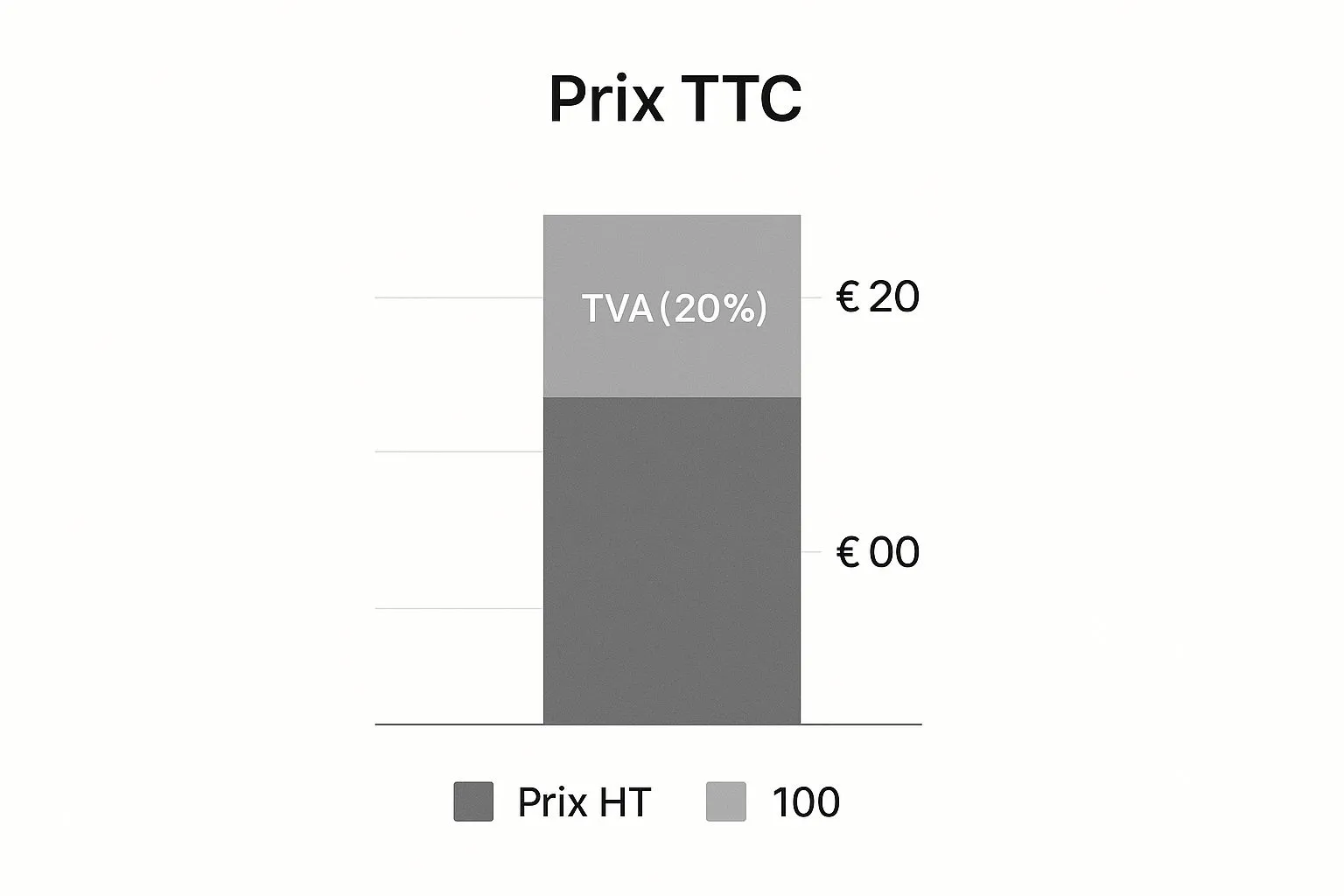
You can clearly see that the final price (VAT-inclusive) is simply the sum of the pre-tax amount and the tax you collect on behalf of the State.
The different VAT rates in France
In most cases, you’ll use the standard rate. But watch out for the exceptions! Knowing them will save you a lot of hassle.
-
The standard rate of 20%: This is the default rate, the one you’ll use most often. It applies to the majority of goods and services: clothing sales, consulting fees, equipment rental, etc.
-
The intermediate rate of 10%: Frequently found in sectors such as catering (for food consumed on-site), passenger transport, or certain renovation work on older housing.
-
The reduced rate of 5.5%: This rate applies to products considered essential. Think basic food products, water, books (print or digital), and electricity and gas subscriptions.
-
The super-reduced rate of 2.1%: This one is more specific. It’s reserved for very particular cases, such as medicines reimbursed by the French social security system.
To help you see things more clearly, here’s a table summarizing all of this.
Summary of VAT rates in France and their applications
This table summarizes the different VAT rates in effect in France, stating their value and giving concrete examples of the goods or services to which they apply.
| Rate Type | Rate Value | Application Examples |
|---|---|---|
| Standard rate | 20% | Most consumer goods (clothing, tech), services (hairdressing, consulting). |
| Intermediate rate | 10% | On-site catering, passenger transport, certain home improvement work, hospitality. |
| Reduced rate | 5.5% | Basic food products, books, gas and electricity subscriptions, live performance tickets. |
| Super-reduced rate | 2.1% | Medicines reimbursed by social security, press publications registered with the CPPAP. |
This summary is a good starting point for quickly identifying the rate that applies to your business.
Choosing the right rate isn’t optional — it’s a legal obligation. When in doubt, it’s always best to consult a chartered accountant or check official sources to confirm your choice before issuing an invoice. Better safe than sorry.
How to calculate the VAT-inclusive amount from the pre-tax amount
Going from the pre-tax amount (HT) to the VAT-inclusive amount (TTC) is arguably the most common calculation when preparing your quotes and invoices. The good news is that the formula is really simple and logical.
To find the final price your customer will pay, you simply need to add VAT to your base rate.
The math formula to know is as follows:
VAT-inclusive = pre-tax × (1 + VAT rate)
In this formula, the “VAT rate” must be used in decimal form. For a rate of 20%, you’d write 0.20. The calculation then simply becomes: pre-tax × 1.20.
Applying it with concrete examples
Theory is good, but let’s see what this looks like in your everyday life as an entrepreneur with real cases.
-
Example 1: A consulting assignment
Imagine you’re invoicing a consulting service at €2,000 pre-tax. The standard VAT rate of 20% applies.
The calculation is: €2,000 × (1 + 0.20) = €2,000 × 1.20 = €2,400 VAT-inclusive.
This is the €2,400 amount your customer will need to pay you. -
Example 2: A restaurant meal
A restaurant offers a set menu at €50 pre-tax. Here, the intermediate rate of 10% applies.
The calculation gives: €50 × (1 + 0.10) = €50 × 1.10 = €55 VAT-inclusive.
The customer will therefore see €55 on their bill.
This calculation is essential. Why? Because the difference between the pre-tax and VAT-inclusive amounts corresponds precisely to the VAT amount you collect on behalf of the State. It’s an indirect tax, and you’re the one acting as the intermediary.
The trick to going faster: Think directly in terms of multiplier coefficients. For VAT at 20%, multiply by 1.20. For 10%, it’s 1.10, and for VAT at 5.5%, it’ll be 1.055. This makes mental math much easier!
Knowing how to handle this conversion is the foundation of accurate, error-free invoicing. If you want to dig deeper into the topic, our full guide explains in detail how to calculate a pre-tax to VAT-inclusive amount.
We’ve seen how to go from pre-tax to VAT-inclusive, which is crucial for invoicing your customers. But knowing how to do the reverse is just as essential, this time for your bookkeeping. It’s this calculation that lets you isolate the VAT you paid on your own business purchases, which you can then deduct.
Recovering the pre-tax amount (HT) from a final price (TTC) isn’t that complicated. The idea is simply to “strip out” the tax that was added to the price.
For this, the formula is straightforward:
Pre-tax = VAT-inclusive / (1 + VAT rate)
Remember the multiplier coefficients? For a rate of 20%, you multiplied by 1.20. Well, to do the reverse, you simply divide by 1.20. It’s as simple as that.
A few concrete examples to make it clear
Nothing beats practice to make this second nature. Let’s look at two situations you’re familiar with.
-
Example 1: The receipt from a business lunch
You have a receipt for €44 VAT-inclusive. In the restaurant industry, the VAT rate is generally 10%.
The calculation to find the pre-tax amount is: €44 / 1.10 = €40 pre-tax.
The recoverable VAT on this expense comes to €4 (€44 - €40). -
Example 2: Buying computer equipment
Your supplier sends you an invoice for €900 VAT-inclusive. Here, the standard rate of 20% applies.
So you divide by 1.20: €900 / 1.20 = €750 pre-tax.
The deductible VAT amount is €150 (€900 - €750).
Being able to quickly isolate the pre-tax amount and the VAT on each expense is a reflex worth building. It’s the guarantee of correctly declaring your deductible VAT and, let’s be clear, not leaving money on the table for the State unnecessarily.
By mastering this calculation, you stay in control. You can check the accuracy of your suppliers’ invoices at a glance and make sure your bookkeeping is spotless. It’s the foundation of sound management with no bad surprises.
Save time and avoid errors with an online tool
Even with the best intentions, doing your calculations by hand, over and over, is an open door to small mistakes. A misplaced decimal point, transposed digits… and your whole quote needs to be redone. This is where an online VAT calculator comes into play and becomes the entrepreneur’s best ally.
Rather than pulling out the calculator and triple-checking your calculations, these tools give you the answer instantly. For a freelancer or the manager of a small business, it’s invaluable help day to day. No more double-checking stress — you gain efficiency and, above all, peace of mind.
How does it actually work?
Let’s take the Bizyness tool as an example. No manual needed — it’s designed to be intuitive and save you time for what really matters.
- Enter your amount: Simply type in the price you have in mind, whether pre-tax or VAT-inclusive.
- Select your VAT rate: Choose the correct rate (20%, 10%, 5.5%…) from the small dropdown list.
- And there’s your result: The tool instantly displays the pre-tax amount, the corresponding VAT-inclusive amount, and the exact VAT amount.
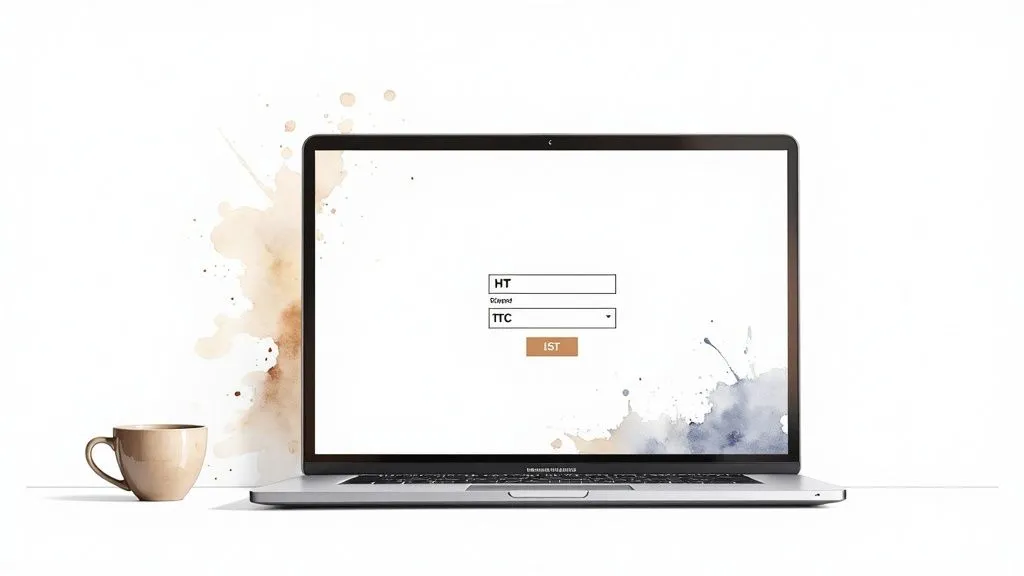
It’s as simple as that. The interface is designed to be crystal clear, as you can see here.
You can see the calculation breakdown right away, with no effort at all.
The big advantage is reliability. A good online tool means zero risk of calculation errors. Your quotes and invoices are always flawless. If you want to bring this same simplicity to your entire bookkeeping, you can go further and discover how to calculate VAT online directly within your software.
I’m thinking in particular of freelancers who issue dozens of invoices every month. The time saved with a simple calculator quickly adds up to precious hours. Hours you can spend finding new clients or simply taking a breather.
Ultimately, using a tool like this isn’t laziness — it’s just common sense. It’s a smart way to secure your bookkeeping and free up your time.
Answering your questions about pre-tax and VAT-inclusive amounts
Even with the formulas in mind, certain practical questions keep coming up. That’s perfectly normal. Let’s go through the most frequent questions to clear up any remaining doubts and help you navigate every situation with confidence.
How can I be sure the correct VAT rate was applied?
Whether on your own invoices or a supplier’s, a quick check is sometimes necessary. The most direct method? Use the reverse calculation.
Simply take the VAT-inclusive amount and divide it by the pre-tax amount. The figure you get should match the multiplier coefficient of the expected VAT rate. For example, for a €600 VAT-inclusive invoice based on €500 pre-tax, the calculation is simple: 600 / 500 = 1.20. This 1.20 does indeed correspond to the coefficient for VAT at 20%. If the result is different, there’s a good chance an error has crept into the invoice.
What should I do if I made a mistake on an invoice already sent to the customer?
To err is human, and it happens even to the most experienced. If you realize the VAT amount is incorrect on an invoice that’s already been sent, above all, don’t panic.
The procedure is well defined: you must issue a corrective invoice, more commonly known as a credit note. This new document officially cancels and replaces the original invoice. For everything to be in order from an accounting standpoint, it must absolutely reference the original invoice number. Also remember to notify your customer promptly to explain the situation with full transparency.
Your responsiveness is your best asset. Correcting an error quickly demonstrates your professionalism and avoids a lot of accounting headaches, for you as well as for your customer.
Is the conversion from pre-tax to VAT-inclusive different for a sole trader?
No, the math formula doesn’t change. What changes is the very specific tax context of the sole trader (or micro-entrepreneur).
The vast majority of them benefit from what’s known as the VAT exemption scheme (“franchise en base de TVA”). In practice, this means they don’t charge VAT to their customers. Their invoices are therefore always issued pre-tax (HT).
To be fully compliant, they must also include the following legal notice on their invoices: “TVA non applicable, art. 293 B du CGI” (VAT not applicable, art. 293 B of the French Tax Code).
So, is a VAT calculator useful to them?
- For their own sales: Not really, since they always invoice pre-tax.
- For their business purchases: Yes, absolutely! It’s essential for them to know the real cost of their equipment or services. Even though they can’t recover VAT, understanding what they actually pay is essential for managing their cash flow properly.
This distinction is really key to correctly running a micro-business day to day.
Stop juggling calculations. Simplify your invoicing and make sure your documents are always compliant with Bizyness. Our tool is designed to free up your time so you can focus on your core business. Discover how Bizyness can make your management easier starting today.
