

 Français
VAT Exemption: A Simple Guide to Optimizing Your Taxes
Learn how to get your business VAT-exempt with ease. Discover the thresholds, procedures and tips for simplified tax management.
Being VAT-exempt simply means not having to charge this tax to your customers. This particularity can considerably simplify your day-to-day management and even give you a slight edge over your competitors. This scheme is designed primarily for the smallest businesses and certain specific sectors of activity.
Let’s break down how VAT exemption works
To really understand it, you need to look at what VAT exemption concretely means for your business. Think of VAT as a tax you collect on behalf of the government on each of your sales, before passing it on. Exemption is a bit like getting a special waiver that frees you from this role as collector.
This scheme was set up for two main reasons:
- Reducing the paperwork and accounting obligations that weigh on small businesses and micro-entrepreneurs.
- Supporting sectors considered essential or of general interest, such as healthcare, training or certain associations.
Don’t confuse “exempt” with “not subject to VAT”
This is a crucial point. You need to clearly distinguish between being exempt and being not subject to VAT. These two terms may sound similar, but their consequences for your business are very different.
An exempt business is, in theory, one that should be charging VAT. Its activities do fall within the scope of the tax, but a specific law or rule allows it not to do so.
Conversely, an activity that is not subject to VAT is simply outside the scope of VAT altogether. The transactions it carries out are, by nature, never concerned by this tax.
This nuance is crucial, because a VAT-exempt business cannot, in return, recover the VAT it pays on its own business expenses. For that business, this VAT becomes a straight cost.
The very real impact on your cash flow
This inability to deduct VAT on your purchases is the flip side of exemption. When you buy equipment, supplies, or pay service providers, the VAT shown on their invoices is lost to you. It goes straight to increasing your costs.
Let’s take a simple example. A graphic designer under the VAT exemption scheme buys a new computer for €1,200 including tax, which includes €200 of VAT. Their real cost is indeed €1,200. Another graphic designer, subject to VAT, will pay the same amount but will be able to “recover” that €200 of VAT by deducting it from the tax they themselves collect. For them, the computer ends up costing only €1,000 excluding tax.
This guide is here to help you see things clearly and determine whether VAT exemption is not only possible for you, but above all whether it’s the wisest strategy for your business.
Taking advantage of the VAT exemption scheme (franchise en base)
For most entrepreneurs starting out, the VAT exemption scheme (franchise en base) is the key mechanism for easing tax constraints. Think of it as a kind of special dispensation: the government allows you not to charge VAT to your customers, provided your revenue stays under certain thresholds. It’s valuable help when you’re getting started.
This scheme isn’t reserved for a single legal status. Whether you’re a micro-entrepreneur, a SASU, or even an EURL, you can benefit from it. The goal is simple: to simplify administrative management for the smallest businesses and spare them the headache of VAT returns.
This image sums up the idea well: you need to keep an eye on your revenue to make sure you stay within the limits.
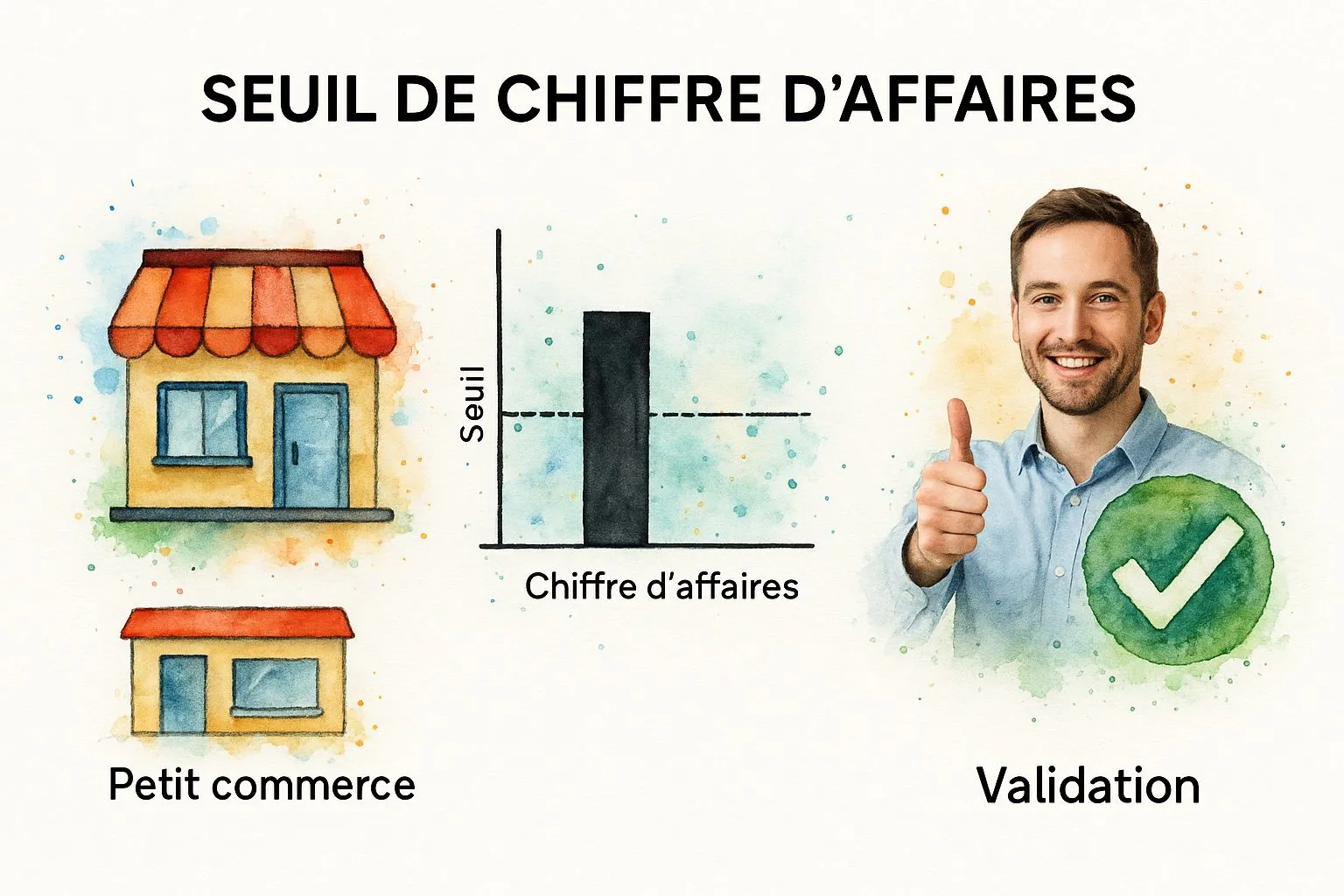
Ultimately, more than just a tax rule, this scheme becomes a management tool for running your business with more flexibility.
Keeping track of the revenue thresholds
The heart of the exemption scheme lies in complying with the revenue thresholds. This is the number one point to watch. Note that these thresholds vary depending on the nature of your activity, so it’s crucial to know exactly which ones apply to you.
To help you find your way, here’s a table summarizing the thresholds not to exceed in order to benefit from the VAT exemption scheme.
VAT exemption thresholds
| Type of activity | Exemption threshold | Tolerance threshold (increased) |
|---|---|---|
| Sale of goods (products, items) | €91,900 | €101,000 |
| Provision of services (including regulated professions) | €36,800 | €39,100 |
| Regulated lawyer activities and authors/performing artists | €47,700 | €58,600 |
To understand these figures:
- The exemption threshold is the base limit. If your revenue for the previous year (N-1) is below it, everything’s fine, you remain exempt.
- The tolerance threshold (or increased threshold) gives you a bit of leeway.
It’s essential to keep a close eye on these thresholds to avoid unpleasant surprises.
How do you handle exceeding a threshold?
Your business is taking off and you’ve exceeded the thresholds? No need to panic, but you do need to act quickly. What to do next depends on how much you’ve exceeded them by.
Imagine your revenue sits between the exemption threshold and the tolerance threshold for a full year. Good news: you can keep the exemption for that year. However, if this happens two years in a row, you switch over: you become liable for VAT from January 1st of the third year.
On the other hand, if you cross the tolerance threshold (for example, €101,000 for sales or €39,100 for services) during the year, the change is immediate. You must start charging VAT from the first day of the month in which the threshold was exceeded.
This switch requires responsiveness. You’ll need to update your invoice templates and promptly request your intra-community VAT number from your local Business Tax Office (SIE). Anticipating this moment is the best way to avoid a tax reassessment.
This scheme is so common among small businesses that it shapes a large part of the tax landscape. Figures from the French Directorate General of Public Finances (DGFiP) make this clear: in 2020, even though exempt businesses accounted for 93% of taxpayers, they represented only 13.9% of total exempt revenue. This shows just how much of a pillar this scheme is for the ecosystem of freelancers and small businesses. For those who want to dig deeper, it’s possible to consult the details of these statistics to better understand the French tax context.
By keeping an eye on your revenue, you turn a simple tax rule into a genuine strategic tool for your business.
Identifying activities exempt by nature
Beyond revenue thresholds, there’s another reason a business can be VAT-exempt: the very nature of its activity. In this case, it’s no longer a question of income, but a basic rule written into law.
Why this distinction? The legislator’s idea is simple: certain services are considered so essential to society that it would be counterproductive to make them more expensive by adding a tax. Making them more accessible is a priority.

Medical and paramedical professions
This is the clearest example for everyone. Care provided by regulated healthcare professionals is not subject to VAT. This covers a wide range of professions, including:
- General practitioners and specialist doctors
- Dental surgeons
- Midwives
- Self-employed nurses
- Physiotherapists
- Speech therapists, psychomotor therapists, and podiatrists
In practice, your consultation with a doctor or your session with a physiotherapist is invoiced tax-free. Note, however, that this exemption applies only to care services. If the same professional starts selling products (such as creams or small equipment), that side activity could well be subject to VAT.
The education and training sector
The transmission of knowledge is another pillar protected by this exemption. Whether it’s school, university, or technical education, or ongoing professional training, these services are in principle exempt from VAT. This ranges from home tutoring to large training organizations.
A crucial point: to benefit from the exemption, the organization generally needs to obtain official recognition from the government. This is a kind of label that guarantees the seriousness and quality of the training, and which in turn justifies this tax advantage.
The goal is clear: to encourage education and skills development by lowering the final bill.
Insurance operations and financial services
Here, the logic is a bit different. Insurance and reinsurance operations, along with most banking services, are exempt for a primarily technical reason. It’s extremely difficult to calculate the precise “value added” on a financial product like a loan or an insurance premium, which makes applying VAT nearly impossible.
Moreover, these sectors are already heavily taxed through other means, notably the tax on insurance agreements. Adding VAT on top would amount to double taxation.
Finally, we can also mention the rental of unfurnished residential housing, which is exempt to protect access to housing.
The impact of these “by nature” exemptions is far from anecdotal. INSEE (the French national statistics institute) calculated that French households’ VAT-exempt spending amounted to €167.7 billion, which represents no less than 18.5% of their total consumption. For those who want to explore the topic further, you can consult INSEE’s full analysis, which breaks down the effect of these measures on sectors such as healthcare and insurance.
If your main activity falls into one of these categories, you are therefore VAT-exempt by default. This is fundamental information to keep in mind from the moment you launch your project.
Weighing the pros and cons: is VAT exemption really right for you?
At first glance, choosing VAT exemption looks like an obvious choice, especially when starting out. You immediately imagine less paperwork and more competitive prices for your customers. Simple, right? In reality, the situation is much more complex. This choice, which may seem trivial, is a real strategic decision that deserves careful thought.
Being VAT-exempt means making a bet. You gain immediate advantages, but you also expose yourself to hidden costs that can end up weighing heavily. To find out whether it’s the right option for you, you need to weigh the pros and cons and see what best fits your project.
The obvious advantages of exemption
The first argument that comes to mind is, of course, administrative simplicity. No VAT to charge, so no return to file. This is a considerable time saver and one less mental burden, which is really not negligible day to day.
This simplicity has a direct effect on your cash flow. The money you collect stays in your pocket, without having to advance the VAT collected to the government. For a small business, this is real breathing room that makes day-to-day financial management easier.
Finally, there’s the competitive advantage, especially if you’re targeting individual customers. A price displayed without VAT is automatically lower than that of a competitor who has to add 20% in tax. You can therefore either offer more attractive rates or keep that margin for yourself.
The often underestimated drawbacks
The flip side, and this is the most crucial point, is the inability to recover VAT on your business expenses. Every purchase of equipment or software, every subcontractor invoice or expense claim becomes a straight cost, VAT included.
Think about it: if your business requires regular investments, this drawback can quickly cancel out all the benefits. Buying a powerful computer for €2,400 including tax? You lose the ability to recover €400 of VAT. For a utility vehicle at €30,000 including tax, that’s €5,000 of VAT turned into a pure and simple cost.
Another, more subtle aspect concerns your brand image with a business (B2B) clientele. For some major accounts, an invoice with no mention of VAT can convey the image of a “small” business, which could make them hesitant. And for your professional customers, whether you charge with or without VAT changes nothing for them: they deduct it on their end anyway.
Finally, managing the thresholds can become a source of stress. If your revenue takes off faster than expected, you could be forced to switch to the standard VAT regime in the middle of the year. This means urgent administrative steps and a complete overhaul of your pricing. To plan ahead more effectively, it’s always a good idea to explore ways to optimize taxes as a sole trader so you can manage your growth with more peace of mind.
Comparison table: being exempt or liable for VAT?
To help you quickly visualize the implications of each option, here’s a table that weighs the main advantages and disadvantages of VAT exemption.
| Criterion | Advantages of exemption | Disadvantages of exemption |
|---|---|---|
| Administrative management | Very simple: no VAT return to manage. | More complex: mandatory periodic returns, rate management. |
| Selling price (B2C) | Competitive advantage: lower final price for individual customers. | Less competitive: the price includes VAT, making it higher. |
| VAT recovery | Impossible: VAT on business purchases is a final cost. | Possible: you recover VAT on your expenses (equipment, services, etc.). |
| Professional image (B2B) | May be perceived as a sign of a “small” business. | Strengthens credibility and the perception of an established business. |
| Growth management | Risk of exceeding the threshold and a sudden switch. | More stable: no threshold to monitor, the system adapts to growth. |
This table is a tool to guide your thinking. The final decision will always depend on your unique situation: the nature of your clientele, the volume of your investments and your growth ambitions. Take the time to weigh each point carefully.
Managing your invoicing and accounting procedures
Congratulations, you’re now VAT-exempt! Your day-to-day life as an entrepreneur is about to get simpler, but this does involve adopting some new habits, especially when it comes to invoicing. Don’t worry, there’s nothing too complicated about it, just a few adjustments to be fully compliant.
The first, and most important, step is to review your invoice templates. Since you no longer collect VAT, it simply must no longer appear. Your prices are now “net of tax,” and that’s what your customers need to see.
The legal notice: a detail that isn’t just a detail
For everything to be in order, every invoice issued must include a small but essential sentence. It’s this sentence that justifies, in the eyes of the law and your customers, why you’re not charging VAT.
“VAT not applicable, art. 293 B of the French General Tax Code (CGI)”
This notice is absolutely mandatory. Forgetting it could cause you problems in the event of an audit. It signals to everyone that you benefit from the VAT exemption scheme. The simplest solution? Build it directly into your document templates so you never have to think about it again. If you’re looking for concrete examples, our guide on invoicing for sole traders is there to help you, with tips and ready-to-use templates.
Simpler accounting, greater vigilance
On the accounting side, this is where you’ll really feel the difference. No more headache-inducing VAT returns! You no longer have to worry about:
- The VAT collected on what you sell.
- The deductible VAT on what you buy.
- The returns to be filed every month or every quarter.
What a time saver! You can finally devote yourself fully to what really matters: your business. Historically, the French tax system has always included exception schemes. VAT, introduced in 1954, exempted sectors such as education or medical care from the very start, for social reasons.
But be careful, this simplicity comes with a trade-off: you must watch your revenue like a hawk. This is the crucial point. Rigorous monitoring of your income is essential so you don’t exceed the thresholds by surprise. Exceeding them would switch you over without warning to the standard VAT regime, with all the obligations that entails.
Your frequently asked questions about VAT exemption
Navigating the ins and outs of VAT exemption often raises very concrete questions. That’s completely normal! To help you see things more clearly and manage your business with confidence, let’s go over the most common situations.
What happens if I exceed the threshold during the year?
This is a classic scenario that can catch you off guard. If your revenue crosses the tolerance threshold, things change immediately. You become liable for VAT from the first day of the month in which the threshold was exceeded.
In concrete terms, this means you must immediately start charging VAT on your services or sales. The first, most urgent step is to contact your Business Tax Office (SIE) to request your intra-community VAT number. Without this number, you can’t invoice correctly!
Can I invoice foreign clients while remaining exempt?
Yes, this is entirely possible, but be careful not to mix things up. Your exemption, tied to the VAT exemption scheme, is a purely French mechanism. When you sell services to a business client based in the European Union, another rule comes into play: the reverse charge mechanism.
In short, you send them a tax-free invoice, and it’s up to them to declare and pay VAT in their own country. These two mechanisms, although both leading to VAT-free invoicing on your end, are entirely separate.
Being under the VAT exemption scheme in France doesn’t exempt you from European invoicing rules. Careful management of these transactions is essential to remain compliant and avoid unpleasant surprises.
As a sole trader, is it worth choosing to pay VAT?
Absolutely! Voluntarily giving up the exemption can even be a very smart move. Imagine you need to invest heavily: buying high-performance computer equipment, a vehicle, machinery…
By opting for the standard VAT regime, you’ll have the right to recover the VAT paid on all your business expenses. Depending on the amount of your investments, this recovery can represent substantial savings. To make the switch, a simple written request to your SIE is enough to activate the option.
Don’t let administrative paperwork hold back your ambitions any longer. With Bizyness, take back control by automating your invoicing and accounting tracking. You’ll finally be able to focus fully on what really matters: your craft. Discover our solutions today at bizyness.fr.
