

 Français
 VAT-free invoicing for sole traders: Quick guide
Use our VAT-free invoicing guide for sole traders (micro-entrepreneurs) to simplify your bookkeeping. Discover the full guide and boost your efficiency now!
The VAT-free scheme: a strategic advantage for your sole trader business
The French micro-entrepreneur (sole trader) scheme offers a considerable tax advantage: the VAT exemption threshold (“franchise en base de TVA”). This scheme simplifies administrative management, letting young entrepreneurs focus on growing their business. No more worrying about VAT complexities! But how does this scheme actually work?
In France, sole traders benefit from simplified tax obligations, particularly regarding VAT. The VAT exemption applies as long as revenue stays below the thresholds set by the tax authorities.
For 2025, these thresholds were €85,000 for the sale of goods and €37,500 for services. A reform project planned to lower them to €25,000 for all activities, but it was suspended until June 1, 2025. Sole traders therefore invoice tax-free, stating “VAT not applicable, art. 293 B of the French Tax Code” on their invoices. Need more information? Check the official resource: Learn more about VAT for sole traders.
This scheme offers an undeniable competitive advantage. The prices offered can be more attractive to individuals, who don’t reclaim VAT. Sole traders are thus favorably positioned against VAT-registered competitors. It is nonetheless essential to fully understand the implications of this scheme.
Understanding the implications of the VAT exemption
The VAT exemption isn’t always the ideal solution. If your clientele consists mainly of professionals, they reclaim VAT. Invoicing with VAT could then let you reclaim VAT on your purchases, representing a potential financial gain.
Anticipating the growth of your business
Anticipating business growth is essential. If your revenue is approaching the VAT exemption thresholds, prepare for becoming VAT-registered. Familiarize yourself with the declarations and choose invoicing software suited to the task, like Bizyness, which handles invoicing with and without VAT. Bizyness simplifies your bookkeeping and lets you focus on what matters: growing your business.
Preparing for VAT invoicing
Becoming VAT-registered requires mandatory information on your invoices: unit price excluding VAT, total amount excluding VAT, VAT amount, and price including VAT. Whether you’re VAT-exempt or VAT-registered, Bizyness generates compliant invoices. This ensures optimal financial management and keeps you at ease with legal obligations. Simplify your admin with Bizyness! Discover Bizyness
Anatomy of a perfect invoice for sole traders
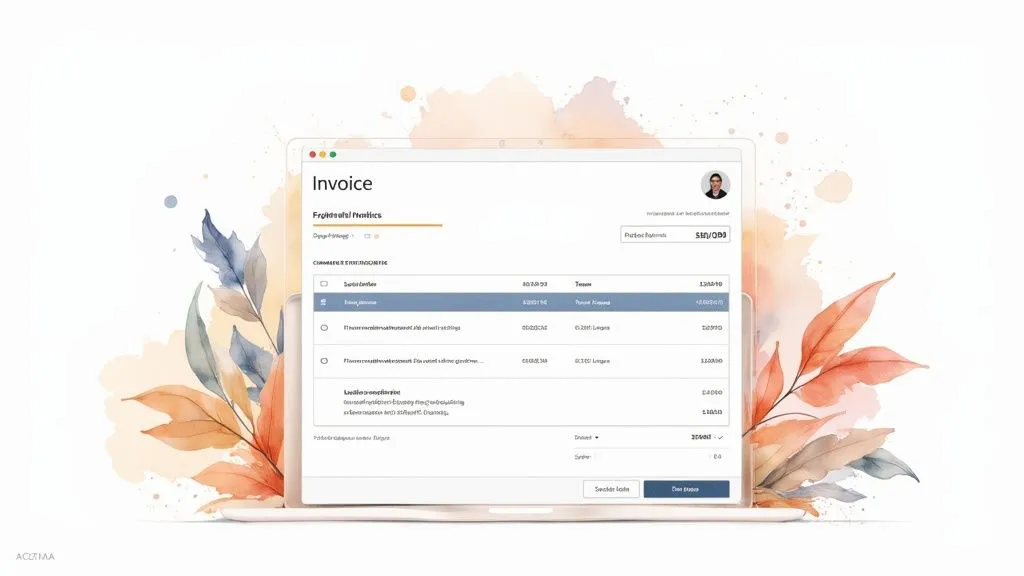
For a sole trader, even one exempt from VAT, a flawless invoice is a major asset. It demonstrates your professionalism and guarantees your business’s compliance. Let’s look at the components of a perfect invoice.
Mandatory information: the foundation of a compliant invoice
Certain information is legally required for your invoice to be valid. Its absence can create difficulties in the event of an audit.
- Issuer identification: Name, full address, and legal form of your sole trader business.
- Client identification: Name and full address of your client.
- Invoice number: A unique, sequential number for each invoice is essential for rigorous tracking.
- Issue date: The date the invoice was created.
- Description of the service: A precise, detailed description of the products or services sold.
- Unit price and quantity: For each product or service, the unit price and quantity supplied.
- Total excluding VAT: The total amount of the service before tax.
- “VAT not applicable, art. 293 B of the French Tax Code” statement: Mandatory for sole traders not registered for VAT.
To help you create your invoices, tools like Bizyness can prove invaluable.
Optional but recommended information: an asset for your image
Beyond legal requirements, additional information can strengthen your credibility and simplify your business exchanges.
- Payment terms: Payment deadlines, accepted payment methods (bank transfer, cheque…).
- SIRET/SIREN number: Makes it easier to identify your business administratively.
- Contact details: Phone number, email address, to smooth out exchanges with your clients.
This information, while not mandatory, contributes to a professional image and reassures your clientele.
To better understand the differences between essential mentions and those that, while optional, optimize your invoice, here is a summary table:
VAT-free invoice mentions: essential vs. optional
Detailed comparative analysis of the elements that make the difference between a legally compliant invoice and a professionally flawless one
| Element | Mandatory | Optional | Client impact |
|---|---|---|---|
| Issuer identification | Yes | Trust and transparency | |
| Client identification | Yes | Confirmation of information | |
| Invoice number | Yes | Tracking and organization | |
| Issue date | Yes | Time reference | |
| Description of the service | Yes | Understanding of the service | |
| Unit price and quantity | Yes | Cost transparency | |
| Total excluding VAT | Yes | Clarity of the amount due | |
| ”VAT not applicable, art. 293 B of the French Tax Code” statement | Yes | Legal compliance | |
| Payment terms | Yes | Smoother transactions | |
| SIRET/SIREN number | Yes | Professionalism and identification | |
| Contact details | Yes | Ease of communication |
This table highlights the importance of each element for optimal invoicing. Optional mentions, while not required by law, significantly improve how your business is perceived by clients.
The impact on your client: a professional, lasting relationship
A clear, precise, well-presented invoice simplifies your client’s bookkeeping. It reflects your seriousness and professionalism, strengthening your business relationship. Invoicing is an essential part of your brand image. A tool like Bizyness lets you generate professional invoices and optimize your administrative management.
Choosing the invoicing tool suited to your reality
Choosing the right tool to invoice as a sole trader can seem complicated. The offering is vast! To shed some light, we gathered feedback from more than 50 sole traders. Their experience? Matching the tool to your business is essential. Some still use traditional tools like Excel, others prefer more powerful digital solutions.
Traditional invoicing vs. digital solutions: the best choice for a VAT-free sole trader business
For a sole trader with a low invoice volume, a spreadsheet like Excel can be enough. But be careful: this method can quickly become time-consuming and error-prone as your business grows. Additionally, Excel doesn’t offer the automation and payment tracking that invoicing software provides.
Digital solutions, on the other hand, automate the creation of invoices compliant with French legislation. The “VAT not applicable, art. 293 B of the French Tax Code” statement is automatically included. Client management, payment tracking, and report creation are all simplified. This time saved lets you focus on your core business.
Choosing software: volume, sector, and growth
Several factors come into play when choosing invoicing software. Business volume is essential. If you issue many invoices, powerful, automated software is indispensable. Your sector also matters. Some software is designed for specific professions.
Finally, think about your growth! Scalable software will support your development, even if you exceed the VAT-free sole trader thresholds. Bizyness (Discover Bizyness) is a complete, adaptable solution, whether you’re VAT-exempt or VAT-registered.
The benefits of software adapted to the French VAT-free scheme
Suitable software simplifies your invoicing management. Mandatory legal mentions are included, limiting errors. It also makes creating reports and analyzing your financial performance easier.
To help you, here is a comparison table of a few solutions:
Invoicing solutions: an in-depth comparative analysis
A rigorous evaluation of the leading solutions used by French sole traders, with real-world feedback
| Solution | Annual cost | Key features | VAT-free compatibility | Feedback |
|---|---|---|---|---|
| Excel/Google Sheets | Free | Basic, little automation | Yes, but manual | Simple for low volume, error-prone |
| Facture.net | From €0/month | Simple invoicing, quotes | Yes | Good value for money |
| Bizyness | From €0/month | Invoicing, quotes, bookkeeping, payment tracking | Yes | Complete, scalable solution |
| FreeAgent | From €10/month | Invoicing, bookkeeping, project management | Yes | Suited to freelancers |
In conclusion, the right invoicing tool is crucial to the success of your sole trader business. Analyze your needs and test different solutions. A powerful tool, like Bizyness, can save you time and help you steer your business.
Software that turns a constraint into an opportunity

Invoicing can quickly become a real headache for a VAT-free sole trader. Yet, thanks to the right tools, this obligation becomes a valuable asset for managing your business. Many software solutions now simplify and automate this process, specifically for French sole traders.
Key features for simplified management
This software, often designed for the sole trader scheme, automatically includes the “VAT not applicable, art. 293 B of the French Tax Code” statement on your invoices. Oversights and the risk of error are now a thing of the past! In addition, they offer features that go well beyond simple invoice creation.
- Payment tracking: Quickly and easily view paid invoices and outstanding ones.
- Automatic reminders: Schedule personalized reminders to optimize your collections.
- Report generation: Analyze your revenue and financial performance.
- Client management: Centralize your clients’ information for more effective, personalized tracking.
These tools let you save valuable time, up to 5 hours per week for some entrepreneurs, according to certain case studies. This time saved can be devoted to growing your business.
Integration into your workflow: the key to efficiency
To choose the right invoicing software, consider leveraging the power of no-code tools for simplified integration and customization. The effectiveness of a piece of software also lies in its ability to integrate with your existing tools. Some software connects to your bank account to automatically sync your transactions. Others integrate with your online sales platforms, simplifying the management of your orders and invoicing. This interconnection streamlines your processes and reduces manual entry, often a source of errors.
Scalability: anticipating the growth of your business
Your invoicing software should be able to adapt as your sole trader business evolves. Even if you’re currently VAT-exempt, plan for a possible move to VAT registration. Choose software that handles invoicing with and without VAT, like Bizyness. You’ll be ready for the next stage of your growth. Bizyness (Discover Bizyness) supports your growth, offering a complete, adaptable solution.
With powerful software, invoicing becomes a tool for steering and analysis. You track your performance, identify areas for improvement, and optimize your profitability. More than a simple obligation, invoicing becomes a true growth lever for your sole trader business.
Smart automation: invoice better, not more
Invoicing automation offers much more than simple time savings, particularly for VAT-free sole traders. It’s a genuine asset for optimizing management, nurturing client relationships, and focusing on your core business. Entrepreneurs who have adopted smart systems for their invoicing see a marked improvement in their organization.
Creating value at every step: concrete examples
Imagine a sole trader business that manages its invoices manually. Drafting, checking, and sending them takes a considerable amount of time. Automated invoicing software, such as Bizyness, simplifies these tasks. The software automatically generates compliant invoices, with the “VAT not applicable, art. 293 B of the French Tax Code” statement, and sends them directly to clients. The entrepreneur can then focus on higher-value activities.
Take payment tracking, for example. Chasing clients is often an unpleasant task. Automation lets you schedule personalized, automatic reminders. This improves the collection rate and frees up valuable time.
Gradual integration: minimizing disruption and maximizing benefits
Adopting automation doesn’t mean a radical overnight transformation. Integrating smart solutions can be done gradually. Start by automating invoice creation with software like Bizyness (Discover Bizyness). Once familiar with the tool, add payment tracking and automatic reminders. This gradual approach minimizes disruption and makes onboarding easier.
Breaking automation down into accessible phases: a practical approach
For sole traders less familiar with digital tools, automation can seem complex. By breaking it down into simple steps, it becomes accessible to everyone.
- Phase 1: Choose invoicing software suited to your business and your VAT-free status, such as Bizyness.
- Phase 2: Integrate your client and product/service data into the software.
- Phase 3: Create and send your first automated invoices.
- Phase 4: Set up payment tracking and automatic reminders.
Each phase is easy to implement and offers immediate benefits.
Entrepreneur testimonials: a transformed perception of their business
Many entrepreneurs, initially reluctant about technology, testify to the positive impact of automation. Not only is their invoicing simplified, but their client relationships also improve. Clear, professional invoices sent on time strengthen credibility and trust. Automation lets you focus on what matters: growing your business and satisfying your clients. Bizyness is a valuable ally for sole traders looking to optimize their invoicing and gain peace of mind.
Proactive payment management: the art of effective tracking
Creating an invoice is an essential first step. For a VAT-free sole trader, payment management is a crucial element in maintaining healthy cash flow. How can you ensure you get paid quickly and efficiently, while preserving a harmonious client relationship? Experienced sole traders share their best practices for optimal collections.
Communicating effectively: the key to successful collections
Rigorous payment tracking relies on clear, proactive communication with your clients. From the moment the invoice is issued, clearly inform them of the payment terms (deadlines, accepted payment methods). In the event of a delay, polite but firm reminders are essential.
Here are some examples of reminder messages:
- First reminder (after one week of delay): “Hello [Client name], a quick reminder about invoice [Invoice number], which was due on [Date]. Could you let me know the status of the payment?”
- Second reminder (after two weeks of delay): “Hello [Client name], I’m following up regarding invoice [Invoice number], which remains unpaid. Prompt payment would avoid any collection procedure.”
- Third reminder (after three weeks of delay): “Hello [Client name], despite my previous reminders, invoice [Invoice number] is still awaiting payment. I invite you to settle it as soon as possible to avoid additional fees.”
Automating reminders with software like Bizyness can save you valuable time.
Anticipating unpaid invoices: identifying warning signs
Prevention is the best way to fight unpaid invoices. It’s important to be attentive to early warning signs.
- Known financial difficulties of the client: Discreetly finding out about your clients’ financial health, particularly for new contracts, can be wise.
- Frequent late payments: A client who systematically pays late represents a higher risk.
- Lack of communication: No response to your reminders can signal a problem.
Preventive measures to minimize delays
Putting preventive measures in place can significantly limit the risk of unpaid invoices.
- Clear payment terms: Clearly state payment deadlines, accepted payment methods, and late-payment penalties on your invoices.
- Deposits: Requesting a deposit, particularly for large projects, secures part of the payment.
- Regular invoicing: Invoice regularly rather than waiting until the end of a long project.
- Invoicing software: Software like Bizyness simplifies payment tracking and automates reminders, reducing delays.
Impact on your cash flow: concrete examples
The importance of effective payment management is reflected in businesses’ actual results. A sole trader business that has implemented rigorous tracking and preventive measures generally sees a significant improvement in cash flow. For example, a sole trader business that automated its reminders with Bizyness saw a 20% decrease in late payments. Others, by systematically requesting deposits, stabilized their cash inflows. These examples show how proactive payment management contributes to the financial health of a VAT-free sole trader business. Bizyness proves to be a valuable tool for optimizing the management of your business and your cash flow.
Pro strategies: turning invoicing into a business asset
For a VAT-free sole trader, invoicing is often seen as a tedious administrative task. Yet the most successful sole traders use it as a genuine growth lever. Let’s see how to turn this obligation into an opportunity.
Structuring your pricing to optimize profitability
The profitability of a VAT-free sole trader business largely depends on effective pricing structure. It’s essential to properly assess your costs and apply a sufficient margin to ensure the sustainability of your business. Several methods are available to you: billing by time spent, at a flat rate, or by value. The choice will depend on your business and your clientele.
A freelance graphic designer, for example, might choose to bill by time spent for complex projects and favor a flat rate for more standardized services. Adaptability is essential. Invoicing software like Bizyness makes managing these different pricing models easier.
Flawless invoicing for a stronger position
Careful, professional invoicing strengthens your sole trader business’s brand image. Clear, precise, personalized invoices reassure your clients and demonstrate your seriousness. The invoice is often the first official contact with your business, so it’s important to take care with its presentation.
Adding visual elements, such as your logo, or carefully worded service descriptions contribute to a positive impression. Invoicing then becomes a communication tool in its own right. With Bizyness, customize your invoices to reflect your brand identity.
Integrating invoicing into your growth strategy
Invoicing shouldn’t be an isolated activity. It’s an integral part of your growth strategy. Analyzing your invoicing data provides valuable insights into your business: identifying your most profitable clients, the services generating the most revenue, and so on.
This data lets you identify areas for improvement and adapt your offering. Powerful invoicing software, such as Bizyness, provides you with detailed reports to steer your business with precision.
Payment tracking: a major challenge
For a VAT-free sole trader, payment tracking is essential. Late payments can impact your cash flow and weaken your business. Put clear reminder procedures in place and use invoicing software to automate this process.
Bizyness lets you, for example, schedule personalized automatic reminders, simplifying your management and optimizing your collections. Rigorous payment tracking is essential to the financial health of your sole trader business.
Concrete example: the impact of optimized invoicing
Take the example of a sole trader business specializing in website creation. By using software like Bizyness, it automated its reminders, reducing late payments by 15% and improving its cash flow. Personalizing invoices also strengthened its brand image and built client loyalty.
This example shows the direct impact of optimized invoicing on a sole trader business’s performance. By turning your invoicing into a strategic tool, you gain efficiency, professionalism, and profitability. Simplify your management and focus on what matters with Bizyness. Discover Bizyness today!
