

 Français
What Is a Quote? A Guide to Writing One Effectively
Learn what a quote is, why it matters, and how to write one to protect your business and reassure your clients. Discover our practical tips.

You often hear people talk about a “quote,” but what exactly is it? Far more than a simple price estimate, it’s a genuine detailed commercial proposal. Think of it as the script of a film: it precisely describes the services or work you’re offering, their cost, and the conditions under which everything will unfold.
It’s a formal document that, once signed by your client, binds you both.
Understanding the essential role of a quote
Let’s go further than the simple definition. A quote isn’t just one more piece of paperwork. It’s the birth certificate of your future collaboration. It’s a bit like an architect’s detailed blueprint before laying the first brick: every material is listed, every step is planned. This ensures you and your client share exactly the same vision of the project.
This clarity from the outset is the key to avoiding misunderstandings and building a solid relationship of trust.
To sum up, the quote plays a dual, fundamental role, both for the client and for you.
The quote in brief This table summarizes the essential functions of a quote for a quick understanding.
| Function | Description for the client | Description for the business |
|---|---|---|
| Information | They get a clear, detailed view of the service, price, and timeline. | You communicate your offer in a professional and transparent way. |
| Security | They have a firm commitment on the price and scope of work, avoiding unpleasant surprises. | You protect your work by defining a precise framework and guarding against unpaid invoices. |
| Decision | They can objectively compare several offers to make an informed choice. | You differentiate yourself from the competition through the quality and clarity of your proposal. |
In short, this document establishes clear ground rules for everyone.
A promise to the client
For your client, the quote is above all a promise. The promise of transparency. It answers their two fundamental questions: “Specifically, what am I getting?” and “How much will it cost me in the end?”.
Thanks to this document, they can break down every aspect of your offer, calmly compare it with other proposals, and make their decision without fear of the dreaded “hidden costs.”
Protection for the business owner
And for you, the business owner? The quote is your shield, both commercially and legally. It very clearly delimits the scope of your assignment. If, along the way, the client asks for additional work, this initial quote becomes the perfect proof to justify an amendment and an additional cost.
It also lets you lock in your rates for a certain period, a point we cover in detail in our article on the validity period of a quote.
A well-built quote is the best tool for laying healthy foundations. It turns a simple discussion into a professional, concrete agreement accepted by both parties.
This formalization is absolutely vital in many industries. Take construction, for example. This market, worth 215 billion euros in 2023 in France, relies heavily on the legal clarity of quotes to secure projects between the 381,000 businesses in the sector and their clients. That shows just how important it is.
The legal value of a quote: much more than a simple document
A quote, at first, is a proposal. A simple commercial offer. But everything changes with a single gesture: the signature. That’s when this document takes on a whole new dimension and becomes a genuine contract that protects your business.
As long as it isn’t signed, think of the quote as a limited-time offer, usually valid between 1 and 3 months. This time limit isn’t trivial: it protects you against an unforeseen rise in the cost of materials or labor. Once that date has passed, you’re free to revise your rates.
The key moment: the signature
It’s when your client affixes their signature, usually accompanied by the well-known phrase “approved”, that the magic happens. The document changes status.
The signed quote becomes a bilateral contract. A slightly technical term that simply means it creates legal obligations for you and your client. It moves from a proposal to an official, mutual commitment.
This change has very concrete consequences for everyone.
- On your side, as the professional: you’re required to carry out the service or supply the goods described, without changing anything, at the price and within the timeframe you set.
- For your client: they commit, in black and white, to paying you the full agreed amount once the work is completed as planned.
Your shield in case of a problem
This mechanism turns your quote into genuine armor for your business. No more misunderstandings about what was included or not! Above all, it secures your cash flow by giving you a solid legal basis if a client is reluctant to pay.
In France, the quote is a cornerstone that protects both the consumer and the professional. It’s an indispensable guarantee of clarity, particularly in sectors like construction. To give you an idea, despite a slight slowdown, 27,500 housing units were still under construction in July 2025, representing just as many projects requiring rock-solid quotes before getting underway. To learn more, you can check the data on new construction on the government website. This rigor is the best way to secure a transaction, especially when prices can change quickly.
Mandatory information on a quote: what you absolutely need to know
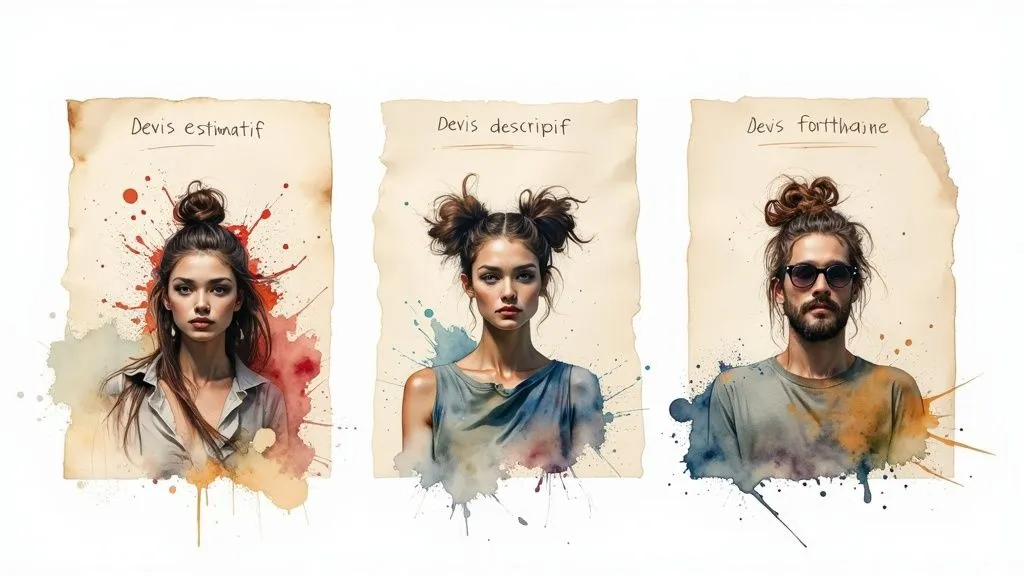
Imagine an incomplete quote as a house built on poor foundations. At the slightest gust of wind, everything threatens to collapse. For it to be solid and protect you in case of a problem, your quote must contain very specific information. This is your compliance checklist.
Forget just one of these items, and your document could lose all its legal value in the event of a dispute. Think of it as the identity card of your service: every detail counts and makes it airtight.
Clearly identifying who is who
The basis of everything is knowing who is committing to what. This is the starting point of the business relationship and a legal obligation that’s as simple as it is essential.
- Your business: State your name, business name, registered address, a phone number, and of course, your registration numbers (SIREN/SIRET). If you’re a tradesperson, don’t forget to mention your ten-year liability insurance (assurance décennale). It’s a mark of professionalism.
- Your client: Specify their name and address. If it’s a company, add their business name. This rigor removes any ambiguity about who the offer is addressed to.
This information sets a clear, professional framework. It shows that you leave nothing to chance.
The heart of the matter: the details of your offer
This is where everything happens. You’re going to precisely describe what your client is buying. Transparency is your best weapon for avoiding misunderstandings and endless discussions later. Your quote should be an open book.
The detail of each service is the cornerstone of trust. It turns a simple promise into a concrete, itemized commitment, line by line.
Here are the points you should never leave out:
- Issue date and validity period: The issue date is the starting point. The validity period, often 1 to 3 months, protects you against a possible increase in your own costs.
- Precise description: List each product or service with its quantity and unit price excluding tax (net of VAT). No technical jargon! Use words your client can understand.
- Additional costs: Travel expenses or other extra costs must be stated clearly, in black and white. No unpleasant surprises.
- Payment terms: Be clear about the deposit, any installments, and the payment methods you accept (bank transfer, check, etc.).
- Totals: Clearly display the total amount excluding tax, the different VAT rates that apply, and finally, the total amount including all taxes (VAT included) the client will have to pay.
These items aren’t negotiable. To make sure you don’t forget anything, take a look at our complete guide on mandatory information for a quote. By following this structure, you bulletproof your commercial proposals and protect your business. It’s as simple as that.
Handling the unexpected with a quote amendment
On a job site or during a service, things don’t always go as planned. That’s the reality on the ground. Does your client want a last-minute change? Does an unforeseen technical difficulty extend the length of the work? That’s where the quote amendment comes into play. It’s your safety net for managing these changes clearly and professionally.
Forget verbal agreements, which are a source of misunderstandings and tension when it comes time to invoice. The amendment is the official document that modifies the original contract. It lets you clearly frame, in writing, any additional service, a change of materials, or an extension of the original scope.
The golden rule for protecting your work
The rule is simple but fundamental: never start additional work without a written amendment signed by the client. This is your only guarantee that these new services will be paid at their fair value and that the client is fully aware of the additional costs incurred.
This tool gives you full transparency with your client, protects your profitability, and defuses potential conflicts. In short, it turns unexpected events into calmly managed opportunities.
An amendment is all the more relevant in an unstable economic context. Take the rising cost of raw materials: in the first quarter of 2025, the Construction Production Cost Index (ICP-F) rose by 0.9%. This increase, driven notably by energy (+3.2%) and materials (+0.8%), can seriously eat into your margins. Passing this increase on through an amendment isn’t just fair, it’s necessary for the health of your business. To go further, you can check the latest INSEE statistics on the subject.
To better understand how these two documents complement each other, here’s a simple comparison.
Comparison: initial quote vs. amendment
This table compares the role of the initial quote and the amendment in managing a project.
| Element | Initial quote | Amendment |
|---|---|---|
| Purpose | Sets the initial contractual framework (price, timeline, services). | Modifies or supplements the initial contract following an unforeseen event or new request. |
| Timing | Drawn up before the work begins. | Created during the project, once the initial quote has been signed. |
| Nature | Founding document that binds both parties. | Supplementary document, dependent on the initial contract. |
| Status | Cancelled and replaced if a new quote is issued before signature. | Does not replace the quote, it supplements it. Unmodified original terms remain valid. |
This table clearly shows that the amendment isn’t the quote’s enemy, but its indispensable partner for navigating a project’s realities with agility.
An incomplete or vague quote opens the door to disputes, as this chart on the most common mistakes highlights.
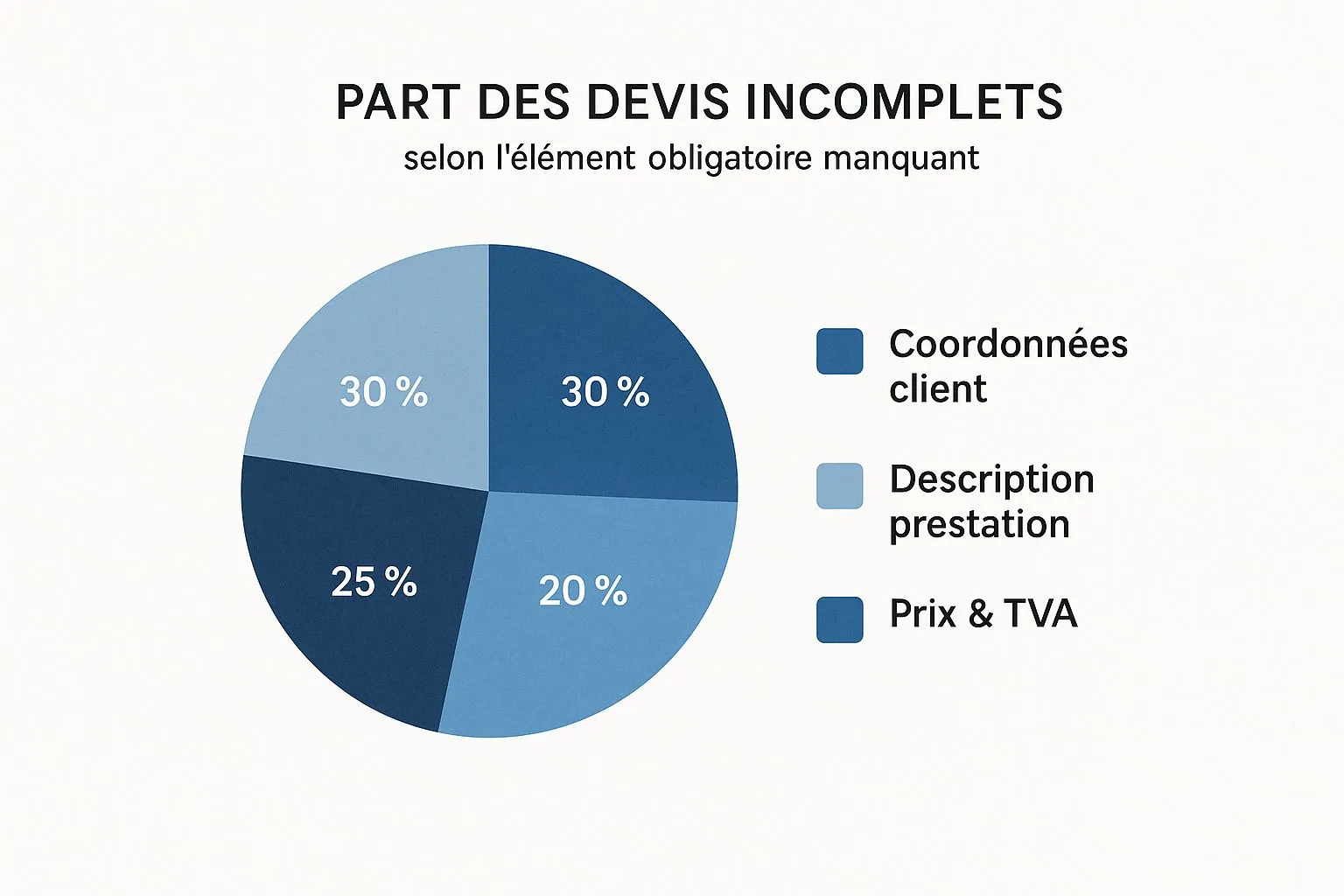
It’s clear that a lack of clarity in the description of services is a major weakness. This is precisely the kind of gray area that an amendment helps clear up to avoid any misunderstanding.
Time to act: create a professional quote in a few clicks
Knowing what a quote is is one thing. Creating one quickly and without errors is even better. We all know that juggling a spreadsheet to draft a commercial proposal can quickly become a headache. It’s often a time-consuming task where the slightest typo or calculation error can tarnish your professionalism, or even cost you money.
That’s exactly where a management tool like Bizyness comes in. Think of it as a co-pilot for your admin work, handling the tedious tasks so you can focus on what you do best: your craft.
Make your life easier with a tool designed for you
The idea is simple: stop reinventing the wheel with every new request. With a well-designed solution, everything becomes smoother.
- No more repetitive data entry: Your clients are saved once and for all. No more searching for their address or SIRET number every time.
- Your catalog at your fingertips: List your services and products with their prices. To create a quote, you just pick from the list. It’s fast and consistent.
- The calculations? Automatic! The tool takes care of everything: totals excluding tax, applying the correct VAT rate, final total including all taxes. The risk of calculation errors is simply reduced to zero. Zero.
To give you a concrete idea, here’s what the quote creation interface looks like on Bizyness.

As you can see, everything is organized in a logical, visual way. In just a few clicks, all this information is compiled into a flawless PDF, ready to be sent.
The benefit is twofold. On one hand, you save precious time you can reinvest elsewhere. On the other, you project a far more professional and reliable image to your prospects. Clear, polished documents without a single error inspire confidence.
To go further and master the process from A to Z, take a look at our complete guide to creating the perfect quote.
Frequently asked questions about managing quotes
Even with the best guide, certain practical questions always end up popping up. That’s perfectly normal! The idea here is to directly answer the most common questions to help you see things more clearly on a daily basis.
Let’s look together at how to handle these situations with more peace of mind.
Is a quote always free?
In common understanding, a quote is a commercial approach, a proposal. And generally, that’s true: it’s free. It’s the basic principle for presenting your offer and convincing a prospect.
But there are exceptions. Imagine that to draw up your offer, you need to carry out an in-depth study, complex research, or travel a long distance. In that case, this preparatory work has a cost, and it’s entirely legitimate to charge for it. The one golden rule imposed by law is clear: you must inform your client clearly and explicitly before starting anything at all.
A small tip: if the client accepts your proposal, deducting the cost of the quote from the final invoice is a much-appreciated commercial gesture that often makes the decision easier.
What’s the difference between a quote and an invoice?
They’re often confused, but their role and their place in time are very different. Think of them as the two stages of the same story:
The quote is the prologue. It comes before the job. It’s a detailed proposal describing the work to be done and the price requested. Its goal? To get the client’s agreement.
The invoice is the epilogue. It arrives after the service has been provided. It’s an official payment request confirming that the client owes you money. Of course, it must correspond exactly to the signed quote.
Can a client cancel a signed quote?
Once the client has affixed their signature, the quote changes status. It becomes a genuine contract that binds you both. In theory, the client cannot cancel it on a whim without exposing themselves to penalties.
There is, however, one major exception: the 14-day right of withdrawal. Be careful, it only applies in a very specific context, that of off-premises sales (for example, during door-to-door canvassing).
Outside of this specific case, cancellation is only possible if you reach an amicable agreement or if, on your end, you fail to meet your own commitments (a very significant delay in starting the work, for example).
What is the validity period of a quote?
You decide! As the professional, you set this period and state it directly on the document. This is an essential protection for you, especially if material or labor prices tend to fluctuate.
In practice, the most common period is 1 to 3 months. Once this period has elapsed, if the client hasn’t made a decision, you’re no longer bound by the rates and terms of your initial offer. You’re free to offer them a new, updated one.
Ready to create professional quotes in the blink of an eye? With Bizyness, generate compliant documents in a few clicks, track their status in real time, and turn them into invoices with a single action. Simplify your management today on Bizyness.fr.
