

 Français
 Which bank for a sole trader? Our 2024 guide
Find out which bank to choose as a sole trader in 2024. Compare the best options to optimize your fees and succeed in your business.

For a sole trader, choosing the right bank often means finding the right balance between flexibility and cost. Neobanks like Shine or Qonto stand out for their agility and attractive pricing, while traditional banks keep the edge with human support and more robust financing solutions.
Finding your way through banking options for sole traders

Choosing your bank is one of the first important decisions you’ll make. Far from a mere formality, this choice will shape the fluidity of your day-to-day management, the weight of your banking fees, and even your ability to grow your business.
The first thing to know is the legal obligation. In France, if your annual revenue exceeds €10,000 for two consecutive years, the law requires you to open a bank account dedicated to your business. The idea is simple: clearly separate your personal finances from your business finances. This makes bookkeeping much easier and clarifies everything in the event of an audit. For a quick overview, take a look at the current banking offers for sole traders.
The two main families of banks
The market splits into two broad categories, each with its own approach and strengths.
-
Traditional banks: We’re talking about big names like Crédit Agricole or BNP Paribas. Their strength lies in the human relationship. Having a dedicated advisor and a network of physical branches to deposit cash or get an in-person appointment remains a major asset for many.
-
Neobanks and online banks: These 100% digital players, like Shine, Qonto or Revolut, bet everything on autonomy and efficiency. Their offers are often much more affordable and come with very practical management tools (invoicing, expense reports) built directly into the mobile app.
The real question isn’t simply “physical branch or fully digital?”. It’s more about knowing which ecosystem will best support the way you work. A craftsperson who regularly cashes checks won’t have the same needs as a digital marketing consultant who invoices clients abroad.
To get your search off to a good start, it’s crucial to list your priorities. Do you need a payment terminal? An authorized overdraft to manage cash-flow gaps? Seamless integration with your accounting software?
This small table summarizes the key differences to help you see things more clearly.
| Feature | Traditional Banks | Neobanks & Online Banks |
|---|---|---|
| Support | Dedicated personal advisor | Digital customer support (chat, email) |
| Pricing | Generally higher, with various additional fees | Very competitive, often clear flat rates |
| Included services | Very broad offering (credit, savings, POS terminals) | Integrated management tools (invoicing, bookkeeping) |
| Flexibility | Less agile, sometimes longer processes | Sign up in minutes, 100% mobile management |
Comparing traditional banks and neobanks: the big match
Choosing your bank as a sole trader is a bit like the first big dilemma. You find yourself facing two worlds: on one side, the reassuring solidity of traditional banks; on the other, the agility of 100% digital neobanks. It’s not just a question of physical branch versus mobile app — it’s a choice between two business management philosophies.
Traditional banks, like BNP Paribas or Crédit Agricole, capitalize on trust and human contact. Their key asset? The dedicated advisor and branch network. If you regularly cash checks or cash, or if you’re planning to apply for financing, this direct relationship is often essential.
By contrast, players like Shine, Qonto or Revolut have revolutionized the landscape with a purely digital approach. Their promise is simple: low fees, total transparency, and a frictionless user experience. Opening an account takes a few minutes on your phone, and day-to-day management is a breeze thanks to tools designed for us, the self-employed.
The question of fees: transparency versus complexity
The first round is fought on pricing. Traditional banks often offer “pro packages” whose advertised cost can hide additional fees: transaction commissions, account maintenance fees, expensive international transfers… You sometimes have to read between the lines.
Neobanks, on the other hand, have adopted the monthly subscription model. Everything is clear: for a fixed price, you know exactly how many transfers are included, what your card limits are, and which services you’re entitled to. For a sole trader who watches their expenses closely, this predictability is a real relief.
This image highlights the typical cost differences between the various types of banks for freelancers.
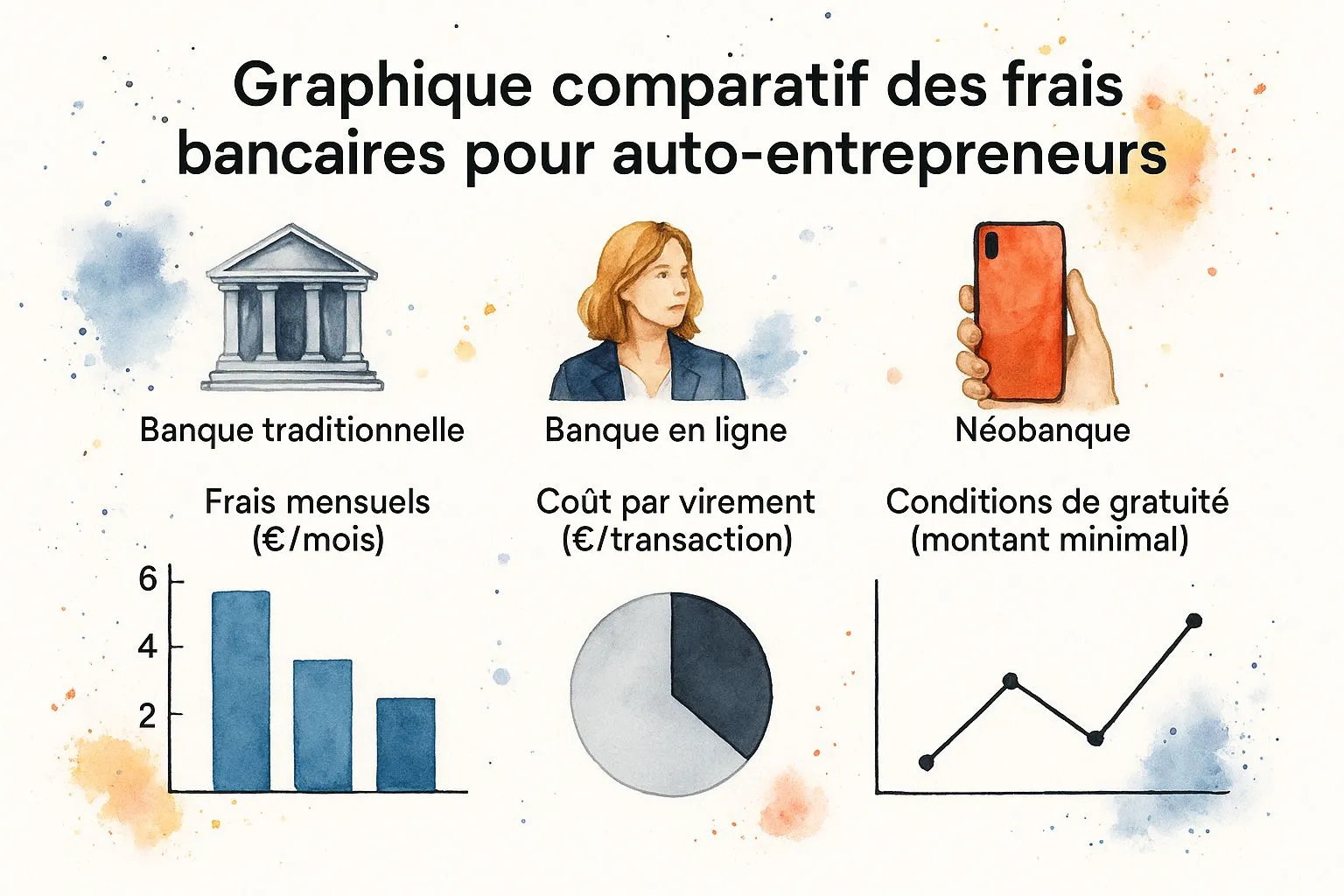
The finding is clear: neobanks show much lower monthly fees and often zero transaction costs on everyday operations, whereas traditional banks maintain a more complex and generally higher pricing grid.
To help you quickly visualize the offers, here’s an overview of popular options.
Comparison of banking offers for sole traders
This table compares the key features of entry-level offers from online and traditional banks popular with sole traders.
| Bank | Type | Monthly fee (starting from) | Included management tools | Customer support |
|---|---|---|---|---|
| Shine | Neobank | €7.90 excl. VAT | Invoicing, contribution calculation | Chat, email, phone |
| Qonto | Neobank | €9 excl. VAT | Invoicing, expense report management | Chat, email, phone |
| BNP Paribas Pro | Traditional bank | ~€25-40 excl. VAT (variable) | Few integrated tools (paid options) | Dedicated advisor, branch |
| Crédit Agricole Pro | Traditional bank | ~€20-35 excl. VAT (variable) | Few integrated tools | Dedicated advisor, branch |
| Revolut Business | Neobank | €0 (limited free offer) | Basic tools (paid upgrade) | Chat |
This comparison clearly shows the difference in approach: neobanks integrate administrative management into their base offer, while traditional banks focus on pure financial services.
Everyday services: a full ecosystem or targeted tools?
Beyond the price, what matters is what the bank does for you every day. Traditional banks offer a genuine financial arsenal: business credit, overdraft authorization, savings solutions, insurance… It’s a one-stop shop if you want to centralize everything.
Neobanks, on the other hand, focus on the essentials: smooth and efficient cash-flow management. No credit or authorized overdraft in most offers. But they make up for it brilliantly with features that change a sole trader’s life:
- Integrated invoicing tools to create and send quotes and invoices in just a few clicks.
- Accounting synchronization with software like Freebe or Indy, so everything flows through automatically.
- Expense report management by simply taking a photo of your receipts.
The real differentiator isn’t the number of services, but their relevance to your daily life. A traditional bank will lend you money; a neobank will save you hours of bookkeeping every month. It’s up to you to decide where your priority lies.
For those drawn to digital, our guide on the online business account for sole traders reviews the best solutions on the market.
Flexibility and support: autonomy or personalized guidance?
Agility is the DNA of neobanks. Changing a card limit, blocking a payment, exporting a statement for your accountant… everything is done in seconds from the app, 24/7. This autonomy is a real luxury for anyone working outside office hours.
Customer support is another point of friction. Neobanks offer ultra-responsive service by chat or email, with very wide time slots. In return, you don’t have a dedicated point of contact.
At a traditional bank, it’s the opposite. You have an advisor who knows you and your project. The catch? They’re only reachable during branch opening hours, and a simple piece of paperwork can sometimes require an appointment.
So, who are they for?
- The traditional bank is ideal if you anticipate a need for financing, if you cash in cash or checks, or if you value having a flesh-and-blood advisor.
- The neobank is perfect for you if you’re primarily looking for low fees, 100% autonomous management, and tools that save you precious time on admin.
Analyzing the essential criteria for a good choice

Choosing the right bank for your sole trader business isn’t just about comparing the prices displayed on a homepage. To make the right choice — one that will support you over the long term — you need to dig a little deeper. It’s about breaking down each offer with your needs in mind, both today’s and tomorrow’s.
Take a methodical approach. Your bank isn’t just a simple account through which your payments flow; it’s a strategic partner. Its features, its customer support, and the whole ecosystem around it can either save you precious time or become a source of frustration.
Decoding the structure of banking fees
The headline price is often tempting, that’s true. But the reality of the costs is often hidden in the fine print. The classic mistake is stopping at the monthly subscription without evaluating what the account will actually cost you in practice.
Transparency is therefore the watchword. Neobanks have made clarity their battle horse, but even with them, you need to check the limits of each plan.
Here are the points to scrutinize:
- Account maintenance fees: Are they included in your plan, or are they an extra line of cost?
- Transaction commissions: These are fees charged on each debit operation. Rare among neobanks, they can quickly add up at a traditional bank, especially if you have many transactions.
- The cost of transfers: Are SEPA transfers truly unlimited? And how much do instant or international transfers cost? Fees for a transfer outside the SEPA zone can be prohibitive.
- Fees on foreign operations: If you buy equipment or services online from foreign suppliers, look closely at the commissions on payments and withdrawals in foreign currencies.
The real question isn’t just “how much does it cost per month?”, but rather “what am I paying for?”. An account at €15/month with unlimited international transfers can turn out to be much more cost-effective than another at €8/month that charges you €20 for each transfer outside Europe.
Evaluating the services and features that really matter
Once the fee puzzle is solved, it’s time to look at the tools that will actually make your life easier. Every business has its own constraints, and the “best bank” is simply the one whose services fit your work routine.
For a sole trader, time is the most precious resource. It’s therefore smart to optimize administrative and financial management from the start, by choosing a bank that automates tasks rather than adding to them.
Here’s a list of services to consider, depending on your profile:
- Payment collection solutions: Do you sell in person? A payment terminal (POS) is probably necessary. Neobanks often offer partnerships with SumUp or Zettle (you buy the terminal and pay a commission per transaction). Traditional banks tend to favor monthly rental, an option better suited if you handle large volumes.
- Card and withdrawal limits: Make sure the limits match your spending. A limit that’s too low can quickly become a headache if you need to buy expensive equipment. Most neobanks let you adjust them in one click from their app.
- Professional insurance: Don’t overlook this aspect. Some offers, notably from Shine or Blank, include very useful coverage (legal protection, equipment insurance, etc.). It’s real added value.
- Cash and check deposits: This is the historic weak point of neobanks. If you often collect payments this way, a traditional bank or an online bank backed by a physical network (like Hello bank! Pro or Monabanq) remains essential.
Analyzing the ecosystem and integrations
The real strength of a modern bank is its ability to communicate with your other tools. This connectivity is a phenomenal time-saver and drastically reduces the risk of human error.
The goal? To create a smooth workflow where your financial information flows effortlessly, from invoicing to your revenue declaration. This is where tools like Bizyness come into their own, syncing perfectly with your business account.
Be sure to check:
- Compatibility with your software: Does your bank integrate easily with invoicing tools like Freebe, Indy or Bizyness? Good synchronization automates the reconciliation between your invoices and your transactions. To go further, take a look at our guide on automatic bank reconciliation.
- Data export: Can you easily download your statements in a clean, usable format (CSV, Excel) to send to your accountant or for your own analysis?
- API access: For those more comfortable with technical matters, having an API opens the door to custom automations for managing your business.
The quality and responsiveness of customer service
Last criterion, but far from the least important: customer support. When you face an emergency — a card blocked abroad, a crucial transfer that hasn’t arrived — how responsive your contact is makes all the difference.
Never underestimate this aspect. Ask yourself what suits you best: a dedicated advisor you can call during office hours, or an ultra-responsive chat support available even on weekends? There’s no right answer, just the one that matches your way of working and your tolerance for stress.
Which bank for which sole trader?
The best bank isn’t the one with the nicest ad. It’s the one that fits your reality on the ground, your everyday life as a freelancer or self-employed professional. Every sole trader has their own pace, their own tools, their own constraints. The first and most crucial step is therefore to carefully analyze your profile to know which bank to choose for your business.
The ecosystem of self-employed workers in France is booming. 2024 even broke a record with 1,111,200 new businesses, a wave driven largely by micro-entrepreneurs (64.5%). From digital service consultants to market-stall craftspeople, this diversity clearly shows that a single banking solution can’t work for everyone.
To help you see things more clearly, let’s review four typical sole-trader profiles. Each scenario highlights very concrete needs and the banking solution that best answers them.
Scenario 1: The freelance developer working internationally
Imagine a web developer whose clients are mainly based in the United States and Switzerland. For them, the crux of the matter is receiving payments in foreign currencies (USD, CHF) quickly and without losing their shirt to fees.
Their needs are therefore very clear:
- Low-cost SWIFT transfers. Traditional banks help themselves generously with high fixed fees and exchange rates that aren’t always in the customer’s favor.
- Multi-currency accounts. Being able to keep dollars or Swiss francs in a dedicated account, without having to convert everything with each transaction, is a real plus.
- Easy integration with payment platforms. They likely invoice via Stripe or PayPal, so good synchronization is essential.
In this scenario, a neobank specialized in international payments like Revolut Business or Wise Business is the obvious choice. They offer ultra-competitive exchange fees, close to the real market rate, and a crystal-clear fee schedule for transfers outside the SEPA zone. A traditional bank would be a real burden here, both financially and administratively.
Scenario 2: The craftsperson selling at local markets
Let’s change the scene. Take a ceramicist who sells her creations at markets and pop-up shops. Her business is rooted in the physical world, and her transactions are often direct, face to face.
What’s vital for her:
- A mobile payment terminal (POS) that never lets her down. She needs to be able to accept card payments anywhere, with a stable connection and transaction fees that don’t eat into her margin.
- The ability to deposit cash. A good portion of her sales are in cash. She needs a simple solution for putting that money into her account.
- A clear view of her cash flow. No need for a complex system, just a simple tracking of what comes in and what goes out.
For this craftsperson, a fully digital neobank can quickly show its limits, particularly for cash deposits. The ideal compromise is often a hybrid solution: an online bank like Hello bank! Pro or Monabanq. They rely on the physical network of their parent company (BNP Paribas, Crédit Mutuel) for deposits. On the POS side, the offers in partnership with SumUp or Zettle, often proposed by neobanks, remain an excellent option.
The key is to choose a bank for what it does on a daily basis, not for what it could do. Technology should be a helping hand, not a headache. The craftsperson doesn’t care about having a multi-currency account, but a broken POS terminal on a Saturday morning at a market is a small catastrophe.
Scenario 3: The digital marketing consultant
Here, we have a consultant who invoices businesses in France for their services. Everything is dematerialized. Their main challenge? Saving time on admin to focus on their assignments.
Their priorities are crystal clear:
- Integrated invoicing tools. Being able to create and send a professional quote or invoice directly from their banking app is a huge time-saver.
- Automatic accounting synchronization. Their account needs to connect effortlessly to their accounting software (like Freebe or Indy) so bank reconciliation happens on its own.
- Hassle-free expense report management. Just a photo of the receipt, and the expense is categorized and the VAT extracted.
This profile is the dream client for neobanks like Shine or Qonto. These platforms were designed from the outset for digital freelancers. They’re much more than a simple account: they’re true administrative co-pilots. Their strength lies in their integration ecosystem and the automation they offer. Knowing how to improve your cash flow also involves having a perfect view of your finances, which these tools serve up on a plate.
Scenario 4: The dropshipping e-commerce seller
Finally, let’s look at a sole trader who runs an online store. They process hundreds of small transactions per month, with payments coming in via Shopify Payments or Stripe and payments going out to their suppliers.
Points to watch for them:
- No transaction commissions. With a traditional bank, these fees charged on each debit operation can quickly turn into a financial pit given such a volume of small transactions.
- High card limits. To pay suppliers or advertising campaigns, they need a card that won’t block them mid-momentum.
- Integrations with e-commerce platforms. A smooth connection with their sales interface is crucial to track profitability in real time.
For the e-commerce seller, a neobank is nearly a must to keep costs under control. Offers from Qonto or Blank are particularly well suited. They offer plans with a large number of included transfers and, above all, without those pesky transaction commissions. Their card limits, including virtual cards, are also designed for online business spending. For this type of activity, opting for a traditional bank would be a major strategic mistake in terms of fees.
Decoding the motivations of sole traders

To choose the right bank, you first need to understand what drives thousands of people to go solo. Becoming a sole trader isn’t just a simple administrative formality; it’s a genuine life project, a decision driven by deep aspirations. And those aspirations directly shape what people expect from a banking partner.
Sole proprietorship has literally exploded in France. Its main asset? A disarming simplicity, both at creation and day to day, making it the ideal gateway for testing an idea or launching a business. The numbers speak for themselves: 61% of businesses created recently were set up under this status. That says a lot about its weight in the economy.
This popularity is no accident. It responds to a quest for meaning and a desire to work differently, in step with our times.
Freedom, the number-one driver
If we had to sum up in one word what motivates sole traders, it would undoubtedly be: independence. A study by La Banque Postale confirms it — for 47% of self-employed people, the desire to be their own boss is the main reason for taking the leap. And this quest for freedom isn’t a minor detail; it’s the cornerstone of all their decisions, including banking ones.
This thirst for autonomy translates into a vital need for flexibility and control. Sole traders want to master their own schedule, choose their clients, their assignments, far from the constraints of a traditional hierarchy. They’re seeking above all to build a business in their own image, a project in which they can fully thrive.
Inevitably, this mindset directly influences the type of banking services sought. Gone are the days of a bank imposing its opening hours and rigid processes. What they expect are tools that give them the power to manage their finances where they want, when they want.
Banking expectations that rhyme with simplicity
Who says independence also says efficiency. Time is money, and every minute spent on admin is a minute less for the core business. Bank management should therefore never be a burden.
Concretely, this quest for simplicity breaks down into a few key points:
- A fast, 100% online account opening: Nobody wants to collect appointments and wait days to get a bank account number.
- An ultra-intuitive interface: The mobile app becomes the dashboard. Everything should be simple there, from transfers to exporting statements for the accountant.
- Crystal-clear pricing: Hidden fees and long, complex pricing grids are real deterrents.
- Integrated management tools: Being able to issue a quote, an invoice, or scan expense receipts from the banking app? That’s a precious time-saver.
Sole traders aren’t just looking for a business account. They’re looking for a true co-pilot that grasps their reality, an ally who understands that every hour saved is a small victory. This is exactly the niche on which neobanks have built their success, betting everything on user experience and efficiency.
The success of digital players is explained by this perfect fit between the values of self-employed people (autonomy, flexibility, simplicity) and what they offer. In 2022, France had more than 2.5 million active sole traders, a figure that keeps climbing, especially in service industries. To learn more on the subject, you can read La Banque Postale’s full analysis.
Ultimately, grasping this psychology is essential. Choosing a bank as a sole trader is much more than a question of price; it’s the search for a tool aligned with a life project.
Frequently asked questions about banking for sole traders
Choosing the right bank for your sole trader business is a bit like choosing your first workspace: it’s a decision that has a direct impact on your daily life. Between legal obligations, the jungle of offers, and the fine print of each contract, it’s perfectly normal to have a thousand questions before signing.
This section is here for that. The idea is to simply answer the most common questions, to help you see things more clearly and make an informed choice, without unnecessary stress.
Is a business account mandatory for a sole trader?
This is the question that comes up all the time. The answer is… nuanced. No, a bank account labeled “professional” isn’t always a strict requirement. The 2019 PACTE law relaxed the rules: you only need to have a dedicated bank account for your business if your revenue exceeds €10,000 for two consecutive years.
In practice, a simple second checking account in your name, kept clearly separate from your personal account, can be enough to comply. At first glance, it’s the most economical solution.
But be careful not to confuse what’s legally sufficient with what’s practically efficient. A real business account, even if not mandatory below this threshold, is designed for you, the self-employed professional.
A business account isn’t just a separate account; it’s a genuine management tool. It often comes with services that change your life: integrated invoicing tools, the ability to connect a payment terminal (POS), professional insurance, or accounting exports that save you a huge amount of time. The small extra monthly cost is very often paid back by the efficiency gained.
In short: if you’re starting out with low revenue, a classic dedicated account can do the job. But as soon as your business starts taking off, switching to a real business account becomes a sensible strategic choice.
Can I get a business loan with a neobank?
Here we touch on a fundamental difference between traditional banks and most neobanks. The majority of 100% digital players like Qonto, Shine or Revolut Business offer neither business credit nor authorized overdrafts.
Their model is ultra-efficient for day-to-day management: collecting payments from your clients, paying your suppliers, managing your expense reports, all with real-time tracking on your smartphone. They excel at this, but financing simply isn’t their business. If you’re planning to buy equipment, invest in stock, or even want a bit of cushion in case of a late client payment, a neobank will quickly limit you.
In this scenario, two main options are available to you:
- Traditional banks (Crédit Agricole, BNP Paribas, etc.) remain the go-to contacts for any financing request. Your account history and the relationship you build with an advisor carry a lot of weight.
- Online banks backed by a large group, like Hello bank! Pro (BNP Paribas) or Monabanq (Crédit Mutuel), offer a very interesting compromise. They combine digital flexibility with the strength of a large network, which allows them to offer authorized overdrafts and credit solutions.
It all depends on your medium-term vision. If your business runs without investment and with comfortable cash flow, a neobank is perfect. If, on the other hand, financing is a lever for your growth, it’s better to turn to a more traditional solution.
How do I accept card payments?
Today, not accepting card payments sometimes means risking losing a sale. Whether you’re at a market, a trade show, or a consultation, it’s become the standard. Fortunately, there are many solutions, and they vary widely from one bank to another.
Neobanks have really democratized a flexible, no-commitment approach. They typically partner with mobile payment terminal specialists, like SumUp or Zettle. The principle is simple:
- You buy your small card reader (just a few dozen euros).
- You pay a fixed commission on each payment collected (around 1.75% typically).
- There’s no fixed monthly fee, no subscription.
This is the ideal solution if you have occasional payments or still-modest volumes. The cost adapts entirely to your business.
Traditional banks, on the other hand, tend to work on a POS rental model. You pay a monthly subscription that covers the rental and maintenance of the terminal, plus a commission on each transaction. This commission is often lower and can even decrease with volume. This model becomes more cost-effective past a certain volume of card revenue.
To decide, there’s no secret: pull out the calculator. Estimate your monthly card payments and compare the total cost (buying or renting the POS + commissions) for each model.
Is it easy to switch professional banks?
Yes, much more than before! Switching banks is no longer the ordeal it used to be. Thanks to the bank mobility assistance service, the process is largely simplified. If your current bank no longer suits you, don’t hesitate.
Your new bank is legally required to assist you. It can handle, free of charge, transferring all your recurring direct debits and transfers (URSSAF, taxes, subscriptions…) within 22 business days. That’s a real weight off your shoulders.
There is, however, one important thing this service doesn’t do for a business: it doesn’t notify your clients of your change of bank details. That’s up to you to do. For a smooth transition, here’s a small checklist:
- Update your bank details on all your official documents: quote templates, invoices, website.
- Personally notify your regular clients of the change. A short email is enough.
- Keep your old account open for a month or two, giving everyone time to adjust.
This slight overlap will spare you payment delays and administrative headaches. With a bit of organization, switching banks is a simple process that can really help you find an offer much better suited to your business.
Ready to simplify your management and focus on what really matters? With Bizyness, automate your invoicing, track your cash flow in real time, and prepare your bookkeeping effortlessly. Discover how our tool can transform your everyday life as a sole trader at https://www.bizyness.fr.
