

 Français
Working Capital Management in 2026: The E-commerce Cash Flow Guide
Optimize your e-commerce cash flow with our 2026 guide to working capital management. Learn to calculate, analyze and reduce your working capital requirement.

Knowing how to manage your working capital requirement (WCR) simply means mastering the gap between your outgoing money (buying stock, paying suppliers) and your incoming money (the sales you actually collect). For an online seller, an impressive revenue figure doesn’t mean your bank account is full. Steering this cycle is how you turn sales into available cash — the key to growth that lasts.
Why working capital management is your biggest challenge in e-commerce
Think of your cash flow as a water tank. Your sales are the rain that fills it, but your Working Capital Requirement (WCR) is all the small leaks. If you don’t plug them, those leaks can drain the tank even while orders are pouring in.
Booming revenue guarantees nothing about your online shop’s survival. Working capital isn’t just an obscure accounting term — it’s the true pulse of your financial health. Concretely, it measures the money that is “locked up” in your day-to-day operations.
For an online seller, working capital is the difference between the money you’ve already spent buying your products and the money your customers haven’t paid you yet. It’s the fuel the machine needs to keep running every day.
The timing gaps putting your cash flow at risk
Several realities of selling online create these gaps, which can quickly become critical:
- Sleeping stock: Every item waiting on a shelf, whether in your own warehouse or at Amazon FBA, is money tied up.
- Collection delays: Money from a sale made on Shopify doesn’t magically land in your bank account. Processing delays from platforms like Stripe or PayPal create a temporary air pocket in your cash flow.
- Returns management: A returned product isn’t just a cancelled sale. It’s cash going out immediately for the refund, long before you can hope to resell the item.
Put together, these factors can dig a cash flow deficit very quickly, even if your sales are booming on paper. It’s a classic trap that trips up many online businesses.
A major economic issue for 2026
In a context where growth is more measured, managing your working capital well becomes a matter of survival. In 2025, customer payment delays climbed to an average of 14 days. For an online seller, this means every sale can widen the hole in your cash flow if the money takes time to arrive. It’s no coincidence that 42% of bankruptcies are directly linked to cash flow problems. You can find more information on the challenges of growth in 2026 in this article from Dynamique Mag.
Whether you sell on Shopify or create digital products, mastering your working capital in 2026 is no longer optional. It’s the fundamental skill for turning your sales into liquidity and building solid growth.
Calculating and interpreting your working capital requirement without being an accountant
You don’t need to be a chartered accountant to master your Working Capital Requirement (WCR). The idea is actually very intuitive: it’s simply about measuring the money you need to run your shop day to day while waiting for your customers to pay. It’s a bit like constantly checking your engine’s oil level.
The basic formula for tracking your WCR is very straightforward:
WCR = Inventory + Accounts Receivable – Accounts Payable
Nothing complicated. Let’s break down together what this actually means for you as an online seller.
The 3 pillars of your e-commerce working capital
Each element of this formula reflects a reality you live every day.
-
Your Inventory: This is all the money sleeping on your shelves. Think of that pallet of products waiting in a warehouse, or that safety stock you carefully keep to avoid running out. It’s cash you’ve already spent but haven’t sold yet.
-
Your Accounts Receivable: This is the money your customers have paid you, but which hasn’t yet arrived in your bank account. A typical example? Weekend sales that Stripe or PayPal won’t pay out to you for a few days. It’s your money, but it’s “in transit”.
-
Your Accounts Payable: This is everything you still owe your partners. It includes your manufacturer’s invoice from Asia payable in 60 days, but also your monthly subscriptions to tools like Shopify or Klaviyo, which will soon be charged.
The calculation is therefore simple: add up what you’re owed (receivables) and what you own but haven’t sold (inventory), then subtract what you owe (payables). To go further on reading financial documents, our guide on how to read a balance sheet can shed some light.
This diagram perfectly illustrates how inventory, payment delays and even product returns interact to impact your cash flow needs.
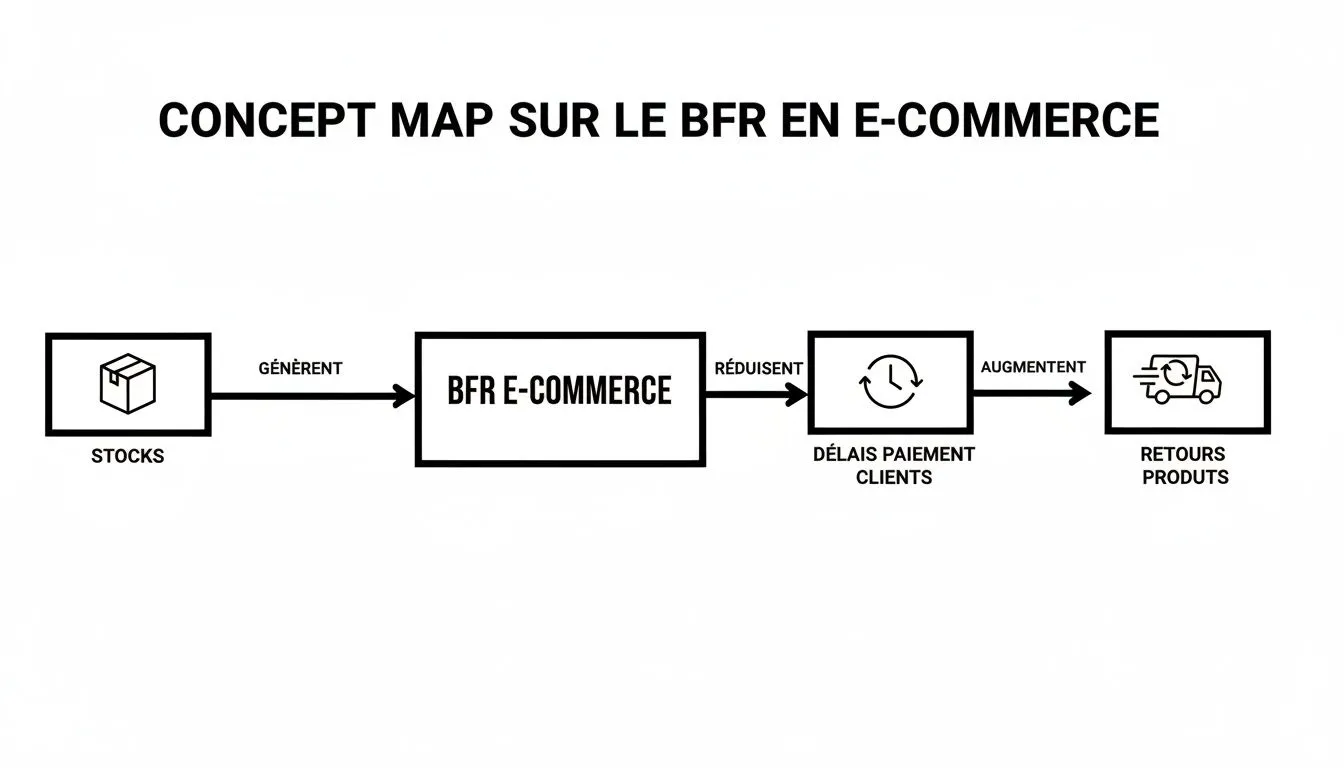
You can clearly see that every step, from buying stock to final collection, has a direct impact on the cash you need to operate.
Turning the result into an action plan
Okay, you have your number. Now what? This result isn’t just an indicator to make a dashboard look good. It’s a real diagnosis telling you whether your business model generates cash or devours it to grow.
A positive WCR means your needs (inventory, receivables) exceed your resources (accounts payable). In this case, you must fund this gap with your own cash. The higher it is, the more your growth costs you in cash.
Careful — a positive WCR isn’t a disaster. It’s actually the typical case for D2C brands that buy and store their own products. The real warning sign is a WCR growing faster than your revenue.
A negative WCR, on the other hand, is something of an e-commerce holy grail. It means you collect your customers’ money before you even have to pay your suppliers. Your business literally generates cash that funds your growth. Think of dropshipping or large retailers, who get paid in cash but pay their suppliers in 90 days.
Finally, a WCR of zero or close to it indicates a perfect balance. The needs of your operating cycle are entirely covered by the resources it generates. It’s a healthy but fairly rare situation, requiring very precise steering.
To help you see things more clearly, this table summarizes what each situation means for your shop.
Interpreting working capital for an online seller
This table illustrates the implications of positive, negative or zero working capital for an online shop, with concrete examples and recommended actions.
| WCR Type | Meaning for Cash Flow | Typical E-commerce Example | Recommended Action |
|---|---|---|---|
| Positive WCR | Your business consumes cash to operate. | A clothing brand that pre-buys its collections. | Optimize inventory, negotiate shorter payment terms with customers (if possible), and longer terms with suppliers. |
| Negative WCR | Your business generates cash. | A dropshipping store or an online course seller. | Use the surplus to invest in growth (marketing, R&D, new products). |
| Zero WCR | Your business self-finances. | A craftsperson who produces to order with a customer deposit. | Maintain the balance and monitor any variation to react quickly. |
Understanding these nuances is the first essential step to move from passively managing your cash flow to truly strategic control of your growth.
The working capital traps threatening online sellers

If your business were a ship, your WCR would be its anchor. Well managed, it stabilizes the vessel in any weather. Poorly controlled, it pins it in place and stops it moving forward, even with the wind of sales in its sails. For an online seller, understanding what inflates working capital is simply vital to avoid getting stuck.
Tight cash flow is never inevitable. It’s most often the symptom of well-identified operational problems. The good news is that by understanding these traps, you can anticipate and defuse them. Let’s analyze together the culprits weighing on your liquidity.
Overstocking, the silent poison
Inventory is often the first item to blow up working capital. It’s a trap that’s all the more dangerous because it’s counterintuitive: having a lot of stock can give a false sense of security. Yet the reality is simple: every product that doesn’t sell is money asleep.
Imagine a Shopify shop specializing in fashion accessories. To prepare for the summer season, the manager orders a large batch of a sunglasses model deemed very trendy. Unfortunately, the weather turns fickle and another trend emerges in parallel. The result: boxes pile up in the warehouse, tying up thousands of euros that could have funded a marketing campaign to move other items.
This overstocking is a classic. Its causes are often the same:
- Slightly too optimistic sales forecasts.
- Bulk purchases to secure a better unit price, without factoring in the real cost of storage.
- Poor analysis of product turnover, letting “dormant” items cannibalize cash flow.
The fatal gap between the sale and the collection
You made a sale, the customer paid. Great! But is that money really in your bank account? For online sellers, the answer is almost always “not yet”.
Payment platforms like Stripe and PayPal, or even marketplaces like Amazon, hold funds for several days, sometimes several weeks, before transferring them to you. This delay, while normal, creates a constant financing need.
Take the case of a SaaS software vendor selling subscriptions through a platform like Paddle. Even with a standard payout delay of 30 days, its working capital requirement can easily climb to represent 15% to 25% of its annual revenue if it isn’t anticipated. Meanwhile, salaries and server costs still have to be paid without delay.
A positive WCR that keeps rising is often a sign that management of these receivables is slipping out of your control. It’s crucial to know precisely the real collection delay for each sales channel in order to steer your cash flow as accurately as possible.
Seasonality and the complex management of returns
Two other factors add pressure to working capital management in e-commerce.
1. Seasonality:
For peak periods like Black Friday or Christmas, you have to invest heavily in inventory, months in advance. Cash goes out well before the first sale, which sends your working capital requirement soaring. If sales disappoint, you end up with a double problem: excess inventory and a hole in your cash flow.
2. Returns management:
A customer return is a double blow to your cash flow. Not only do you refund the money immediately, but the returned product becomes an uncertainty. Is it resellable as-is? How long will it take to inspect and restock it? Every return generates an immediate cash outflow and an asset (the product) that becomes unavailable.
This fragile economic context makes mastering working capital even more critical. Business failures in France are rising sharply, with a forecast of more than 68,000 cases in 2026. This situation is directly linked to cash flow tensions and the end of post-Covid aid. As experts point out, rigorous tracking is essential to turn your working capital into a true growth lever. You can also check out forecasts on business failure trends here on Daf-mag.fr.
Unmanaged working capital is therefore not just an accounting line item. It’s very often the main cause of difficulties for businesses that are otherwise profitable on paper.
Putting concrete strategies in place to optimize your working capital
Now that your working capital diagnosis is set, it’s time to roll up your sleeves and take action. Good working capital management doesn’t stop at a simple calculation; it’s constant optimization work. Think of this section as your toolbox for taking back control of your cash flow and turning what was a financing need into a real growth lever.
The objective is clear: act on the three pillars of working capital — inventory, accounts receivable and accounts payable — using targeted, measurable actions. Every euro freed up this way becomes available to invest in your marketing, develop new products, or simply breathe a little easier.
Mastering your inventory with precision
Let’s be clear: inventory is very often culprit number one behind soaring working capital. Every product gathering dust on a shelf is cash asleep. The whole art lies in finding the perfect balance: having enough stock to meet demand without tying up excessive capital.
To achieve this, two techniques work wonders in e-commerce:
- ABC analysis: A classic, but formidably effective. Sort your products into three categories. Category A gathers the 20% of your SKUs that generate 80% of your revenue. These are your stars! Focus your management and forecasting efforts on them. Categories B (mid-range products) and C (slow-moving products) can be managed with much lighter stock, or even just-in-time.
- Just-in-time (JIT), revisited: Instead of placing massive orders months in advance, work with responsive suppliers to order more often, but in smaller quantities. This approach drastically reduces tied-up cash and the risk of ending up with unsold stock on your hands.
By refining your inventory management, you tackle head-on one of the heaviest items in your working capital. To go further on this crucial point, I invite you to read our full article on optimizing inventory turnover, a key indicator.
Before/After case study: Inventory optimization
An online cosmetics shop had a working capital requirement of €45,000, weighed down by €60,000 of inventory. After an ABC analysis, the team realized that only 15 SKUs out of 100 generated 75% of its sales. By focusing on these flagship products and drastically reducing category-C stock, average inventory dropped to €40,000. Direct result: €20,000 in cash freed up immediately.
Speeding up the collection of your sales
The second major lever is the famous “accounts receivable” item. Every day gained on collecting a sale is one more day of cash flow to run your shop. In e-commerce, even if the end customer pays immediately, the money sometimes takes an incredibly long time to land in your bank account.
Here’s how to reduce this delay:
- Audit your payment processors: Take the time to compare the payout delays of Stripe, PayPal or other solutions. A simple change of contract or provider can sometimes save you several precious days.
- Automate follow-up: If you do B2B or issue invoices, automated reminder tracking isn’t optional, it’s a necessity. Tools like Bizyness can send systematic reminders, which limits oversights and speeds up payments from your business customers.
- Offer incentives: For large B2B orders, why not offer a small discount for upfront payment? The cost of this discount is often far lower than the cost of financing excessive working capital.
Negotiating skillfully with your suppliers
The third and final lever is optimizing your accounts payable. Careful — the idea isn’t to become a bad payer, far from it. It’s rather about intelligently aligning your outgoing money with your incoming money. In practice, paying your suppliers a bit later means using their cash to fund your own operating cycle.
Negotiation is key, and it must always be done while respecting your business relationship. If you’re a loyal, reliable customer, you have a card to play.
Highlight your loyalty and order volume to ask for longer payment terms. Going from 30 to 45 days, for example. This gain of 15 days may seem trivial, but it can have a considerable impact on your working capital, giving you the breathing room to collect your sales before having to settle your purchase invoices.
How accounting automation frees up your cash flow

Steering your cash flow by only looking in the rearview mirror is an enormous risk. Especially at the frantic pace of e-commerce, where working capital management can no longer afford to wait for monthly or quarterly statements. This is precisely where technology, and accounting automation in particular, stops being a chore and becomes a genuine strategic asset.
Gone are the days of labyrinthine Excel spreadsheets and endless manual entry. For an online seller, every sale on Shopify, every payment collected via Stripe, or every order shipped via Amazon has a direct, immediate impact on working capital. Trying to piece together all these puzzle pieces by hand isn’t just a monumental waste of time, it’s also an open door to errors and delayed decisions.
Centralizing for better control
The true power of automation lies in its ability to connect information that would otherwise stay siloed. Specialized tools like Bizyness plug directly into your sales platforms (Shopify, Amazon, etc.) and your payment solutions (Stripe, PayPal).
This direct connection gives you a unified, up-to-date view of all your financial flows. Instead of waiting until the end of the month to see clearly, you know exactly where every euro of your operating cycle stands, at any time.
- Real-time visibility on receivables: You instantly see money that’s in transit, between the moment the customer paid and the moment the funds actually arrive in your account.
- Simplified bank reconciliation: The tool automatically links your shop’s sales to the lines on your bank statement. No more hours of manual matching.
- Automated invoicing: Every order generates a compliant invoice, which streamlines your processes and solidifies your accounting.
The goal isn’t just technical; it’s eminently practical. It’s about turning a flood of raw data into readable, actionable information. The stakes are twofold: freeing up precious time to focus on growth, and above all, freeing up cash. To go further on this point, discover how business process automation can reinvent your management.
This dashboard, for example, synthesizes complex information into simple visual indicators for daily tracking of working capital.
Such a visual makes it possible to spot an anomaly immediately, such as a sudden increase in receivables, and act before it turns into a real cash flow problem.
A decisive lever for competitiveness
In a tense economic climate, mastering working capital is no longer optional, it’s a factor of survival and differentiation. A recent study highlighted a +7-day deterioration in working capital among SMEs compared to 2023. While large groups have the means to negotiate and limit the damage, SMEs bear the full brunt of this impact, which can cost them up to 10% in competitiveness.
Automation changes the game. Solutions like Bizyness, by connecting marketplaces and automatically generating accounting entries (FEC), enable their e-commerce customers to reduce their effective working capital by 12 to 18%.
By automating the collection, categorization and reconciliation of transactions, you don’t just gain efficiency. You equip yourself with real-time analysis capability. You can finally anticipate your cash flow needs, make informed decisions based on reliable, up-to-date data, and turn your financial management into a true engine for growth.
Your action plan to reduce your working capital starting today
Enough theory, let’s move to action. Working capital management may seem intimidating, but improving it comes down to concrete, measurable steps. Think of the following as your step-by-step roadmap to start freeing up your cash flow right now.
The goal isn’t to change everything overnight, but rather to lay the foundations for healthier, more responsive financial management. Every small optimization will have a direct impact on your cash. Never forget that “cash is king”. Follow these five steps to take back control.
1. Calculate your current working capital requirement
The first thing to do is take stock. No need to drown yourself in complex formulas for now. Simply use the simplified method we’ve seen:
Inventory + Accounts Receivable – Accounts Payable = Your Working Capital Requirement
Use your most recent figures. The goal is to get a snapshot of your situation at this moment. This number, whether positive or negative, will become your reference point for measuring all your future progress.
2. Identify the products blocking your cash flow
Your inventory is a goldmine… or a real financial black hole. Dive into your product list and spot the 3 SKUs that represent the largest value of dormant stock. These are often items that turn over slowly, or seasonal products you bought in excessive quantities.
By focusing on these few products, you tackle the heart of the problem head-on: locked-up money. A well-targeted promotion, or the decision to stop stocking them, can free up a significant amount.
3. Time your real collection delays
Do you think Stripe or PayPal pay you in 2 or 3 days? It’s time to check. Take a typical day of sales and follow the money trail. Note the order date, then the date the funds actually arrive in your bank account.
This simple exercise often reveals surprises. Between processing by the payment platform and the actual transfer, the delay is often longer than you’d imagine. Knowing this real figure is essential for accurate cash flow forecasts.
4. Go through your supplier terms with a fine-tooth comb
Your accounts payable are a valuable resource, a lever not to be overlooked. List your top 3 suppliers and, for each, note the current payment terms (payment on order, net 30, etc.).
Have you ever tried to negotiate? A supplier you have a trusted relationship with might well agree to grant you an extra 15 days. For you, that’s 15 days of breathing room for your cash flow, at no cost.
5. Set up weekly tracking
Managing your working capital isn’t a one-off action, it’s a discipline. To be effective, it has to become a habit. Set yourself a weekly reminder to track the evolution of your three key indicators:
- The total value of your inventory.
- The amount of accounts receivable outstanding.
- The amount of accounts payable due.
A simple dashboard is enough to get started. Of course, automation tools like Bizyness can do this work for you by centralizing the data for an effortless, real-time overview. This regularity will let you spot slippage before it becomes critical, and turn managing your working capital into a real edge over your competitors.
Frequently asked questions about working capital management in e-commerce
The concept of working capital is now clearer, but there may still be some gray areas. That’s normal! Here are direct, practical answers to the questions you’re probably asking yourself.
Is negative working capital really possible in e-commerce?
Absolutely! It’s even the holy grail of some of the best-performing business models. Having negative working capital is very simple: you collect your customers’ money before having to pay your suppliers. Your business doesn’t just self-finance, it generates a cash surplus that can fuel its own growth.
This scenario is particularly common in two cases:
- Dropshipping: The customer pays you, and only after receiving that money do you pay your supplier to ship the order. Inventory? You don’t have any to finance.
- Digital products: Whether it’s an e-book, a course or software, the customer pays immediately for a product whose main cost is development, not physical storage.
For these businesses, negative working capital isn’t a happy accident, it’s the norm. It’s an incredibly powerful financial resource, provided you manage it well.
How often should you track your working capital?
It all depends on how fast your business moves. For an online seller, monthly tracking is the bare minimum, but let’s be honest, it’s rarely enough. Your sales and inventory can fluctuate so quickly that weekly tracking is far more relevant.
Setting up a dashboard to track the weekly evolution of your inventory, accounts receivable and accounts payable is like switching from fog lights to full beams. You anticipate slippage before it becomes critical and move from a reactive mode to proactive steering.
Doesn’t my accountant already handle this?
Your accountant plays a crucial role: they certify your accounts and prepare your annual balance sheet. They analyze your working capital, but after the fact, often only once a year. Operational management of working capital, the day-to-day kind, is your job as the business owner.
You’re the one at the controls to make the decisions that influence it: negotiating a payment delay with a supplier, launching a promo to move dormant stock, or choosing a faster payment processor. Think of it this way: your accountant is an excellent co-pilot, but you’re the one holding the wheel of your cash flow.
I don’t hold stock in dropshipping. Is a tool really useful?
Even without physical inventory, your working capital very much exists! It’s made up of your accounts receivable (the money “sleeping” at Stripe or PayPal while waiting for the transfer) and your accounts payable. An automation tool therefore remains essential.
It gives you a clear, real-time view of the money owed to you and the date you’ll receive it. Thanks to this, you can perfectly synchronize paying your suppliers with your actual collections. That’s the key to maintaining your negative working capital model and avoiding unpleasant cash flow surprises.
Don’t let your accounting hold back your growth any longer. With Bizyness, automate your financial management from A to Z, from invoicing to bank reconciliation, and take back full control of your cash flow. Discover how Bizyness transforms e-commerce accounting at bizyness.fr.
