

 Français
Accountant engagement letter for online sellers 2026
Learn how to write the perfect accountant engagement letter for your e-commerce business. Clauses, template and tips to secure your collaboration.

The accountant’s engagement letter is far more than a simple contract. It’s the founding document that seals your collaboration. For an online seller, it’s not a mere administrative formality but a genuine roadmap that secures the relationship and clarifies everyone’s responsibilities.
Why is this letter so fundamental in e-commerce?

In the world of e-commerce, financial flows are often complex. Between payments via Shopify, sales on Amazon or transactions via Stripe, it’s easy to get lost. A well-drafted engagement letter helps avoid misunderstandings and structures the work. Above all, it ensures your accountant fully understands the specifics of your business, such as managing the OSS/IOSS VAT one-stop shops.
Made mandatory by the French Order of Chartered Accountants (Ordre des Experts-Comptables), this letter turns a legal requirement into a powerful management tool. Under Article 151 of Decree No. 2012-432, it must precisely define the engagement, as well as the rights and duties of each party, including for a one-off assignment. It’s always worth reading up on the detailed obligations tied to this contract to grasp all the nuances.
Breaking down the essential clauses of an engagement letter

An accountant’s engagement letter is not a mere formality; it’s the contract that seals your collaboration and secures it legally. To be valid, it must contain certain absolutely fundamental clauses.
These essential clauses lay the foundations of your professional relationship:
- Identification of the parties: Basic but crucial information. This includes your company’s legal name, address and SIRET number, as well as the firm’s registration number with the Order of Chartered Accountants.
- Purpose and scope of the engagement: This is the heart of the document, and for an e-commerce business, precision is essential.
For an online seller, the scope must be detailed without any ambiguity. It must explicitly list VAT return management (domestic regime, OSS/IOSS), production of the Accounting Entries File (FEC), and above all, reconciliation of financial flows coming from different platforms such as Shopify, Amazon or Stripe. Every service must be spelled out in black and white to avoid any misunderstanding.
By clearly defining the services, this legal document becomes a real guide for your collaboration. To go further in structuring your partnerships, take inspiration from this service agreement template, which will help you secure all your engagements.
E-commerce-specific clauses: what your engagement letter must absolutely include
A standard accountant’s engagement letter is often too generic for an online seller. Your business has very specific characteristics that, if not clearly defined, can quickly become a source of misunderstanding, or even tax reassessment.
It’s therefore crucial to adapt this contract to reflect the reality of your online business. Think about it: financial flows via Stripe or Amazon, international VAT management, marketplace commissions… Without dedicated clauses, who does what? That’s the surest way to end up with blind spots on issues that are nonetheless critical.
The must-have points to contractualize
For the collaboration to run smoothly and securely, certain topics need to be set in stone in your engagement letter.
- Intra-community VAT management (OSS/IOSS): Spell out in black and white who is responsible for filing returns through the one-stop shops. Does the accountant handle it entirely, or do you need to provide a specific export?
- Reconciliation of financial flows: Does the engagement include detailed reconciliation of sales (for example, from Shopify) with payments received from platforms, after deducting their commissions and fees? This is time-consuming, technical work.
- Platform access: Include a clause authorizing and securing your accountant’s access to your tools (Shopify back office, Amazon Seller Central, etc.). This lets them retrieve data at the source, avoiding data-entry errors.
- Format of accounting records: Does the firm accept exports from your tools (CSV files, sales reports) as supporting documents, or does it require a specific format?
To dig deeper into these issues, our full guide on e-commerce accounting covers every angle.
This simple diagram helps you visualize the point at which these clauses stop being optional and become a necessity.
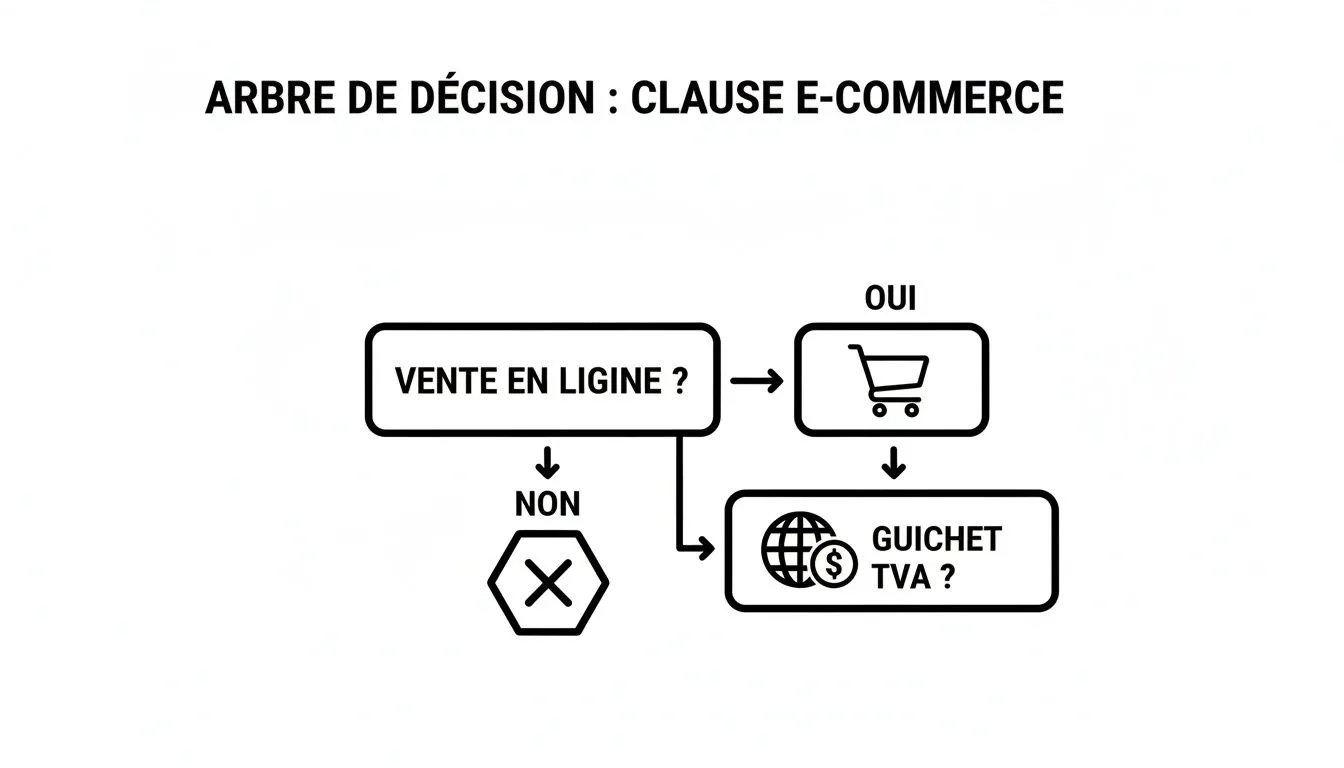
Put simply, the question arises the moment you start selling online. Add sales to individuals within the EU, and these clauses become absolutely essential to secure your accounting.
Checklist of e-commerce-specific clauses
To make sure you don’t forget anything, here’s a summary table of clauses to check or have added to your engagement letter. Consider it your safety net for well-structured accounting.
| E-commerce-specific clause | Main objective | Points to watch |
|---|---|---|
| Management of OSS/IOSS one-stop shops | Clarify who is in charge of VAT filings and payments for B2C sales within the EU. | Specify frequency, information to be provided, and liability in case of error. |
| Marketplace reconciliation | Define the level of detail for reconciling sales against receipts (Amazon, Stripe, etc.). | Should the firm check every transaction or just the overall balances? |
| Access to data and platforms | Formalize the firm’s secure access to your tools (Shopify, Seller Central, etc.). | Define access rights (read-only) and the firm’s confidentiality obligations. |
| Handling returns and refunds | Specify the accounting treatment of product returns and credit notes. | How are refund flows tracked and recorded in the accounts? |
| Validation of Accounting Entries Files (FEC) | Ensure that exports from your tools comply with FEC standards. | Who is responsible for bringing the files into compliance before integration? |
This table is an excellent starting point for a constructive discussion with your future accountant. It shows that you understand the challenges of your business and that you want to build a solid, transparent collaboration from day one.
For your collaboration with an accountant to pay off, there’s one golden rule: clarity. It’s absolutely essential to delineate everyone’s playing field to avoid misunderstandings that, all too often, end up costing dearly. Your accountant engagement letter is precisely there for that: it must spell out in black and white who does what.
Dividing up the tasks: who handles what?
On the accountant’s side, engagements can range from full bookkeeping to a simple annual review, including preparing tax returns. But be careful, your own obligations are just as crucial. The most important one? Providing all supporting documents and records on time. Never forget that proper retention of accounting records remains your legal responsibility.
The classic mistake is staying too vague. To avoid this pitfall, I always recommend including a table summarizing everyone’s tasks and responsibilities. It’s simple, visual, and leaves no room for interpretation.
The special case of e-commerce
If you’re an online seller using a pre-accounting tool like Bizyness, it’s an excellent idea to specify this in the engagement letter. Explicitly mention how data flows (sales, fees, etc.) are transmitted automatically. This not only reduces your manual transmission obligations but also guarantees better data quality, drastically limiting the risk of data-entry errors.
To go further and make sure you haven’t forgotten anything, I’d recommend taking a look at the 6 key points of an effective engagement letter, which will help you bulletproof your contract.
Download our engagement letter template for online sellers
To get started on solid foundations, nothing beats a clear engagement letter. That’s why we’ve prepared a complete accountant engagement letter template, designed from the ground up for the specifics of e-commerce.
This ready-to-use document is fully annotated. Every clause is explained so you clearly understand its scope, with clear guidance on the points to adapt to your situation: your legal status (SASU, sole trader/micro-entrepreneur, etc.), your sales channels such as Shopify or Amazon FBA, and the international dimension of your business.
The idea is to give you a concrete working document to frame your relationship with your accountant. No more misunderstandings or gray areas that can cost you dearly down the line.
You’ll find sample wording for very common situations, such as managing Stripe flows or accounting for stock held at Amazon fulfillment centers. Use this template as a checklist to make sure you don’t miss anything and to start your collaboration on the right foot.
Negotiating fees, duration and termination conditions
We often tend to focus on the technical aspects of the engagement, but the administrative clauses are just as important. They form the framework of your relationship with your accountant and protect you if something goes wrong. Don’t skim over them!
Let’s start with fees. You’ll mainly encounter two approaches: an annual flat fee, which has the advantage of being clear and predictable, or time-based billing, more flexible but with a risk of budget overrun. My advice? Always require an annual review clause. This allows fees to be adjusted transparently and avoids unexpected increases that can strain the relationship.
Next, the duration of the engagement. It’s generally aligned with a full accounting year. Pay close attention to renewal terms, which are often tacit. This means that if you say nothing, the contract automatically renews for another year.
And this is where a crucial, often underestimated point comes in: the notice period for termination. It’s generally three months before the closing date of your accounting year. If you miss this window, you risk being forced into another year’s renewal or having to pay sometimes hefty penalties. It’s a detail that can cost you dearly, so mark this deadline in your calendar.
Evolving the engagement toward strategic advisory

Your accountant engagement letter shouldn’t be limited to basic tax and accounting compliance. For an online seller, it’s an opportunity to turn this document into a genuine management tool. Think of it as the starting point of a more strategic collaboration.
Concretely, this means enriching the engagement with high-value services. For example, you could include setting up custom financial dashboards or an in-depth profitability analysis by sales channel. For an online seller, this can even extend to support for valuing the company ahead of a future sale.
Industry practices are moving in this direction too. More and more engagement letters now include services like “enhanced account presentation,” where the accountant uses data visualization to turn raw spreadsheets of figures into clear, digestible visual analyses.
The goal is to make your accountant a key partner who helps you anticipate and steer your business. With this in mind, adding a section on building a forecast budget is entirely relevant. This is a point we cover in detail in our guide to choosing the right accountant for your e-commerce business.
Here are the answers to the questions we’re most frequently asked about engagement letters.
Is the engagement letter really mandatory?
Yes, without the slightest ambiguity. This question comes up constantly, but the answer is clear-cut: Article 151 of Decree No. 2012-432 is very explicit on this point. It requires the signing of an engagement letter for absolutely any service, even a very one-off engagement, as soon as it’s performed by an accountant registered with the Order.
Think of it as a mutual guarantee. This document is not a mere administrative formality; it’s the foundation that secures your relationship by spelling out each party’s commitments in black and white.
Can an engagement letter evolve over time?
Of course, and it’s even excellent practice. Your business as an online seller is dynamic, and so are your accounting needs. If you start selling internationally, for example, you’ll need to add management of OSS/IOSS VAT returns.
Any change of this kind, or the addition of a one-off advisory engagement, must be formalized through an amendment. This document, written and signed by you and your accountant, amends the original contract and ensures everyone is aligned on the new services and their costs.
What should I do if my accountant doesn’t meet their commitments?
The first thing to do is always to favor dialogue. A frank conversation is often enough to clear up a misunderstanding or unblock a situation.
If the conversation leads nowhere, your engagement letter becomes your best asset. It’s irrefutable contractual proof of your accountant’s obligations. Armed with this document, you can then move to the next step: requesting mediation from the Order of Chartered Accountants. As a last resort, you can initiate termination proceedings for breach of contract, strictly following the terms set out in your contract.
