

 Français
Accounting documents to keep: the complete guide
Which accounting documents should you keep, and for how long? Discover the legal retention periods and best practices for risk-free management.

Keeping an accounting document is not just another administrative box to tick. It’s a legal obligation, of course, but above all it’s the foundation of your business’s good health. Think of this archiving as your activity’s living memory: it retraces every financial decision, justifies your current situation and, above all, secures your future in case of trouble.
Why keeping your accounting documents is far more than a chore

Reducing paperwork to a mere mental burden is a common mistake, and one that can prove costly. In reality, good management of your accounting archives is a genuine pillar for your business. It turns a legal obligation into a strategic asset.
Far from being dead weight, your archives are tangible proof of the health and rigor of your management. They become essential in many situations.
Your shield in the event of a tax audit
The first and most obvious role of your archives is to protect you. During an audit, the tax authorities can go back several years to scrutinize your accounts. If you cannot provide the supporting document for an expense you deducted, it will simply be rejected. The result? A tax reassessment, often accompanied by steep penalties.
Your archives are your best line of defense. They prove the reality of every entry and the good faith of your accounting. It’s peace-of-mind insurance that’s priceless.
A mark of trust for your partners
Rigorous document management inspires confidence. Whether you’re trying to secure a bank loan, raise funds, or simply negotiate payment terms with a key supplier, your ability to present a clear, well-documented financial history makes all the difference.
A business that presents impeccable archives is immediately seen as serious and well-managed. It’s a trust capital that smooths every one of your business relationships.
A valuable tool for steering your business
Finally, never underestimate the value of your own archives for yourself. They’re a goldmine of information. By analyzing your past figures, you can identify trends, understand the seasonality of your activity and, ultimately, make better decisions for the future.
In short, good management of your accounting documents brings four major benefits:
- Legal compliance: You are in line with the Commercial Code and the tax authorities.
- Financial security: You drastically reduce the risk of reassessment and penalties.
- Rock-solid credibility: You build strong, trusting relationships with your partners.
- A sharper strategic vision: You have reliable data to guide your growth.
Mastering the legal retention periods
When it comes to business paperwork, the question that keeps coming up is: “how long do I need to keep all this?” It’s a crucial question, because retention periods aren’t there just for show. They protect your business.
https://www.youtube.com/embed/7QFFLrgmcD8
Let’s dive into these rules together to get a clearer picture. Think of these periods not as a constraint, but rather as your best insurance in the event of an audit or dispute.
The golden rule, the number to remember, is 10 years. Most of the accounting documents you need to keep, such as invoices, purchase orders, and account books, fall under this period. It’s not a number pulled out of thin air; it comes straight from the Commercial Code.
Specifically, French law is very clear: every business must keep its books, registers, and supporting documents for 10 years from the closing of the financial year. Whether you’re a sole trader or a large SME, the rule is the same for everyone. If you want to go straight to the source, the French chart of accounts is available on the website of the Autorité des normes comptables.
The 10-year rule explained
Watch out, there’s an important nuance: the 10-year countdown doesn’t start on the date the document was created, but rather on the closing date of the financial year it relates to. It’s a detail that changes everything.
Let’s take a simple example. An invoice issued in March 2024, for a financial year ending on December 31, 2024, must be kept carefully until December 31, 2034.
Why 10 years? It’s simply the period during which legal action can be brought in commercial matters. This gives the tax authorities, as well as your customers or suppliers, time to revisit a transaction if necessary.
Think of this 10-year period as a safety guarantee. During this time, you hold irrefutable proof of every transaction, protecting you against any unjustified claim or in-depth tax audit.
This infographic gives you a visual overview of the various retention periods.
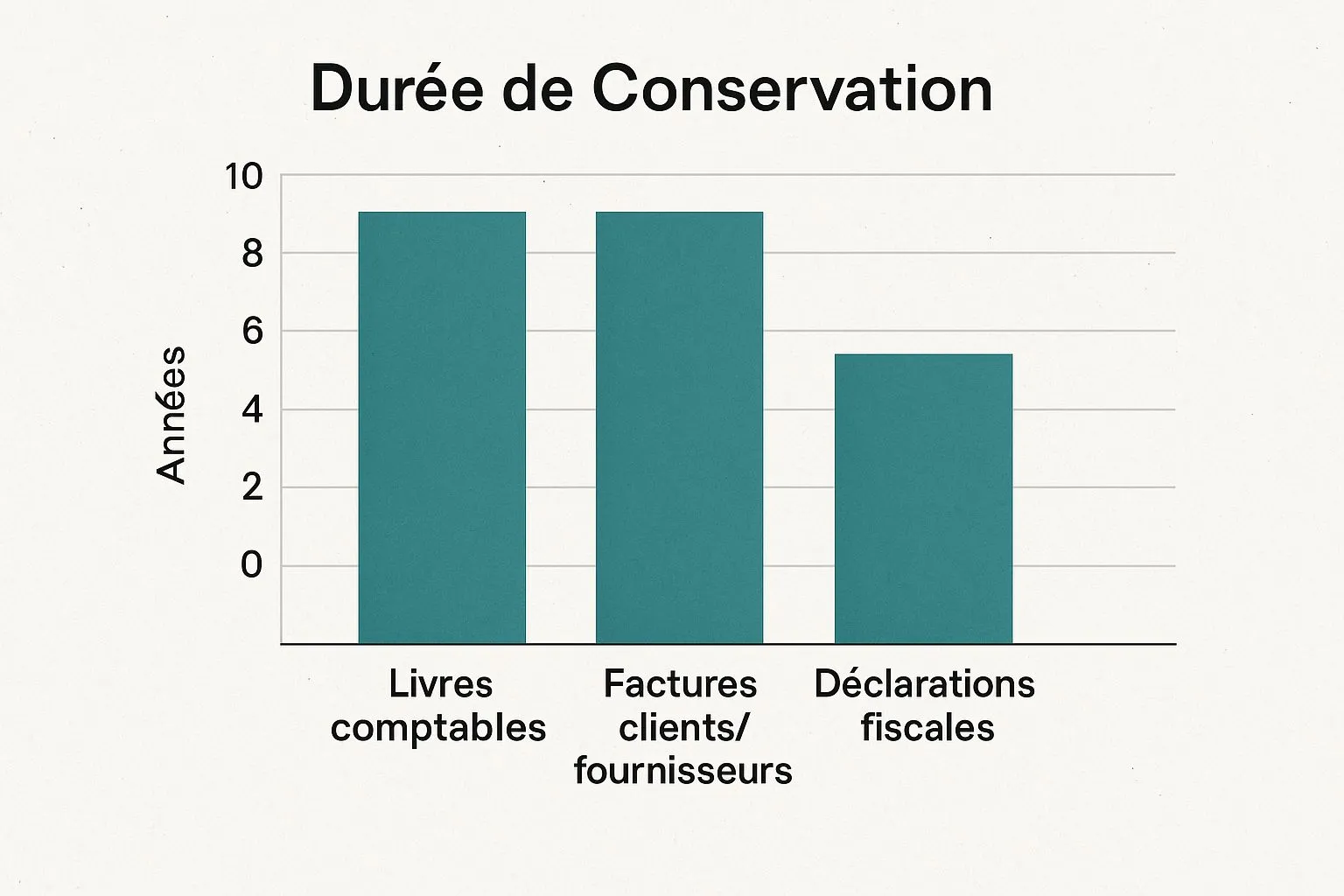
It’s clear that while the 10-year period is the norm for key accounting documents, purely tax-related papers, for example, have a shorter legal shelf life.
To help you find your way, here’s a summary table. It brings together the legal deadlines you need to know for the most common documents in a company’s life.
Summary of retention periods by document
A clear overview of the legal retention periods for the main business documents.
| Document category | Retention period | Legal basis (example) |
|---|---|---|
| Accounting records (invoices, purchase orders) | 10 years | Article L123-22 of the Commercial Code |
| Tax documents (VAT returns, business property tax…) | 6 years | Article L102 B of the Tax Procedures Code |
| Employment documents (payslips) | 5 years | Article L3243-4 of the Labor Code |
| Legal documents (company articles of association) | Indefinitely (or 5 years after dissolution) | Article 2224 of the Civil Code |
| Bank statements | 10 years | Practical recommendation aligned with the Commercial Code |
Keep this table handy — it could be very useful for organizing your archiving and avoiding oversights. Each line corresponds to a specific obligation that guarantees your compliance.
The important exceptions to know
While the 10-year rule is an excellent benchmark, it’s not the only one. Other documents, governed by tax, employment, or corporate law, have their own set of rules. It’s essential to master them to be fully compliant.
Here’s a summary of the specific periods to remember:
- Tax documents: For everything related to your taxes (income tax returns, VAT, corporate tax), the retention period is 6 years. This is the period during which the tax authorities can carry out an audit.
- Employment documents: Your employees’ payslips must be kept for 5 years. For documents related to social security contributions, the period is shorter: 3 years.
- Legal documents: Your company’s articles of association are the cornerstone of your business. They must be kept indefinitely (or at least 5 years after dissolution). Management reports and minutes of general meetings, meanwhile, are kept for 3 years.
Which accounting documents really need to be archived?
Now that we’ve covered the legal deadlines, the question becomes very concrete: which accounting documents should you keep? Starting to archive without knowing exactly what to keep is a bit like setting off on a trip without a destination. To make sure you don’t forget anything and stay compliant, you first need to clearly identify the different categories of documents.
Every paper, every file has its importance. Some are the foundations of your accounting, others are the concrete proof of your activities. It all starts there: good organization begins with a clear inventory.
The pillars of your accounting
At the heart of your management are the well-known mandatory account books. Think of them as your business’s backbone; they track every financial movement, in order and with method.
- The journal: This is the logbook of your activity. It records absolutely every transaction (purchases, sales, cash flow) day by day, without the slightest omission.
- The general ledger: This one reorganizes everything recorded in the journal, but this time by type of account. It’s thanks to this that you can precisely track what’s happening on the account of a customer, an electricity supplier, or any other item.
These two registers are inseparable. They form the basis of every tax audit and must be kept with military rigor.
Picture the journal as the chronological narrative of your year. The general ledger, meanwhile, would be more like an encyclopedia detailing each character (account) and each event in that story.
The concrete proof of every transaction
If account books are the structure, supporting documents are the bricks that make it up. They’re what prove that every entry corresponds to a real, legitimate transaction. Without these supporting documents, your accounting has no value in the eyes of the authorities.
The list is long, as it includes everything that can attest to a transaction:
- Customer and supplier invoices: The ABCs of any business relationship.
- Purchase and delivery orders: They allow you to track the progress of a sale, from intent to receipt.
- Receipts and expense reports: Essential for justifying everyday small expenses and travel.
- Bank statements: Crucial for bank reconciliation and making sure everything matches up.
Being meticulous on this point is all the more important as the rules of the game keep evolving. French regulations, via the General Chart of Accounts, increasingly emphasize the reliability and traceability of archives.
Legal and employment documents, the great forgotten ones
There’s often a tendency to focus solely on purely numerical documents, and that’s a classic mistake. Legal and employment documents are just as important and must absolutely be part of your archiving process.
We’re talking here about the company’s articles of association, minutes of general meetings, or important contracts (commercial lease, employment contracts, etc.). These documents form the legal skeleton of your business. For a complete overview, our guide to accounting documents to keep will give you even more detail.
Paper or digital: which archiving method should you choose for your accounting documents?
The traditional overflowing binder versus the secure cloud server… this isn’t just a matter of preference. It’s a genuine strategic decision that will directly influence your day-to-day efficiency, the security of your data and, of course, your legal compliance. Let’s weigh the pros and cons of each method together so you can make the best choice for your business.
Paper archiving is the method everyone knows. It has the merit of being tangible and doesn’t require advanced computer skills. You handle the documents, you file them away. Simple, on the surface. But this simplicity hides logistics that can quickly become a headache.
First you need to find physical storage space. And not just any space: a secure location, safe from prying eyes, but also from very real risks like fire or flooding. Then you need patience to set up a rigorous filing system, because finding a 7-year-old invoice in a pile of boxes can be quite a feat.
Digital archiving, much more than a simple alternative
Digitization has come to shake up these old habits, and for good reason. The most obvious advantage? The space savings. Imagine: all your archives, which used to fill entire cabinets, now fit on a hard drive or, even better, in the cloud. Access also becomes child’s play. A quick keyword search, and presto, the invoice you were looking for appears in seconds.
Be careful though, going digital isn’t without its challenges. New technical and legal constraints come into play. The security of your data becomes an absolute priority to protect yourself against cyberattacks or IT failures. Above all, for a digitized document to be as valid as the paper original in the eyes of the law, it must comply with very precise rules.
Going digital isn’t just about changing the medium. It’s about rethinking an entire process. To be valid, your digital archiving must absolutely guarantee that every accounting document remains intact, accessible over time and perfectly traceable.
The essential concept of the “reliable copy”
For the tax authorities to accept your scanned documents during an audit, they must have the status of a “reliable copy” (copie fiable). This isn’t marketing jargon; it’s a legal concept clearly defined by Article A102 B-2 of the Tax Procedures Code.
For a digital copy to be considered reliable, it must tick several boxes:
- A perfect reproduction: The copy must be a clone of the original. The content, the colors, the format… everything must be identical. No alteration, no loss of information is tolerated.
- Rock-solid integrity: Once created, the digital file must no longer be able to be modified. To achieve this, techniques such as qualified timestamping or electronic signature are used, which act like a digital wax seal.
- Documented processes: You must be able to explain and prove your entire process. How are documents scanned, named, filed, stored? This procedure must be written down in black and white.
If and only if these conditions are met does your digital copy gain probative value. Concretely, this means it has the same legal force as the paper original. You can then legally destroy the latter. In the event of an audit, it’s the digital file that will serve as proof.
Ultimately, the choice between paper and digital really depends on your situation: the volume of your documents, your budget, but also your company’s culture. While paper may still seem sufficient for a very small structure, digital represents an investment that offers unmatched efficiency and security gains in the long run.
Understanding the risks and penalties

We often think of archiving as a chore of no great importance. A pile of paperwork gathering dust. But this negligence can cost you dearly the day a registered letter from the tax authorities or URSSAF lands on your desk.
Being unable to present a requested supporting document isn’t a simple oversight. It’s a mistake that can seriously undermine your business’s financial health.
Picture the scene: an auditor combs through your accounts and asks you to prove a significant expense you deducted. Without the original invoice, there’s no way to justify it. The verdict is almost immediate: that expense is added back to your taxable profit. The result? A tax reassessment, almost always accompanied by steep penalties.
So think of keeping your documents not as a waste of time, but as an investment. It’s your best insurance against unpleasant surprises.
Tax risk, the most immediate threat
It’s naturally on the tax front that the danger is most immediate. The absence of accounting records can trigger a real chain reaction with disastrous consequences.
Specifically, here’s what awaits you:
- The outright rejection of your accounts: If the auditor deems your archives incomplete or unreliable, they can rule your accounting “non-probative.” The authorities then reserve the right to reconstruct your income and expenses themselves. Needless to say, the calculation is rarely in your favor.
- Fines that sting: The French General Tax Code is very clear. Article 1734, for example, provides for a fine of up to €10,000 for the mere failure to produce required documents.
- Penalties and late-payment interest: On top of the reassessment amount come surcharges, notably for bad faith (up to 40% of the tax evaded), as well as late-payment interest that adds to an already hefty bill.
Failing to keep an accounting document is a bit like handing the tax authorities a blank check to recalculate your taxes as they see fit. You lose control and expose yourself to penalties that can jeopardize your business.
Beyond tax matters, other very real dangers
But the range of risks doesn’t stop at taxes. Poor document management can have criminal and commercial repercussions that are just as serious.
In the most extreme cases, if the absence of documents conceals intentional fraud (undeclared work, organized tax evasion…), the penalties change in scale entirely. You then enter the realm of criminal law, with much higher fines and the risk of prison sentences for the company’s director.
From a commercial standpoint, the impact is more discreet but no less damaging. How can you assert your rights against a customer who disputes an invoice and claims never to have received it? Without this precious accounting document to keep, your legal recourse has very little chance of succeeding. It’s a straight loss for your cash flow, and a blow to your credibility.
Securing your archiving: why turn to an accountant?
Navigating the maze of rules on accounting documents to keep can quickly become a headache. Faced with this complexity and the risks it entails, an accountant is not just a service provider — they’re a genuine strategic partner who watches over the good health of your business.
Their work goes far beyond simple data entry. They keep constant watch over legal developments, guide you toward best archiving practices (particularly for safely going digital), and can even handle the entire process for you.
By delegating this essential task, you free up valuable time to focus on what you do best: growing your business. Above all, you gain the certainty that your archives are managed by the book, safe from unpleasant surprises.
Their role is, incidentally, widely valued. In France, there are nearly 22,000 accountants who advise more than 77% of businesses. A statistic that speaks volumes about their crucial importance in managing, verifying, and retaining documents. You can learn more about the importance of this profession on Tool Advisor.
Entrusting this task to an expert simply means investing in your business’s legal security. It’s a cornerstone of sound financial management for your business that will bring you invaluable peace of mind.
The questions everyone asks about archiving
Managing archives is a bit like the company attic: everyone knows it needs sorting out, but no one’s quite sure where to start. To help you see things more clearly, here are some straightforward answers to the most frequently asked questions.
Should paper invoices go straight in the bin after scanning?
It’s tempting, but be careful! For a digital version to validly replace the paper original, it must be considered a “reliable copy.” This means the scan must be perfect, without the slightest alteration, and the file must be secured with a sort of digital seal, such as a timestamp.
Without this precise procedure, only the paper document has real value in the eyes of the law. My advice? Before launching into a big destructive sort-out, make sure your scanning method is fully compliant.
What happens to my documents if I close my business?
The fact that your business shuts its doors doesn’t make your obligations disappear. The responsibility for keeping every accounting document stays with you. Whether you’re the former director or the liquidator, you must guarantee document archiving for the entire legal retention period.
Think about this carefully at the time of dissolution: you’ll need a secure storage solution that remains accessible in the long term.
Ceasing an activity doesn’t end responsibilities. Your company’s accounting history remains a living memory that must be available for consultation if needed, long after closure.
Is the 10-year period a hard-and-fast rule?
For most accounting documents, yes, 10 years is the magic number to remember. This is the case for invoices, account books, and so on. But there are important exceptions to know.
For example, your company’s articles of association or a property title should be kept indefinitely. And for trickier situations like an overdue invoice, context can change things. If you’re facing this kind of case, don’t hesitate to check out our advice on chasing an unpaid invoice.
With Bizyness, managing and archiving your documents becomes child’s play. Our tool automates and secures your accounting so you can stay focused on your growth. Discover how to simplify your daily life at https://www.bizyness.fr.
