

 Français
Accounting for Beginners: The Guide to Finally Understanding It All
Simplify accounting for beginners with this practical guide. Discover the basics, invoicing and taxes explained without jargon for newcomers.

At its core, accounting is simple: it’s the language that tells your business’s story with numbers. Think of it as the financial dashboard of your activity, the one that tells you what you own, what you owe, and whether you’re making or losing money.
Diving into accounting without drowning
Getting started with accounting can feel intimidating, a bit like learning a new language with its own grammar and jargon. But honestly, that feeling is often the only real obstacle. The reality is much simpler: if you know how to manage your personal budget, you already have the basics in hand to understand your business’s accounting.

Why accounting is your best GPS
Imagine for a moment driving a car with no dashboard indicators at all. No speed, no fuel gauge, no warning light for engine trouble… unsettling, right? That’s exactly the role accounting plays for your business. It’s your financial GPS, an essential tool for:
- Making informed decisions. Is this the right time to invest in new equipment? Can you afford to hire? Your numbers hold the answers.
- Anticipating hard times. Well-kept books flag a cash flow problem long before it becomes an emergency.
- Steering your project toward success. It shows you what’s working (which of your services are the most profitable?) and where you need to adjust course.
Rigorous management, even if it stays simple, is the foundation of a healthy, lasting business. It lets you know precisely where you stand, and above all, where you’re heading.
Simplifying to move forward better
This guide to accounting for beginners was designed to demystify every concept. We won’t bombard you with technical terms — instead, we’ll rely on concrete analogies so that every notion becomes crystal clear. The goal isn’t to turn you into a chartered accountant, but to give you the keys and the confidence to master the basics.
Accounting isn’t just a legal obligation; it’s the most powerful management tool an entrepreneur can have to ensure the growth and longevity of their business.
For those who want to dig deeper and see how to apply all this day-to-day, our detailed article on how to do your own accounting will give you practical steps and targeted advice. By understanding the fundamentals, you turn what looks like an administrative chore into a real strategic asset for your success.
Accounting basics: decoding the jargon for you
To get started in accounting without losing feathers, you first need to learn to speak the same language. Accounting vocabulary can be a bit intimidating at first, but rest assured, it’s all built on a few very logical ideas. Once you’ve grasped these fundamental concepts, everything else becomes much clearer.
Imagine your business is a house. To know if it’s healthy and well-built, you’d need two things: the blueprints (to see its structure) and an energy performance diagnosis (to see if it consumes too much). In accounting, it’s the same with the balance sheet and the income statement.
The balance sheet: a snapshot of your assets at a given moment
The balance sheet is simply a snapshot of what your business owns and what it owes at a specific moment, often the last day of the year. It’s always presented in two columns that must balance perfectly: assets and liabilities.
- Assets (what you own): This is everything of value to your company. It includes things that last, like your computer or your vehicle (fixed assets), but also the money sitting in your business account, invoices your clients still owe you (accounts receivable), or your inventory of goods.
- Liabilities (what you owe): Here, we list the source of funds, meaning your debts and resources. This includes the money you put in from your own pocket to get started (share capital), any bank loan, or your suppliers’ invoices still waiting to be paid (accounts payable).
A good way to see it: assets show you how the money is used (a computer, inventory…), while liabilities explain where it came from (your contribution, a loan…). One never goes without the other.
The income statement: the movie of your activity
If the balance sheet is a photo, the income statement is a movie. It traces everything that happened in your business over a given period (generally a full year) to answer THE question everyone asks: did you make or lose money?
To find out, two elements are weighed against each other:
- Revenue: This is everything that brings in money and enriches your business. The most important, of course, is your turnover, meaning the total of everything you’ve invoiced.
- Expenses: This is everything that takes money out and depletes your business. Think of your equipment purchases, your rent, electricity, your software subscriptions, salaries…
The calculation couldn’t be simpler: Revenue - Expenses = Result. A positive result means a profit. A negative result means a loss. This document is absolutely essential for judging whether your business is performing well and, above all, profitable.
Expenses and revenue: the heart of the engine
To really master the income statement, you need to clearly distinguish between an expense and a revenue item. Every transaction you record feeds one of these two categories and has a direct impact on your final result.
Let’s take a freelance graphic designer as an example:
- Revenue: The €1,500 invoice sent to a client for creating a logo is revenue. It increases the wealth of their business.
- Expenses: The €65 monthly subscription to the Adobe suite, the purchase of a new font at €40, or the coworking space invoice are expenses. They decrease their wealth.
Every expense and every receipt is classified into a very specific category. To find your way around, you can take a look at our guide on the general chart of accounts, which is a bit like the official accounting dictionary.
To help you see things more clearly, here’s a quick summary table.
The 5 pillars of accounting explained simply
This table should let you grasp, at a glance, the role of each essential accounting document and concept.
| Key concept | Simple analogy | What it tells you |
|---|---|---|
| Balance sheet | The architect’s blueprint | ”Here’s everything I own and everything I owe as of today.” |
| Income statement | The energy diagnosis | ”Over the year, did I make or lose money?” |
| Assets | The house’s belongings | ”Here’s the value of my computer, my cash, etc.” |
| Liabilities | The house’s financing | ”Here’s how I financed my belongings (contributions, debts).” |
| Expenses | The regular bills | ”How much does it cost me to run my business?” |
| Revenue | The money received | ”How much wealth has my business generated?” |
There you go, you now master the basics! It’s this vocabulary that will let you organize your day-to-day management, understand where your project stands, and make the right decisions for its future.
Organizing your accounting day-to-day
Now that the theoretical basics are in place, let’s move on to practice. Accounting isn’t just a balance sheet at the end of the year; it’s a daily discipline. Building it into your routine as a self-employed professional is the best way to stay at ease and avoid costly mistakes.
Far from being a chore, good organization turns this legal obligation into a real dashboard for your business. All it takes is putting a few simple habits in place so that everything becomes second nature.
The perfect invoice: an essential step
Invoicing is the beating heart of your business. A well-drafted invoice isn’t just a legal requirement, it’s also proof of your professionalism. To get paid quickly and avoid misunderstandings, every invoice must be clear, complete, and free of the slightest error.
A compliant invoice must include certain mandatory details. Forgetting even one can expose you to penalties.
Here’s the checklist of essential elements to include on every invoice you issue:
- Your identity: Name, first name, business address, plus the mention “EI” or “Entrepreneur Individuel” (sole trader).
- Your identification numbers: Your SIREN number and the mention “Dispensé d’immatriculation…” if that applies to you.
- The client’s information: Their name (or company name) and address.
- Invoice details: A unique number following a logical, continuous sequence, and of course the issue date.
- The description of the service: Be precise about the nature of the service or product, the quantity, and the unit price excluding tax.
- The total to pay: The total amount excluding VAT.
- The VAT mention: If you’re under the VAT exemption threshold, don’t forget the famous phrase: “TVA non applicable, art. 293 B du CGI”.
This basic structure guarantees the validity of your documents and will considerably simplify your tracking.
Bank reconciliation demystified
The term bank reconciliation may sound a bit scary, but it’s actually a very simple operation. Think of it as a scavenger hunt: on one side, your bank statement, on the other, your invoices sent and expenses recorded.
The goal? Make sure every line on your bank statement matches a transaction in your books (a client invoice paid, an equipment purchase, etc.). This small, regular check lets you immediately spot any anomaly: a client payment that’s taking too long, an amount error, or an unexpected direct debit.
Bank reconciliation isn’t an annual chore. By doing it every week, or at minimum every month, you keep total control over your cash flow. It’s the number one health habit for your business’s finances.
Understanding VAT management
As long as your turnover stays under certain thresholds, you get to benefit from the VAT exemption (franchise en base). It’s simple: you don’t charge it. But what happens if your business takes off and you exceed these thresholds? You’ll then need to start charging VAT.
VAT management rests on two very logical concepts:
- Output VAT (VAT collected): This is the tax you add to the amount of your sales invoices. You “collect” it on behalf of the State.
- Input VAT (deductible VAT): This is the tax you pay on your own business purchases (your computer, software, supplies…).
Periodically, you simply do the math: output VAT - input VAT. If the result is positive, you owe that difference to the State. If it’s negative, the State owes you money — this is known as a VAT credit.
This infographic nicely sums up the pillars that support your business’s financial health, from the balance sheet to the income statement.
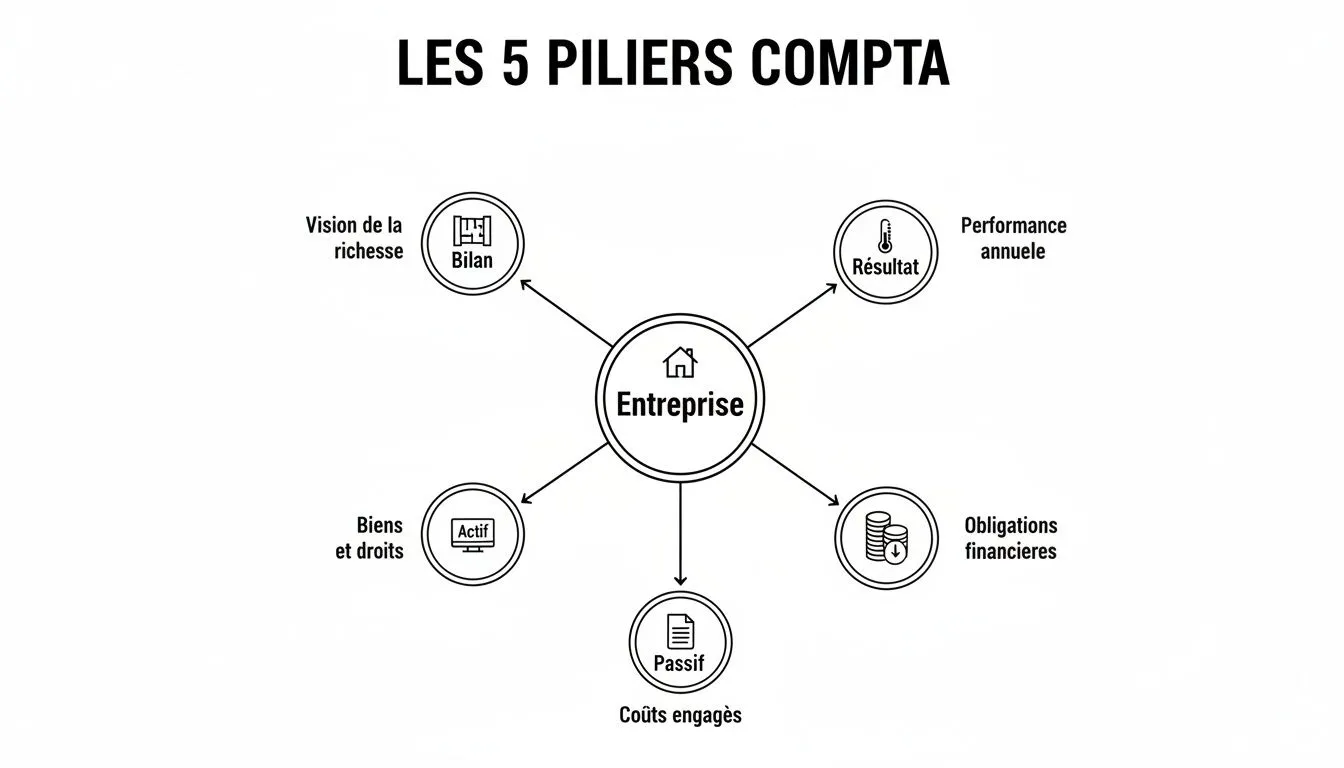
Every element, from assets (what you own) to liabilities (what you owe), plays a key role in giving a faithful, accurate picture of your business’s situation at a given moment.
In fact, the accounting profession itself is undergoing major change. According to France Travail, the sector anticipated around 20,000 recruitment plans, with nearly 30% of the workforce expected to retire by 2030. This dynamic is driving the automation of repetitive tasks and reinforcing accountants’ strategic advisory role. Mastering the basics is therefore becoming an even more valuable skill.
Finally, good organization also means rigorous record-keeping. It’s crucial to know how and how long to keep your accounting documents to stay compliant in case of an audit. Building good habits from the start is the secret to peace of mind over the long run.
Managing your taxes without losing your mind
Let’s be honest, the word “taxes” tends to raise stress levels, especially when you’re just starting out. You immediately picture a mountain of incomprehensible paperwork. The goal here is simple: we’re going to demystify all of it and give you a clear roadmap so taxes stop being a source of anxiety.
No need to become a chartered accountant overnight. The idea is to give you the keys to understand what you need to do, when to do it, and how to avoid unpleasant surprises. With a bit of organization, managing your taxes becomes a simple routine.
Which taxes actually apply to you?
To start, you should know there are two main families of business taxation. Your legal status determines which box you fall into, and that changes everything.
-
Income tax (IR): This is the most common case for sole traders, and therefore for micro-entrepreneurs. The principle is simple: there’s no separation between your business income and your personal income. Your turnover, after a deduction for expenses, is added to your household’s other income. The total is then subject to the standard tax scale.
-
Corporate tax (IS): This applies to companies such as SARLs or SASs. Here, the business is its own separate legal entity, which pays its own taxes on its profits. If you pay yourself a salary or dividends, you’re then taxed personally on those amounts, under income tax.
As a micro-entrepreneur, you’re therefore subject to income tax, which already simplifies things a lot.
The micro-entrepreneur’s tax calendar: dates not to miss
The tax rhythm of a micro-entrepreneur is fairly simple to follow. There are mainly two deadlines to keep in mind.
-
Turnover declaration to URSSAF: This is your regular appointment (monthly or quarterly, your choice) to declare what you’ve invoiced and collected. Your social contributions (health insurance, retirement…) are calculated from this amount. A golden rule: even if your turnover is €0, the declaration is mandatory.
-
The annual income tax return: Every year in spring, like everyone else, you have to fill out your tax return. You’ll need to report your annual turnover in a specific box (BNC or BIC, depending on the nature of your activity). The tax administration then applies a deduction to calculate your final taxable income.
The secret to stress-free management? Anticipation. Note these dates in your calendar and get into the habit of setting aside a small percentage from every invoice you collect. You’ll thank yourself when it’s time to pay.
Don’t forget the Cotisation Foncière des Entreprises (CFE)
The CFE is a local tax that almost all businesses have to pay, including micro-entrepreneurs. Yes, even if you work from your living room.
The good news is you’re fully exempt from it in your first year of activity. For following years, you’ll receive a payment notice in autumn, to be settled before December 15. The amount depends on the city where you’re based and on your turnover.
Taxation is a sensitive topic in France. The third Barometer of Tax and Social Contributions revealed that 78% of French people believe the level of taxation is too high. This distrust, combined with the fact that only 22% of respondents trust the State to use this money well, shows just how important transparent management is. For an entrepreneur, mastering your taxes well isn’t just an obligation — it’s also a guarantee of peace of mind for running your business. To learn more, you can check the details on this perception of taxes in France.
Choosing the right tools to simplify your management
In today’s all-digital era, insisting on managing your accounting with a simple spreadsheet is a bit like stubbornly trying to cross the country with a paper road map: it’s possible, but honestly, why put yourself through it? It means taking unnecessary risks and wasting a ton of time. The good news is that there are now technological copilots designed for you, the entrepreneurs. A good online accounting tool can genuinely turn this chore into a mere formality.
Ditch the crashing Excel formulas and the data-entry errors that can cost you a small fortune. A modern tool gives you a secure framework and walks you through every step. Think of it as your best ally for sleeping soundly and focusing on what really matters: growing your business.

Why software really changes the game
Switching from a spreadsheet to management software is a bit like trading an old Nokia 3310 for the latest smartphone. The benefits are immediate, especially when you’re just starting out and feel a little lost in accounting for beginners.
Here’s what it will concretely change for you:
- A phenomenal time saving: No more spending hours creating invoices or chasing clients. All of that is automated. That time, you can finally devote it to what you love doing: your craft.
- The end of error-related stress: A misplaced comma, an extra zero in a cell, and your whole set of books is wrong. Software, on the other hand, doesn’t make mistakes. It calculates VAT, totals, and prepares your reports without ever faltering.
- A clear, precise view of your cash flow: By linking your bank account, you have a dashboard in front of you that tells you in real time where you stand. Who owes you money? Which invoices are about to come due? You know everything, all the time.
In short, a management tool doesn’t just store numbers. It gives you the keys to run your business with reliable, always up-to-date information.
Good accounting software doesn’t replace you, it gives you superpowers. It’s your personal assistant working 24/7 so your finances stay flawless, freeing your mind to focus on new ideas.
The features that really make life easier
So how can a tool like Bizyness concretely transform your daily routine? Imagine doing all of this in a few clicks, whether you’re at your computer or on the go with your smartphone.
Creating quotes and invoices that make an impression Stop tinkering with Word or Google Docs. Here, you choose a professional template, add your logo, and the software handles the rest: legal mentions, calculations, unique numbering… A client approves a quote? One click and it turns into an invoice. It’s simple, fast, and immediately gives your business a more professional image.
Syncing your bank account for effortless tracking This is probably the life-changing feature. You connect your business account, and every money in or out flows in automatically. Your only job? Assign each line to the right invoice or expense. The famous bank reconciliation, once a real headache, becomes almost a game.
Generating reports to make the right decisions Which service brings in the most? Who are your most loyal clients? In an instant, the software gives you clear, readable charts that answer these questions. These reports are true goldmines for understanding what’s working and adjusting your strategy. No more flying blind — you run your business based on facts.
Storing your receipts securely Just left a restaurant with a client? Bought some equipment? Snap a photo of the receipt with your phone. The app saves it, files it, and links it to the expense. Goodbye to the famous shoebox full of paperwork. Everything is digitized, organized, and fully compliant in case of an audit.
Choosing the right tool ultimately means giving yourself the means to run your business with peace of mind, without having to become a chartered accountant. You quickly realize that successful accounting for beginners doesn’t depend on your knowledge, but on the quality of your copilot.
FAQ: accounting for beginners (almost)
Diving into accounting is a bit like learning a new language: at first, you quickly feel overwhelmed by questions. That’s completely normal! This section is here to answer the most common ones, straightforwardly and without jargon, so you can get started with peace of mind.
Think of it as your personal catch-up session. We’ve compiled the questions that come up again and again from entrepreneurs who, like you, are starting their journey. The idea? Clear, concrete answers so you can focus on what really matters: growing your business.
Do you absolutely need a chartered accountant as a micro-entrepreneur?
The answer is simple: no, it’s absolutely not a legal requirement. The micro-entreprise status was specifically designed to be as simple as possible administratively and from an accounting standpoint.
Your obligations boil down to two essential points:
- Keeping a receipts ledger: This is a simple register where you note, in order, all the sums you receive.
- Keeping a purchases register (if your activity requires it): This only applies if you sell goods, supplies, food (dine-in or takeaway) or offer accommodation services.
That said, hiring a chartered accountant can become a good idea if your business grows significantly. For example, if you’re approaching the VAT thresholds or considering switching to a company structure. But to get started, management software like Bizyness is often the perfect alternative. It gives you a secure, automated framework, without weighing on your budget as much as a chartered accountant would.
What’s the worst mistake to avoid at the very start?
By far, the most frequent and most dangerous mistake is mixing your personal and business finances. Paying your suppliers or receiving payments from clients through your personal checking account is a very, very bad habit to get into.
The golden rule is to open a bank account dedicated to your business. It’s strongly recommended from day one, and it even becomes mandatory if your turnover exceeds €10,000 for two consecutive years.
This simple reflex is the healthiest foundation for your business. It keeps your cash flow clear, drastically simplifies calculating your expenses and profits, and protects you in case of an audit. It’s non-negotiable.
By separating accounts, you see the financial health of your business at a glance, without having to sort your grocery shopping from your business equipment purchases.
Am I required to keep all my invoices in paper form?
Good news, the days of overflowing binders are over! You can absolutely keep your supporting documents (purchase invoices, expense reports…) in digital format.
That said, there are a few rules to follow for the tax administration to accept your digitized documents. The digitization must be:
- Faithful to the original: The digital copy must be an exact copy of the paper document, without the slightest alteration.
- Reliable and durable: The file must be saved in a stable format (PDF is ideal) and stored in a secure location that guarantees its integrity over time.
Don’t forget that the legal retention period for these documents is 10 years. The simplest and safest approach is to use management software with built-in storage. You take a photo of your receipt, link it to the right expense, and the software takes care of archiving it securely for you.
Is the general chart of accounts a mandatory step?
Picture the General Chart of Accounts (Plan Comptable Général, or PCG) as a huge dictionary that assigns a number to each type of transaction (purchases, rent, salaries…). For a beginner, and even more so as a micro-entrepreneur, trying to memorize it is completely useless and counterproductive.
Think of it this way: when you use a GPS, you don’t need to know the name of every street by heart. You enter your destination, and the app calculates the route. Good accounting software does exactly the same thing for you.
When you record an expense under a clear category like “Office supplies,” the software takes care, behind the scenes, of assigning it the right PCG account number. Knowing this “dictionary” exists is good. But mastering it is the job of your tool or your accountant. Your role is to properly categorize your transactions, not to memorize a list of numbers.
Ready to turn your bookkeeping into a mere formality? With Bizyness, create flawless invoices, track your cash flow in real time, and automate your filings. Focus on your craft, we’ll handle the rest. Discover how Bizyness can simplify your day-to-day starting today at bizyness.fr.
