

 Français
Accounting: how to prepare a balance sheet - practical guide
Learn how to prepare a balance sheet step by step with our clear guide for small businesses and entrepreneurs in France.

Preparing a balance sheet is a bit like taking an instant snapshot of your company’s financial health at a specific moment. On one side, you list everything the company owns (assets), and on the other, everything it owes (liabilities). The goal? Make sure these two columns balance perfectly.
The balance sheet: your strategic dashboard
Far more than a simple administrative formality, the balance sheet is the true dashboard of your business. It gives you a clear, structured view of your assets and liabilities at the closing date of your accounting period. It’s an indispensable tool for steering your business intelligently.

To truly understand how to prepare a balance sheet, you first need to master its two pillars. It’s simple: imagine your company as a house.
Assets: what your company owns
Assets are simply all the resources your company controls, whether long-lasting property or cash ready for use. Going back to the house analogy: the assets are the foundations, the walls, the furniture, and even the cash you keep in the till.
Assets fall into two main categories:
- Fixed assets: These are the assets that will serve the company over the long term. Think of your computer, delivery vehicle, a patent, or even your premises if you own them.
- Current assets: Here we’re talking about elements that are meant to move, be transformed, or used quickly. This includes your inventory of goods, accounts receivable (money your customers still owe you), and of course, the cash available in your bank account.
Liabilities: how it’s all financed
Liabilities, on the other hand, tell a different story: that of the origin of the funds used to finance everything you own as assets. They answer the crucial question: “Where does the money come from?” They show who the company’s “creditors” are, including you yourself as a shareholder.
Liabilities essentially consist of:
- Equity: This is the financial heart of your company. It includes the money the shareholders contributed at the start (share capital), as well as profits set aside over the years (reserves).
- Debts: Here we list everything the company owes to third parties. This ranges from a standard bank loan to amounts owed to suppliers, not forgetting tax and social security debts (VAT to be paid, URSSAF contributions, etc.).
The golden rule of accounting: balance. Your Total Assets must ALWAYS equal your Total Liabilities. If your assets amount to €50,000, your liabilities must also show €50,000. This is the mathematical proof that every resource (asset) is indeed financed by a counterpart (liability).
This principle of transparency hasn’t always been a given. It emerged with the industrial revolution in the 19th century. It was the 1867 law that made the annual balance sheet mandatory for public limited companies, mainly to protect investors. To give you an idea, fewer than 10% of French companies prepared a balance sheet in 1870. That figure jumped to over 70% by 1914 and exceeds 98% today. If you’re interested in the topic, you can explore the evolution of accounting to better understand the context.
This table offers a clear overview of both sides of the balance sheet for an immediate understanding.
Quick summary of balance sheet components
| Component | Simple definition | Concrete examples |
|---|---|---|
| Fixed assets | What the company owns and uses on a lasting basis (> 1 year). | Computer equipment, vehicle, machinery, patent, goodwill. |
| Current assets | What the company owns and that will be converted quickly (< 1 year). | Inventory of goods, accounts receivable, cash (bank, till). |
| Equity | Resources belonging to the shareholders and the company. | Share capital, reserves (retained earnings), profit for the period. |
| Debts | Resources borrowed from third parties (to be repaid). | Bank loan, trade payables, tax and social security debts (VAT, URSSAF). |
Understanding this structure is really the first step toward the balance sheet ceasing to be an administrative constraint and becoming what it should be: a powerful decision-making tool for your company’s future.
Setting the stage: the key documents to gather
Before diving headfirst into the balance sheet figures, there’s a preliminary step you can’t skip. It’s a bit like a chef meticulously preparing all their ingredients before starting a complex recipe. Good preparation is the key to an accurate balance sheet that gives a true picture of your company’s health.
In concrete terms, this means gathering a series of documents that are the raw material of your accounting. Each piece of the puzzle matters and provides crucial information that will need to be pulled together. Trying to put together a balance sheet without these elements is like navigating blind in a storm.
The checklist of essential documents
To make sure you don’t forget anything, method is your best friend. Start by gathering the following documents, which form the foundation of your year-end closing.
- The general ledger: This is the ultra-detailed logbook of your business. It records every transaction (purchases, sales, bank movements) and sorts them by account. An essential document for digging into the detail of a line item if needed.
- The trial balance: Think of it as a summary of the general ledger. It lists all the company’s accounts with their final balance, whether debit or credit. It’s the ultimate control tool for checking that total debits equal total credits.
- The fixed asset and depreciation schedule: This register is fundamental for properly valuing what your company owns over the long term. It lists your durable assets (equipment, vehicles, software) and details the depreciation already recorded and that to be calculated for the period.
- The physical inventory count: If you sell products, this step is mandatory. As of the closing date, you must precisely count and value everything remaining in stock. This value will directly feed into your current assets.
A small error at this stage can have serious consequences. Imagine you overvalue your inventory by €10,000. This artificially inflates your profit, and therefore the corporate tax you’ll have to pay. Rigor is not optional.
Once you have all this, the work is just beginning. Now you need to check that everything is consistent.
Verifying and cross-checking information
All the documents are on your desk? Perfect. Now it’s time for analysis. This isn’t about simply stacking papers, but making sure the numbers speak to each other and tell the same story.
An expert tip: always start with the trial balance. Is it balanced? If the sum of debits doesn’t match the sum of credits, stop! That’s the signal of a data-entry error somewhere in the general ledger. You must find and correct the anomaly before going any further.
Next, on to the cross-checks:
- Reconcile your bank accounts. The balance of your “Bank” account (the well-known account 512) in your books must match, down to the cent, the balance on your bank statement as of the closing date. This is what’s known as bank reconciliation.
- Scrutinize your third-party accounts. Take a look at customer accounts (411) and supplier accounts (401). The balances should match the sum of outstanding invoices. This is the ideal moment to spot a late-paying customer or make sure a supplier invoice hasn’t slipped through the cracks.
- Check social and tax filings. The balances on your VAT, URSSAF, or tax accounts should match your latest filings. For example, the amount in the “VAT payable” account should be identical to that on your most recent annual VAT return.
I’ll grant you, this preparation phase can seem long and tedious. But it’s absolutely crucial. A balance sheet built on solid foundations is far more than a mere legal obligation; it’s a reliable dashboard for steering your business and making the right decisions.
Closing and year-end entries: the finishing touches
Once you’ve gathered all your documents, you enter the most technical part of the work. This is when you adjust the accounts so they accurately reflect your company’s reality as of December 31st. This is where closing entries, or year-end adjusting entries, come in. They are absolutely essential for your balance sheet to be an accurate and faithful snapshot of your assets and liabilities.
In concrete terms, this involves recording transactions that don’t stem from a simple invoice, but that are crucial for complying with core accounting principles. Think of it as a photographer’s final adjustments: each tweak sharpens the image so it’s crisp and precise.
This little diagram sums up the three pillars of this preparation well.
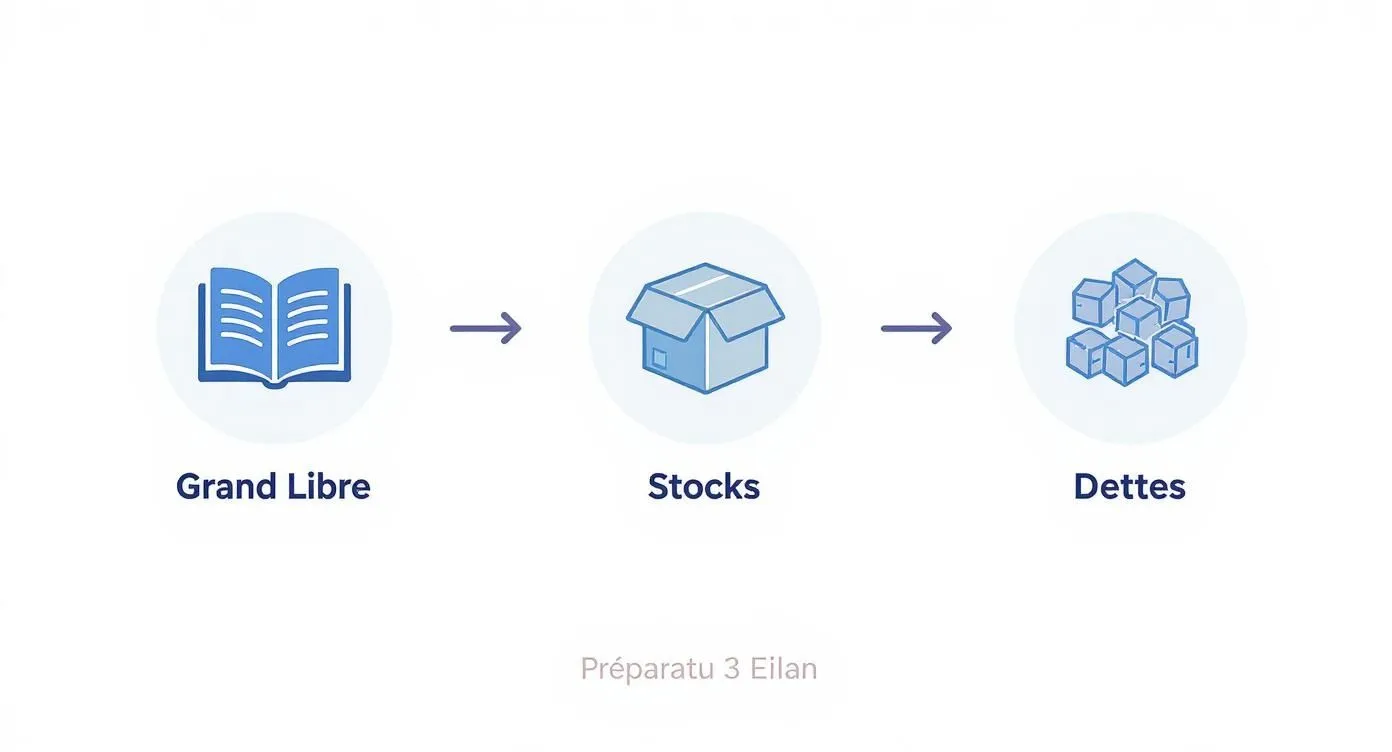
It’s clear that the soundness of the final balance sheet rests on reliable data from the general ledger, an accurate valuation of inventory, and rigorous control of debts.
Calculating and recording depreciation
Your professional equipment (vehicle, computer, machinery) loses value over time and through use. This loss in value is depreciation. It’s mandatory to calculate it every year. Why? So that the value of your assets shown on the balance sheet is realistic.
The calculation is often quite simple. Take a computer purchased for €1,200, which you decide to depreciate over 3 years (i.e. 36 months). The annual depreciation will be €400 (€1,200 / 3 years). This amount is treated as an expense for your company, which has the advantage of reducing your taxable profit. It’s a win-win.
Adjusting inventory value
The physical inventory count you did is only the starting point. Now you need to translate that count into an accounting entry. The idea is to cancel the value of the beginning-of-year inventory and replace it with the value of the end-of-year inventory. This is known as an “inventory change,” and it has a direct impact on your profit.
Let’s imagine you had €5,000 of goods on January 1st and you have €7,000 left on December 31st. You’ve therefore “created” €2,000 of inventory value. This positive change will increase your profit. Conversely, if your inventory has decreased, this will reduce your profit. For any retail business, this is a key step.
Anticipating setbacks with provisions
Being a business owner also means knowing how to anticipate problems. Provisions are there for that. They allow you to virtually set money aside to cover a probable risk, even if you don’t yet know the exact amount or precise date.
A very telling example: one of your key customers is going through receivership. You estimate there’s a strong chance they’ll never pay their invoice for €3,000. You’ll therefore “provision” this receivable. In concrete terms, you record an exceptional expense of €3,000, which reduces your profit but makes your balance sheet more prudent and therefore more accurate.
This mechanism can also apply to a dispute with an employee, a risk of tax penalties, or even the warranty you offer on your products. The key word here is caution.
Assigning each item to the right year
In accounting, there’s a golden rule: the matching principle (separation of financial periods). Only the expenses and income relating to the year should appear in that year’s profit or loss. To achieve this, adjusting entries are used.
Here are the two cases you’ll encounter most often:
- Prepaid expenses: You paid your annual insurance premium of €1,200 in December. It covers the period from January 1st to December 31st of the following year. This expense therefore doesn’t relate to the current period. It must be cancelled and “carried forward” to the following year.
- Accrued income: You completed a project for a client in December for €2,500, but the invoice won’t go out until January. For this revenue to be correctly matched to the year in which you did the work, you need to record it using an accrued income entry.
Mastering these adjustments is at the heart of accounting expertise. These operations may seem complex, but they follow an unwavering logic and recur every year. If you’re interested in the topic, our full guide on how to properly close your accounts covers each of these steps in detail.
Fortunately, you no longer have to do it all by hand. Software like Bizyness automates a large part of these calculations, which significantly reduces the risk of error and saves you precious time.
Time to practice: building your balance sheet with concrete examples
Theory is all well and good, but nothing beats practice for truly grasping the subject. Now that your figures are ready, it’s time to actually build your balance sheet. This is the moment when all the pieces of the accounting puzzle come together to give a clear, precise snapshot of your company’s assets and liabilities.
To make this as concrete as possible, we’re going to break down the process with two scenarios I encounter often in the field, very representative of the French entrepreneurial landscape.

We’ll start with a small services-based single-member company, like a consultant or freelance developer. Their balance sheet is generally simpler, focused on cash and a few fixed assets. Then we’ll move on to a limited company that sells products, a slightly more complete case with inventory, equipment, and bank debts.
Case #1: Mr. Dubois’s services company
Let’s imagine Mr. Dubois, a marketing consultant, is closing his very first accounting period. Once his year-end entries have been recorded (depreciation, accrued expenses, etc.), his books give him the following final balances.
Our task is simple: take each item from this “general trial balance” and place it in the right slot on the balance sheet.
- In fixed assets: His professional software, acquired for €1,500. This is an asset he’ll use over several years, so it’s an intangible fixed asset.
- In current assets: We find an outstanding customer invoice of €4,000 (his receivables) and the €10,000 available in his bank account.
- In equity: The capital he deposited at incorporation, €1,000, as well as the profit for the year, which amounts to €11,000.
- In debts: He still owes €2,500 in contributions to URSSAF. These are social security debts.
The secret is to be meticulous and forget nothing. Every account must find its place. Fortunately, modern accounting software does this classification work for you, which greatly reduces the risk of oversight.
We total each side. Total Assets: 1,500 + 4,000 + 10,000 = €15,500. Total Liabilities: 1,000 + 11,000 + 2,500 = €15,500. A perfect balance! Mr. Dubois’s balance sheet is correct.
Case #2: Mrs. Leroy’s retail limited company
Let’s change scenery with a slightly denser case: a limited company selling home decor items. Its business generates more activity and therefore more accounting entries. Here’s what its final trial balance looks like after completing its inventory count and calculating depreciation.
We’ll proceed in exactly the same way, column by column.
Building the Assets
- Fixed assets: We start by listing what the company owns on a lasting basis. The company has a delivery vehicle (with a net value of €12,000 after depreciation) and fixtures in its shop worth €8,000. Total: €20,000.
- Current assets: Here we include everything that’s meant to be quickly converted into cash. We find inventory of goods valued at €15,000, unpaid customer invoices for €10,000, and of course, cash in the bank, at €5,000. Total: €30,000.
In the end, Total Assets for the company come to €50,000 (20,000 + 30,000).
Building the Liabilities
Now let’s look at where the money that financed these assets came from.
- Equity: This is the wealth that truly belongs to the company. There’s the initial share capital (€10,000), profits from previous years that were set aside (€5,000 in reserves), and the profit for the period that just ended (a profit of €7,000). Total: €22,000.
- Debts: We list everything the company owes to third parties. There’s a bank loan of €15,000, supplier invoices to pay of €8,000, and various tax and social security debts (VAT, taxes, contributions) of €5,000. Total: €28,000.
Total Liabilities therefore come to €50,000 (22,000 + 28,000). Everything checks out!
The company’s final balance sheet at a glance
To make everything clear, nothing beats a summary table. If you’d like to see other structures, feel free to check out our article offering another balance sheet example in more detail.
Here, then, is the final balance sheet for Mrs. Leroy’s company, presented properly.
Example of a simplified balance sheet for a limited company
| ASSETS | Amount (€) | LIABILITIES | Amount (€) |
|---|---|---|---|
| Fixed assets | 20,000 | Equity | 22,000 |
| Vehicle | 12,000 | Share capital | 10,000 |
| Fixtures | 8,000 | Reserves | 5,000 |
| Profit for the period | 7,000 | ||
| Current assets | 30,000 | Debts | 28,000 |
| Inventory of goods | 15,000 | Bank loan | 15,000 |
| Accounts receivable | 10,000 | Trade payables | 8,000 |
| Cash (bank) | 5,000 | Tax and social security debts | 5,000 |
| TOTAL ASSETS | 50,000 | TOTAL LIABILITIES | 50,000 |
As you can see, the golden rule is respected: Total Assets = Total Liabilities. This check is crucial, it’s the final control. If the two totals don’t match, that’s the alarm bell: an error has slipped in somewhere. You then need to retrace your steps to find the forgotten account or the mistyped figure.
Tools like Bizyness make this step much less tedious. The software generates the balance sheet automatically from the entries you’ve recorded throughout the year. Every account is classified in its place, and the balance is mathematically guaranteed. The risk of human error is almost eliminated, leaving you more time for what really matters: analyzing these figures to steer your business.
Analyzing your balance sheet to make the right decisions
There you have it, your balance sheet is complete, balanced, ready to be presented. Well done! But don’t stop there. This document, often seen as a mere administrative obligation, is actually a goldmine of strategic information. It’s time to make the numbers talk, turning this constraint into a true dashboard.
This is where the magic happens: a well-conducted analysis gives you an ultra-precise snapshot of your company’s financial health. You’ll be able to assess its soundness, its ability to weather setbacks, and above all, its growth potential.
Decoding the health of your cash position
The very first thing to check is liquidity. In concrete terms: does your company have what it takes to pay its short-term bills? Two indicators, very simple to calculate from your balance sheet, give you an almost immediate answer.
-
Net working capital (NWC): It measures the balance of your financing. Simply put, it’s the difference between your stable resources (equity + long-term debt) and your fixed assets. Positive net working capital is a good sign! It means your investments are financed over the long term and you even have a safety cushion left to fund your operating cycle.
-
Working capital requirement (WCR): This is the crux of the matter for many entrepreneurs. It reflects the cash-flow gap inherent to your business: you pay your suppliers before your customers have paid you. The calculation is simple: Inventory + Accounts receivable - Trade payables. If your WCR is high, it means your business consumes a lot of cash to keep running.
The holy grail is having net working capital (NWC) higher than your working capital requirement (WCR). When this balance is achieved, your cash flow breathes easy. Otherwise, you risk constantly juggling with your bank overdraft, a solution that’s both costly and precarious.
Advice from the field: Keep a constant eye on your WCR, especially if your business is seasonal or growing fast. Anticipating a spike in WCR will let you negotiate a line of credit with your banker well before you’re in the red, and therefore from a position of strength.
The checklist of errors to watch for before finalizing
Before sending your balance sheet to the authorities, one last check is needed. This is your safety net for avoiding classic mistakes that can be costly, whether in credibility or tax penalties.
1. Have you forgotten a provision? This is a classic. Think of that somewhat shaky customer who might never pay you, or that small dispute dragging on with a supplier. Forgetting a provision means artificially inflating your profit and therefore paying more tax than necessary.
2. Are your prepaid expenses properly recorded? The annual insurance premium paid in December for the following year is the perfect example. Only the portion of the expense relating to the period you’re closing should remain. The rest must be “carried forward” to the following year. This is the ABC of the matching principle.
3. Is the shareholder’s current account correct? A crucial point to watch. Make sure the balance actually matches the shareholder’s real contributions and withdrawals. A debit balance (meaning the shareholder owes money to the company) is simply prohibited in most limited companies and can be severely penalized.
4. Has depreciation been calculated on all assets? It’s easy to forget the new computer or software bought during the year. Every oversight is a deductible expense that slips through the cracks and, potentially, higher corporate tax as a result.
Doing this analysis and these final checks isn’t just about being compliant. It’s above all about giving yourself a clear, honest view for the year ahead. You’ll know where your financial strengths and weaknesses lie, and you’ll make much more informed decisions for your company’s future.
Make your life easier with the right tools for your balance sheet
Knowing how to build a balance sheet by hand is an excellent education, no doubt about it. But let’s be honest, in the digital age, slogging away at endless spreadsheets is a waste of time and a source of potential errors. A good accounting tool can truly turn this chore into a simple formality.
Far from just filing your invoices, these programs are true co-pilots. They calculate the most technical items for you, such as depreciation on your fixed assets, based on the information you feed them along the way. Every expense you record, every customer invoice you issue, is already one step closer to an accurate balance sheet.
Automation: your best ally for reliable figures
The real trick is these programs’ ability to generate your summary documents almost on demand. In just a few clicks, your balance sheet and income statement are ready, and above all, perfectly balanced. Assets equal liabilities, without you having to tear your hair out. It’s the end of calculation errors or unfortunate omissions that haunt manual entries.
The time you save is precious. Instead of drowning in compiling figures, you can finally focus on what matters: understanding what they’re telling you. Analyzing performance, identifying weak points, making informed decisions… that’s the real work of an entrepreneur. Of course, for those who prefer a more “homemade” approach, mastering Google Sheets and its formulas remains a very useful skill for putting together a simple balance sheet and keeping a close eye on it.
Going digital is no longer optional. To give you an idea, in 2023, of the more than 3 million French companies that filed their accounts, 2.5 million did so electronically. That shows just how central the balance sheet is to our economy, even in its dematerialized form.
Ultimately, an easy-to-use accounting software like Bizyness gives you a clear, up-to-date view of your financial health, without having to spend your evenings on it. It’s the assurance of having accurate bookkeeping, compliant with the law and always under control.
People often have a whole host of questions when preparing their balance sheet. That’s entirely normal. Let’s untangle the most common questions to help you see things more clearly.
Is a balance sheet mandatory for a micro-entrepreneur?
The answer is simple: no. If you’re under the micro-entrepreneur (sole trader) regime, you benefit from simplified bookkeeping. A revenue ledger and, in some cases, a purchase register are enough.
The balance sheet only becomes mandatory if your business grows and you decide to convert to a company structure, such as an EURL or SARL. For now, you don’t need to worry about it.
Are the balance sheet and the income statement the same thing?
Absolutely not, and this is a classic point of confusion. Think of the balance sheet as a snapshot of your company at a given moment, generally December 31st. It lists everything the company owns (its assets) and everything it owes (its liabilities).
The income statement, on the other hand, is more like a film. It traces the entire year’s activity and tells you whether, in the end, you made money (profit) or lost money (loss).
To put it simply: the balance sheet is the wealth; the income statement is the performance.
Can I really do my own balance sheet without an accountant?
Legally, nothing stops you. With a good management tool, it’s technically possible. But let’s be honest, it’s a delicate exercise.
Having an accountant by your side is much more than simple help. Their signature gives instant credibility to your accounts, whether for your banker or the tax authorities. It’s also the assurance that everything is done by the book, not to mention the valuable advice they can give you to optimize your taxes.
Tired of juggling numbers and deadlines? Bizyness is here for that. Our platform automates the creation of your balance sheets, invoices, and filings so you can finally focus on your core business. Discover how Bizyness can simplify your everyday life starting today.
