

 Français
 Accounting Records Retention: A Practical Guide for E-commerce
Master accounting records retention for your e-commerce business: durations, formats and risks, with simple solutions to stay compliant.
As an online seller, you’re juggling orders, marketing, logistics… and paperwork. Let’s talk about that famous accounting records retention requirement. It’s a legal obligation, sure, but above all it’s an unavoidable rule of the game for securing your business. In practical terms, the law requires you to keep all your supporting documents for at least 10 years for accounting purposes, and 6 years for tax purposes. This is what lets you justify every line of your books in the event of an audit.
Why archiving your documents is vital for your e-commerce business
For an online seller, properly archiving your documents isn’t just about ticking a box on an administrative to-do list. It’s the foundation of your credibility and your best legal and financial life insurance. Every transaction, whether it comes from Shopify, Amazon or Stripe, generates a mountain of data that must be kept with near-military discipline.
Think of your archives as your online store’s black box. They tell the entire story of your business and are the ultimate proof of your good faith should the tax authorities come knocking. With good management, this constraint quickly turns into a real asset.
Your shield against tax risks
The first, and most obvious, reason to take archiving seriously is tax compliance. During an audit, an inspector can go back several years. If you don’t have the right supporting documents, the consequences can be severe.
Here’s what you’re actually risking if your archiving falls short:
- A hefty tax reassessment, often based on an estimate of your income that won’t work in your favor.
- The rejection of your accounting records as a whole, which would render them void in the eyes of the authorities.
- The challenging of expenses you deducted, such as your stock purchases or advertising campaigns.
- The application of penalties and late interest that can seriously hurt your cash flow.
Be warned: a simple monthly sales statement provided by a marketplace is absolutely not enough. The authorities expect proof for every transaction, with VAT detail, to justify each entry in your Fichier des Écritures Comptables (FEC, the French accounting records file).
A pillar for your company’s growth
Well-structured archiving isn’t just a defensive posture. It’s a genuine engine for growing your business. Well-organized, easily accessible documents are essential to:
- Analyze your performance with reliable figures and make the right strategic decisions.
- Secure financing: no bank will lend you money without solid, well-supported financial statements.
- Simplify your accountant’s life, saving them time (and saving you money).
In e-commerce, transaction volumes grow fast, and international sales through the OSS/IOSS schemes add complexity to VAT. Flawless document retention is the foundation of healthy, controlled growth. It doesn’t just prove your compliance; it demonstrates the seriousness and solidity of your business.
Which documents to keep, and for how long?
Knowing exactly what to keep and for how long can quickly become a headache, especially in the fast-moving world of e-commerce. It’s not enough to just set aside the invoices you send to your customers. No — to truly protect your business, you need a 360-degree view that covers every document that can support a transaction or an accounting entry.
Think of your compliance as a solid wall. Each document is a brick. If even one is missing on audit day, the whole structure risks cracking. That’s why accounting records retention must be flawless.
The essential documents for online sellers
As an online seller, you generate a far larger volume of supporting documents than traditional retail. Your job is to identify all of them and archive them carefully.
Here are the categories of documents you absolutely must keep on hand:
- Sales and revenue records: The obvious ones are invoices created on Shopify or WooCommerce. But don’t overlook the detailed sales reports from marketplaces like Amazon or Etsy. These are what justify your declared revenue.
- Proof of financial transactions: Payment confirmations and transaction statements from your payment gateways (Stripe, PayPal, etc.) are crucial. They link an order to an actual flow of money.
- Proof of expenses and purchases: Invoices from your suppliers for stock, expense reports for your advertising campaigns (Google Ads, Meta), software subscriptions, carrier invoices… everything must be kept.
- Supporting commercial documents: Purchase orders, delivery notes, and carrier tracking proof (Colissimo, Mondial Relay) evidence the transaction and prove the goods were actually shipped.
The pillars of your accounting
Beyond these everyday documents, there are the fundamental accounting records. These are what structure and summarize all your operations. They’re the official reflection of your business’s health.
The FEC (Fichier des Écritures Comptables) is the centerpiece. It’s a file in a standardized format that the tax authorities will systematically request at the very start of an audit. It must be in perfect agreement with all your supporting documents.
On top of that come the other key documents:
- The journal ledger, which records every operation day by day.
- The general ledger, which breaks these operations down by account.
- The inventory book, which details your company’s assets and liabilities.
The rule is clear: these documents must be kept for at least 10 years after the accounting period closes. It’s a non-negotiable legal obligation.
Summary of retention periods for e-commerce documents
To make things easy, here’s a table summarizing the legal retention periods you need to know. It distinguishes commercial law requirements (for disputes) from tax law requirements (for audits).
| Document type | Retention period (Commercial Code) | Retention period (Tax Code) | Practical recommendation for online sellers |
|---|---|---|---|
| Customer and supplier invoices | 10 years | 6 years | Keep for 10 years to align with the longer period and cover all risks. |
| Accounting books (FEC, general ledger, etc.) | 10 years | 6 years | Keeping for 10 years is a strict accounting obligation. No discussion possible. |
| Purchase and delivery orders | 10 years | 6 years | Keep for 10 years, as these are documents that support your accounting entries. |
| Tax returns (VAT, corporate tax) | Not specified | 6 years | Keep for 10 years as a safety measure, to stay consistent with your accounting. |
So, given these varying periods, what’s the best strategy to adopt?
The golden rule is very simple: always align with the longest period. In nearly every case, that’s the 10-year accounting period. By adopting this principle, you ensure complete peace of mind. Whether it’s a tax audit, a dispute with a supplier, or a simple request from your bank, you’ll always be ready.
To dig deeper into the topic, check out our full guide on document retention periods. It’s the guarantee you’ll never be caught off guard.
Paper or digital: which archiving method should you choose?
For an online seller, the image of binders overflowing with invoices is a distant memory. Or at least, it should be. The question is no longer really whether to go digital, but how to do it properly. The stakes are high: guaranteeing accounting records retention that’s both practical and legally flawless.
Let’s be clear: paper has had its day. It takes up a huge amount of space, deteriorates over the years, and can be lost or destroyed in a fire. And let’s be honest, finding a specific invoice in a pile of binders can sometimes feel like archaeology. For a business that lives and breathes digital, clinging to physical archiving simply doesn’t make sense.
Going digital is therefore a no-brainer. But be careful: a simple invoice scan dropped into a folder on your computer isn’t enough. For a digital copy to have the same legal value as a paper original, it must follow very strict rules.
The conditions for a digital document to be valid proof
For a digital document to be considered reliable proof in the event of a tax audit, it must guarantee three fundamental principles. Picture your archiving system as a digital safe, sealed and tamper-proof.
This safe must ensure:
- Authenticity of origin: it must be possible to know, beyond any doubt, who issued the document.
- Integrity of content: the document must not have undergone any modification since its creation. The safe’s seal must remain intact.
- Long-term readability: the document must remain perfectly readable and accessible throughout the entire legal retention period, i.e. 10 years.
The tax authorities are uncompromising on this point. A PDF invoice received by email and simply stored on a Google Drive doesn’t meet these conditions. It’s a mere backup, not archiving with evidentiary value.
For digital archiving to be unquestionable, it must rely on precise technologies such as qualified timestamping, which certifies the creation date, and electronic signature, which guarantees the author’s identity and the document’s integrity.
This is precisely where modern tools come into play. They’re designed to build in these security requirements from the moment the document is created, without you having to think about it.
How do you guarantee the integrity of your digital archives?
Technology now offers robust solutions to turn this legal constraint into a simple, secure process. Good accounting document retention in the digital age relies on a chain of trust that must never be broken.
Here are the mechanisms that ensure this reliability:
- Qualified timestamping: It’s a bit like a postmark, but in digital form. A trusted third party affixes a certified date and time to the document, making it impossible to falsify. Any later modification would break this time seal.
- Electronic signature: It formally identifies the issuer and guarantees that the content hasn’t been altered after signing. It’s the equivalent of your handwritten signature, but with a much higher level of security.
- The reliable audit trail (PAF): This is the set of controls that lets you reconstruct an invoice’s journey, from its creation to its archiving. It’s proof that your processes are under control and that your documents are trustworthy.
- Choosing the right format: Documents must be kept in a format that can’t be altered, such as PDF/A. This is a version of PDF specifically designed for long-term archiving.
In practical terms, for an online seller, this means using platforms that natively handle these aspects. A modern electronic document management solution doesn’t just store files; it seals them in a secure environment that guarantees their legal value over time.
By centralizing the collection of your Shopify, Stripe or Amazon invoices in such a system, you say goodbye to the risks of loss, falsification or degradation. Every document is automatically timestamped, secured and filed, ready to be presented in the event of an audit. You turn a complex obligation into an invisible automatic process, freeing your mind to focus on what really matters: growing your business.
What are the risks if you don’t keep your documents?
Many online sellers see accounting records retention as an administrative chore, a background task of little importance. Big mistake. It’s actually a pillar of your company’s long-term survival. Poor archive management isn’t a minor oversight — it’s a major risk that can shake, or even sink, your business.
Picture the scene, a classic of the genre: a tax auditor shows up (or rather, sends you a letter) and asks for the sales records of your Shopify store from three years ago. Without square, accessible digital archiving, it’s panic on board. You’re unable to provide the proof. And that’s when the domino effect begins.
Tax reassessment: when forgetfulness costs dearly
The first risk, the most direct and painful one, is purely financial. If the authorities can’t verify the accuracy of your accounting because documents are missing, they won’t just take your word for it. Quite the opposite. They have an entire arsenal at their disposal to recalculate, on their own, what they believe you should have paid.
Here’s specifically how it plays out:
- Automatic taxation: Your VAT returns look shaky, or you don’t have the invoices to back them up? The authorities can decide, on their own, what your revenue amount is. And their estimate is rarely generous.
- Rejection of your accounting records: Without solid proof, your entire accounting can be swept aside. The inspector will deem it unreliable, which gives them the right to reconstruct your income and expenses from scratch.
- Challenging deducted expenses: Every expense recorded to lower your tax bill (stock purchases, Facebook ads, software subscriptions) must be supported by an invoice. No invoice? The deduction is cancelled, and your taxable base automatically rises.
A tax reassessment isn’t just about paying the missing tax. You also need to add hefty penalties, up to 40% of the amounts owed, not to mention late interest. The final bill can quickly become astronomical.
Collateral damage: far beyond the tax audit
But the trouble doesn’t stop at writing a check to the Treasury. Poor accounting records retention has much broader repercussions, ones that can quietly hold back your growth.
Damaged credibility and closed doors
Your accounting is your online store’s medical record. If it’s not reliable, your credibility as an entrepreneur crumbles. You’ll quickly hit a wall if you try to:
- Get a bank loan to buy more stock or invest in marketing.
- Sell your business, since no serious buyer will put a euro on the table without a clear, verifiable financial history.
- Convince investors of the solidity of your business model.
A monumental loss of time and energy
Finally, there’s the cost in time, often overlooked. Trying to reconstruct years of accounting after the fact is a near-impossible mission, and above all, an energy sink. All that time spent digging through old emails is time you’re not spending finding new customers, optimizing your products, or growing your brand.
When a company can’t provide the documents requested by the tax authorities or Urssaf (France’s social security collection agency), the consequences are severe. A recent study found that a majority of French companies had strengthened their archiving policy, a sign of genuine awareness of the danger. You can learn more about managing risks related to accounting documents on Archipelia. The message is clear: prevention beats cure. Good organization upfront will cost you far less than picking up the pieces after a botched audit.
Setting up your custom e-commerce archiving system
Theory is good. But practice is even better. Let’s be clear: turning the chore of accounting records retention into a smooth, near-invisible process is entirely possible, even with thousands of transactions. The secret? Build a smart system from the start.
The goal isn’t to turn you into a professional archivist, but to set up a reliable mechanism that runs in the background. This frees up your mind and your time for what really matters: selling your products and growing your brand. Let’s look at how to go about it, step by step.
Step 1: centralize all your data sources
The first headache for an online seller is scattered information. Your sales come from Shopify, your payments from Stripe, your purchases from multiple suppliers, your ad campaigns from Meta… Each platform generates its own supporting documents. Trying to gather it all by hand is a recipe for disaster.
The first move should therefore be to connect all these sources to a single platform. Picture building a dam: instead of letting the water (your data) flow out into dozens of small streams, you channel it into one large reservoir. Tools like Bizyness are designed exactly for this, connecting directly to your stores and payment processors.
Step 2: automate the collection and creation of invoices
Once everything is centralized, the next step is to make collection automatic. Manual intervention should become the exception, not the rule. A good system should be able to:
- Automatically retrieve detailed sales reports from Amazon or Shopify.
- Instantly generate a proper invoice for every customer order.
- Pull in invoices for your recurring expenses (software subscriptions, ads, etc.).
This process ensures no document slips through the cracks. Every transaction is immediately linked to its supporting document, without you having to lift a finger.
Automation isn’t a luxury, it’s a necessity. For a fast-growing e-commerce business, transaction volume can double in just a few weeks. A manual system will never keep pace and will quickly become your main administrative bottleneck.
Step 3: opt for secure cloud storage
Your documents are now collected. Great. But where do you keep them? A simple folder on your computer or a Google Drive isn’t enough to guarantee the evidentiary value that the tax authorities require. You need a real “digital safe.”
Choose a cloud solution that ensures three fundamental things:
- Security against hacking and unauthorized access.
- Tamper-proofing, thanks to mechanisms like qualified timestamping.
- Durability, with multiple backups to prevent any data loss over 10 years.
An accounting platform designed for e-commerce natively integrates this secure storage dimension. It doesn’t just back up your data — it archives your documents in compliance with legal standards.
This infographic illustrates the risk involved in an audit, and the importance of an archiving system that holds up.
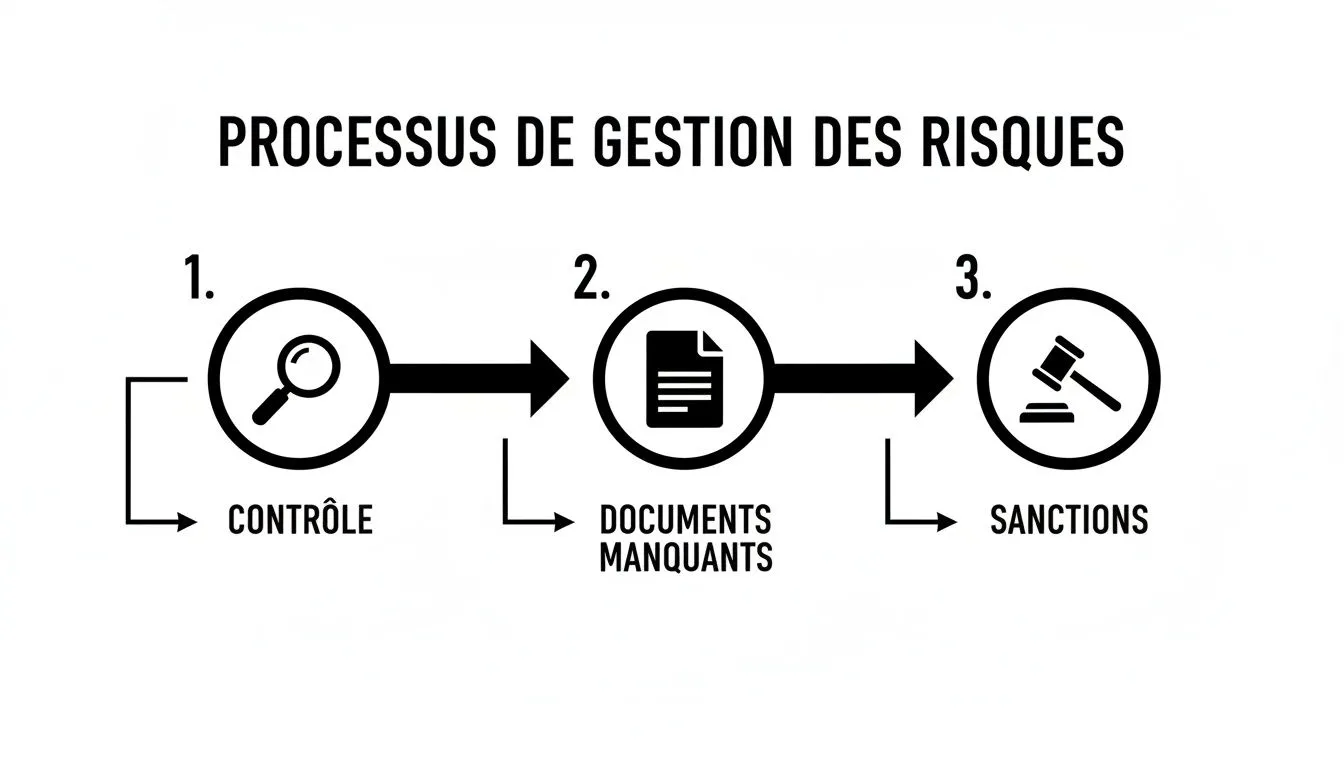
The diagram leaves no room for doubt: no document at audit time means a direct penalty. There’s no way around it.
Step 4: define a simple, clear naming convention
Even with the best tool in the world, good organization requires a simple, consistent filing logic. If automation handles 90% of the work, defining a clear naming convention for your files is the finishing touch that will save you a huge amount of time.
A good practice is to include key information directly in the file name. For example:
- For sales invoices:
INV-Customer_2024-05-25_Order-1234.pdf - For purchase invoices:
INV-Supplier_Google-Ads_2024-05.pdf - For marketplace reports:
Sales-Report_Amazon_May-2024.csv
Most modern tools let you configure these rules so they apply automatically. The goal is simple: to be able to find any document in a few seconds with a simple search, even years later.
Step 5: schedule quick, regular check-ins
Finally, even the best system needs a bit of oversight. Get into the habit of blocking off a short slot, once a month or once a quarter, to do a few quick checks. This is your routine “check-up” to make sure everything is running smoothly.
This quick review can include:
- Checking the connection with all your platforms (Shopify, Stripe, etc.).
- Spot-checking a few recent transactions to see whether the supporting documents were properly generated and archived.
- Making sure new expenses (a new software subscription, for example) are properly picked up by the system.
This little 15-minute routine ensures your archiving system stays perfectly tuned over the long run. By following these five steps, you turn accounting records retention from a source of stress into a genuine asset for your e-commerce business.
Automation, the key to effortless retention
Throughout this guide, one thing is certain: the legal retention periods, and especially the famous 10 years for accounting records, are non-negotiable. For digital archiving to be valid, it must have evidentiary value. At the same time, the financial risks of non-compliance are far too serious to take lightly.
For an online seller, whose transaction volume can explode overnight, manually managing accounting records retention is a real ticking time bomb. Every new sale on Shopify or Amazon adds a piece to the puzzle, and manual tracking quickly becomes an unmanageable, risky nightmare.
Moving to a smart system
Automation is no longer a luxury — it’s an absolute necessity to secure your business and let it grow without drowning you in paperwork. The idea is to turn this legal constraint into a smooth, secure process that fits seamlessly into your daily life as a seller.
Rather than chasing after every invoice or receipt, a good automated system will:
- Centralize data coming from all your sales and payment platforms.
- Generate and file every document instantly in a compliant digital safe.
- Guarantee the integrity of these documents with reliable mechanisms like timestamping.
Think of it as insurance for your store’s long-term survival. You don’t take out home insurance hoping for a fire, but for the peace of mind it provides. Automating your accounting archiving plays exactly that protective role for your business.
This proactive approach eliminates the risk of human error, saves you precious time, and ensures you’re always ready in the event of a tax audit. You can finally focus on what really matters: selling. To dig deeper, find out how to automate administrative tasks and unlock your e-commerce business’s true potential.
Your questions about accounting records archiving, answered
Running an online store means juggling a thousand things at once. Accounting archiving often raises very practical questions. Let’s go through them together to clear up any lingering doubts that might be holding you back day to day.
The PDF invoice in my inbox — do I need to print it?
That’s the classic question everyone asks. Your supplier sends you their invoice by email, in PDF format. Do you absolutely need to print it out? The answer is no, but there’s a crucial condition.
You must archive it in digital format following very specific rules so that it retains its evidentiary value. Simply dropping it into an “Invoices” folder on your computer isn’t nearly enough.
For your archiving to be compliant, it must guarantee three essential points:
- Integrity: the document must be impossible to modify once saved.
- Authenticity: it must be possible to be certain who issued it.
- Readability: the file must remain readable without issue throughout the entire legal retention period of 10 years.
In practice, the best approach is to use a system that digitally “seals” the document as soon as you receive it, for example with qualified timestamping.
Sales on Amazon, Stripe, PayPal… how do I archive them?
The bulk of your revenue probably flows through these platforms. A common mistake is to rely solely on the global bank transfers landing in your account as your only record. That’s a very bad idea.
Platforms like Amazon, Stripe or PayPal generate extremely detailed transaction reports. It’s these reports that constitute your real accounting records. They break down each sale, the fees charged to you, the VAT collected, and so on. Your obligation is to download and carefully keep them.
To save yourself hours of clicking around and the risk of forgetting one, specialized e-commerce accounting tools can automate this retrieval for you.
Failing to keep these detailed reports is likely one of the most common — and most costly — mistakes in the event of an audit. A tax inspector will consider a simple transfer statement completely insufficient.
Panic mode: I’ve lost some supporting documents! What do I do?
Even if you’re very organized, it can happen. A failed hard drive, an email accidentally deleted… If you find yourself in this situation, don’t give up. The first thing to do is try everything possible to reconstruct the proof.
A few avenues to explore right away:
- Contact your suppliers and ask them for a duplicate of the missing invoice. They’re required to provide it.
- Dig through your account history on marketplaces or payment platforms. Old reports are often still available there.
- Keep a written record of every step you’ve taken to try to recover these documents.
Showing that you’re acting in good faith and that you’ve done everything you can to fix the situation can genuinely work in your favor with the tax authorities. But let’s be clear: the best strategy remains prevention — a reliable, automated archiving system will save you a lot of cold sweats.
Put an end to the stress of archiving and compliance. With Bizyness, automate the collection and secure retention of all your e-commerce accounting documents. Discover how Bizyness can secure your business — click here.
