

 Français
The best accounting software for sole traders, finally made simple
Discover how to choose the right accounting software for a sole trader. Simplify your invoicing and filings, and stay ahead of your legal obligations.
Let’s be honest, starting out with an Excel spreadsheet or a simple notebook seems like the easy, and above all cheapest, solution. But that simplicity is only a facade. Very quickly, it reveals its true face: a machine that devours your time. Every invoice created by hand, every check of your revenue thresholds, every quarterly filing — these are hours slipping away and a risk of error that climbs sharply as your business takes off.
Why Excel is no longer enough for your accounting
Managing your accounting on a spreadsheet is a bit like trying to sail a cargo ship with a simple compass. At first, hugging the coastline, it can work. But as soon as you head for open water, as the currents (regulations) grow more complex and your cargo (your business) gains value, the compass quickly becomes obsolete. You need a real dashboard to steer with confidence.
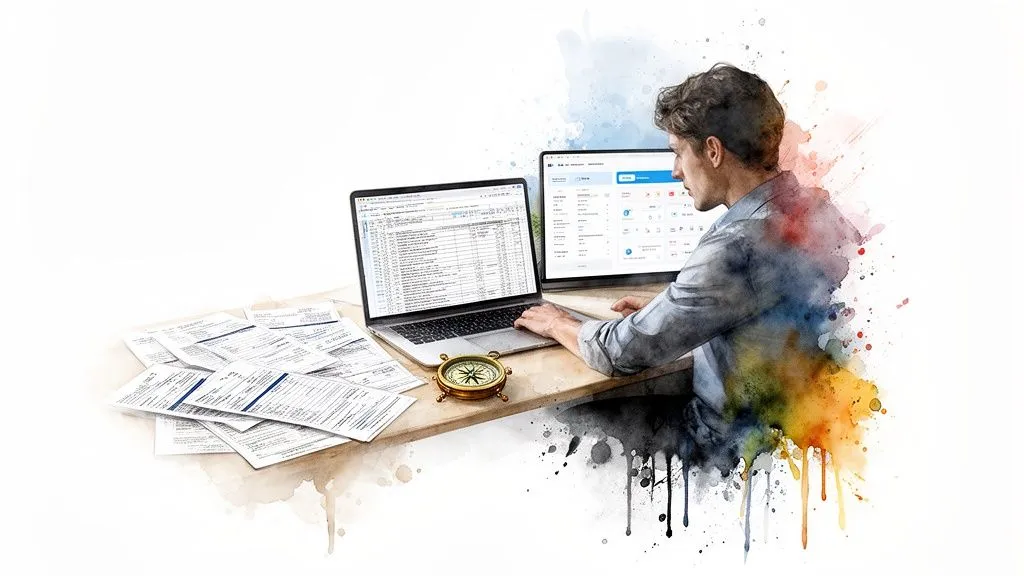
For a sole trader starting out today, time is gold. Yet many find themselves drowning in administrative tasks that are a genuine brake on their growth. Repetitive manual data entry, the anxiety of forgetting a legal mention on an invoice, the fear of crossing a threshold without even noticing… all of this is a very real source of stress. Even with a mastery of advanced Google Sheets formulas, a spreadsheet remains a passive tool. It cannot, for instance, actively check that you’re in compliance.
The hidden cost of manual management
Switching to accounting software for sole traders is not an expense, it’s an investment. An investment in your efficiency and, above all, in your peace of mind. The numbers speak for themselves: creating an invoice takes only 2 minutes with a good tool, versus nearly 15 minutes when done by hand. On top of that, this software makes sure all mandatory mentions are present and securely archives your documents for the required 10 years.
Did you know? Only 32% of sole traders use invoicing software. That means the vast majority are still exposed to errors that could easily be avoided, and to a considerable mental load, even though solutions are readily available.
The market is full of tools designed with us in mind, with features that go well beyond simple invoice creation: real-time threshold tracking, alerts before you cross a limit, bank synchronization… To better understand why a dedicated tool can be a game changer, take a look at our comparison on accounting on Excel for sole traders. You’ll see how to turn this administrative chore into a genuine growth lever for your business.
Breaking down a sole trader’s accounting obligations
The sole trader status is appealing for its simplicity, but be careful: administrative simplicity doesn’t mean an absence of rules. Your accounting obligations, while lighter than those of a traditional company, are very real and non-negotiable. Picture your management as a structure resting on three pillars: if one of them wobbles, your entire business is at risk.
These three pillars form the foundation of your legal and financial compliance. Neglecting them means exposing yourself to costly errors and considerable stress. Fortunately, good accounting software for sole traders can handle almost all of these tasks for you.
Invoicing, a clearly defined obligation
Every sale or service provided to a business client must result in an invoice. And it’s not just a simple piece of paper. Every invoice must contain a precise list of mandatory mentions: date, unique sequential number, your identity, the client’s identity, and so on.
A simple omission or a numbering error can be enough to invalidate your invoice during an audit. A dedicated invoicing tool saves you from this headache by generating flawless documents in a few clicks, with guaranteed chronological numbering and not a single gap.
Keeping a revenue ledger and issuing compliant invoices isn’t optional, it’s a legal obligation. Specialized software turns this constraint into a simple formality, giving you peace of mind and compliance.
The revenue ledger, the logbook of your business
This document is the heart of your accounting. You must record chronologically all the revenue you’ve received, specifying its origin and payment method. The law is clear: this ledger must be kept without blanks or corrections, making it “tamper-proof” for the authorities.
Forget the paper notebook where entries can be crossed out, or the endlessly editable Excel file. Good software records every transaction securely and immutably. Even better, when you mark an invoice as paid, it updates your revenue ledger instantly. It’s simple, automatic, and fully compliant.
Revenue declaration and a dedicated bank account
Whether monthly or quarterly, you’re required to declare your revenue to URSSAF for the calculation of your social contributions. The smallest error can lead to penalties. Accounting software gives you this exact figure in real time, sparing you from risky last-minute calculations.
Finally, as soon as your revenue exceeds €10,000 for two consecutive years, you must open a bank account dedicated to your business. This clean separation between your business and personal finances is a healthy practice, one that many software tools make much easier thanks to bank synchronization.
What features are actually essential?
Faced with a jungle of accounting software, every provider claims to be “complete” or “all-in-one.” But let’s be honest, what do you really need on a daily basis? Instead of drowning in endless feature lists, the goal is to focus on what will actually save you time and, above all, peace of mind.
Think of your future software as a toolbox. Having fifty screwdrivers is great, but if you don’t have the right hammer, you won’t get far. The goal, then, is to find the tool that’s perfectly calibrated for your business — the one that solves your most common problems without burdening you with superfluous options.
To help you see things more clearly, let’s start at the very beginning: the decision to move from manual management to software. This infographic sums up the situation perfectly.
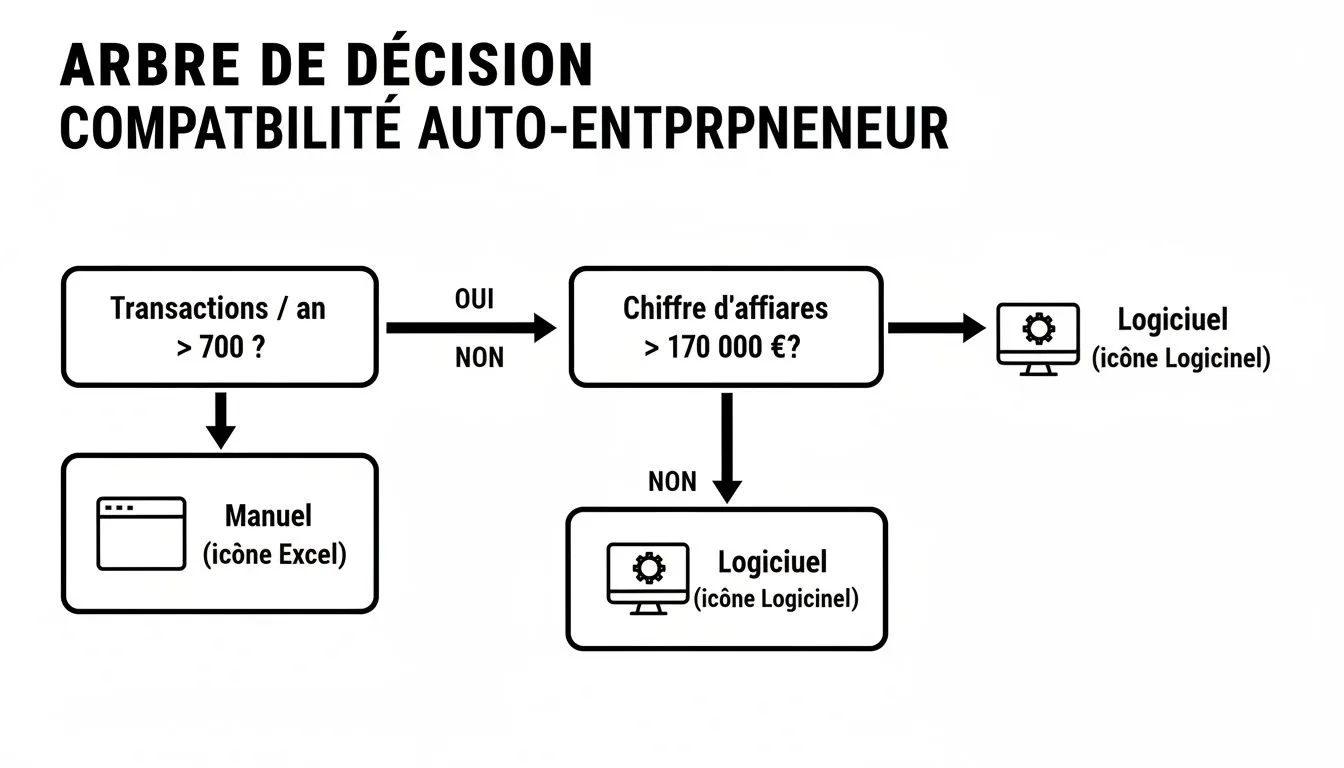
The key takeaway is that as soon as your business gains a bit of momentum, even slightly, software quickly becomes the only reasonable option for staying in control efficiently and securely.
To guide you, here’s a summary table of the key features to examine closely, followed by a more detailed explanation.
Comparison of key features of software for sole traders
This table compares the essential features, their practical use, and points of caution for a sole trader, particularly in the e-commerce sector.
| Feature | Main benefit | Essential for whom? | Point of caution |
|---|---|---|---|
| Smart dashboard | Real-time revenue tracking and threshold alerts (revenue and VAT). 360° view. | All sole traders, without exception. | Alerts must be automatic and configurable. A simple revenue display isn’t enough. |
| Bank reconciliation | Connect your business bank account to match transactions, invoices, and expenses. | Those with more than 10 to 15 transactions per month. | Synchronization must be stable and compatible with your bank. Matching suggestions must be relevant. |
| VAT & One-Stop Shop (OSS) management | Automatic calculation and application of VAT based on the customer’s country (EU). | E-commerce sellers selling to consumers in Europe. | The software must correctly identify the customer’s country and pre-fill the OSS declaration to avoid errors. |
| FEC export | Generate the Accounting Entries File, a standardized mandatory format. | Everyone. It’s a legal safeguard and proof of professionalism. | The export must be one click away and guaranteed compliant with tax authority standards. |
This table highlights the pillars of good management. Let’s dig a bit deeper to understand why these points matter so much.
The dashboard: your control tower
The first thing you’ll see when you log in is the dashboard. It’s much more than a simple revenue counter. A good dashboard acts as a co-pilot: it must automatically alert you when you’re approaching revenue thresholds or, even more important, VAT thresholds.
No more stressing over calculating where you stand each month. The software watches out for you and sends a notification, giving you time to calmly prepare for the switch to VAT. It’s the whole difference between reacting under pressure and steering your business proactively.
Bank reconciliation: your anti-hassle weapon
Bank reconciliation simply means verifying that every movement on your bank account matches an issued invoice or a recorded expense. On paper, it sounds simple. In practice, it’s a time-consuming task and a major source of errors when done by hand.
Good accounting software for sole traders should therefore offer smooth bank synchronization. In practice, it connects to your business account, retrieves transactions, and suggests linking them to the right invoice in one click.
Automated bank reconciliation turns what used to be a chore taking several hours a month into a simple validation that takes a few minutes. It’s one of the features with the most immediate return on investment in terms of time saved.
Managing international VAT (OSS) for e-commerce sellers
Here we touch on a crucial point. If you sell products or services to consumers in the European Union, this feature is simply non-negotiable. Managing VAT through the One-Stop Shop (OSS) manually is a real headache.
High-performing software, especially one designed for e-commerce like Bizyness, must be able to:
- Identify the country of each of your customers.
- Automatically apply the correct VAT rate for the destination country.
- Compile all this information to pre-fill your OSS declaration.
Without this automation, you’d find yourself juggling dozens of different VAT rates and compiling scattered data. The risk of error is enormous.
Accounting export: a safeguard for the future
Even if you handle everything yourself today, the day may come when you need to pass your figures on to an accountant or the tax authorities. That’s where exporting the Accounting Entries File (FEC) comes in.
Your software must be able to generate this file, in a standardized, official format, in a single click. It’s the guarantee that your accounting is clean, readable, and usable by any professional. It’s a mark of seriousness and essential peace of mind for the future of your business.
Getting ahead of the e-invoicing revolution
A major reform is on the horizon, and believe me, it will deeply change the way every sole trader handles invoicing. This isn’t just a minor technical tweak, it’s a real shift. It’s best to prepare for it now so you’re not caught off guard.
Picture this: the rules of the game are changing completely. Today, a simple PDF sent by email does the job. Tomorrow, that will be over. The new standard is what’s called the e-invoice, a document in a precise format that computers can read and process automatically.
Understanding the new invoicing standard
It’s not just a matter of format. The law will soon require us to go through state-certified platforms to send and receive invoices between businesses. The goal is clear: modernize management, make VAT filings easier, and, of course, fight fraud more effectively.
A simple PDF sent by email will soon no longer be considered a valid invoice in the eyes of the law. The reform imposes a structured format (such as Factur-X) and requires going through an approved platform, radically changing processes for everyone.
In practice, the reform will roll out in two stages. Starting September 1, 2026, all sole traders who charge VAT will need to be equipped to receive e-invoices. A year later, from September 1, 2027, they’ll be required to issue their own invoices following this new system. For more clarity, we recommend our guide to e-invoicing for sole traders.
Choosing accounting software for a sole trader that’s already ready for this reform is therefore not a constraint, but a genuine strategic choice. It means giving yourself a smooth transition, without last-minute stress. To better gauge the impact of this change, feel free to check out this comprehensive guide to invoicing for 2026.
Getting ahead of the curve means giving yourself a head start. While some will discover everything in a rush, you’ll already be fully operational. You’ll have a tool in hand that not only keeps you compliant, but also already simplifies your day-to-day management. Adopting the right software now simply means investing in the peace of mind of your business.
Choosing the right software for your e-commerce business
If you sell online, your day-to-day looks nothing like that of a consultant or a craftsperson. You’re constantly juggling orders on Shopify, sales through Amazon, customers scattered across Europe… and VAT management that can quickly turn into a nightmare. Your sole trader accounting software needs to be much more than a simple invoicing tool. It needs to become the true control center of your business.
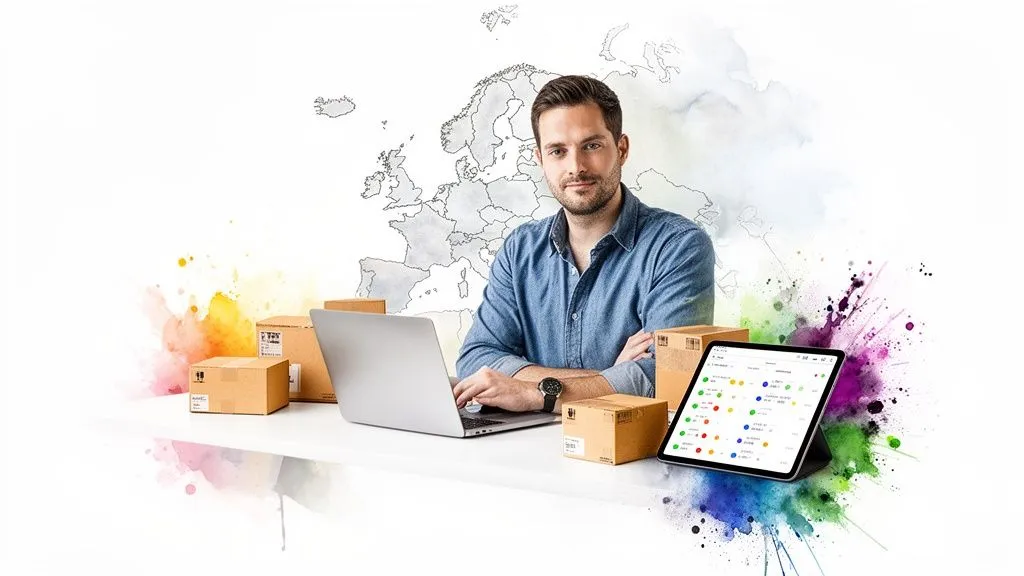
Selling online means generating a huge, and often scattered, volume of data. Every order is a transaction that needs to be recorded, invoiced, and accounted for correctly. Doing it by hand isn’t just a monumental waste of time, it’s also an open door to costly errors, especially when it comes to VAT.
Integration, the non-negotiable point
For an e-commerce seller, the first selection criterion is clear: native integration with your sales and payment platforms. Good software must be able to connect directly to your Shopify or WooCommerce store, as well as to your Amazon, Stripe, and PayPal accounts.
This connection changes everything:
- Full automation: Every new order automatically triggers the creation of a compliant invoice, without you having to lift a finger.
- Data centralization: All your revenue sources are gathered in one place. You finally get a clear, real-time view of your revenue.
- Perfect synchronization: Customer information, products sold, and amounts are captured without a single data entry error.
This automated approach is simply vital. The market for freelance management tools is booming, moreover. There were 3.186 million active sole traders in 2025, and yet a large share still rely on manual methods. This trend toward automation clearly shows that entrepreneurs are becoming aware of the importance of saving time and making their management more reliable. You can take a look at the figures behind this trend in the latest URSSAF statistics.
Managing international VAT without the headache
If you sell to consumers in the European Union, managing VAT through the One-Stop Shop (OSS) is mandatory. This is precisely where specialized software like Bizyness shows its full power. It doesn’t just connect to your stores, it intelligently analyzes every sale.
Software designed for e-commerce automatically identifies the destination country of each customer. It then applies the correct VAT rate and consolidates all this data to pre-fill your OSS declaration. What used to take hours becomes a simple formality that takes just a few clicks.
This intelligence is what turns a basic invoicing tool into a true financial partner. To go further on this topic, we strongly recommend reading our comprehensive guide on accounting specific to e-commerce, which covers all these crucial aspects in detail. Choosing a solution built for online selling simply means making sure your accounting keeps pace with your growth, without ever becoming a bottleneck.
Your questions about accounting software
Still hesitating to take the leap? That’s completely normal. To help you see things more clearly and make the right decision, we’ve gathered the questions that come up most often among sole traders. Here are clear, straightforward answers.
Is accounting software really mandatory?
No, on paper, the law doesn’t require the use of accounting software for a sole trader. However, it does require an impeccable revenue ledger and the issuance of 100% compliant invoices.
Faced with these obligations, software quickly becomes the simplest and most reliable solution. It ensures you’re in compliance without having to spend hours on it. It’s a bit like an anti-stress guarantee that automates compliance.
By the way, with the arrival of mandatory e-invoicing, expected in 2027, going through an approved platform will be unavoidable for invoicing your business clients. Getting ahead of this shift now is simply good strategy.
Can I just keep using Excel?
At the very start, yes, it’s technically possible. But over the long term, it’s a fairly risky bet. A simple spreadsheet like Excel cannot guarantee the compliance of your invoices, the immutability of your revenue ledger, or automatic tracking of your VAT thresholds.
The math is simple: every additional euro of revenue increases the risk of human error and the time you lose on manual management. Specialized software eliminates this risk by securing and automating the entire process.
How can software help me with international VAT?
This is where the magic happens, especially for a tool designed for e-commerce. High-performing software connects directly to your store, whether it’s Shopify, WooCommerce, or another platform.
For every order, it automatically identifies the customer’s destination country and applies the correct VAT rate. All this information is then centralized to make your life easier when it’s time to file your One-Stop Shop (OSS) declaration. A task that could quickly become a headache turns into a simple formality.
Shift into a higher gear and let technology handle your accounting. With Bizyness, every sale becomes a clear, compliant accounting entry, without you having to lift a finger. Discover the solution built for online sellers.
