

 Français
 Which bank should you choose as a sole trader
Find the best bank for your sole trader business. Our complete guide compares offers to help you choose the ideal account for your activity.

Choosing the right bank for your sole trader business is far more than a simple formality. It’s a decision that lays the foundation for sound, stress-free management. Separating your personal and professional finances is absolutely essential, both for day-to-day clarity and to stay compliant.
Why a dedicated account is the cornerstone of your micro-business
Launching your business is a bit like putting a boat to sea: to sail far, you need a solid hull. That dedicated bank account is exactly the hull of your entrepreneurial ship. It’s not just another piece of paperwork, but a genuine dashboard for steering your business with precision.
Picture the headache of filing your returns: hundreds of transactions where weekly groceries, client payments, and social security contributions all blend together. A real nightmare! A dedicated account turns that potential chaos into perfect clarity.
Simply clearer management
By isolating your business cash flows, you get an immediate overview of your company’s financial health. At a glance, you know exactly where you stand: your revenue, your business expenses, and what’s left in cash. This organization is what will make your life easier, especially for bookkeeping and tax tracking.
This separation is also essential for operations like bank reconciliation. To learn more on this topic, our guide on automatic bank reconciliation shows you how to automate this task and save a huge amount of time.
Having a dedicated account is the first move of a true professional. It protects your personal assets in case of trouble and boosts your credibility with clients and partners.
A clearly defined legal obligation
Sole trader status is thriving! There were more than 2,500,000 active self-employed workers in France in 2023. Faced with such success, the law had to adapt.
Opening a dedicated bank account becomes mandatory once your revenue exceeds €10,000 per year for two consecutive years. This rule was put in place to ensure transparent management and make administrative checks easier. If you want to dig deeper into offers designed for freelancers, you can explore the information from La Banque Postale.
Choosing the right bank for sole traders is therefore a strategic decision that will directly impact your efficiency and peace of mind.
Demystifying the bank account’s legal obligations
Starting out as a sole trader is a bit like learning a new language. At first, the administrative jargon can seem complex, especially when it comes to bank accounts. But don’t panic, the rules of the game are much simpler than they appear. The real question is: do you need a “dedicated” account or a “business” account?
The PACTE law came to clarify things. The obligation to open a bank account entirely reserved for your business only applies if your annual revenue exceeds €10,000 for two consecutive years.
If you’re below that threshold, you’re allowed to use your personal current account. Be careful though: this is a practice I strongly advise against. Mixing your personal and business expenses is the perfect recipe for headaches when it’s time to do your accounts.
Dedicated account or business account, what’s the real match-up?
Once you cross that famous €10,000 threshold, two options are available to you. It’s essential to weigh the pros and cons carefully to make the wisest choice for your business.
The dedicated account is simply a standard current account that you decide to use exclusively for your micro-business. Its big strength? Cost. It’s often very low, or even free, especially if you turn to online banks. It fully meets the legal obligation to separate your transactions.
The business account, on the other hand, is a formula designed specifically for professionals. Even though it isn’t mandatory for a sole trader, it comes with services that can genuinely change your daily life.
Think of the dedicated account as an excellent Swiss Army knife: versatile and covers the essentials. The business account is the craftsman’s complete toolbox, designed to make you more efficient and bring you real peace of mind.
To make an informed choice, nothing beats a summary table. Here are the fundamental differences between the two options.
Quick comparison: dedicated account vs. business account
| Feature | Dedicated account (personal) | Business account |
|---|---|---|
| Legal obligation | Sufficient to comply with the law | Not mandatory, but recommended |
| Cost | Very low, or even free | Monthly, averaging €5 to €40 |
| Payment collection methods | Transfers, cheques, sometimes a card reader | Transfers, cheques, card reader, payment links |
| Included services | Basic (card, transfers) | Invoicing tools, accounting, insurance |
| Support | General customer service | Dedicated business advisor |
| Financing | Limited, or even impossible | Easier access to business loans and overdrafts |
This table makes it clear: the choice really depends on your needs and your ambitions for your business. The dedicated account is a simple, cost-effective entry point, while the business account is a true growth partner.
This infographic sums up perfectly why a bank suited to your status is a strategic decision, not just a constraint.
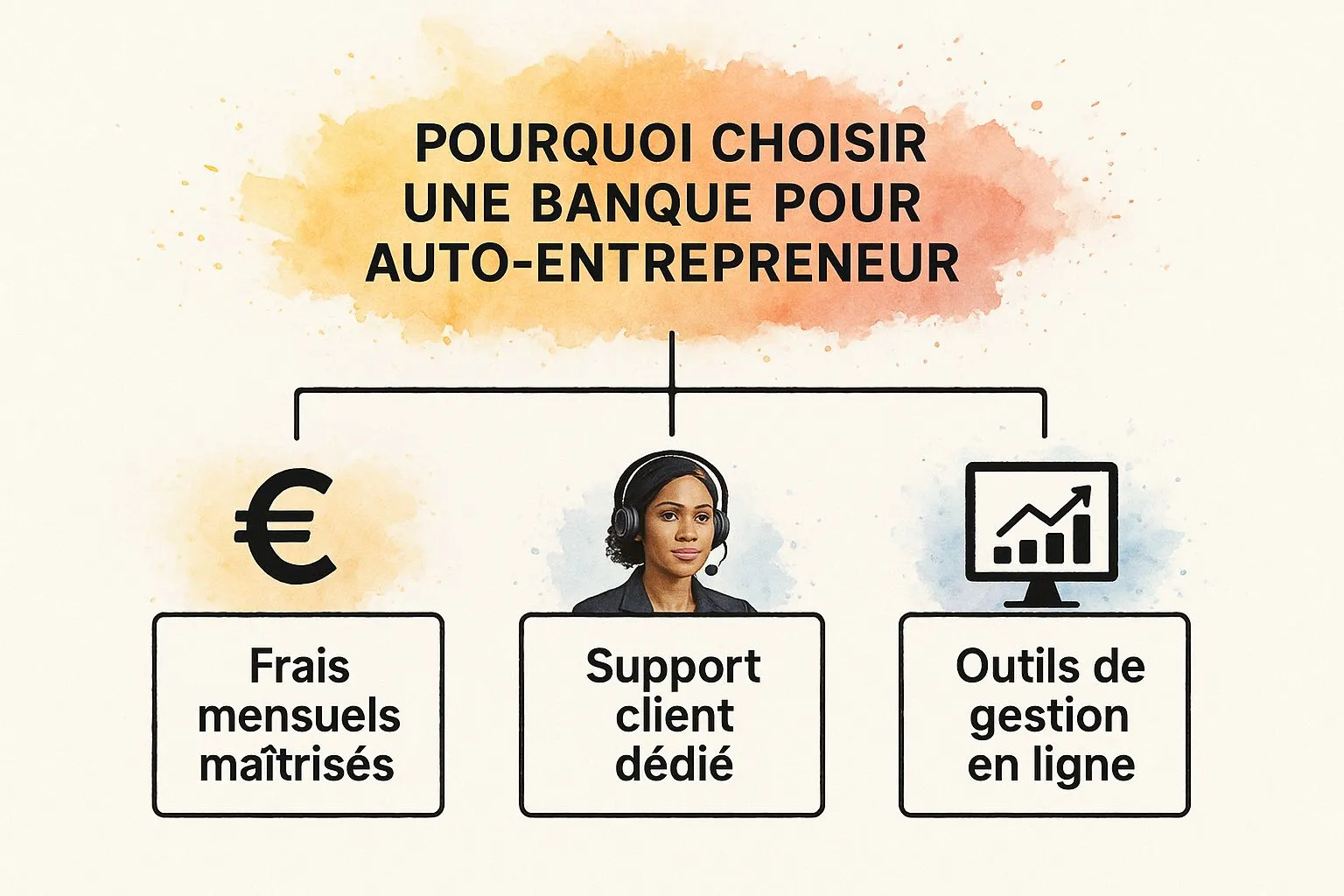
As you can see, controlled fees, support that understands your challenges, and management tools designed for you are the three pillars of a banking offer that will save you time and money.
The concrete benefits of a business account
Going beyond a simple dedicated account means investing in the future of your business. Concretely, here’s what you gain by switching to a business offer:
- Payment collection methods that make life easier, such as a card reader (payment terminal) so you never have to turn down a card sale again.
- Management tools that save you precious time. Many business banks include software to create quotes and invoices in a few clicks.
- Support that makes the difference. Your advisor knows the challenges faced by the self-employed and can suggest relevant solutions.
- Financial products tailored to your business, such as professional insurance, equipment financing solutions, or more flexible overdraft facilities.
Keeping a clear separation between your finances is also a matter of administrative clarity, a pillar of good business management. If this topic interests you, take a look at our article explaining how to properly keep your accounting records so you’re always at ease in case of an audit.
How to find the perfect bank for your business?
Choosing a bank for your sole trader status isn’t just about opening an account. It’s a bit like choosing a co-pilot for your entrepreneurial journey. You need to find the right partner, one that will simplify your life without costing you an arm and a leg. To do that, you need to run a little investigation and scrutinize each candidate.
Let’s look together at how to break down the offers, beyond the marketing gloss. The idea is to arm yourself with a solid checklist to make an informed choice, perfectly suited to your reality as a freelancer or craftsperson.
Decoding the pricing grid
The first instinct is to look at the price of the monthly subscription. Logical. But be careful, that’s often just the tip of the iceberg. Banking fees are a whole ecosystem, and the bill can quickly climb if you don’t read the fine print.
For a proper analysis, you need to scrutinize several key points.
- Account maintenance fees: This is the entry ticket, the monthly or annual subscription. Take a look at free offers — they’re often conditional on a certain number of card uses.
- The cost of the bank card: Is it included? What are the payment and withdrawal limits, and are they enough for you? A deferred debit card can be a real breath of fresh air for managing your cash flow precisely.
- Fees on everyday transactions: Look closely at the cost of SEPA transfers (usually free, but not always), direct debits, and, above all, transfers outside the SEPA zone if you have international clients.
- Movement commissions: This is a red line. These fees, calculated as a percentage of your debits, are a practice from another era. Make sure they’re set to zero in your contract. This is very rare for sole traders, but vigilance is required.
Think of banking fees like an iceberg. The subscription price is the visible part. But all the ancillary fees (incidents, special transactions, etc.) form the much more dangerous submerged mass.
Assessing the tools and services you’ll use every day
A bank isn’t just a place where your money sleeps. It’s above all a toolbox you’ll open very often. The quality and relevance of these tools are therefore absolutely essential selection criteria.
If you collect card payments, the electronic payment terminal (card reader) becomes a central topic. Don’t just look at the purchase or rental price of the device. What matters most is the commission rate charged on each transaction. A difference of 0.2% may seem minor, but across your entire annual revenue, it quickly adds up to a tidy sum.
The interface’s ergonomics are just as crucial. The mobile app and website should be smooth, intuitive, and reliable. Ask yourself: can I export my statements easily? Categorize my expenses in one click? Receive real-time notifications for every incoming or outgoing payment? These small details change everything on a daily basis.
Analyzing the services that truly make the difference
Finally, certain additional services can turn a banking offer from “adequate” into a “true ally for your growth”. These are the small extras that often distinguish an excellent bank for sole traders from a merely functional one.
Here are a few gems to look for:
- Built-in invoicing tools: Some neobanks let you create and send quotes and invoices directly from your client portal. A monumental time saver.
- Financing solutions: Does the bank offer micro-loans, overdraft facilities, or loan options designed for the self-employed? Anticipate tomorrow’s needs.
- Professional insurance: It’s not uncommon to find Professional Civil Liability (RC Pro) or legal protection offers at negotiated rates for customers.
- Cheque and cash deposits: If your business involves handling physical money, check the terms carefully. This is often the Achilles’ heel of 100% online banks.
And never forget: responsive, competent customer service is a service in its own right. Being able to easily reach an advisor who understands the specifics of your status, whether by phone, chat, or email, is priceless. It’s a real guarantee of peace of mind. Don’t hesitate to test it out before signing anything at all.
Comparing the best banks for sole traders
Now that you know exactly what to look for, it’s time to dive in. The banking market for sole traders splits into two distinct camps, each with its own philosophy: on one side, agile neobanks, and on the other, well-established traditional banks.
Your choice will depend on how you work, your priorities, and what you envision for the future. It’s a bit like choosing a vehicle: do you need a small electric scooter, perfect for weaving through the city at low cost, or a comfortable sedan with full service, ready for long trips? Let’s analyze together which route suits you best.
Neobanks and online banks: the choice of agility
Players like Shine or Qonto (the neobanks) and Boursorama or Hello bank! (the online banks) have completely shaken up the landscape. Their promise is simple and effective: a 100% mobile experience, ultra-competitive rates, and account opening that takes just a few minutes from your couch.
For a sole trader just starting out, this is often the most appealing solution.
- Unbeatable rates: Many offers start at €0 per month or for less than €10. For that price, you get an account, a bank card, and basic operations are included.
- Disarming simplicity: The apps are designed to be intuitive. Everything is at your fingertips, from checking your balance to exporting statements for your accountant.
- Life-simplifying tools: Most include handy features such as creating quotes and invoices, calculating VAT, or even help with your URSSAF filings.
That said, this model does have its limits. Depositing a cheque or cash can quickly become a headache, or simply be impossible. Also, customer service is entirely digital (chat, email), which can be frustrating if you’re facing a complex problem and need an immediate answer.
Neobanks are the perfect partner for digital freelancers, consultants, or e-commerce sellers. In short, all those whose financial flows are digital and who are primarily looking for cost-effective efficiency.
Traditional banks: the choice of support
Retail banks (Crédit Agricole, BNP Paribas, Société Générale…) haven’t stood still and have adapted their offers for the self-employed. Their main asset remains the human touch and the proximity of a physical branch you can walk into.
Their real strength lies in a much richer range of services.
- A dedicated advisor: Having a point of contact who knows your file, your sector, and the challenges of your business is a valuable asset. Especially when you have development plans.
- Financing solutions: Access to a business loan, a more comfortable overdraft facility, or leasing is much simpler than with a neobank.
- A full range of services: They offer solutions for your business savings, investing your cash reserves, or comprehensive insurance tailored to your needs.
- Cash and cheque management: Deposits are simple and quick thanks to the network of branches and ATMs.
Naturally, this level of service comes at a cost. Monthly fees are higher, generally ranging between €15 and €40.
The dynamism of entrepreneurship in France is, moreover, impressive. The country recently hit a record with 1,111,200 new businesses, of which 64.5% are micro-businesses. This wave, driven by young people (nearly 39% of founders are under 30), clearly shows the need for suitable banking solutions. If this trend interests you, you can check the analysis on entrepreneurship in France.
Summary of banking offers for sole traders
To help you visualize at a glance which family of banks might suit you, here’s a summary table. It highlights the strengths and weaknesses of each model.
| Bank type | Main advantages | Potential drawbacks | Ideal sole trader profile |
|---|---|---|---|
| Neobank / Online | Very low rates, built-in management tools, smooth mobile experience. | Limited cheque/cash deposits, no physical advisor, harder financing. | Digital freelancer, consultant, e-commerce seller, 100% online business. |
| Traditional bank | Dedicated advisor, access to credit, branch network, full services. | Higher rates, less innovative digital tools, slower processes. | Craftsperson, shopkeeper, professional practice, business with physical payments or growth plans. |
Ultimately, there’s no “best” choice in absolute terms, only the one best suited to your reality. Take the time to weigh the pros and cons based on your business and your ambitions.
Steps to open your bank account, hassle-free
Does the mere thought of paperwork stress you out? Take a deep breath. Opening a bank account dedicated to your sole trader business is nowadays a much simpler and faster process than you’d think, especially with online banks. The process has been designed to be efficient.
Think of it like a recipe: if you prepare all the ingredients in advance, the dish comes together in a flash. It’s exactly the same here. Having the right documents on hand is the key to a quick account opening.
Gathering the necessary documents
Even before clicking “Sign up,” take five minutes to gather your supporting documents. This is really the step that, if well prepared, will save you precious time.
Here’s the list of documents you’ll definitely be asked for:
- A valid ID document: national ID card, passport, or residence permit. A quick check to make sure it hasn’t expired, and you’re good to go.
- A recent proof of address: an electricity, gas, water, or even phone/internet bill less than 3 months old will work perfectly.
- Your SIRET number: this is your micro-business’s registration number. If you’ve just launched, you’ll receive it by mail from INSEE.
Having these three documents ready will make the whole process incredibly smoother.
A friendly tip: Take sharp, well-lit photos of your documents with your smartphone. Watch out for glare, shadows, or cut-off edges. A blurry photo is the number one cause of delays in validating your application.
Following the opening procedure
Once your documents are ready, the rest is a mere formality, generally unfolding in three steps. Most banks, whether traditional or online, follow a very similar pattern.
- Fill out the online form: You’ll be asked for your personal and professional information. Standard stuff.
- Upload your supporting documents: This is where your preparation really pays off! All that’s left is to drag and drop the files.
- Verify your identity: This is often done via a short video call or by taking a dynamic selfie to prove it’s really you.
Once everything is submitted, the bank reviews your application. Validation can take anywhere from a few hours to a few days. As soon as it’s approved, you receive your bank details and can start using your account.
This administrative organization is crucial, just like properly managing your tax documents. To go further, feel free to read our article on the tax certificate for sole traders, another essential document to know about.
Choosing a bank that will grow with your business
Opening an account for your micro-business isn’t just about settling an administrative formality. It’s a strategic choice that will shape your future. Today, your needs may be simple, but your business will evolve. Your revenue, we hope, will grow.

The real question is therefore: will the bank you choose today still measure up tomorrow? It’s a bit like choosing a co-pilot for a long journey. You need someone reliable and agile, capable of adapting to the road’s unexpected turns. Tomorrow, you might need a bit of financing for equipment, more comprehensive professional insurance, or simply the ability to upgrade your account without endless paperwork.
This long-term vision is crucial, especially in France’s current context. Entrepreneurship is thriving, with very strong business creation momentum in sectors like transport, food service, or business services. If this interests you, you can check the figures on business creation momentum to get a sense of it.
Your bank isn’t just a manager of financial flows. Think of it as a potential ally for your ambition, a support capable of adapting to your success.
Frequently asked questions about the sole trader bank account
We know choosing a bank account for your business raises quite a few questions. Here are clear answers to the most common ones to help you see things more clearly.
Is a simple personal current account enough?
Technically, the law doesn’t prevent you from opening a second personal account for your business. It’s tempting, we agree.
But be careful, this is a false good idea. Nearly all traditional banks formally forbid it in their terms and conditions. For them, a personal account is for personal use, period.
The risk? One fine morning, your bank could decide to close your account without notice, blocking your transactions and paralyzing your business. To avoid this kind of cold sweat, it’s really best to go with an offer designed for sole traders.
And if I don’t comply with the dedicated account obligation, what do I risk?
If your revenue exceeds the €10,000 threshold for two consecutive years and you still don’t have a separate account, the main danger comes from the tax authorities.
In the event of an audit, the tax administration will have great difficulty untangling your business expenses from your weekend groceries. In doubt, and this is the worst-case scenario, it could consider every deposit into your account as business income. Hello, tax reassessment!
Beyond the tax risk, not having a dedicated account exposes you to management and filing errors. The peace of mind this account brings you is well worth the small administrative step of opening it.
How do I switch banks without a headache?
Good news: switching banks has become a breeze. Thanks to the bank mobility assistance service, your new bank can handle everything for you, free of charge, to transfer your recurring direct debits and transfers.
For your sole trader business, it’s even simpler. Just pass on your new bank details to your regular clients and, of course, to URSSAF for your contributions. Just remember to keep your old account open for a few weeks while everyone updates their records, then you can close it calmly.
To go further and truly simplify managing your micro-business, take a look at Bizyness. It’s a tool designed for us, the self-employed: it syncs your bank transactions, generates your invoices and quotes, and makes your filings easier. The idea is to free up your time so you can focus on your core business. Find out how at https://www.bizyness.fr.