

 Français
Your ready-to-use blank invoice template
Download a free, compliant blank invoice template in Word, Excel or PDF. Simplify your invoicing and ensure legal compliance with ease.
Stop wasting time building your invoices from scratch. Download our blank invoice template now, available in Word, Excel and PDF formats. These templates are ready to use and designed to make your life easier while meeting French legal requirements.
Why a good invoice template matters
Creating an invoice from scratch without a safety net is a bit like assembling furniture without instructions. You waste a lot of time, get frustrated, and risk making mistakes. Using a blank invoice template means choosing safety and efficiency.
It’s a simple habit that protects you against costly oversights. A missing legal notice, for example, can not only delay your client’s payment but also expose you to fines. A well-made invoice is the first building block of your professional credibility.
Save time and peace of mind
Every minute spent wrestling with columns and alignment on your invoice is a minute you don’t spend on your core business. A good template gives you a clear framework: all that’s left is to fill in the sale details.
The benefits are immediate:
- Ultra-fast creation: In a few minutes, your invoice is ready to send.
- Guaranteed compliance: All the important fields and legal notices are already there.
- A polished image: You present a clean, professional document that reassures your clients.

Which invoice template format should you choose?
So, Word, Excel or PDF? The right choice really depends on how you work and your preferred tools. To help you decide, here’s a quick comparison table summarizing the pros and cons of each format.
This table helps you choose the format best suited to your needs by comparing the strengths and weaknesses of blank invoice templates in Excel, Word and PDF.
| Format | Advantages | Disadvantages | Ideal for |
|---|---|---|---|
| Excel | Total and VAT calculations are automatic. Easy to copy for a new invoice. | The risk of accidentally deleting a formula is very real. The look can be less “professional”. | Entrepreneurs comfortable with spreadsheets who handle a reasonable invoice volume. |
| Word | Offers great freedom to customize the design and layout. | All calculations must be done by hand, which increases the risk of errors. | Those for whom visual appeal is essential and who want a unique invoice. |
| A non-editable format, which secures the document once sent to the client. | Once generated, it’s difficult to modify. Less flexible for last-minute adjustments. | The final version sent to the client. It’s the authoritative, professional and secure version. |
Ultimately, whichever format you choose, the key is to start from a solid, complete base. Many freelancers juggle formats: they prepare the invoice in Excel for the calculations, then export it to PDF to send to the client.
To dig deeper into the topic, take a look at our simple invoice template, which offers more tips for getting started.
Mandatory information for a properly issued invoice
An invoice isn’t just a piece of paper to claim money. It’s above all a commercial and legal document that seals an agreement between you and your client. Starting from a blank invoice template is an excellent idea, but you still need to know how to fill it in so it’s valid under the law.
The tax authorities don’t take this lightly. Every invoice must include a precise list of information, known as “mandatory notices”. If they’re missing or incorrect, you risk penalties. But beyond that, a poorly made invoice can create tension with your client and, above all, delay your payments.
Think of these notices as pieces of a puzzle. If one is missing, the picture is incomplete. It’s the same for an invoice: every piece of information plays its role, from identifying the parties to calculating VAT, so everything is transparent and compliant.
Clearly identifying who is selling and who is buying
The basis of any invoice is knowing who is who. It’s the first thing everyone looks at. This information must be crystal clear to avoid any confusion.
For you, the seller:
- Your full name or your company’s registered name.
- The address of your registered office, even if you work from home or elsewhere.
- Your SIREN or SIRET number, the unique registration number for your business.
- If applicable, your legal structure (for example, the mention “EI” or “Individual Entrepreneur” has been mandatory for micro-entrepreneurs since 2022).
For your client, the buyer:
- Their full name (or company name).
- Their address, which may be a specific billing address if it differs from the registered office.
- If they are a professional within the EU, their intra-community VAT number is essential for cross-border transactions.
A simple omission on these points can make your invoice invalid. Legally, your client would then be entitled to refuse payment until they receive a correct document.
This diagram clearly shows how an invoice is organized into three blocks for easy reading.
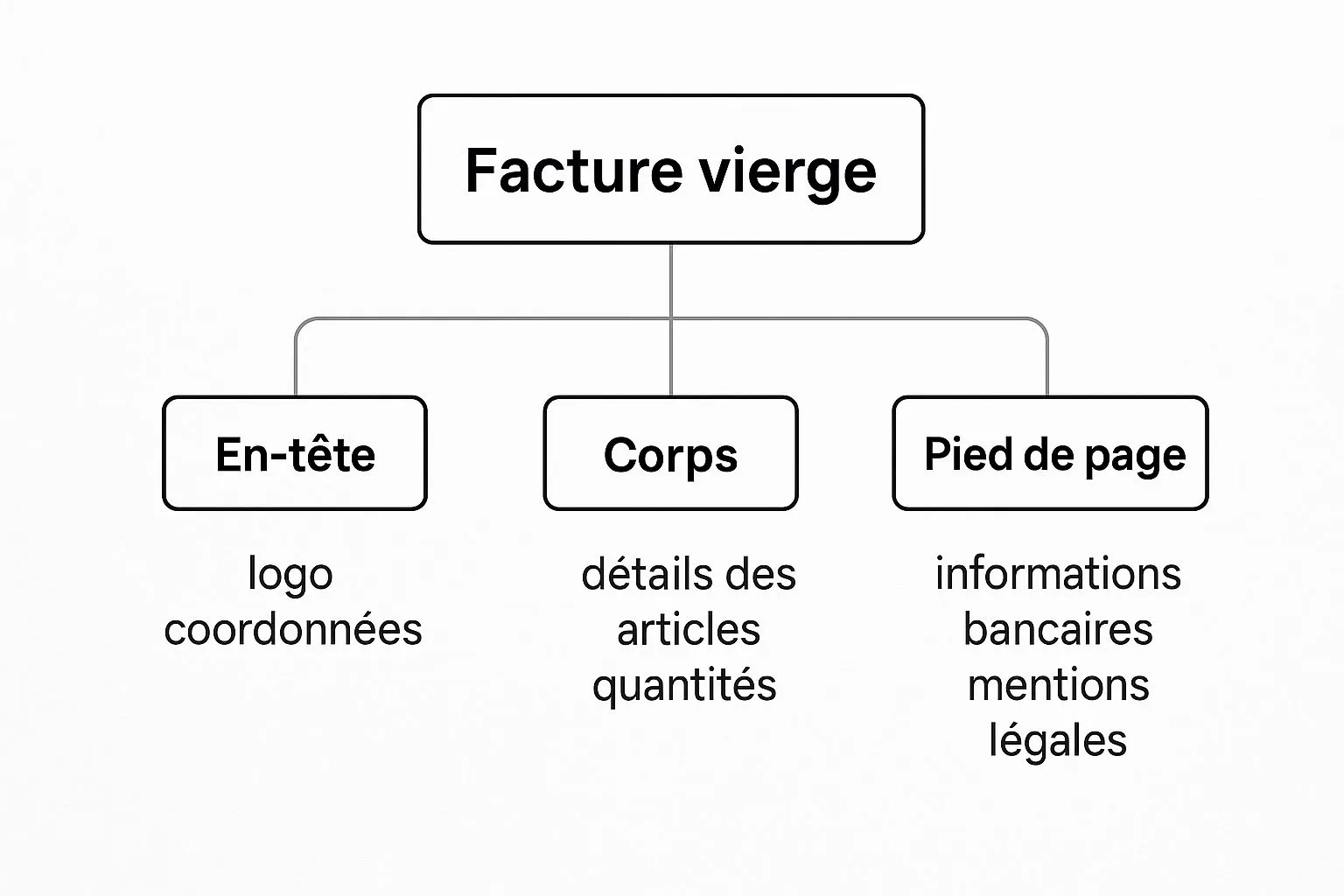
The logic is immediately clear: the header for identification, the body for detailing the sale, and the footer for everything related to payment and legal notices.
The details that validate the transaction
Once you know who the parties are, the core of the invoice must precisely describe what was sold. This is where you need to be rigorous to leave no room for doubt or potential dispute.
The invoice number is probably the most closely watched element. It must be unique and follow a logical sequence, with no gaps. You can opt for a simple format like “2024-001”, “2024-002”, and so on. What matters is that the sequence stays continuous. A break in the numbering is a red flag for the tax authorities.
French law requires an invoice to be issued for every sale between professionals. For individuals, it’s mandatory if the amount exceeds €25 including tax. This document must contain key information to secure the transaction and facilitate audits. To go further, take a look at our complete guide to mandatory invoice notices.
Here’s the other crucial information:
- Issue date: The day you issue the invoice.
- Date of sale or service: The day the work was completed or the product delivered.
- Detailed description: For each line, be precise. Indicate the nature of the product, its reference, or the details of the service.
- Quantity: The number of units sold.
- Unit price excluding tax: The cost for a single item or a single hour.
A classic mistake is being too vague. “Consulting service” doesn’t say much. Instead, write: “Digital strategy consulting - 5 hours - July 2024”. It’s clear, precise and unambiguous.
The financial breakdown and payment terms
Finally, the figures section must be absolutely clear. This guarantees you get paid correctly and on time, while staying fully compliant with VAT rules.
The calculation must clearly show:
- The total amount excluding tax.
- The applicable VAT rate(s) for each line, along with the total VAT amount. If you are not liable for VAT (for example, as a micro-entrepreneur), you must indicate this with the mention: “VAT not applicable, art. 293 B of the French Tax Code”.
- The total amount including all taxes. This is the sum your client must pay you.
Don’t forget the payment terms, which are just as vital:
- The due date or payment deadline (for example, “Payment due within 30 days net”).
- The late payment penalties you will apply if the deadline is missed.
- The amount of the flat-rate compensation for collection costs, set at €40.
Omitting this last information doesn’t remove your right to claim payment, but including it on the invoice strengthens your position in case of a dispute and encourages your client to pay on time.
How a simple clay tablet inspired our invoices
To truly grasp the importance of a blank invoice template and all the rules that surround it, we need to travel back in time. Much further than you might think. Forget software and computers — our story begins thousands of years ago, on the fertile lands of Mesopotamia.
Picture the merchants of that era, bartering sacks of grain, jars of oil or livestock. How could they keep track of these exchanges? How could they make sure no one forgot what they owed? The answer was as simple as it was brilliant: engrave the details of the transaction on a clay tablet.
These tablets were much more than a simple reminder. They represented the very first form of invoice, tangible proof of a commercial agreement. Each engraved symbol corresponded to a quantity, a product, an agreement. The foundations of accounting and trust in business had just been laid.
From the tablet to the law
This need to formalize commercial exchanges only intensified as societies became more complex. The very first traces of invoicing date back more than 5,000 years, around 3500 BC, in Mesopotamia. The famous King Hammurabi even made this system a cornerstone of his administration to better manage his kingdom’s economy. To learn more, you can read about the fascinating history of invoicing and its evolution.
The basic principle has never really changed: recording a debt on a durable medium so it isn’t forgotten. Over the centuries, clay gave way to papyrus, then to parchment, and finally to paper. Each technological innovation made invoicing easier, faster and more accessible.
An invoice is not just an administrative constraint. It is the legacy of a millennia-old quest for transparency, trust and proof in business relationships. Filling out a template today is, in the end, carrying on a gesture that founded commerce itself.
Yet despite the changes, the spirit has remained the same. The invoice has always fulfilled three key functions:
- Proving that a transaction took place: It’s the indisputable trace that a good was sold or a service performed.
- Detailing each party’s obligations: The seller commits to delivering what was promised, and the buyer commits to paying the agreed price.
- Serving as a basic accounting and tax document: Without invoices, it’s impossible to track a company’s financial health or correctly calculate taxes.
The invoice in the digital age
Today, we are living through a new stage in this long history with the imminent shift to mandatory electronic invoicing. This change may seem huge, but it actually fits into the continuity of this evolution. The goal remains the same: making exchanges safer, faster and more reliable.
In the end, the electronic invoice is nothing more than the modern version of the clay tablet. It guarantees the authenticity and integrity of information, while automating tasks that were once manual and time-consuming.
Understanding this past gives a whole new perspective. The mandatory notices, the numbering rules… none of this is administrative whim. It’s the result of centuries of adjustments to build a commercial system founded on trust. Your blank invoice template is therefore much more than a simple form; it’s an essential link in a chain connecting the merchants of antiquity to the entrepreneurs we are today.
Personalizing your invoice to strengthen your brand
A blank invoice template is an excellent starting point. But let’s be clear: it’s only a starting point. Think of it as a blank canvas. It’s functional, but completely impersonal. Yet every document you send to a client is a golden opportunity to make an impression and reinforce your image.
A well-thought-out invoice is not just a simple administrative slip. It’s an extension of your visual identity, a real vector of trust. By personalizing it, you turn a plain payment request into a polished, professional client experience.
This attention to detail shows that you’re thorough, which reassures your clients about the quality of your work. It’s the kind of thing that, without fanfare, sets you apart from the competition.
Incorporating your visual identity
The first step in making your invoice your own is adding elements of your brand guidelines. This creates immediate consistency with your other materials, like your website or business cards.
Here are the essentials to add:
- Your logo: The most powerful element for recognition. Place it prominently, usually top-left or centered in the header.
- Your brand colors: Use them for headings, totals, or even simple dividing lines. Be careful not to overdo it; a few subtle touches are more than enough.
- A readable font: If your brand has a signature font, make sure it stays easy to read, even at small sizes. Otherwise, a clean, classic font (like Arial or Calibri) will do the job perfectly.
The goal is simple: your invoice should be identifiable at a glance. When your client opens it, they should know it’s from you before they’ve even read your name.
Structuring information for clarity
A professional invoice is above all one that’s understood without effort. Good structure guides your client’s eye toward the essential information. The result? Easier approval and faster payment.
Beyond the mandatory legal notices, put yourself in the reader’s shoes. A dense, poorly laid-out document can quickly feel overwhelming and end up on a “deal with later” pile.
Here’s a perfect example of a well-structured invoice, where every piece of information naturally finds its place.
This example clearly shows how the use of white space, thin lines and visual hierarchy (bold headings, clearly visible totals) makes the whole document much easier to digest.
A clear invoice is an invoice paid faster. If your client understands everything at a glance, they have no reason to set it aside. Clarity is your best ally against late payments.
Adding elements to build loyalty and ease payment
Personalization isn’t limited to design. You can also use your blank invoice template to add strategic information. Although not mandatory, it will save you valuable time and improve your client relationships.
These small additions turn your invoice into a genuine tool for your client:
- Your bank details (IBAN/BIC): Probably the most important. By clearly displaying your IBAN, you save your client from having to ask you for it to make a transfer.
- Accepted payment methods: Specify whether you accept bank transfers, checks, online payments… This removes any ambiguity.
- A thank-you message: A simple phrase like “Thank you for your trust” or “Looking forward to working with you again” adds a much-appreciated human touch. It’s a small gesture that carries real weight in building loyalty.
- A link to your terms of sale: Rather than cluttering the invoice, insert a clickable link to the page on your website where your terms of sale are found.
By optimizing your invoice this way, you do much more than request payment. You facilitate the transaction, demonstrate your professionalism, and maintain a positive relationship with your clients. It’s a small investment for a genuinely significant return on image.
When free templates are no longer enough
Starting out with a blank invoice template in Word or Excel is a rite of passage for many entrepreneurs. It’s simple, immediate and, let’s be honest, free. For your very first jobs, it’s often the perfect solution.
But then your business grows. What was initially a valuable aid gradually becomes a real burden. Manual tasks that only took a few minutes start adding up and eat away a surprising amount of time. Time you’re not spending with your clients.
Imagine your business management as a small rowboat. At first, crossing a calm pond, paddling by hand is more than enough. But as soon as you head for the open sea and need speed, oars won’t cut it anymore. You need an engine. Invoicing software is exactly that: the engine that replaces the oars of your Excel template.
The pitfalls of manual management
The main flaw of a free template is its very nature: it’s a static tool that depends 100% on you. And that dependency opens the door to a whole range of risks that can, without you realizing it, weaken your business.
Data entry errors are without question the most common. A simple typo on an amount, an incorrectly applied VAT rate, a missing client reference… and it’s the start of endless back-and-forth with your client, delaying payment even further.
And beyond simple calculation errors, day-to-day tracking quickly becomes a headache:
- Tedious payment tracking: You have to manually check off each paid invoice, update a tracking spreadsheet, and above all remember due dates so you don’t miss an unpaid invoice.
- Inconsistent follow-ups: Spotting late payments requires constant effort. It’s so easy to forget to send a reminder, which directly impacts your cash flow.
- No overall visibility: With files scattered across your computer, it’s impossible to get a clear, real-time view of your revenue or know who your most profitable clients are.
The time you spend checking, correcting and tracking your invoices by hand is a hidden cost. It’s not just lost time; it’s a mental burden that keeps you from focusing on what really matters: growing your business.
Electronic invoicing: the game-changer on its way
But the biggest challenge for Word and Excel templates is no longer just a matter of productivity. It’s now a matter of compliance. A major reform is on track and about to completely change the rules of invoicing in France.
This shift toward mandatory electronic invoicing will simply make traditional invoice templates obsolete for exchanges between professionals. Soon, it won’t be enough to just send a plain PDF by email. The process will be much more regulated and secure.
In France, this reform is part of a broader modernization plan, and the government has chosen a specific system: the “Y model”. In practical terms, this means invoices will have to pass through certified partner platforms before reaching the tax authorities. By 2026, all business-to-business (B2B) transactions should be affected. To dive deeper into the topic, you can discover the details of electronic invoicing in France.
So, what does this change for you day to day?
- A mandatory file format: No more plain Word or PDF. Invoices will need to be created in structured formats (such as Factur-X, UBL, etc.) that contain machine-readable data.
- A regulated sending process: You will no longer send your invoices directly to your clients. They will have to pass through partner dematerialization platforms (PDPs) or the public invoicing portal (PPF).
- Full traceability: Tax authorities will have real-time visibility into invoicing flows, notably to better combat VAT fraud.
Anticipating this shift is essential. Continuing to rely entirely on a blank invoice template in Excel means risking being completely stuck once the reform becomes mandatory for you. Switching to a dedicated invoicing solution is no longer just a matter of convenience; it’s a strategic decision to secure the future of your administrative management.
Moving up a gear with invoicing software
Starting with a blank invoice template is a smart move. It’s free, it’s simple, and at first, it works perfectly well. But let’s be honest: as soon as your business grows a bit, this manual method quickly shows its limits. It can even become a real burden.
Switching to invoicing software like Bizyness isn’t a whim — it’s the logical next step for any entrepreneur who wants to secure their operations and boost efficiency. It’s the moment you decide to stop being at the mercy of paperwork and finally take control of it.
Investing in a dedicated tool pays off quickly. Not just in hours saved, but also in reduced mental load. You free up your mind to focus on what really matters: your business.
Automation, your best ally for productivity
The first obvious gain is automation. No more repetitive tasks draining your energy and time. No more risk of making a mistake copying an address or calculating VAT. The software works for you, with a precision you could never match manually.
In concrete terms, what does this change day to day?
- Perfect numbering: The software automatically assigns unique invoice numbers that follow a continuous, gap-free sequence. This is a legal requirement, and here, you’re certain to be in the clear.
- Data always ready: Your client records and your catalog of services or products are saved. To create an invoice, you just pick from your lists. A few clicks, and it’s done.
- Accurate calculations, every time: The pre-tax totals, VAT amounts, total including tax… everything is calculated instantly. The risk of calculation error drops to zero.
Payment tracking that will let you sleep at night
Every freelancer’s nightmare? Unpaid invoices. Good invoicing software turns this source of stress into a clear, controlled process. You finally get a real-time overview of your cash flow.
A good tool doesn’t just create invoices; it actively helps you get paid. It becomes your best ally for maintaining healthy, predictable cash flow.
Tracking becomes simple, almost effortless. At a glance, you see which invoices are pending payment, which are overdue, and which are settled. Some features even give you a head start, like email open tracking, which confirms your client has actually seen the invoice.
Even better, you can schedule automatic reminders. Polite but firm follow-ups are sent at the right time, without you having to think about it. It’s remarkably effective at reducing payment delays while preserving a good client relationship. For those just starting out, there are excellent free invoicing software options that already offer these key features.
In short, adopting software like Bizyness means choosing professionalization. It means staying compliant with the law at all times, drastically cutting down time spent on admin, and ultimately giving yourself the means to run your business with more peace of mind and efficiency.
Frequently asked questions about invoice templates
Getting started with invoicing inevitably comes with its share of questions, especially when starting from a blank invoice template. It’s a crucial step for any entrepreneur. To help you see things more clearly, here are the questions that come up most often on the ground.
The goal is to give you clear, practical answers so you can secure your administrative management from day one.
Can I really use a Word template for my micro-business?
Yes, technically, nothing stops you. It’s entirely legal, but be careful: there’s one non-negotiable condition — your invoice must include all the mandatory notices, and your numbering must follow a sequence with no gaps whatsoever.
Let’s be honest, this manual method is an open door to errors. A simple typo, a gap in the number sequence, a miscalculation… these happen more often than you’d think. This is why dedicated software is strongly recommended for peace of mind. It handles all the automation, guarantees your legal compliance, and saves you a huge amount of time.
What do I risk if my invoice isn’t compliant?
A non-compliant invoice really shouldn’t be taken lightly. The consequences are very real: you risk a tax fine of €15 for each missing or incorrect notice. The total fine can climb up to a quarter of the invoice amount.
But beyond the fine, the most direct risk is to your cash flow. Your client has the right to refuse to pay an invoice that doesn’t follow the rules. In the event of an audit, it can even lead to a tax reassessment. Compliance isn’t optional — it’s essential protection for your business.
Does electronic invoicing really concern me?
Yes, absolutely. It’s the future for everyone. Eventually, the major electronic invoicing reform will apply to all businesses subject to VAT in France for their business-to-business (B2B) exchanges.
This change is being rolled out progressively, and the obligation to issue electronic invoices will apply to all businesses, regardless of size, by September 2027. Getting ahead of the curve by choosing a tool like Bizyness now gives you a real head start. You’ll avoid managing this transition under pressure and secure an advantage for your business’s future.
Don’t let paperwork hold back your growth any longer. With Bizyness, you can automate your invoicing, secure your compliance, and free up valuable time for what really matters: your business. Discover how Bizyness can simplify your daily routine.
