

 Français
 Boost Your E-commerce Sales in 2025: 8 Key Tips
Discover how to boost your e-commerce sales in 2025 with 8 effective strategies to optimize your site, retain customers, and grow your revenue.
Boost Your E-commerce: The Ultimate 2025 Guide
Looking to boost your e-commerce sales? This guide presents 8 essential strategies to improve your results in 2025. Discover how to optimize your conversion rate, automate your email marketing, personalize the customer experience, leverage influencer marketing, improve your mobile presence, set up retargeting campaigns, build customer loyalty, and integrate artificial intelligence. Apply these techniques to drive your online growth.
1. Conversion Rate Optimization (CRO)
Conversion rate optimization (CRO) is an essential strategy for boosting e-commerce sales. It aims to improve the percentage of site visitors who take a desired action, such as making a purchase, signing up for a newsletter, or downloading an ebook. In other words, CRO focuses on turning more visitors into paying customers. This is crucial for the profitability of any e-commerce business, as it maximizes the return on investment of marketing and traffic acquisition efforts.
CRO relies on a methodical, iterative approach combining data analysis, A/B testing, and continuous improvement of the user experience. By understanding user behavior on your site, you can identify friction points that prevent them from completing a purchase and optimize those points to smooth out the customer journey. For example, a complex checkout process, a lack of product information, or unclear calls to action (CTAs) can negatively impact your conversion rate.
Key CRO features:
- A/B testing on product and checkout pages: Compare different versions of a page to identify which one converts best.
- Conversion funnel analysis: Identify the steps where visitors abandon the purchase process.
- Call-to-action optimization: Create compelling, persuasive CTAs.
- Improved loading speed: A fast site improves both the user experience and SEO.
- Simplified purchase process: Make the path from browsing to buying as smooth as possible.
Benefits of CRO:
- Monetizes existing traffic without additional acquisition costs: Optimizing what you already have is more cost-effective than constantly acquiring new visitors.
- Improves the overall user experience: A faster, more pleasant site encourages visitors to return.
- Measurable, quantifiable results: CRO lets you precisely track the impact of the changes you make.
- Direct impact on revenue: A higher conversion rate translates into more sales and revenue.
Drawbacks of CRO:
- Takes time to see significant results: Optimization is an ongoing process that requires patience.
- Requires technical and analytical skills: Data analysis and A/B testing require a certain level of expertise.
- May require investment in specialized tools: Some tools come at a cost, though they are often paid back by increased conversions.
CRO success stories: Airbnb increased its conversions by 30% by optimizing its booking process, demonstrating the powerful impact of CRO on major platforms. Unbounce improved its conversion rate by 41% by redesigning its pricing page, proving that even seemingly minor changes can have a significant impact. Obama’s 2008 presidential campaign generated an extra $60 million through A/B testing, illustrating the effectiveness of this technique in various contexts.
Practical CRO tips:
- Start by analyzing your current conversion funnel to identify weak points.
- Test one element at a time for reliable, interpretable results.
- Focus first on your highest-traffic pages to maximize the impact of your optimizations.
- Use tools like Google Analytics, Hotjar, or Optimizely to track data and run A/B tests.
The infographic below illustrates the conversion rate optimization process in three key steps: conversion funnel analysis, targeted A/B testing, and call-to-action (CTA) optimization.
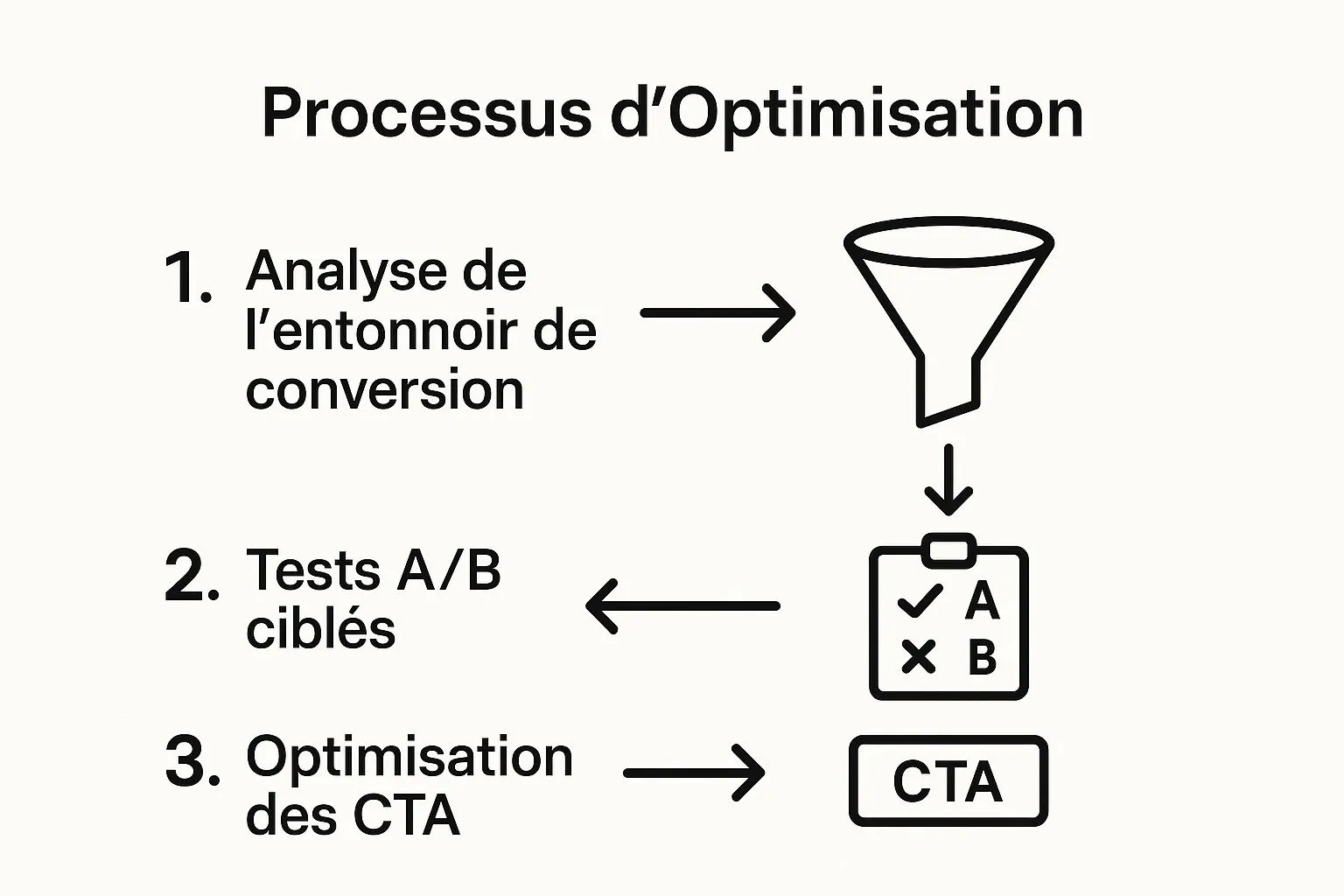
This diagram highlights the iterative nature of CRO: data analysis guides A/B testing, which in turn informs CTA optimization, and the cycle starts again for continuous improvement.
Learn more about Conversion Rate Optimization (CRO)
CRO is an essential strategy for boosting e-commerce sales. By optimizing the user experience and removing obstacles to conversion, you can maximize your site’s potential and generate more revenue. Whether you’re a sole trader, a small business, or a growing company, CRO is a cost-effective and sustainable approach to improving your e-commerce performance. CRO pioneers such as Bryan Eisenberg, Peep Laja (ConversionXL), and Tim Ash (SiteTuners) have widely popularized these techniques, demonstrating their importance for online success.
2. Automated Email Marketing
Automated email marketing is a powerful strategy for boosting e-commerce sales. It involves using pre-programmed email sequences triggered by specific user actions on your website. Imagine a customer who adds a product to their cart but doesn’t complete the purchase: an automated email reminding them of their abandoned cart can convince them to come back and finish the sale. That’s just one of many examples of the power of automation. This strategy helps maintain engagement, recover abandoned carts, build customer loyalty, and increase customer lifetime value (CLV) through personalized, timely communication. It also frees up valuable time to focus on other aspects of your business, all while working around the clock to nurture your prospects and customers.

In concrete terms, how does automated email marketing work? It relies on pre-defined scenarios. For example, when a new visitor signs up for your newsletter, they automatically receive a welcome email. If they add a product to their cart but don’t complete the purchase, a follow-up email sequence is triggered. After a purchase, follow-up emails can offer complementary products or special deals. The possibilities are endless and can be adapted to every stage of the customer journey.
Key features of automated email marketing include: automatic welcome emails, abandoned cart recovery, customer nurturing sequences (to guide prospects toward a purchase), personalized product recommendations based on browsing and purchase history, and optimization of transactional emails (order confirmations, etc.).
Among its undeniable benefits, the return on investment (ROI) is exceptional, estimated at $42 for every dollar invested on average. Once set up, the system runs autonomously, enabling personalization at scale and excellent customer retention. Companies like Amazon, Spotify, and Sephora use email automation successfully. Amazon generates 35% of its revenue from recommendation emails, Spotify boosts engagement with its personalized email playlists, and Sephora uses email automation for an omnichannel customer journey. Learn more about Automated Email Marketing for concrete examples of e-commerce marketing campaigns.
That said, it’s important to consider the drawbacks. Initial setup can be complex and requires a certain level of expertise. Poor configuration can lead to emails being flagged as spam, damaging your reputation. Additionally, the effectiveness of email marketing depends on a qualified email database and compliance with GDPR regulations.
To optimize your automated email campaigns and boost your e-commerce sales, here are a few practical tips:
- Segment your audience: Speak to specific groups with more relevant messages. For example, a customer who has already bought a product will receive different offers than a new prospect.
- Test different send times: Identify the ideal time to maximize your emails’ open and click-through rates.
- Personalize beyond the first name: Incorporate data such as purchase history or browsing behavior for more targeted recommendations.
- Track advanced metrics: Monitor key indicators such as customer lifetime value (CLV) and attribution to optimize your campaigns and boost e-commerce sales.
Automated email marketing is a powerful tool for sole traders, freelancers, SMEs, and anyone selling online. It automates a large part of customer communication, from prospecting to retention, and significantly increases sales while optimizing the customer experience. By following best practices and adapting strategies to your business, you can make the most of this essential e-commerce lever. Experts such as Ryan Deiss (DigitalMarketer), Ann Handley (MarketingProfs), and Chad White (Oracle) have widely popularized the effectiveness of this approach.
3. Personalization and Product Recommendations
In the competitive world of e-commerce, standing out and increasing sales is a constant challenge. Personalization and product recommendations, powered by artificial intelligence and data analysis, offer a powerful solution to this challenge. This strategy involves analyzing visitor behavior, purchase history, and preferences in order to offer relevant products at the right time. This creates a tailor-made shopping experience, significantly boosting sales and customer satisfaction, which fully justifies its place on this list.

In practice, personalization takes many different forms. Imagine a visitor who regularly browses hiking gear. A smart recommendation system would then suggest walking shoes, backpacks, or suitable clothing, instead of showing them items with no connection to their interests. This targeted approach improves the user experience by saving them time and showing them products they’re likely to buy.
Key features of personalization and product recommendations include: AI-based recommendations, real-time personalization, collaborative filtering (based on purchases by similar users) and content-based filtering (based on product characteristics), dynamic merchandising (adapting product display based on visitor behavior), and an adaptive user experience across all devices (desktop, tablet, smartphone).
The benefits of this strategy are numerous: an average sales increase of 10 to 30%, a significant improvement in the user experience, a higher average order value thanks to complementary product suggestions, and stronger customer loyalty through a personalized, relevant shopping experience. E-commerce giants such as Netflix, Amazon, and Zalando have demonstrated the effectiveness of personalization. Netflix drives 80% of its engagement through recommendations, Amazon attributes 35% of its sales to its recommendation engine, and Zalando increased its conversions by 40% through personalization.
However, setting up a personalization and product recommendation system also comes with challenges. Implementation costs can be high, especially for small businesses. In addition, the system’s effectiveness depends on the quantity and quality of the data collected — the more data you have on your customers, the more accurate the recommendations will be. Technical complexity is also a factor to consider, often requiring specialist expertise. Finally, data privacy is a critical issue. It’s essential to comply with applicable regulations and be transparent with users about how their data is collected and used.
For sole traders, freelancers, and small businesses, it’s advisable to start with simple recommendations, such as “similar products” or “trending products.” Collect qualitative data, such as reviews and product ratings, to fine-tune recommendations. Test different placements for recommendations on your website to optimize their visibility and impact. Tools like Dynamic Yield, Barilliance, or Nosto can help you set up effective personalization systems.
In conclusion, personalization and product recommendations are an essential lever for boosting e-commerce sales. While implementation may represent an investment, the long-term benefits in terms of sales, customer satisfaction, and loyalty are considerable. By taking a gradual approach and using the right tools, even small businesses can leverage this powerful strategy to stand out and thrive in the world of e-commerce.
4. Influencer Marketing and Partnerships
Influencer marketing is a powerful strategy for boosting e-commerce sales, especially for sole traders, freelancers, and small businesses. It involves partnering with influential figures on social media, known as influencers, to promote your products or services to their engaged audience. By tapping into the trust and credibility these influencers have built with their followers, you can reach a wider, more qualified audience, generating leads and sales as a result. What sets influencer marketing apart is its more organic and authentic approach compared to traditional advertising. The influencer weaves the product naturally into their content, recommending it as a solution to a problem or a product they genuinely like.
How does influencer marketing work?
The process begins with identifying influencers relevant to your niche. You can work with micro-influencers, who have a smaller but highly engaged audience, or macro-influencers, with a larger reach. The key is to find influencers whose values and audience match your brand and products.
Once an influencer has been identified, the collaboration can take various forms:
- Authentic, engaging content: The influencer creates original content, such as posts, stories, videos, or livestreams, featuring your product naturally within their own world.
- Promo codes and affiliate links: Exclusive promo codes for the influencer’s audience can encourage purchases. Affiliate links allow you to track sales generated by the influencer and compensate them accordingly.
- Multi-platform campaigns: A campaign can be rolled out across several platforms (Instagram, TikTok, YouTube, blogs, etc.) to maximize reach and impact.
- Long-term partnerships: Building a lasting relationship with an influencer can be more beneficial than a one-off collaboration. It strengthens credibility and reaches the influencer’s audience repeatedly.
Success stories:
Several brands have demonstrated the effectiveness of influencer marketing for boosting e-commerce sales:
- Daniel Wellington: The watch brand built its reputation almost entirely through collaborations with Instagram influencers.
- Gymshark: The activewear brand generated over $500 million in revenue through partnerships with fitness influencers.
- Fashion Nova: A significant share (40%) of Fashion Nova’s sales is attributed to collaborations with fashion influencers.
Advantages and disadvantages of influencer marketing:
Advantages:
- Access to qualified, engaged audiences.
- Authentic, credible content.
- Often lower cost than traditional advertising.
- Improved brand awareness.
Disadvantages:
- Difficult to precisely measure return on investment (ROI).
- Reputational risk if the wrong influencer is chosen.
- Costs can vary and sometimes be high.
- Dependence on third parties.
Practical tips for successful influencer marketing:
- Prioritize engagement over follower count: An influencer with a smaller but highly active, engaged audience is often more effective than one with millions of passive followers.
- Check audience authenticity: Make sure the influencer hasn’t bought fake followers.
- Build long-term partnerships rather than one-off deals: A lasting relationship with an influencer helps build genuine trust with their audience.
- Use platforms like AspireIQ, Upfluence, or Creator.co: These platforms make it easier to find influencers and manage campaigns.
Learn more about Influencer Marketing and Partnerships
When to use influencer marketing?
Influencer marketing is particularly relevant for:
- Launching a new product: Generating buzz and visibility quickly.
- Targeting a niche market: Reaching a specific audience that’s hard to reach with traditional advertising.
- Humanizing your brand: Giving your company a human face and creating an emotional connection with your audience.
- Increasing credibility and trust: Benefiting from the trust the influencer has already built with their audience.
Influencer marketing thoroughly deserves its place in an e-commerce sales growth strategy. It offers an authentic, engaging approach to reaching new customers and generating qualified sales. By following the tips above and choosing the right influencers, you can tap into this strategy’s potential to drive your business’s growth.
5. Mobile Optimization and Progressive Web Apps
Today, more than half of e-commerce traffic comes from mobile devices. Ignoring this reality means giving up a significant share of potential customers. Mobile optimization and the adoption of Progressive Web Apps (PWAs) have become essential for boosting e-commerce sales and delivering a smooth, engaging user experience, regardless of the device used. This strategy fully deserves its place on this list, as it directly addresses shifting consumption habits and lets you capitalize on the huge potential of the mobile market.
Mobile optimization is not just about responsive design. It encompasses a range of techniques aimed at delivering intuitive navigation, fast loading, and an optimal user experience across all mobile devices. The “mobile-first” concept is at the heart of this approach: the website is designed with mobile as the priority, then adapted to larger screens. This ensures a consistent, pleasant user experience regardless of the device used.
Progressive Web Apps (PWAs) represent a major evolution in web development. They combine the flexibility of the web with the power of native apps, offering the best of both worlds. A PWA is accessible directly through a web browser, with no download or installation required, while offering features similar to a native app, such as push notifications, offline access, and a fast, smooth user experience.
Key features of mobile optimization and PWAs:
- Responsive, mobile-first design: The site automatically adapts to screen size, offering an optimal visual experience on all devices.
- Progressive Web Apps (PWAs): Offer a user experience similar to a native app, accessible directly from the browser.
- Mobile speed optimization: Fast loading is crucial for holding the attention of often-impatient mobile users.
- Optimized touch interface: Buttons, menus, and other interactive elements are designed for easy use on a touchscreen.
- Offline features: Some PWAs allow access to content even without an internet connection, improving the user experience.
Benefits of mobile optimization and PWAs for boosting e-commerce sales:
- Significant improvement in mobile conversions: A better user experience directly translates into increased sales.
- Better user experience: Smoothness, speed, and accessibility contribute to a positive user experience, encouraging loyalty.
- Lower cost than native apps: Developing a PWA is generally less expensive than developing native apps for iOS and Android.
- Better mobile SEO: Google favors mobile-optimized sites in its search results.
Drawbacks to consider:
- Complex technical development: Building a PWA can require specific technical skills.
- Sometimes requires a full overhaul: Adapting an existing site to a mobile-first approach can involve a major redesign.
- Limitations compared to native apps: Some native app features remain inaccessible to PWAs.
- Multi-device testing required: It’s essential to test the PWA’s compatibility and performance across different devices and browsers.
Success stories:
- AliExpress recorded a 104% increase in conversions after launching its PWA.
- Flipkart saw its conversions rise by 70% following mobile site optimization.
- Pinterest cut its loading time by 40% thanks to its PWA, significantly improving the user experience.
Practical tips for optimizing your mobile site and implementing a PWA:
- Use Google PageSpeed Insights: This free tool lets you identify performance issues on your mobile site and get optimization recommendations.
- Implement lazy loading for images: This technique loads images only when they become visible on screen, reducing initial load time.
- Simplify the mobile checkout process: A fast, intuitive payment process is essential for maximizing conversions.
- Test across different devices and connections: Make sure your site works properly across a variety of devices and connection speeds.
For sole traders, freelancers, SMEs, and other e-commerce players, mobile optimization and PWAs represent a smart investment for boosting sales and staying competitive in an ever-changing market. By adopting a mobile-first approach and leveraging the benefits of PWAs, you can deliver an exceptional user experience and maximize your growth potential. Influential figures such as Google (promoting PWAs), Luke Wroblewski (mobile-first design), and Ethan Marcotte (responsive design) have widely popularized these concepts, underscoring their importance in today’s digital landscape.
6. Remarketing and Retargeting Strategies
Remarketing and retargeting are crucial strategies for boosting e-commerce sales, especially for sole traders, freelancers, and small businesses. They allow you to specifically target visitors who have already shown interest in your products or services but haven’t completed a purchase. In other words, you “recapture” these potential prospects and encourage them to come back to your site to convert. This is a particularly effective technique for maximizing advertising ROI and optimizing conversion rates. Its place on this list is justified by its ability to turn hesitant visitors into loyal customers, significantly contributing to boosting e-commerce sales.
How does it work?
Remarketing relies on the use of “tracking pixels” or “tags.” These small snippets of code, embedded in your website, track visitor behavior. When a visitor views a specific product page, adds an item to their cart, or starts the checkout process without completing it, the pixel records this information. This data is then used to create “custom audiences” on advertising platforms such as Google Ads or Facebook/Meta. Thanks to these audiences, you can serve targeted ads only to people who have already interacted with your site. For example, if a visitor viewed the page for a pair of shoes, they will then see ads for that same pair, or for similar products, on other websites or on social media.
Key features:
- Tracking pixels and custom audiences: The foundation of remarketing, allowing you to track visitors and build precise audience segments.
- Dynamic ads featuring viewed products: Show precisely the products the visitor viewed, maximizing the ad’s impact.
- Progressive ad sequences: Adapt the ad message based on where the visitor is in the buying journey. For example, a first ad might remind them of the product they viewed, while a second might offer a discount.
- Exclusion of existing customers: Avoid showing remarketing ads to your current customers, focusing your budget on acquiring new ones instead.
- Cross-platform retargeting: Track your visitors across different platforms (web, mobile, apps) for optimal coverage.
Advantages and disadvantages:
Advantages:
- 2-3x higher conversion rate: Visitors targeted by remarketing are more likely to buy because they’ve already shown interest in your products.
- Often lower acquisition cost: By targeting a qualified audience, you optimize your ad spend and get a better return on investment.
- Hyper-personalized messages: Tailor your ads to visitor behavior for maximum impact.
- Maintains brand awareness: Even if the visitor doesn’t buy right away, remarketing keeps your brand top of mind.
Disadvantages:
- Can feel intrusive if poorly managed: Overly aggressive remarketing can irritate visitors.
- Dependence on third-party cookies: Evolving data privacy regulations, particularly the gradual phase-out of third-party cookies, are affecting remarketing. Alternative solutions are emerging, such as Google’s Privacy Sandbox.
- Complex audience management: Creating and managing custom audiences can be complex, requiring technical expertise.
- Possible ad fatigue: If a visitor sees the same ad too often, they may develop “ad fatigue” and become less receptive.
Success stories:
- Criteo, a retargeting leader, generates $25 billion in annual revenue through this strategy.
- ASOS increased its conversions by 200% thanks to dynamic remarketing ads.
- Booking.com uses retargeting to reduce booking abandonment and encourage visitors to complete their reservation.
Practical tips:
- Create intent-based audiences: Segment your audiences based on pages viewed, time spent on site, and other purchase-intent indicators.
- Vary your creatives to avoid fatigue: Use different images, videos, and copy for your remarketing ads.
- Use appropriate frequency caps: Limit how many times the same ad is shown to the same visitor to avoid saturation.
- Test different remarketing windows (7, 14, 30 days): Experiment with different durations for your remarketing campaigns to determine the optimal period for your audience.
Popularized by:
- Criteo: Retargeting leader.
- Facebook/Meta: Custom audiences.
- Google: Remarketing Ads.
In conclusion, remarketing and retargeting are powerful levers for boosting e-commerce sales. By tapping into purchase intent already expressed by visitors, these strategies help maximize advertising ROI and optimize conversion rates. However, careful setup and rigorous audience management are essential to avoid pitfalls and fully harness the potential of these techniques.
7. Loyalty Programs and Gamification: Boost Your Sales and Build Customer Loyalty
In the competitive world of e-commerce, building customer loyalty is essential for sustainable growth. A loyalty program, combined with gamification mechanisms, proves to be a powerful strategy for boosting e-commerce sales, encouraging repeat purchases, and maximizing customer lifetime value (CLV). This system turns the shopping experience into an engaging game, rewarding loyal customers and encouraging them to come back for more. In this section, we’ll explore in detail how to set up an effective program and how to use it to boost your sales.
How a gamified loyalty program works:
The core idea is to reward customers for their interactions with your brand, whether that’s purchases, referrals, reviews left, or interactions on social media. Gamification comes into play by incorporating playful elements, such as:
- Points and rewards system: Customers earn points with every purchase and can redeem them for discounts, gifts, free shipping, or exclusive products.
- Progressive VIP tiers: Reaching certain point thresholds unlocks VIP status with increasing benefits, creating aspiration and a sense of exclusivity.
- Purchase challenges and missions: Offering challenges, such as “buy 3 products from the same category to get a bonus,” boosts engagement and encourages additional purchases.
- Referrals and recommendations: Rewarding customers who refer new buyers is a great way to acquire new customers while retaining existing ones.
- Exclusive experiences: Offering privileged access to events, private sales, or exclusive content strengthens a sense of belonging to a community.
Success stories:
Major online retailers have demonstrated the effectiveness of gamified loyalty programs:
- Starbucks: Starbucks’ loyalty program generates 40% of its revenue, showing its significant impact on sales.
- Sephora: With 25 million active members, Sephora’s Beauty Insider program is a standout example of customer engagement success.
- Nike: Nike Membership connects 300 million members worldwide, creating a massive, loyal community around the brand.
Practical tips for your e-commerce business:
- Simplify sign-up and use of the program: Sign-up should be quick and intuitive. Tracking points and rewards should be clear and accessible.
- Offer value from the very first purchase: Encouraging sign-up with an immediate reward, such as a small discount, boosts adoption.
- Personalize rewards: Use customer data to offer rewards that are relevant and tailored to each person’s preferences.
- Use dedicated platforms: Platforms like Yotpo, LoyaltyLion, or Smile.io make it easier to set up and manage your program.
Advantages and disadvantages:
Advantages:
- Increased customer lifetime value (CLV)
- Improved loyalty and retention
- Rich customer data collection for better personalization
- Competitive differentiation
Disadvantages:
- Setup and maintenance costs
- Complex reward management
- Risk of margin erosion if rewards aren’t well calibrated
- Requires long-term customer engagement
When and why use a gamified loyalty program?
This approach is particularly relevant for e-commerce businesses that:
- Sell products or services with high repurchase potential.
- Want to build a lasting relationship with their customers.
- Are looking to differentiate themselves from the competition.
- Have the resources needed to manage an effective program.
In conclusion, a well-designed and well-executed gamified loyalty program is a powerful lever for boosting e-commerce sales, building customer loyalty, and creating a strong brand. Don’t hesitate to draw inspiration from these success stories and adapt the tips to your own context to create an engaging, profitable program.
8. Artificial Intelligence and Chatbots: Boost Your E-commerce Sales
In today’s hyper-connected world, customers expect immediate, personalized support. Integrating artificial intelligence (AI) and chatbots has become essential for boosting e-commerce sales and meeting these growing expectations. Not only do these tools automate customer service, they also guide purchases and offer round-the-clock support, freeing up valuable time to focus on other aspects of your business. That’s why AI and chatbots thoroughly deserve their place among the best strategies for boosting your online sales.
How does it work?
AI and chatbots use natural language processing (NLP) to understand customer queries and respond relevantly. Imagine a virtual assistant available 24/7, able to answer frequently asked questions, guide customers to the products they’re looking for, and even offer personalized recommendations based on their browsing history. Thanks to machine learning, these tools learn and continuously improve, delivering an ever more optimized customer experience.
Key features for boosting e-commerce sales:
- Automated 24/7 customer support: Answer customer questions at any time, even outside business hours.
- Smart product recommendations: Suggest relevant products based on customer preferences and behavior, boosting cross-selling and upselling.
- Natural language processing: Understand customer queries phrased in natural language, offering a smoother, more intuitive interaction.
- Omnichannel integration: Deliver a consistent customer experience across all communication channels, from the website to social media to mobile apps.
- Analytics and continuous learning: Analyze interaction data to improve chatbot performance and further personalize the customer experience.
Concrete success stories:
- H&M: H&M’s chatbot boasts a 70% customer satisfaction rate, demonstrating the effectiveness of AI in improving the customer experience.
- Sephora: Sephora Assistant, through its AI-based recommendations, has helped increase conversions by 11% — tangible proof of its positive impact on sales.
- eBay: eBay ShopBot helps 40% of users find products faster, making navigation easier and encouraging purchases.
Practical tips for a successful implementation:
- Start small: Automate frequently asked questions first to lighten the load on your support team.
- Human option: Always provide an option for customers to speak with a human for complex or sensitive requests.
- Quality data: Train your AI with quality data for accurate, relevant responses.
- Dedicated platforms: Use platforms like Dialogflow, ManyChat, or Drift to make it easier to build and manage your chatbot.
Advantages and disadvantages:
Advantages:
- 24/7 availability for customers
- Reduced customer service costs
- Instant, personalized responses
- Continuous improvement through machine learning
Disadvantages:
- Potentially significant initial investment
- Limitations when handling complex requests
- Requires ongoing maintenance and updates
- May lack human empathy in certain situations
When and why use AI and chatbots?
If you’re looking to boost your e-commerce sales, improve the customer experience, and optimize the efficiency of your customer service, AI and chatbots are solutions worth seriously considering. Whether you’re a sole trader, a small business, or a growing company, these tools can help you achieve your goals. By automating repetitive tasks and offering personalized support, you free up time and resources to focus on the strategic aspects of your business. The initial investment may seem significant, but the long-term benefits, in terms of increased sales and customer loyalty, are considerable. Remember that the key to success lies in thoughtful implementation and continuous optimization of your chatbots.
8 Ecommerce Sales Boost Strategies Comparison
| Strategy | Implementation complexity 🔄 | Resources required ⚡ | Expected results 📊 | Ideal use cases 💡 | Key advantages ⭐ |
|---|---|---|---|---|---|
| Conversion Rate Optimization (CRO) | Medium to high (A/B testing, analysis) | Analytics tools and technical skills | Improved conversion rate, increased revenue | E-commerce sites looking to monetize existing traffic | Improves user experience, measurable results |
| Automated Email Marketing | Complex (setup and sequences) | Email platforms, qualified email base | Loyalty, increased ROI | Personalized communication at scale | High ROI, full automation after setup |
| Personalization and Recommendations | High (AI and advanced analysis) | Large datasets, AI resources | Higher sales and average order value | Sites wanting a tailor-made user experience | Increases sales, builds loyalty, adaptive experience |
| Influencer Marketing and Partnerships | Medium (collaboration management) | Influencer budget, management platforms | Increased awareness, qualified sales | Brands seeking to reach engaged audiences | Authentic content, often lower cost than traditional advertising |
| Mobile Optimization & PWAs | High (specialized technical development) | Technical teams, multi-device testing tools | Optimized mobile conversion | Sites with significant mobile traffic | Improves mobile conversions, lower cost than native apps |
| Remarketing and Retargeting | Medium (pixel setup, audience tracking) | Ad platforms, audience management | Increased conversion, reduced acquisition cost | Recovering prospects who abandoned | Personalized messages, 2-3x higher conversion rate |
| Loyalty Program & Gamification | Medium to high (reward complexity management) | Loyalty tools, customer management | Stronger loyalty, increased CLV | Businesses looking to drive repeat purchases | Increases customer lifetime value, competitive differentiation |
| Artificial Intelligence and Chatbots | High (AI, NLP implementation, maintenance) | AI resources, data scientists, AI platform | 24/7 support, improved customer satisfaction | E-commerce wanting to automate support and guide purchases | Reduces support costs, instant responses |
Ready to Boost Your E-commerce Sales?
Boosting e-commerce sales is a constant challenge, but one that’s achievable through effective strategies. We’ve explored eight key levers: conversion rate optimization, automated email marketing, personalized product recommendations, influencer marketing, mobile optimization and Progressive Web Apps, remarketing and retargeting strategies, loyalty programs and gamification, and finally, the use of artificial intelligence and chatbots. Mastering these approaches will not only help you boost e-commerce sales sustainably, but also improve the customer experience and build audience loyalty. A crucial point to remember is that each strategy must be adapted to your target audience and your specific goals. Analyzing your data and continuously adjusting your actions are essential to maximizing your return on investment.
By optimizing every step of the customer journey, from product discovery to final purchase, you build a thriving, resilient online business. The impact of these optimizations translates into a significant increase in revenue, better resource management, and sustainable growth for your business.
Want to focus on these growth strategies without getting lost in accounting management? Discover Bizyness, the all-in-one management tool for small businesses and sole traders. Bizyness simplifies your accounting and integrates with your online stores for optimal financial management, letting you fully focus on boosting your e-commerce sales. Visit Bizyness today and unlock your growth potential!
