

 Français
 Business Document Management: Simplify Your Workflow
Improve your business document management with our strategies to strengthen security, productivity and compliance. Find out how today!

In concrete terms, what is business document management? It’s simply the set of practices put in place to organize, classify and archive the information that keeps your company running. Nowadays, businesses rely heavily on digital solutions to automate and secure these tasks, turning what used to be an administrative burden into a genuine performance lever.
Why mastering your documents has become essential

Imagine for a second looking for a crucial piece of information in a huge library with no catalogue, where the books are just piled on top of one another. It’s a bit chaotic, isn’t it? Well, that’s the daily reality for many companies that have no real strategy for their documents. The time wasted digging through poorly organized folders, whether on paper or on a server, ends up costing a lot in lost productivity.
Fortunately, it doesn’t have to be that way. Business document management is no longer the dusty chore it used to be. It has become a strategic pillar capable of turning that potential disorder into remarkably efficient organization.
From chaos to performance
Think of a well-designed document management method as the catalogue of our library. It brings logic and a clear structure for classifying every piece of information, finding it in the blink of an eye and keeping it secure. Without it, risks are everywhere: loss of important data, non-compliance with regulations, and worse still, decisions made on the basis of outdated information.
A study showed that an employee spends an average of 18 minutes a day looking for a document. Do the math: over a year, that adds up to nearly 80 hours lost per employee. That’s a huge hidden cost for the company.
Setting up an effective system means freeing yourself from that burden. It guarantees that every member of your team can access the right version of the right document, exactly when they need it.
The foundations of an agile business
Ultimately, managing your documents well means laying the groundwork for a more efficient, more responsive company. The benefits are very concrete and are felt quickly:
- Near-instant access to information: No more endless searches. A document is found in seconds thanks to smart classification and search.
- Stronger data security: Access is controlled, every change is tracked, and sensitive information is protected from leaks or accidental loss.
- Simplified regulatory compliance: Meeting legal obligations, such as GDPR or retention periods, becomes much easier to manage, or even automatic.
In short, well-run document management is a direct investment in the flexibility and resilience of your company. If you’d like to dig deeper into the topic, we’ve put together a complete guide on business document management that will give you all the keys to getting started.
Understanding the risks of poor document management

Ignoring document management is a bit like trying to sail through a storm with a broken compass. You think you can manage, but the consequences of poor organization go well beyond a few misplaced files. They creep in everywhere, generating hidden costs, frustration and real dangers for your business.
The first problem, and the most obvious one, is wasted time. It’s simple: every minute an employee spends digging through poorly named folders or dusty archives is a minute they’re not spending on their actual job. Added up, those lost minutes quickly turn into a financial sinkhole for the company.
The hidden costs of disorganization
Beyond the wasted time, sloppy filing leads straight to costly mistakes. Imagine a salesperson sending a proposal based on old pricing because they couldn’t find the latest version. A simple mistake, but one that can cost you margin, or even an important client, and damage your reputation.
This kind of scenario is nothing exceptional. It’s the logical consequence of a disorganized system. Here are a few concrete examples of what you risk:
- Plummeting productivity: As mentioned, search time is a real problem. It’s estimated that an employee can lose up to several hours a week just finding the right information.
- Billing errors and late payments: A lost customer invoice or a poorly filed supplier invoice, and your cash flow suffers with payments that never arrive.
- Decisions based on bad information: If your teams work from reports or analyses that are out of date, the strategic decisions that follow risk being completely off the mark.
Poor organization can also cost a great deal in the event of an audit. Being unable to provide a document requested by the tax authorities can result in a fine of €10,000, as provided for by Article 1734 of the French General Tax Code.
Security gaps and non-compliance: the invisible dangers
Poor document management is an open door to legal and security problems. Your documents hold a wealth of sensitive information: customer data, business strategies, financial information. Without clear access control and change tracking, that data is at the mercy of anyone.
Regulatory compliance is the other major point of concern. GDPR, for example, imposes very strict rules on the handling of personal data. A leak or the inability to prove that you manage this information properly can result in fines running into the millions of euros. The same goes for the retention of legal and tax documents, which lies at the heart of good business administrative management.
Businesses are increasingly aware of this. According to the 2024 France Num Barometer, 56% of small and medium-sized businesses now use an online document-exchange platform, an 11-point increase in a year. This trend proves it: securing access to information to prevent data loss has become a priority.
The concrete benefits of a document management solution
Implementing an Electronic Document Management (EDM) solution isn’t just about fixing a few everyday annoyances. It’s a genuine transformation that goes to the heart of your efficiency and, ultimately, your profitability. People often talk about “saving time,” but the benefits go much deeper and are measurable.
By centralizing all information, an EDM system puts a definitive end to the document hunt. No more different versions of the same file circulating by email or important documents lost in the depths of a poorly organized server. Every employee gets instant access to the right information, which streamlines decision-making and ensures far greater consistency across the company’s actions.
Optimizing costs and processes
One of the first gains you’ll notice is a significant drop in direct costs. Less paper, less ink, fewer cabinets to buy, and above all, less office space devoted to physical archiving. But the real treasure lies in the optimization of business processes.
Take a concrete example: the approval workflow for a supplier invoice. Without an EDM system, the paper document travels from desk to desk. It can get lost, be forgotten on a corner of a table, or simply run late. With an EDM system, it’s a different story. The invoice is scanned as soon as it’s received and enters an automated approval workflow. The right people receive a notification, deadlines are followed to the letter, and payment is triggered on time. The result? You avoid late-payment penalties and maintain good relationships with your suppliers.
The table below perfectly illustrates the “before/after” of such a project.
Comparison before and after implementing an EDM system
This table highlights the concrete improvements gained by moving from manual management to electronic document management.
| Criterion | Manual Management (No EDM) | Electronic Management (With EDM) |
|---|---|---|
| Finding a document | Several minutes, or even hours. Depends on who filed it. | A few seconds thanks to keyword search. |
| Access to information | Limited to the office, depends on the physical presence of documents. | Accessible 24/7 from anywhere (computer, tablet, mobile). |
| Invoice approval | Slow, manual process, prone to losses and delays. | Automated approval workflow, instant notifications. |
| Data security | Risk of loss, theft, destruction (fire, flood). | Controlled, secure access, automatic backups. |
| Storage costs | High costs tied to physical space (cabinets, archive rooms). | Much lower, optimized digital storage costs. |
As you can see, the benefits go far beyond mere convenience; they directly impact operational performance.
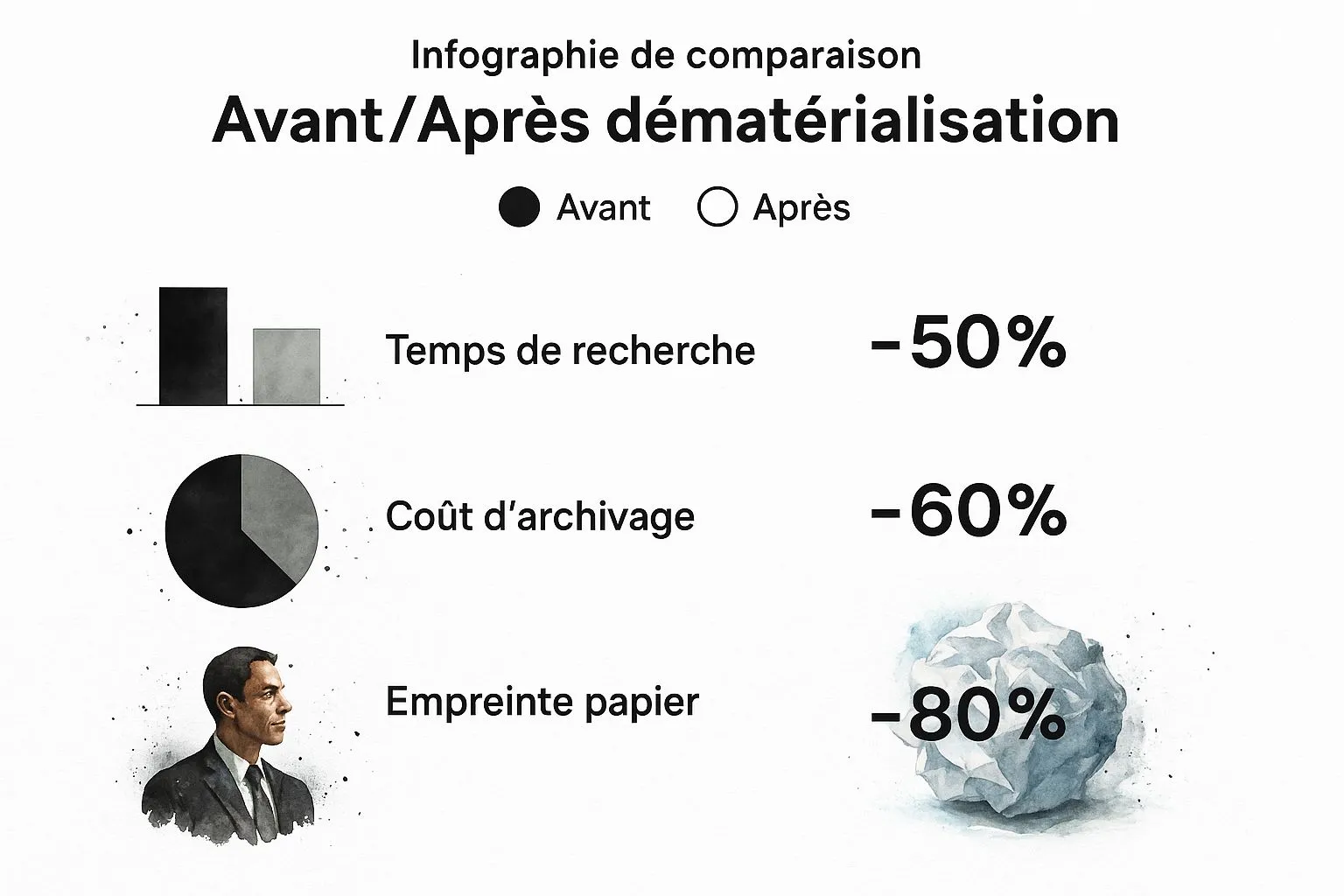
The data doesn’t lie. The reduction in costs related to archiving and printing is direct, but the decrease in time spent searching for information is a huge productivity gain for every team.
Stronger security and collaboration
Business document management through an EDM system is also, and above all, a matter of security. It’s not just about being more efficient. Thanks to fine-grained access rights management, you ensure that only authorized employees can view, edit or delete sensitive documents. No more cold sweats.
A single, secure repository transforms the way teams collaborate. Every member works on the latest version of a document, changes are tracked, and the risk of human error is significantly reduced.
This dual challenge of security and efficiency has been thrust into the spotlight with the rollout of e-invoicing. Since 2024, this requirement has pushed a large number of companies to adopt EDM solutions to automate their processes and protect themselves from cyberattacks. The dematerialization market is expected to reach €9.5 billion, a sign that investing in an EDM system has become a crucial strategic decision. If you’re interested in this topic, you can discover why document management is so strategic on adoc-solutions.com to explore this trend further.
To sum up, the benefits of an EDM system can be broken down as follows:
- Reduced costs related to printing, paper and physical storage.
- Faster workflows, such as approval or signature circuits.
- Improved team collaboration thanks to a single point of access to information.
- Enhanced security and traceability for all of the company’s documents and data.
Building your document management strategy
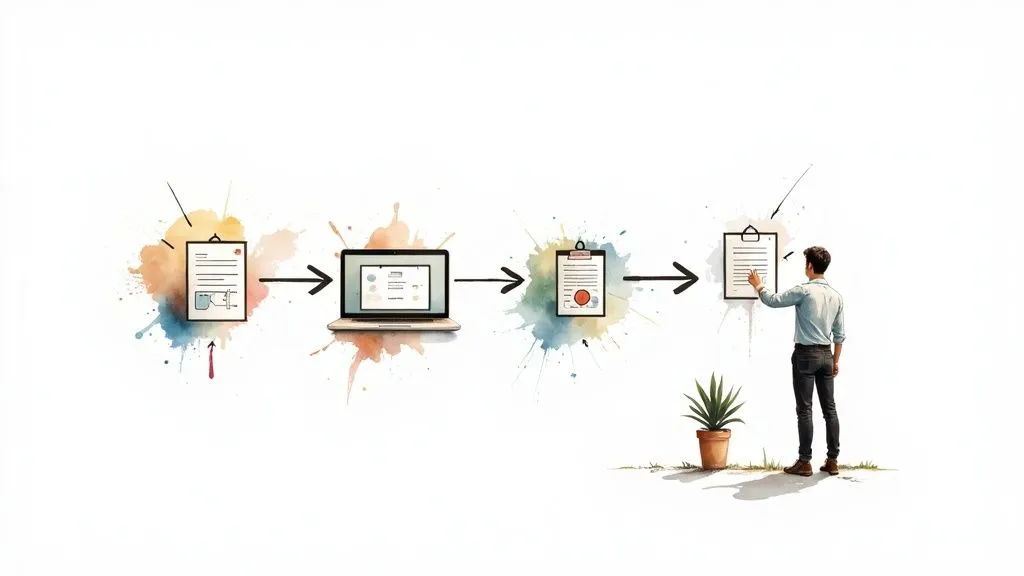
Implementing effective document management doesn’t happen by chance. It’s a genuine strategic project that requires a clear roadmap so you don’t lose your way. Think of it as the foundations of a house: without a solid plan, the building risks collapsing at the first gust of wind.
Success doesn’t depend solely on choosing good software. It rests first on the clarity of your processes and the involvement of your teams. By moving forward step by step, you ensure that every piece of the puzzle is in place, guaranteeing a smooth transition and successful adoption by everyone.
1. Audit your current document flows
The very first thing to do, and it’s crucial, is to take stock of where things stand. You need to understand precisely how documents circulate in your company today. To get a clear picture, you need to ask the right questions and map out your processes.
- What types of documents do you handle? Invoices, contracts, quotes, payslips, expense reports… List everything.
- Who creates them, who approves them, who archives them? Identify the people involved at every step.
- Where are they currently stored? On a server at the office, in personal cloud accounts, or in good old metal filing cabinets?
- Where are the friction points? This is where it gets interesting: documents that can’t be found, approvals that drag on, confusion between different versions of the same file…
This audit will give you a clear picture of the situation, with its strengths and, above all, its weaknesses. It will instinctively show you the priority areas to tackle and your employees’ real needs.
2. Set clear, shared rules
Once the audit is done, it’s time to set the ground rules. The goal is simple: create a common language so everyone classifies and names documents the same way. Consistency is the cornerstone of good business document management.
To do this, you’ll draft a simple, concrete document charter. It could include:
- A logical filing structure: Think of a simple, intuitive folder structure that even a new hire could understand without training.
- A standardized naming convention: For example,
YYYY-MM-DD_DocumentType_ClientName-Project. A well-thought-out file name means a search that takes 3 seconds instead of 10 minutes. - The lifecycle of each type of document: Define who has the right to create, edit, view or delete a document. Don’t forget to set the legal retention periods to avoid unpleasant surprises.
The idea isn’t to create an administrative bureaucracy, but to establish a framework that makes everyone’s work easier. Clear rules mean less chaos and a system that runs itself over the long term.
3. Choose the right tool and support the change
With a precise view of your workflows and your rules in place, choosing your Electronic Document Management (EDM) tool suddenly becomes much easier. You can now look for a solution that adapts to your needs, not the other way around. For example, for freelancers, invoice management is a major challenge. If that’s your situation, our guide on invoicing for sole traders might be helpful.
Finally, the most important point is the human factor. The best tool in the world is completely useless if nobody uses it, or uses it badly. Supporting your teams is the key to success.
- Explain the “why”: Show them concretely what they’ll gain from it in their day-to-day work. Less wasted time, less stress.
- Train your users: Favor short, hands-on training sessions focused on their actual tasks.
- Appoint a point person: Choose an enthusiastic go-to person who can answer questions and encourage best practices.
By following this roadmap, you turn a project that can seem complex into a structured, well-managed process. It’s the best guarantee for the success of your new document management approach.
How to choose the right document management tool
Choosing your document management software is a bit like the moment of truth for any project of this kind. It’s easy to draw an analogy with choosing a vehicle: you don’t take a sports car for a house move, or a truck for your daily commute. The idea isn’t to find the most sophisticated tool on the market, but the one that truly fits your needs.
Faced with the jungle of available solutions, ranging from simple shared storage to ultra-complex enterprise content management (ECM) platforms, it’s easy to feel overwhelmed. The secret is not to get dazzled by endless feature lists. Instead, focus on what will genuinely bring value to your organization.
A poor choice can be very costly. And not just in terms of subscription fees. The biggest cost is often that of failed adoption by teams. A tool that’s too complex or doesn’t align with the way you work will quickly be abandoned, and you’ll be back to square one.
The essential questions before deciding
To make the right choice, you first need to make a clear, honest diagnosis. Take a moment to answer these few fundamental questions. Think of them as a checklist to guide your decision.
-
What level of security do you really need? Is simple access control enough, or do your documents require cutting-edge encryption with full traceability of every action? Security is not optional, especially if you handle sensitive data.
-
Can the tool connect to your current software? A good EDM solution needs to work as a team with your ecosystem, whether that’s your CRM, your ERP, or your accounting software like Bizyness. Successful integration means the end of double data entry and the assurance of consistent data everywhere.
-
Is it simple enough for everyone to adopt? The interface needs to be intuitive. If your employees have to go through days of training just to learn how to file a document, that’s a predictable failure. Usability is a key success factor, it’s not negotiable.
-
Is the solution designed to scale? Your company is going to grow, and with it, your volume of documents. You need to make sure the tool can handle that growth without forcing you to switch everything in two years.
The best solution is the one your teams will enjoy using. Always bet on simplicity and efficiency. That’s the best way to guarantee a good return on investment and rapid adoption.
Anticipating tomorrow’s challenges
Choosing a tool also means keeping an eye on the future, particularly regulatory and technological developments. In France, electronic document management faces significant challenges, such as managing exploding data volumes and ever-tighter security requirements.
Compliance is another major issue. This includes the rollout of e-invoicing, which will become mandatory for all VAT-registered businesses from September 1, 2026. Your future tool absolutely needs to be ready to handle these new obligations to spare you serious problems. If you’re interested in the topic, you can check out a detailed analysis of document management challenges on toosmart.io.
Ultimately, the right tool is the one that aligns with your strategy, simplifies your teams’ lives, and secures your company’s future.
Frequently asked questions about document management
Even with the best intentions in the world, getting started with document management always raises its share of very practical questions. That’s perfectly normal. Choosing the right tools, understanding the technical or legal implications… all of this can seem a bit fuzzy at first.
The goal here is to answer the most common doubts simply and directly, so you can see things more clearly and move forward with confidence.
What’s the difference between an EDM system and simple cloud storage?
That’s THE question everyone asks, and the confusion is understandable. But the difference is genuinely fundamental.
Think of cloud storage, like Google Drive or Dropbox, as a huge digital garage. You can drop all your boxes (your files) in there. It’s handy for storing things and handing a colleague a key, but if you don’t tidy up meticulously, it quickly turns into chaos. You’re the one doing all the organizing.
An Electronic Document Management (EDM) solution, on the other hand, is much more than a simple storage space. It’s a smart system that behaves like a professional archivist for your company.
- It manages the lifecycle: An EDM system tracks a document from its creation to its legal archiving, and even its secure destruction once the retention period has passed.
- It automates processes: No more “Have you approved the invoice?” The system can manage an approval workflow itself, sending notifications to the right people at the right time.
- It ensures traceability and version control: Every action (who viewed it, who edited it, when?) is logged. Never again any doubt about the correct version of a contract or a quote.
- It takes care of security and compliance: The EDM system applies advanced security rules and helps you comply with legal standards, such as the well-known retention periods.
In short, cloud storage is a passive tool. An EDM system, on the other hand, is an active, intelligent system that works for you.
Is electronic document management really secure?
Yes, and in the vast majority of cases, it’s far more secure than your servers in the back office or your metal filing cabinets. Think about the risks of physical storage: theft, water damage, fire, a simple spilled coffee, or access by an unauthorized person… the list goes on.
Good business document management through a serious digital solution is precisely designed to counter these threats.
A quality EDM solution is built on multiple layers of security. It doesn’t just store files; it actively protects them against threats, whether they come from inside or outside the company. It’s the best guarantee for the integrity and confidentiality of your critical information.
Modern EDM systems rely on solid protection mechanisms:
- Data encryption: Your documents are encrypted, both during transfer (in transit) and when stored (at rest). In concrete terms, this makes them unreadable to anyone without the key.
- Fine-grained access rights management: You decide with surgical precision who has the right to view, edit, download or delete each type of document.
- Full traceability: A log (or audit trail) records every action. This is essential in the event of an audit or dispute, to prove your good faith.
- Automatic backups: Backup copies are made regularly and stored in different locations to prevent any accidental data loss.
What are the legal obligations around digital archiving?
In France, the law is very clear on this point. For a digital document to have the same legal value as a paper original, it’s not enough to scan it and drop it in a folder. Digital archiving must guarantee three fundamental principles: integrity (the document hasn’t been altered), durability (it will still be there in 5 or 10 years) and readability (it can be opened and read).
Standards, such as the NF Z42-013 certification, precisely govern the technical requirements for a reliable Electronic Archiving System (EAS). This is a mark of trust that ensures your digital archives will be considered valid evidence in the event of a tax audit or dispute.
Don’t forget the legal retention periods either. For example, French commercial law requires invoices and accounting records to be kept for 10 years. A capable EDM system knows these rules and can automate the management of these periods. It will even alert you when a document can be legally destroyed. That’s a time saver and peace of mind that are priceless.
Ready to transform how your business runs? With Bizyness, automate your invoicing, simplify your accounting and keep full control over your documents. Focus on what really matters: growing your business.
