

 Français
 The guide to the best business management software
Discover the ideal business management software. Our guide compares the best solutions to run your business efficiently.

Put simply, business management software is a platform that brings together, in one place, all the tools you need to run your business. Think of it like your car’s dashboard: everything is centralized to simplify day-to-day driving, from invoicing to customer follow-up to project management.
Understanding the role of management software
Does this sound familiar? Dozens of Excel files, notes scattered everywhere, an inbox overflowing… Every piece of information is like a small isolated island. That’s the organized chaos many freelancers and small business owners live in. Business management software exists precisely to bring order to all of that.
Don’t think of it as just a program, but rather as the nervous system of your business. It links your different areas of activity — sales, accounting, projects — so information flows without friction, in real time. That centralization is where its power comes from.
The digital co-pilot analogy
Picture this tool as a true co-pilot. While you’re at the wheel, focused on strategy and growing your business, it handles all the repetitive but vital tasks. It generates a quote, sends a reminder for an unpaid invoice, or updates a customer record — all automatically.
The time savings are simply enormous. Some studies show small businesses can save up to 10 hours a week just by automating their administrative tasks. That’s precious time you can reinvest where you add the most value: your craft.
Turning data into decisions
One of the most important benefits is the visibility this type of software brings. No more compiling numbers by hand just to know where you stand. You get clear dashboards that update instantly.
A good management software doesn’t just store data. It analyzes it and turns it into concrete insights that help you decide. You’re no longer flying blind; you make decisions based on facts, whether about your cash flow, a project’s profitability, or future growth opportunities.
The infographic below sums up this idea well: the software acts as a hub connecting all the essential functions of your business.
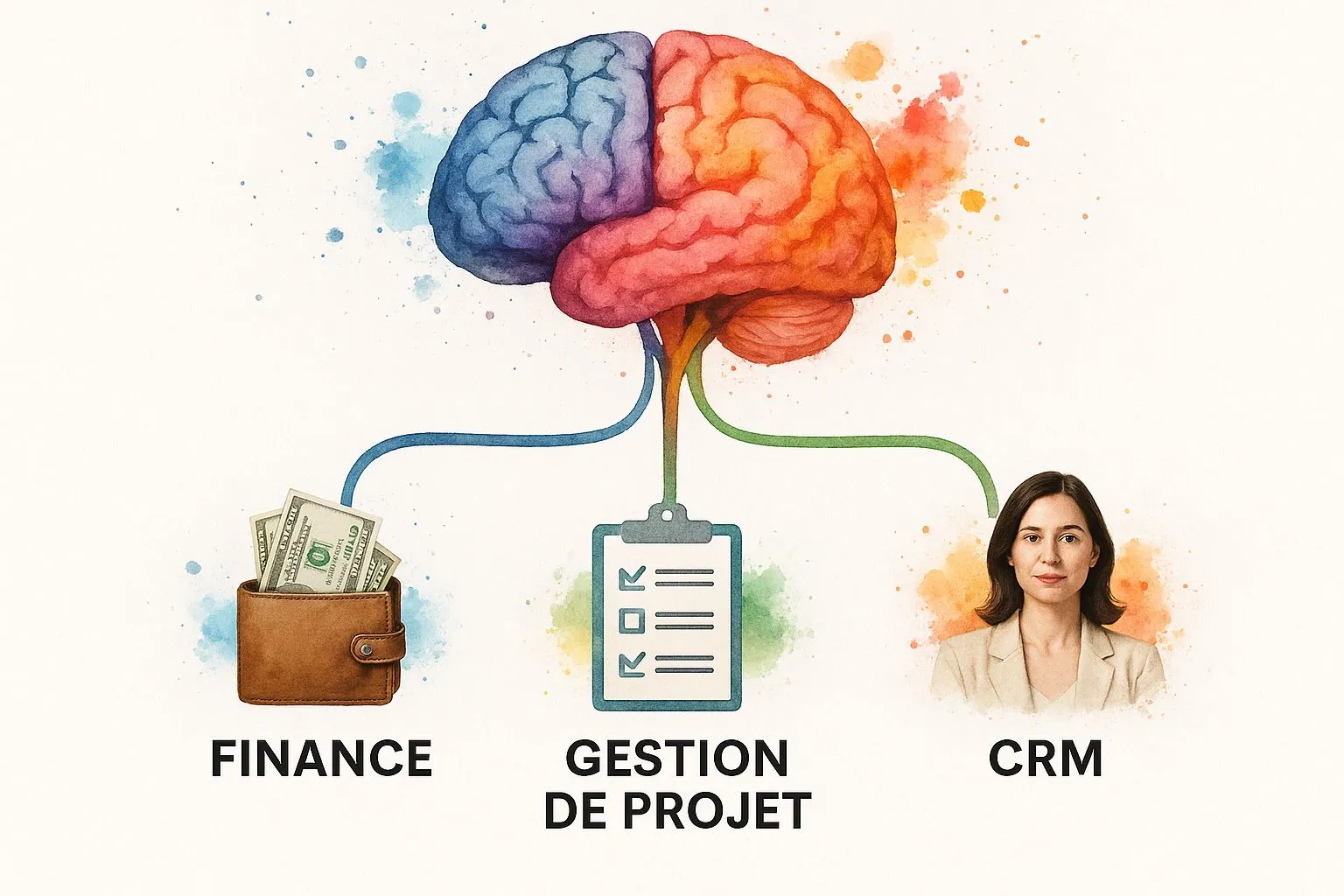
You can clearly see that finance, customer relations (CRM), and project management are no longer separate worlds, but pieces of the same puzzle. Ultimately, adopting a business management software is not an expense. It’s a concrete investment to structure your business, professionalize it, and lay the groundwork for solid growth.
Breaking down the key features of good management software

Effective business management software is not just a checklist of functions. Think of it instead as a perfectly organized toolbox: each tool is designed to work in synergy with the others, creating a system that multiplies your productivity. Far from being mere gadgets, these features are the real gears of your growth engine.
Understanding their role will help you sort out what’s essential for you from what’s superfluous. Let’s look at the three key pillars: customer relationship management (CRM), invoicing/accounting, and project tracking.
Pillar 1: Customer relationship management (CRM)
The CRM is the beating heart of your sales activity. This is where you centralize absolutely everything about your prospects and customers: their contact details, of course, but also the history of your exchanges, the quotes you’ve sent them, ongoing projects… In short, it’s much more than a simple digital address book — it’s the living memory of your business.
The impact of a well-managed CRM is huge. In France, this market was worth around 1.8 billion euros in 2023, proof of its strategic importance. Companies that adopt it see their revenue climb by an average of 41% and their marketing costs drop by 32% thanks to better use of data.
Concretely? A freelancer can use it to schedule automatic follow-ups with prospects who’ve gone a bit quiet. A small business can segment its database to launch a promotional campaign targeted solely at its most loyal customers.
Pillar 2: Invoicing and accounting
The financial health of your business depends on flawless management of invoices and accounts. Good business management software automates most of this work, which drastically reduces the risk of human error and frees up precious time.
A solid financial module should let you:
- Create quotes and invoices: Generate professional documents, compliant with the law and your brand, in just a few clicks.
- Track payments: See at a glance the status of each invoice (sent, read, paid, overdue) to stay on top of your cash flow.
- Automate reminders: No more forgetting! Set up automatic reminders for unpaid invoices.
- Sync your bank accounts: Connect your bank so transactions are automatically reconciled, radically simplifying your accounting.
Imagine a tradesperson who, right there on a job site, sends a quote from their smartphone. Once the quote is accepted, they turn it into an invoice with a single click. This fluidity eliminates double entry and speeds up the entire sales process.
Pillar 3: Project management and time tracking
For any service-based business — consultants, agencies, freelancers — the profitability of each engagement is critical. The project management module is precisely the tool that puts you in control, from initial planning to final delivery.
It serves several vital functions. On one hand, it helps you structure a project into clear tasks, assign them, and set deadlines. On the other, it often includes time tracking, essential for knowing exactly how many hours are spent on each project.
With this data, you can:
- Bill at the right price: You know exactly how much time you actually spent and can justify your rates with confidence.
- Spot profitable projects: Identify which engagements bring in the most relative to the effort involved.
- Refine future estimates: Base your next quotes on concrete data rather than guesswork.
This table sums up nicely how each module can concretely help you day to day.
Comparison of the key modules of management software
This table compares the main features of business management software, their primary goal, and the concrete benefits for a small or medium business.
| Management module | Primary goal | Benefits for the business |
|---|---|---|
| CRM (Customer Relations) | Centralize customer and prospect data | Improved sales follow-up, personalized interactions, increased sales. |
| Invoicing & Accounting | Automate and secure the financial cycle | Time saved on admin, fewer errors, better visibility on cash flow. |
| Project Management | Organize, plan, and track engagements | Optimized resources, deadlines met, better profitability assessment. |
| Time Tracking | Measure time spent on tasks and projects | Accurate billing, productivity analysis, better decisions for future quotes. |
Each module addresses a specific need, but it’s their integration that creates real added value for running your business efficiently.
Of course, this is just an overview of the core modules. Modern management software should also connect to your other tools. The ability to link it to your online store or payment solution is often crucial. To dig deeper, discover the importance of software integrations on Bizyness.
Ultimately, software isn’t judged by the number of its features, but by how relevant its key modules are to solving your everyday problems.
Why small businesses can no longer do without it

The idea that business management software is a complex, expensive tool reserved for big companies dies hard. Yet for a small business or sole trader, it’s quite the opposite: this tool is no longer a luxury but a genuine engine for growing with peace of mind. It’s not a mere convenience, but a strategic ally in everyday operations.
We all know the situation: juggling dozens of Excel files, overflowing notebooks, and a chaotic inbox to keep track of your business. On top of wasting a huge amount of time, this system is a breeding ground for problems: data-entry errors, missed follow-ups, and a completely blurry view of the company’s financial health.
Freeing up your most precious resource: time
The first benefit, the one you feel right away, is the time saved. It’s dramatic. Imagine no longer having to create every quote by hand, retype the same information to turn it into an invoice, then set yourself a reminder to follow up with the client in 30 days. Good software handles this entire cycle automatically.
What used to easily take several hours a week now boils down to a few clicks. That time is not nothing. It’s time you can finally devote to your real craft, to finding new clients, or simply to catching your breath and regaining some work-life balance.
Professionalizing your brand image
The look of your business documents is the first impression you give. A quote or invoice with sloppy formatting, missing legal notices, or typos can seriously damage your credibility. It’s this kind of detail that can tip the scales in a client’s mind.
Business management software ensures that all your documents are flawless and compliant.
- Standardization: All your quotes, invoices, and purchase orders follow a single, professional template with your logo and colors. No more improvising!
- Legal compliance: Mandatory notices (VAT, business registration number, etc.) are added without you having to think about it, and they’re always up to date. This helps you avoid nasty surprises.
- Reliability: Calculations are automated, eliminating any risk of error on totals or VAT.
This rigor builds trust with your clients and strengthens your brand image. You come across as a reliable, serious partner, whatever the size of your company.
Steering your business with a clear view
Running a business without accurate figures is a bit like navigating in thick fog. Management software gives you a real-time dashboard, a real cockpit for making the right decisions. No more waiting for the accountant’s annual report to know where you stand.
Moving from manual management to a centralized tool means replacing uncertainty with control. You instantly know your revenue, which invoices are awaiting payment, and which services are bringing in the most.
This clarity is essential for anticipating your cash flow needs, spotting growth opportunities, or correcting course if a project turns out less profitable than expected. Adopting this type of tool is a decisive step in digitalizing a business, a journey we explore in our guide on how to successfully digitalize your small business.
Investing in such software is therefore far from an expense. It’s an investment that pays for itself very quickly — not just through time saved, but also through errors avoided and opportunities seized thanks to a clearer view of your business. For a small structure, it’s the assurance of building your future on solid foundations.
Online or installed software: the big dilemma
When you start looking for business management software, you quickly run into a first big question: should you install a program on your computers, or choose a solution accessible from a simple web browser? This is the well-known debate between the classic, so-called on-premise model, and the modern SaaS (Software as a Service) approach.
Not so long ago, the choice was quickly made. The only option was to buy a license, often at a steep price, then install and maintain the software on the company’s machines. This method meant managing everything in-house: backups, updates, security… A real headache that demanded time, technical skills, and a heavy upfront investment.
Fortunately, things have changed a lot. Today, another path has become dominant, especially for small businesses and freelancers: online software, or SaaS. Think of it like a Netflix subscription for your business management. You don’t own the software, but you pay a monthly or annual fee to use it. All the technical side is handled by the provider, which takes a huge weight off your shoulders.
Why the SaaS model changed everything
SaaS has become the standard, and that’s no accident. It’s simply more flexible, more agile, and much better suited to the realities of small businesses. This underlying trend is clearly visible in the numbers: the French management software market is growing fast, driven by the massive adoption of SaaS, which already accounted for 56% of total revenue in the sector in 2022. The flexibility and much lower entry costs have won over French businesses. To dig deeper, you can consult an analysis of the French software market on modelesdebusinessplan.com.
Concretely, for you, the benefits are numerous:
- Accessible from anywhere: A simple internet connection, and you’re connected to your management tool, whether you’re on your computer at the office, on your tablet on the train, or on your smartphone. Handy for finishing a quote right after a client meeting.
- Always up to date, effortlessly: No more manual installation of new versions or security patches. The provider handles everything in the background. Your tool evolves and stays secure without you lifting a finger.
- Security first: Your data is carefully kept on highly protected servers, with encryption systems and automatic backups. This is often a much higher level of security than a small business could afford on its own.
- A clear, surprise-free budget: The monthly subscription replaces the large upfront purchase. Costs are smoothed and predictable. You pay for what you need, with plans that can grow alongside your business.
Specialized tool or all-in-one platform?
Once the “online or installed” question is settled, another choice arises. Is it better to use multiple expert tools, each for a specific task, or to go with a platform that centralizes everything?
Simply put: a specialized tool will be unbeatable at one function (invoicing, for example), while an all-in-one solution — also called an ERP (Enterprise Resource Planning) — aims to cover all your management needs in one place.
Software like Bizyness is a perfect example of an all-in-one solution designed for small businesses. It brings together CRM, invoicing, project tracking, and cash management in a single interface. The benefit? You no longer have to juggle between different pieces of software, which reduces the risk of oversights or data-entry errors. Above all, you get a 360° view of your business — an invaluable asset for making the right decisions and running your business efficiently.
How to choose the right management software for your business
Choosing the right business management software is a bit like finding the perfect business partner. You’re looking for someone reliable, who understands your trade and who can support you as your business grows. The task may seem complex, but with a bit of method, it becomes entirely manageable.
The goal isn’t to find the most sophisticated tool on the market, but the one that really fits your reality. Forget the feature race; focus on what will genuinely simplify your life.
It all starts with your needs — yours, not your neighbor’s
Even before you start comparing solutions, the first step is introspection. Grab a notebook or open a document, and map out your daily routine. List, without filtering, everything that annoys you, what takes forever, and the information you’re missing to run your business with more peace of mind.
To guide you, ask yourself the right questions:
- What is THE number-one problem I want to solve? (For example: “Spending my Friday evenings drawing up quotes and chasing payments.”)
- What are the 3 to 5 tasks I repeat every week? (Example: “Entering purchase invoices, checking bank transfers, updating my cash-flow spreadsheet.”)
- What data do I need right now to make a better decision? (Example: “Knowing whether this big-budget project is actually profitable in the end.”)
This little analysis is your roadmap. It will keep you from falling into the trap of gimmicky options and help you stay focused on the essentials.
The criteria to scrutinize
Once your needs are clear, you can start shopping. Think of this list as the essential checkpoints before investing in a tool that will become the heart of your organization.
1. Simplicity above allUltra-powerful software that nobody uses is a wasted expense. The interface should feel logical, almost obvious. If after 15 minutes you’re still hunting for how to create a quote, that’s a bad sign.
2. A solution that grows with youYour business won’t stay still, and your tool needs to keep up. Ask yourself whether the software can handle more clients, more projects, or even adapt if you launch a new offering tomorrow.
3. Customer support that’s actually thereThe day something goes wrong (and it will), you’ll be glad to have responsive, competent customer support. Is it easy to reach? Do reviews mention effective service?
4. Data security — a non-negotiable pointYour business’s and your clients’ information is a treasure. Make sure the vendor offers secure hosting (ideally in Europe for GDPR compliance) and automatic backups.
Think of your management software as a member of your team. It needs to be reliable, high-performing, and available. It’s far more than just a line item on your expenses — it’s a strategic partner.
The free trial: the moment of truth
The finest sales brochure will never replace a real-world test. Fortunately, most online solutions offer a free trial period. Seize that opportunity — it’s a crucial step. Don’t just browse the menus; really get your hands dirty.
During the trial, simulate your daily routine:
- Create a quote for a real client.
- Turn it into an invoice with a single click.
- Log an expense or a purchase invoice.
- Take a look at the dashboard to see if the numbers make sense to you.
It’s by going through these simple actions that you’ll know whether it clicks. Is the flow smooth? Is information easy to find?
Solutions like Bizyness, for example, were designed specifically for small businesses and sole traders with these criteria in mind. The tool brings together the essentials (CRM, quotes, invoicing, project tracking) in a clear interface, with a pricing model that grows with you. Trying it will give you a very concrete sense of what well-designed software can change in your organization.
Ultimately, choosing your business management software isn’t a race. It’s a thoughtful process that, done well, will save you precious time, bring you peace of mind, and let you refocus on your core business.
Artificial intelligence in the service of your management
When we talk about artificial intelligence, we often picture complex robots or science-fiction scenarios. Yet today, AI has quietly settled at the heart of the best business management software to transform the way we work. It’s no longer a gimmick, but a true personal assistant that anticipates your needs and saves you precious time.
Think about it for a moment. You get back from a meeting and simply take a photo of your expense receipt with your smartphone. Instantly, the AI analyzes the document, identifies the vendor, the amount, the VAT, and prepares the entry for your accounting. A task that used to take several minutes is now done in a few seconds, with no risk of error.
But this technology goes much further. By studying your invoicing habits and cash-flow history, the algorithms can build surprisingly reliable financial forecasts for the months ahead. You’re no longer flying blind — you’re steering your business a step ahead.
AI, a real driver for your business
AI adoption touches every part of the business. In France, among companies that have adopted it, 28% use it for marketing and sales, 27% for production, 25% for finance, and 24% for administrative tasks. While large corporations were the first to take the leap, small and medium businesses are not far behind: 69% of them are turning to turnkey software that already integrates these features. To dig deeper, the key figures on AI adoption in France on squid-impact.fr are quite telling.
Concretely, how does this translate in your software day to day?
- Predictive analysis: The system can warn you that a client is likely to pay late, simply by analyzing their payment history.
- Optimized customer relations: Your CRM tool can suggest relevant actions, like following up with a prospect at the right time or offering a complementary deal to a loyal client.
- Smart automation: AI automatically sorts and categorizes your expenses, greatly simplifying the preparation of your accounting.
Artificial intelligence in management software isn’t there to replace humans. It’s there to enhance their capabilities. It takes over repetitive tasks and raw data analysis, freeing up your time for what really matters: strategy and customer relationships.
What used to be reserved for large companies with dedicated budgets and teams is now within reach of everyone, including small businesses and sole traders. It’s a huge competitive advantage for small structures that know how to seize it.
Business process automation is, moreover, one of the most immediate gains, helping you build a stronger, more efficient business. Choosing business management software equipped with smart features simply means deciding to work smarter, not harder.
Your questions (and our answers)
Changing your habits and adopting a new tool always brings its share of questions. That’s completely normal! To help you see things more clearly, we’ve gathered the most common questions about business management software, with direct, jargon-free answers.
The idea is simple: clear away the last hesitations so you can choose the right solution for you, with total peace of mind.
What does it cost, budget-wise?
The price can really vary tenfold. Forget the old solutions you had to install on your computer, which required a heavy upfront investment. Today, most tools, like Bizyness, work on a monthly subscription basis.
This model, known as SaaS (Software as a Service), is perfect for small businesses. For a few tens of euros a month, everything is included: access to the software, updates, maintenance, and security. Your budget is clear, surprise-free, and grows with you.
Is it complicated to use?
Not at all anymore! Gone are the days of clunky systems that required days of training. Modern software is designed to be picked up quickly, even if you’re not tech-savvy. Its mission is to simplify your life, not complicate it.
In general, everything is designed to support you. You’ll often find free trials to test it yourself, clear video tutorials, and customer service ready to help at the slightest hiccup. You’re never left to figure it out alone.
Is my data really safe in the cloud?
Yes, and it’s the top priority of any serious vendor. Your information (clients, invoices, quotes) is stored on highly secure servers, generally based in France or Europe to be fully GDPR-compliant.
These servers benefit from much stronger protections than an independent worker or small business could set up on their own: data encryption, automatic backups, constant monitoring… In the end, your data is often far more secure than if it were locked away in an Excel file on your computer.
So, ready to shift up a gear and free up time for what really matters? See for yourself how Bizyness can lighten your day-to-day as an entrepreneur. Start your free trial and discover the difference.
