

 Français
Cash flow forecast plan: a practical guide to steering your business
Learn how to build a reliable cash flow forecast plan. A concrete guide with examples to anticipate risks and steer your business with peace of mind.

What exactly is a cash flow forecast plan? Picture a simple spreadsheet that lists, month by month, all your expected money coming in (receipts) and all your money going out (disbursements). The goal is crystal clear: know in advance how much money you’ll actually have in your bank account. It’s the only way to make sure you can pay your bills on time and, why not, seize a great opportunity when it comes along.
Why a cash flow forecast is your best ally
Running a business without a cash flow plan is a bit like navigating through thick fog without a compass. You move forward, sure, but any unexpected event can quickly turn into a nightmare. For any entrepreneur, this tool isn’t just another table of numbers. It’s your financial GPS, essential for staying on course and anticipating the turns ahead.
With it, you shift from “reaction” mode to “anticipation” mode. No more stress from discovering an overdrawn bank account at the end of the month. You take the wheel.
Anticipate so you never have to endure
The daily life of a freelancer or small business owner is an obstacle course. A big client who pays late, social contributions falling due at the worst possible time, the computer that gives out… Without a clear view of your future cash position, the smallest setback can destabilize your whole business.
Let’s take a concrete example: a freelance developer who just delivered a big project. He worked flat out for two months. He sends his invoice, but his client has a 60-day payment policy. Without a forecast, our freelancer risks a cold shower the following month, when he has to pay his rent and expenses, even though his order book is full.
With a cash flow plan, he would have seen this mismatch coming from a mile away. He could then have:
- Negotiated a deposit upfront to smooth out his cash inflows.
- Anticipated and set aside part of his previous income.
- Discussed an authorized overdraft with his bank in advance, forecast in hand.
A cash flow plan won’t predict the future for you, but it gives you a reliable roadmap. It flags the dangerous turns, the hills to climb, and also the nice straight stretches where you can finally accelerate.
A tool for making the right decisions
Beyond avoiding disasters, the forecast is a formidable decision-making tool. It provides clear answers to questions you ask yourself every day:
- Can I hire my first employee? By simulating the cost of a salary and associated contributions, you’ll immediately see the impact on your cash flow, month after month.
- Is this the right time to invest in that new software? The forecast will tell you whether you can afford it without jeopardizing your current cash position.
- What should I do with a cash surplus? If your forecasts are looking good, you can calmly plan to pay off a loan, invest that money, or pay yourself a well-deserved bonus.
This visibility is all the more valuable in the current context. According to the Bpifrance Le Lab - Rexecode barometer, cash flow remains a major concern: 32% of small and mid-sized business owners consider it difficult to manage. Having a reliable forecast gives you a real edge to navigate more calmly than others.
Ultimately, understanding the value of this tool is an essential first step. The next is to grasp the fundamental difference between a budget and a cash flow plan. That’s exactly what we explain in our article highlighting why the cash flow budget is crucial for the future. Fortunately, tools like Bizyness exist to simplify your life by automating much of the work. This lets you focus on what really matters: analysis and strategic decisions.
Building your cash flow plan step by step
Theory is good, but practice is even better. It’s time to roll up your sleeves and build your own cash flow forecast plan. Don’t worry, we’re far from complex spreadsheets and accounting jargon. The approach is actually very logical: it simply involves organizing the financial flows you already know about to anticipate the future.
The goal is simple: create a table, usually monthly, that projects your financial situation over the coming year. Each column represents a month, and each row a category of money coming in or going out. This is the document that will give you the visibility you need to steer your business with peace of mind.
Think of it as a financial GPS. This process helps you navigate with more clarity, anticipate tight turns, and ultimately make much better decisions.
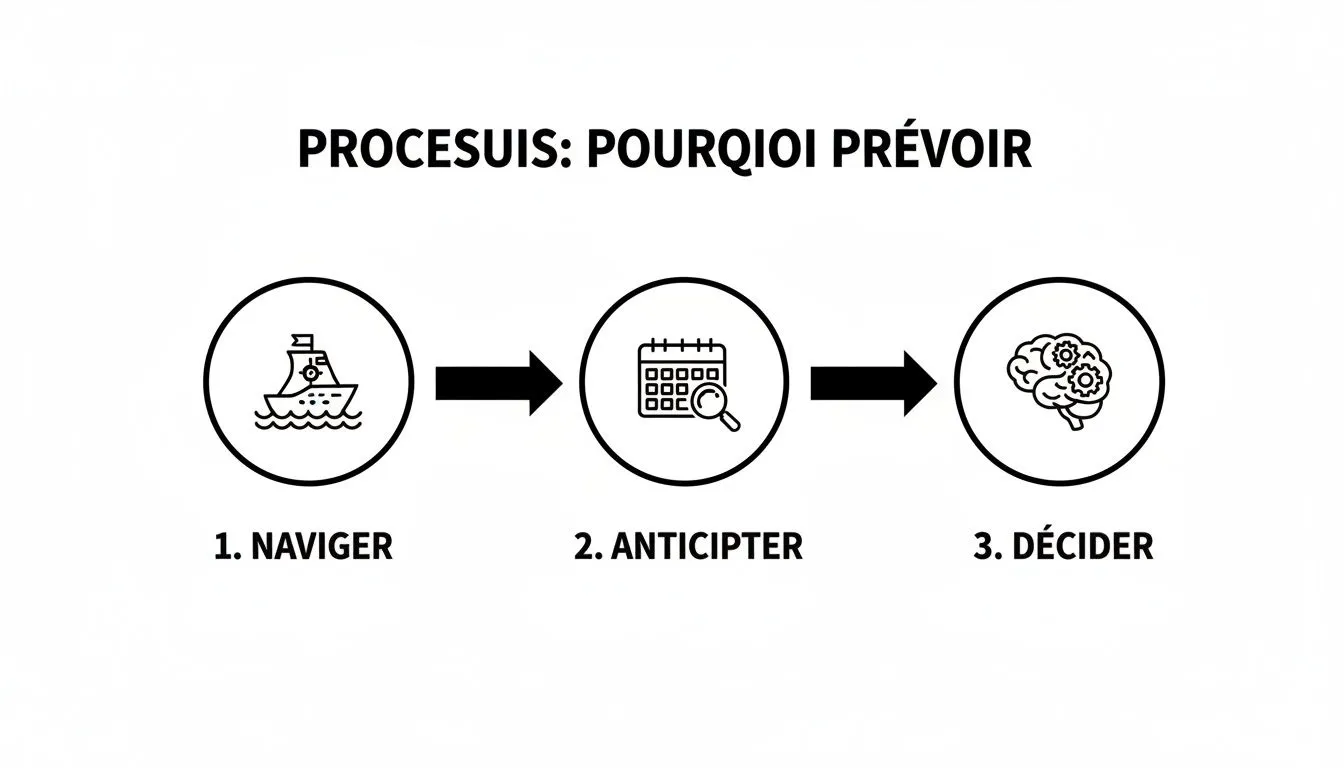
This visualization makes it clear: forecasting isn’t a destination, but a continuous cycle that feeds your strategy and secures your growth.
Precisely list all your receipts
The first step, and probably the most motivating, is to inventory all the expected money coming in. This is your company’s fuel. For your forecasts to hold up, you need to be both thorough and realistic.
Start with your forecast revenue including VAT. This is often the trickiest estimate. If your business is already up and running, your best ally is your figures from previous years. Don’t forget to factor in seasonality! If you’re just starting out, base your estimate on your market research, but stay cautious. A good surprise is always better than a bad one.
One essential point: factor in payment terms properly. An invoice issued in January but paid within 30 days at month-end is money that won’t reach your account until March. It’s this actual receipt date that matters for your cash flow, not the invoice date.
Beyond your sales, other sources of income can feed your cash flow:
- Capital contributions or shareholder current account contributions, if you plan to inject funds.
- A bank loan, which will result in a significant one-off receipt.
- Grants or public subsidies you expect to receive.
- VAT credit refunds, if you’re eligible.
The idea is to map out every euro that should come in and, above all, know when it will arrive.
Identify all your disbursements
Now let’s move on to the less exciting but equally crucial side: money going out. The most common mistake? Forgetting one. A single large expense left out can completely throw off the final result. So be meticulous.
To make sure you don’t miss any, it’s best to sort them into broad categories.
Fixed costs These are the easiest to anticipate. They’re your recurring expenses, whose amount varies little.
- Rent and property charges
- Gross salaries and social contributions (employee and employer)
- Various subscriptions (phone, internet, SaaS software)
- Professional insurance
- Accountant’s fees
- Loan repayments (principal + interest)
Variable costs As their name suggests, these fluctuate based on your level of activity.
- Purchases of raw materials or goods
- Subcontracting costs
- Transport and delivery costs
- Sales commissions
- Marketing and advertising expenses
Taxes and duties These are often the ones that hurt the most if not anticipated.
- VAT payable (the difference between the VAT collected on your sales and the VAT deductible on your purchases)
- Corporate income tax (installments and balance)
- The owner-manager’s social contributions (URSSAF, pension, etc.)
- The Corporate Property Contribution (CFE)
Take the concrete example of a freelance graphic designer. In June, she invoices €5,000 excluding VAT. Her forecast must absolutely show a cash outflow of €1,100 (i.e. 22% in URSSAF contributions) for the following quarter. Forgetting this line guarantees a very bad surprise three months later.
Here too, the golden rule is to record each expense for the month it’s actually paid, not when the invoice is received.
Calculate the final cash balance
Once your lists of receipts and disbursements are properly set out, month by month, the hardest part is done. All that’s left is a few additions and subtractions to bring your cash flow plan to life.
For each month, two key indicators need to be calculated.
-
The monthly cash balance: This is simply the difference between what came in and what went out.
Monthly balance = Total receipts for the month - Total disbursements for the monthThis figure tells you whether, over the period, you gained or lost cash. -
The cumulative cash balance: This is the true pulse of your business. It represents the amount you’ll actually have in your bank account at the end of the month.
Cumulative closing balance = Cumulative opening balance + Monthly balance
The opening balance for the very first month of your forecast? It’s simply your bank account balance at the moment you start.
Here’s a very simple table to illustrate the mechanism:
| Item | January | February | March |
|---|---|---|---|
| Opening balance | €2,000 | -€500 | -€1,300 |
| Total receipts | €4,000 | €5,200 | €6,500 |
| Total disbursements | €6,500 | €6,000 | €5,000 |
| Monthly balance | -€2,500 | -€800 | €1,500 |
| Closing balance | -€500 | -€1,300 | €200 |
In this example, we immediately spot a major problem in January and February. Even with activity that looks good (receipts are increasing), the disbursements create an overdraft. This is exactly what the plan is for: seeing this “dip” coming and being able to act before you’re underwater.
For those who want a solid foundation to get started right away, we’ve put together a complete guide including a forecast table to fill in. This template will help you structure your information properly and avoid the most common calculation errors.
Choosing the right tool to manage your cash flow forecast
Once you have the method in hand to build your cash flow forecast plan, the next question is inevitable: which tool should you use? This isn’t a minor detail. The medium you choose will have a direct impact on the reliability of your figures, the time you spend on it, and your ability to react quickly when needed.
In practice, two main paths are available to you. There’s the “homemade” method with a good old spreadsheet, and the automated approach via dedicated software. Each has its strengths and weaknesses, and the best choice for you will depend on the size of your business and what you expect from this management tool.
The spreadsheet: flexible, but tricky
For many business founders, the first instinct is Excel or Google Sheets. That makes sense: it’s an accessible solution, often already installed on the computer, offering total freedom. You can build your table from scratch, adding the rows and columns that perfectly fit your business.
But watch out, this flexibility has a downside. Managing your forecast by hand in a spreadsheet exposes you to some very real risks:
- Data entry errors: A simple typo, an unfortunate copy-paste, and all your calculations can be thrown off without you noticing.
- Formulas that turn into a nightmare: Maintaining formulas for the cumulative balance, VAT, or payment delays can quickly become a real tangle, especially as your business grows.
- The chore of updating: Importing bank transactions, checking off invoices, readjusting forecasts… It’s tedious work. The risk? You put it off, you forget, and the forecast ends up gathering dust, becoming completely useless.
- A snapshot frozen in time: A spreadsheet is a photo at a given moment. It struggles to adapt in real time to the unexpected and doesn’t give you a living view of your cash.
The spreadsheet still remains an excellent way to get started and understand the mechanics. That’s why we offer our downloadable Excel cash flow plan template. It’s already structured to save you time and help you avoid beginner mistakes.
Specialized software: automation to regain peace of mind
If you really want to turn your cash flow plan into a strategic day-to-day ally, management software is the safest solution. Its secret? Automation.
A tool like Bizyness doesn’t just give you a table to fill in. It connects directly to your bank accounts to retrieve transactions in real time. It also connects to your invoicing tool to anticipate upcoming receipts. This near-total synchronization eliminates the need for manual entry and, with it, the vast majority of error risks.
Here you can clearly see how everything is connected: invoicing, accounting, and cash flow all talk to each other.
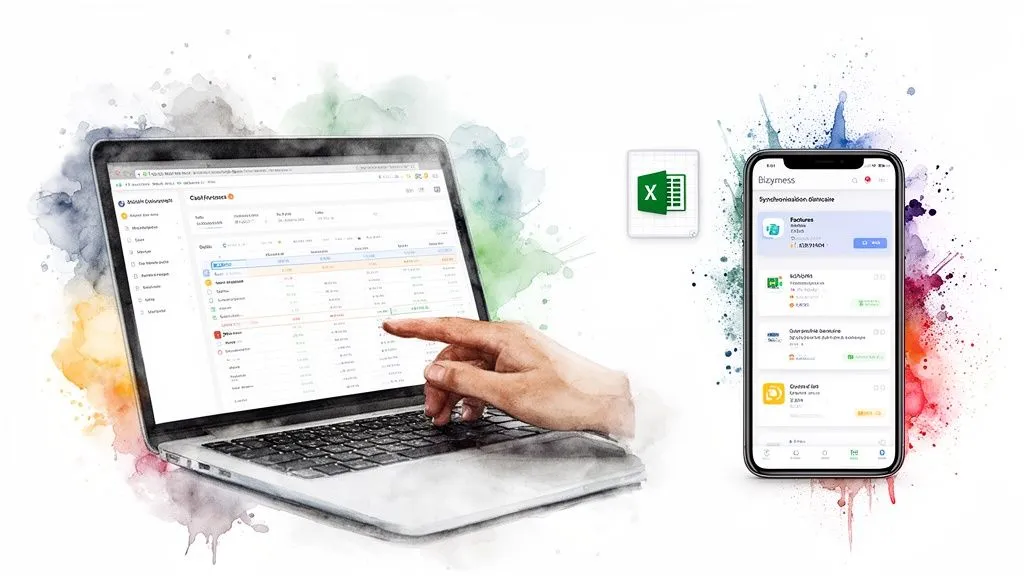
Thanks to this centralized view, you generate reliable forecasts effortlessly, based on real, always up-to-date data.
The goal isn’t just to save time. It’s to gain confidence. An automated forecast gives you reliable figures you can rely on to make real decisions, instead of flying blind.
Choosing business management software is often a decision that goes beyond just managing cash flow. It’s a step toward better structuring all your processes. To dig deeper into the topic, feel free to check out our complete guide.
To sum up, here’s a quick head-to-head comparison of the two approaches:
| Criteria | Spreadsheet (Excel, Google Sheets) | Specialized software (Bizyness) |
|---|---|---|
| Reliability | Low to medium (high risk of human error) | Very high (automated data) |
| Time spent | High (manual entry and updates) | Low (the tool does the heavy lifting) |
| Visibility | Static (a snapshot at a given moment) | Dynamic (real-time updates) |
| Cost | Free or included in an office suite | Monthly subscription (often quickly worth it) |
| Collaboration | Limited (version management hassle) | Easy (shared, secure access) |
Ultimately, while the spreadsheet is a good starting point to get the hang of things, it quickly shows its limits. Switching to specialized software is a real investment in your peace of mind and performance. You free up precious time you can finally devote to what really matters: your clients and growing your business.
The common mistakes that put your cash flow at risk
Establishing a cash flow forecast plan is a crucial step, but its true value depends on its accuracy. A forecast full of errors or approximations can quickly give a false sense of security and lead you to make poor decisions. For it to become your true dashboard, it’s essential to learn how to avoid the most common pitfalls.
Knowing how to spot these classic mistakes is the best way to build solid forecasts capable of withstanding everyday uncertainties. Let’s review the missteps that most often undermine entrepreneurs’ cash flow and, above all, how to avoid them in practice.
Excessive optimism about sales
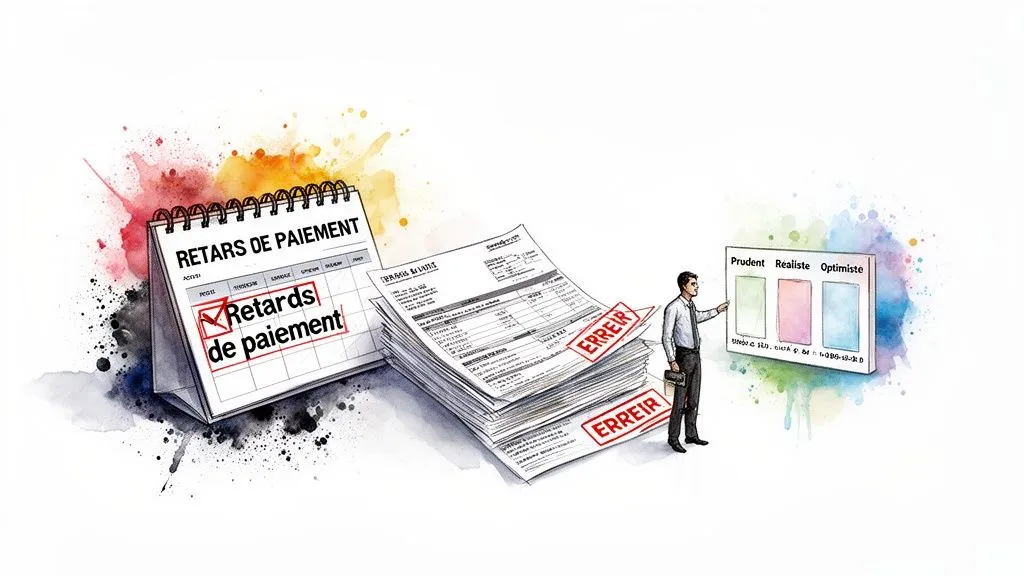
This is mistake number one. It often comes from good intentions, but it can be very costly. Of course you believe in your project, but forecasting 30% monthly growth right from launch is rarely realistic. Overestimating future receipts throws off the entire forecast chain and completely masks the risk of running dry.
The solution is simple: base your estimates on facts.
- If your business is already up and running: Dive into your figures from previous years. Take seasonality and market trends into account.
- If you’re just starting out: Base your estimate on your market research, but take a conservative approach. Better to plan for a gentle start and get a good surprise than the opposite.
Expert tip: Don’t rely on a single figure. Build three scenarios for your revenue: a cautious one, a realistic one, and an optimistic one. This will give you room to maneuver and prepare you, mentally and financially, for any eventuality.
Forgetting or underestimating expenses
Another very common mistake is focusing on big expenses like rent and salaries while forgetting all the “small” costs. The problem is that once added up, they can amount to significant sums. Have you thought about bank fees? Software subscriptions? Travel expenses? The Corporate Property Contribution (CFE)?
Along the same lines, taxes and social contributions are often the great forgotten items. The quarterly URSSAF payment or a corporate tax installment can blow a gaping hole in your cash flow if they haven’t been anticipated.
To make sure you forget nothing, go back through your bank statements from recent months and list absolutely everything that goes out. Every expense line, even the smallest, must have its place in your forecast.
Ignoring the impact of VAT and payment terms
Your cash flow plan isn’t done excluding VAT, but with all taxes included. What matters is the money that actually comes in and goes out of your bank account.
Here, two points deserve close attention:
- VAT: You collect it on your sales (a receipt), but you must remit it to the state (a disbursement). If you forget to plan for this outflow, a bad surprise is guaranteed.
- Payment terms: Invoicing in January doesn’t mean being paid in January. If your clients pay you within 30 or 60 days, the receipt must be recorded in the column for the month you receive the money, not the one in which you issued the invoice.
This rigor is the key to having a forecast that truly reflects the reality of your available cash.
Not updating the forecast regularly
A cash flow plan isn’t a document you create once a year and let sit in a drawer. It’s a living tool that needs to breathe at the same pace as your business. Letting it gather dust is like driving while looking at an old road map: you risk missing the exit or ending up in a dead end.
The current economic climate makes this vigilance even more crucial. Uncertainty weighs on small and mid-sized businesses, with three-month cash flow outlooks reaching -22 points. In this climate, where 85% of businesses are worried about their cash flow, failing to model these uncertainties is a serious mistake. This can lead to risky investments, when only 39% of business owners still plan to invest. To dig deeper into these figures, you can consult the latest analyses on SME confidence.
Your forecast should be updated at least once a month. Compare what you had planned with the actual figures. This regular exercise will help you spot discrepancies, understand why they exist, and above all fine-tune your forecasts for the following months. That’s how your cash flow plan becomes a strategic ally you can truly rely on.
How to interpret your forecast and act on it
A well-built cash flow forecast plan is much more than a simple table of numbers. It’s your roadmap, a true management tool for turning raw data into informed decisions. Having a clear view is good. Acting on it is better. Knowing how to read between the lines of your forecast is what lets you go from spectator to true pilot of your business.
The goal isn’t to passively endure your forecasts, but to use them to shape your company’s future.
Anticipate a cash flow gap and act ahead of time
The major strength of your forecast is its ability to sound the alarm before problems arrive. Imagine your table shows a negative balance in three months. Above all, don’t panic. You’ve just gained the most valuable advantage there is: time.
Instead of being caught off guard when the moment comes, you can pull several levers starting today. The idea is to combine small actions whose cumulative effects will gradually turn things around.
- Speed up cash inflows: This is the most direct and often most effective lever. Dig into your outstanding invoices and step up your client follow-ups. A simple phone call can sometimes unlock a payment much faster than yet another email. Also consider offering a small discount for immediate payment.
- Talk to your suppliers: Do you have a large supplier invoice falling due right when your cash flow dips? Pick up the phone. Contact your partner, explain the situation transparently, and see if you can get a payment extension or installment plan. A good business relationship also relies on this kind of exchange.
- Postpone non-essential expenses: That investment in a new computer, that extra advertising budget… Can it wait a month or two? Review your planned disbursements and identify anything that isn’t vital to the business’s short-term operations.
The most important thing is to act now. The longer you wait, the less room you’ll have to maneuver. An overdraft anticipated and negotiated with your banker, forecast in hand, will always cost you less than an unplanned, unauthorized overdraft.
This proactive approach is all the more crucial in the current economic climate. The Rexecode barometer reveals that 59% of businesses anticipate a future deterioration in their cash flow and 43% plan to reduce their investments. Your forecast gives you the keys not to passively endure this trend, but to respond to it with a clear strategy. To dig deeper into these figures, feel free to consult the full analysis on the situation of SMEs.
What to do when you have a cash surplus?
Conversely, your forecast can bring you excellent news: a lasting cash surplus is on the horizon. This is a very comfortable position, but one that also calls for strategic thinking. Letting this money “sleep” in a current account is rarely the best option, especially in an inflationary context.
Here are a few ways to put this surplus to smart use:
- Build a safety cushion: This is the first instinct, and it’s a very healthy one. Setting aside the equivalent of three to six months of fixed costs gives you invaluable peace of mind for facing the unexpected.
- Invest in growth: This is the perfect time to fund the projects that will take your business to the next level. Buying more efficient equipment, developing a new offering, hiring a key talent… This surplus lets you fund these steps with your own capital, without increasing your debt.
- Pay down debt early: If you have loans outstanding, using your surplus for an early repayment can generate substantial savings on interest and lighten your fixed costs going forward.
- Invest the cash: If the surplus is significant and no investment project is planned in the short term, investment solutions can let this money work for you and offset the effects of inflation.
By giving you such visibility, your forecast becomes your best ally in all your financial discussions. Presented to your banker, it demonstrates your rigor and control. Shown to investors, it makes your project’s potential tangible. It’s proof that you’re not flying blind, but firmly holding the wheel.
Cash flow forecast plans: your questions, our answers
Getting started with a cash flow plan often raises quite a few questions. That’s perfectly normal. To help you see things more clearly, I’ve gathered here the most frequent questions entrepreneurs ask me.
How often should you update your forecast?
A cash flow plan is a bit like a navigation chart: it’s only useful if it’s up to date. A monthly review is really the bare minimum. The idea is simple: you take your forecasts and compare them with what actually happened in your bank accounts.
This small regular exercise is incredibly powerful. It lets you immediately see where things are going off track, understand why, and above all adjust course for the following months. In the current climate, I’d even recommend a deeper analysis every quarter to stay ahead.
VAT or no VAT? Should you think in terms excluding or including tax?
This is THE question that can throw off all your calculations. The answer is unequivocal: always including all taxes.
Think of it very concretely: your cash flow plan should reflect the money movements in your bank account. And when a client pays you, they transfer the amount including VAT. When you pay a supplier’s invoice, you also pay including VAT. The VAT you collect for the state before remitting it is a very real cash outflow. Forgetting it is the best way to end up in the red without understanding why.
What’s the difference with a forecast budget?
We tend to lump everything together, and yet these two tools don’t play in the same league at all.
- The forecast budget looks at the profitability of your business. It compares revenue (sales excluding tax) with expenses (purchases excluding tax) to see whether you’ll generate a profit or a loss. It’s the tool that helps you know whether your business model holds up.
- The cash flow plan, on the other hand, focuses on liquidity. Its sole purpose is to make sure you’ll have enough cash to pay the bills at the end of the month. It tracks actual money flows, including tax.
To put it simply: you can be very profitable on paper (budget in the green) and yet go bankrupt for lack of cash to pay salaries (negative cash flow). These two tools are therefore not only different, but essential and complementary for steering your business with peace of mind.
Want to spend less time on Excel and more on your core business? With Bizyness, you can automate your cash flow plan by simply connecting your bank accounts and invoices. Make the right decisions, based on reliable, up-to-date figures, without pulling your hair out. Discover how Bizyness can change your daily routine.
