

 Français
 Creating a professional quote that wins over your clients
Discover how to create a clear, persuasive quote. Our practical tips will help you turn your proposals into signed contracts.

A quote is much more than a simple price list. Think of it as your first business card, tangible proof of your professionalism. To hit the mark, it needs to be clear, complete, and give a taste of the quality of your work. It’s a genuine tool of persuasion that turns a prospect into a loyal client.
The impact of a well-crafted quote on your brand image
In a market where everyone is fighting for attention, a quote can no longer be a mere administrative formality. It’s often the first concrete contact between your prospect and the quality you promise. Think of it as the cornerstone of your future client relationship; it must inspire confidence immediately.
A well-thought-out quote demonstrates that you truly listened to and understood your client’s needs. It doesn’t just line up numbers. It tells a story: the story of the solution you’re proposing to solve their problem. Every detail matters, from the clarity of the layout to the precision of the descriptions, not forgetting the absence of spelling mistakes.
Strengthening your credibility
A meticulous, professional document fully justifies your pricing structure. From experience, I can assure you that an exceptionally clear and detailed quote is the best argument for defending a higher price. The client perceives the added value even before you’ve started working. The document itself becomes proof of your rigor and expertise.
To go further, feel free to read our guide that explains in detail what a quote is and its essential role for any business.
A poorly put-together or incomplete quote can torpedo your offer in an instant, even if your services are flawless. It creates doubt and opens the door to negotiations that will never work in your favor.
Before exploring how to create this document, let’s summarize its strategic importance.
The strategic roles of an effective quote
This table summarizes the essential functions a quote fulfills, beyond simple pricing.
| Function | Impact on your business | Benefit for the client |
|---|---|---|
| Sales tool | Increases conversion chances by demonstrating professionalism. | Aids decision-making with a clear, structured offer. |
| Legal framework | Secures the transaction by defining each party’s obligations. | Protects against misunderstandings and hidden costs. |
| Showcase of expertise | Highlights your know-how and justifies your rates. | Reassures about the provider’s competence and reliability. |
| Foundation of the relationship | Establishes a climate of trust and transparency from the start. | Feels heard, understood, and respected in their needs. |
This document is therefore a pillar of your sales approach, and it deserves your full attention.
Standing out from the competition
With a record number of business creations in France, mostly micro-entrepreneurs, competition has never been fiercer. In this context, knowing how to create a quote is no longer optional — it’s a decisive competitive advantage. You turn an administrative constraint into a powerful persuasion tool.
By perfecting this document, you’re not just selling a service. You’re selling peace of mind and the promise of a job well done.
Creating a compliant quote: what the law says
Navigating legal obligations can quickly become a headache. Yet a quote that isn’t up to standard can cost you dearly. We’re talking about penalties that can reach up to €1,500, not to mention the risk of your agreement being purely and simply invalidated. To spare you this kind of unpleasant surprise, let’s break down the mandatory information together.
Every piece of information matters. It’s not just a checklist. These elements clearly identify who does what, lay the groundwork for the service, and ensure full transparency, particularly on tax matters.
Rigor begins well before you type the first line of your quote, right from the first contact with your client. That’s where you gather the essential information.
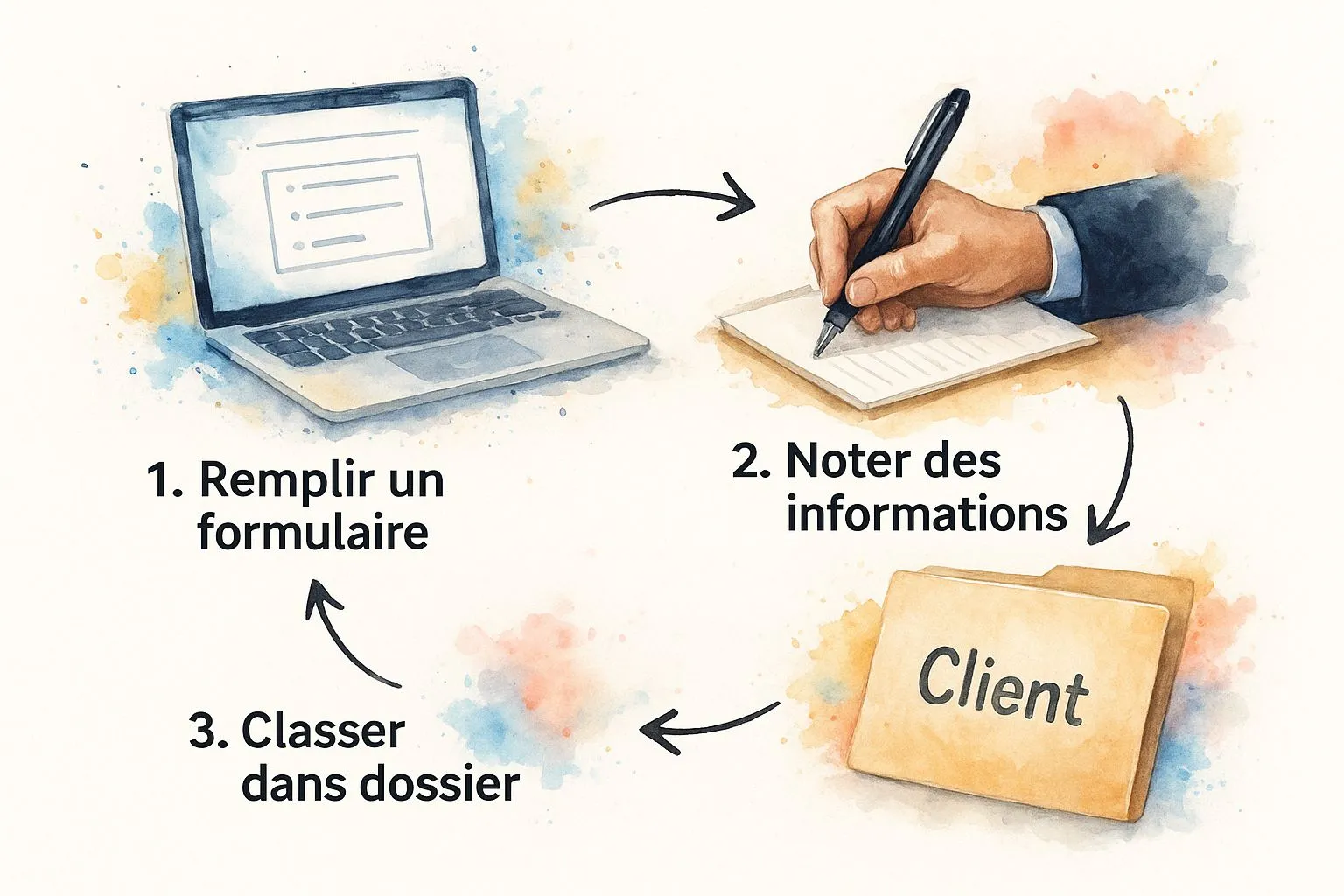
This illustration shows it well: everything starts with good information gathering.
The information you must never forget
For a quote to be rock-solid, there’s a base of information you need to include systematically. It’s the foundation of trust and your legal protection. Think of it as your safety net.
Here’s what must appear on every quote you send:
- Your company’s identity: your name, business name, registered address, a phone number, and an email address.
- Your legal identifiers: your legal status, SIREN number, and, if applicable, your intra-community VAT number.
- Your client’s contact details: their name and precise address.
- The details of the quote itself: a unique number so it can be easily found, its issue date, and its validity period.
- The description of the service: the heart of the matter! Detail each service or product, specifying the quantity and unit price excluding tax.
The idea is to leave no room for doubt. Any ambiguity could one day come back to bite you.
A good quote is a document that’s self-sufficient. If a dispute ever arises, it should answer every question: who did what, how, for how much, and when. It’s your best protection.
Mentions specific to your status
Be careful, certain information depends directly on your status. A craftsperson, a merchant, or a sole trader don’t display exactly the same legal notices.
A craftsperson, for example, must include their registration number with the trade register (RM). A merchant, on the other hand, will mention their registration number with the trade and companies register (RCS). Forgetting this kind of detail can weaken your document in the eyes of the law. For sole traders, the classic mistake is omitting the famous wording “VAT not applicable, art. 293 B of the French Tax Code”, which can confuse the client and cause you trouble.
That’s where a tool like Bizyness becomes a real ally. The software automatically adds the right wording based on your status. No more stressing about forgetting something. Every time you need to create a quote, you’re guaranteed it’s fully compliant. You can finally focus on what really matters: the quality of your offer. Peace of mind.
How to structure your offer to convince?
A good quote does far more than list prices. It’s your first real sales tool. To be effective, it needs to be structured in a way that persuades your prospect that you’re the right person for the job. The idea is to turn a simple administrative document into a pitch that showcases your expertise and genuinely makes people want to sign.
The best way I’ve found to achieve this is to break the offer down into several logical packages. Imagine you’re telling a story: each package is a chapter describing a key stage of the project, creating a clear throughline from start to finish.
Focus on benefits, not features
We all fall into the same trap at the start: listing purely technical tasks. But honestly, your client doesn’t care. Instead of writing “Creation of 5 web pages,” try instead: “Design of a complete showcase website, including a homepage to capture attention, a services page to detail your value, an ‘About’ section to build trust, a gallery to showcase your successes, and a contact page designed to make booking easy.”
The difference is huge. Your client isn’t paying for code or hours of work. They’re investing in a result. Every line of your quote should therefore answer their silent question: “And what’s in it for me?”.
My expert tip: I always start my quotes with a short, personalized introduction. In one or two sentences, I summarize the client’s main objective, like: “Following our conversation, here is my proposal for the redesign of your visual identity to appeal to a more premium clientele.” This immediately proves that you’ve clearly understood their expectations.
Layout details that make all the difference
A well-thought-out structure needs to be paired with careful formatting. This is what will make your quote not only readable, but also impactful. Here are a few techniques I use systematically:
- Play with bold text: Make key information stand out. Highlight the subtotals of each package, the total excluding VAT and, of course, the VAT amount. This guides the client’s eye toward what matters.
- Create distinct blocks: Give each section of your offer a meaningful title. For example: “Phase 1: Design & Mockups”, “Phase 2: Development & Integration”.
- Include subtotals: Showing a price per package helps the client better visualize the value of each stage. Psychologically, it also makes the final amount seem much less daunting.
By applying these tips, you’re no longer just pricing a project: you’re selling it. If you’d like to save time while incorporating these best practices, I recommend using a well-designed quote template. It’s an excellent starting point.
Setting your rates and terms of business
This is where everything is decided. The pricing section is the heart of your quote, the moment when your expertise takes on a concrete, quantified value. In today’s economic climate, finding the right price is a real balancing act. You have to juggle staying competitive with ensuring your own profitability. The key? Being as strategic as you are transparent.
Setting your rates isn’t just about adding up your costs and slapping on a margin. It’s much more subtle. You need to keep an eye on the market and anticipate its fluctuations. We’ve all seen indices like the IPSE (Services Producer Price Index) climb. In this context, adjusting your prices is no longer a matter of choice, but of survival. That’s why including a validity period on your quote has become essential to protect your margins. To keep track of these trends, take a look at the latest statistics published by INSEE.
Lock down your cash flow with clear terms
Think of your terms of business as your financial safety net. They must be crystal clear, leaving no room for doubt or misunderstanding. Here are the points I recommend always including:
- The deposit: State clearly the percentage you require upon signing. A deposit of 30% is a common and sound practice. It’s proof of commitment on both sides and secures the project’s launch.
- Payment installments: For projects that stretch over time, don’t hesitate to plan for intermediate payments. It’s the best way to maintain positive cash flow.
- Payment terms: Specify when the balance must be settled. Whether it’s “upon receipt of invoice” or “within 30 days,” what matters is that it’s written down.
- Late payment penalties: It’s the clause nobody likes, but it’s essential. Mention the applicable rate in case of late payment, in accordance with the law. It’s mainly a deterrent.
For a freelancer, a deposit isn’t a luxury, it’s a lifeline. It validates the client’s commitment, covers your initial costs, and keeps you from working for free if the project suddenly stops.
Rigorous financial management is just as decisive as the quality of your services. In fact, if you’re looking to better manage your income, our article on tax optimization for sole traders is packed with practical tips.
By nailing down this part of your quote, you’re doing far more than proposing a price. You’re laying the foundations of a healthy, professional collaboration, while protecting your business for the future.
Turning your quotes into signed contracts: the art of the follow-up
Sending a quote is only the first step. I see too many entrepreneurs who think the hard part is done, when in fact that’s often where everything really begins. It’s the follow-up that makes the difference, that turns a simple proposal into a solid contract. Trust me, a well-executed follow-up, both professional and respectful, can literally double your conversion rate.
The worst mistake? Letting your quote drown in your prospect’s inbox. Never take radio silence as a definitive “no.” Very often, your contact is simply overwhelmed or waiting for the green light from their management. It’s up to you to stay visible.

Setting up a follow-up strategy that works
Following up isn’t harassing. It’s simply good customer service. You show that you’re committed to the project and ready to clear up any grey areas. Timing is everything. I’ve noticed that a first follow-up email, 3 to 5 days after the initial send, is generally the ideal starting point. It’s soon enough that the prospect still has your offer in mind, but spaced out enough not to seem pushy.
Still no response after a week? That’s the time to pick up the phone. A call is much more personal and allows you to clear up doubts that an email couldn’t resolve. It’s also a chance to strengthen the human connection.
Here’s a template you can easily adapt:
- Day 3: A simple, direct follow-up email. “Hi [Contact name], I just wanted to make sure you received my proposal. Feel free to reach out if you have any questions.”
- Day 7: A phone call. The idea isn’t to ask “So, are you signing?”, but rather to show genuine interest. “I wanted to check that my proposal matched what you had in mind.”
- Day 14: A final email to close the loop. Offer to close the file if there’s no follow-up, while always leaving the door open for the future.
This is precisely where a tool like Bizyness changes the game. It notifies you as soon as your quote has been opened and viewed. That’s crucial information that lets you follow up at just the right moment, when your proposal is still fresh in your prospect’s mind.
A tip from experience: Always take the time to analyze your rejected quotes. It’s a real goldmine. You’ll find clues to adjust your rates, refine your service descriptions, or better anticipate future objections. Every “no” is a lesson that brings you closer to the next “yes.”
Here are the questions that come up most often about quotes
Whether you’re just starting out or have years of experience, creating a quote always raises a few questions. To help you see things more clearly and make your business proposals rock-solid, I’ve gathered the most common questions. Here are clear, direct answers to save you time and give you peace of mind.
So, is a signed quote really a contract?
Yes, without a doubt. Once your client has added the date and signature to your quote, along with a clear mention such as “Approved” or “Approved for work,” the document changes status. It becomes a fully-fledged contract.
In practical terms, this means both parties are legally bound. You must carry out the service described, and your client must pay the agreed price within the set deadlines. Think of it as your best insurance in case of disagreement or dispute.
Can I charge for a quote?
The basic principle is simple: a quote is free. It’s a commercial offer, a gesture to start a trusting relationship with a prospect.
That said, there are exceptions. You are entitled to charge for a quote if it requires substantial preparatory work. Imagine having to carry out an in-depth study, draw up detailed plans, or travel a long distance. In that case, it’s legitimate to charge for that time. The one golden rule is to inform the client before starting. If the project goes ahead, good business etiquette dictates that this amount is then deducted from the final invoice.
A tip from experience: never modify a quote that has already been sent. If changes are needed, the best solution is to create a new quote with a distinct number. The other, more formal option is to draft an amendment that cancels and replaces the previous version. This guarantees perfect traceability and will save you a lot of headaches.
Stop juggling administrative complexities. With Bizyness, you can create professional, compliant quotes in minutes, giving you more time for what really matters: your core business. Discover how to simplify your management today.
