

 Français
Creating Quotes: a clear guide to winning over your clients
Learn how to create clear, compliant quotes to secure your clients and earn their trust.
Creating a quote isn’t just about lining up numbers on a page. It’s much more than that. It’s often the first official document you exchange with a prospective client. It’s your business card, your sales pitch, and your legal safety net, all rolled into one.
Why a flawless quote is your best ally for winning contracts
Let’s be clear: a well-crafted quote often makes the difference between a won project and a deal that slips through your fingers. The goal isn’t just to give a price, but to reassure your prospect, convince them you’re the right person for the job, and lay solid foundations for your future collaboration.

Picture the scene: your client receives a clear document, free of any mistakes, perfectly structured. The image you project is that of a serious, meticulous professional. It’s a preview of the quality of the work you’re about to deliver. Every detail matters, from the precise description of your services to the clarity of your terms of sale.
More than an offer, a genuine commitment
A quote isn’t a figure thrown out on the fly. It’s a formal commercial offer. And as soon as your client signs it with the words “Approved, good for agreement,” it turns into a contract, with real legal weight.
From that moment on:
- You commit to carrying out the services described in the document.
- You commit to the prices and deadlines you announced.
For their part, your client commits to paying the agreed amount, under the terms you set together. This framework protects everyone, avoids misunderstandings, and prevents potential disputes. It’s an essential safeguard.
A quick but essential reminder: a quote is not an invoice. The quote proposes a service, while the invoice confirms that the work has been done and triggers payment. It’s a key distinction for sound management.
In the current climate, where economic uncertainty looms, the precision of your quotes becomes even more strategic. Take the construction sector, which expects a downturn in activity in 2025, estimated between -1.2% and -5.6% depending on the segment. In a tighter market, every commercial proposal becomes decisive for winning a contract. To learn more, you can check out the details on the 2025 construction industry outlook.
Ultimately, polishing your quotes isn’t just an administrative chore. It’s a genuine sales act that builds your credibility and helps your prospects decide faster. In your favor, of course.
The mandatory details for a legally airtight quote
For a simple proposal to become a document that truly protects you, every detail matters. A quote isn’t just a price list; it’s a formal commitment that lays the groundwork for your future collaboration. Forgetting a single piece of legal information can void it and open the door to disputes.
Think of it as the foundation of your client relationship. These details aren’t there to look nice or to complicate your life. They exist to spell out, in writing, who does what, for whom, at what price, and under what conditions. Above all, it’s a matter of transparency and professionalism.
Clearly identify who is committing to what
The very first step is knowing who’s talking to whom. It’s the basis of any commercial agreement, and it avoids plenty of misunderstandings.
- Your information, clearly displayed: Your business name (or your first and last name), your full address, a phone number, and an email where you can easily be reached. And above all, never forget your SIRET number, the official registration of your business.
- Your client’s precise details: Always ask for the person’s full name (or company name if it’s a business) and their address. This is what makes the quote personalized and therefore legally valid.
These elements remove any ambiguity about the parties to the contract about to be formed.
Detail the service without leaving room for doubt
This is probably the most important part, where precision is your best ally. A vague description is the perfect recipe for a future dispute.
Never settle for a generic line like “Website creation.” Break that task down into several clear steps: “Mockup design - 3 proposals,” “Integration of 5 pages (Home, About, etc.),” “Contact form development”… For each line, indicate the quantity (in hours, days, or units) and the unit price before tax (excl. VAT).
This rigor is your best insurance policy. If a client one day tells you, “Oh, but I thought that was included!”, all you’ll need to do is point to the signed quote. It’s an incredible source of peace of mind, for both you and them.
This approach also protects you against clients who might try to “cherry-pick” your offer to lower the price, by removing elements you know are actually essential to the project’s success. You’re the expert; it’s up to you to define the scope that guarantees a quality result.
If you want to dig deeper into the topic, our complete guide on the mandatory details of a quote covers everything, including more specific cases like ten-year (decennial) insurance or VAT-related subtleties.
To make sure you don’t forget anything before hitting “Send,” here’s a summary table to keep handy.
Checklist of mandatory quote details
This table brings together all the legal information that must be included in your quotes for them to be compliant in France. A good habit to get into!
| Element | Description | Example / Important note |
|---|---|---|
| Number and date | Every quote must have a unique number and an issue date. | Use a logical sequence (e.g., QUOTE-2024-001) to keep track. |
| Validity period | The period during which the prices and terms of your offer are guaranteed. | Typically: “Offer valid for 30 days from the issue date.” |
| Amounts payable | The total excl. VAT, the VAT amount (if applicable), and the total incl. VAT. | For sole traders, the well-known “VAT not applicable, art. 293 B of the French Tax Code” statement is mandatory. |
| Signature | A dedicated space for “Approved, good for agreement” and the client’s signature. | It’s this signature that turns your proposal into a fully-fledged contract. |
By following these rules to the letter, you’re doing far more than complying with the law. You’re building a solid relationship of trust with your client and securing your work before you’ve even started.
Pricing your quote and handling VAT
This is the crux of the matter. The financial part of your quote is the one your client will scrutinize closely. A simple oversight or calculation error, and either your margin melts away, or a prospective client gets scared off by a price deemed too high. It’s a real balancing act that requires rigor.
To offer a fair and, above all, profitable quote, the key is to break down your price properly. Avoid the trap of a lump sum with no explanation. Show your client exactly what they’re paying for, by detailing things clearly.
- Your labor: Whether you bill by the hour or by the day, your rate should reflect your expertise while covering your costs. Be realistic.
- Materials and supplies: List each item with its unit cost. Transparency is your best ally for justifying the final amount and building trust.
- Miscellaneous expenses: Don’t overlook anything! Travel costs, delivery fees, or any other expense directly related to the job should appear clearly.
Pricing is only the culmination of a process that begins much earlier, right from identifying the parties and precisely describing the job.
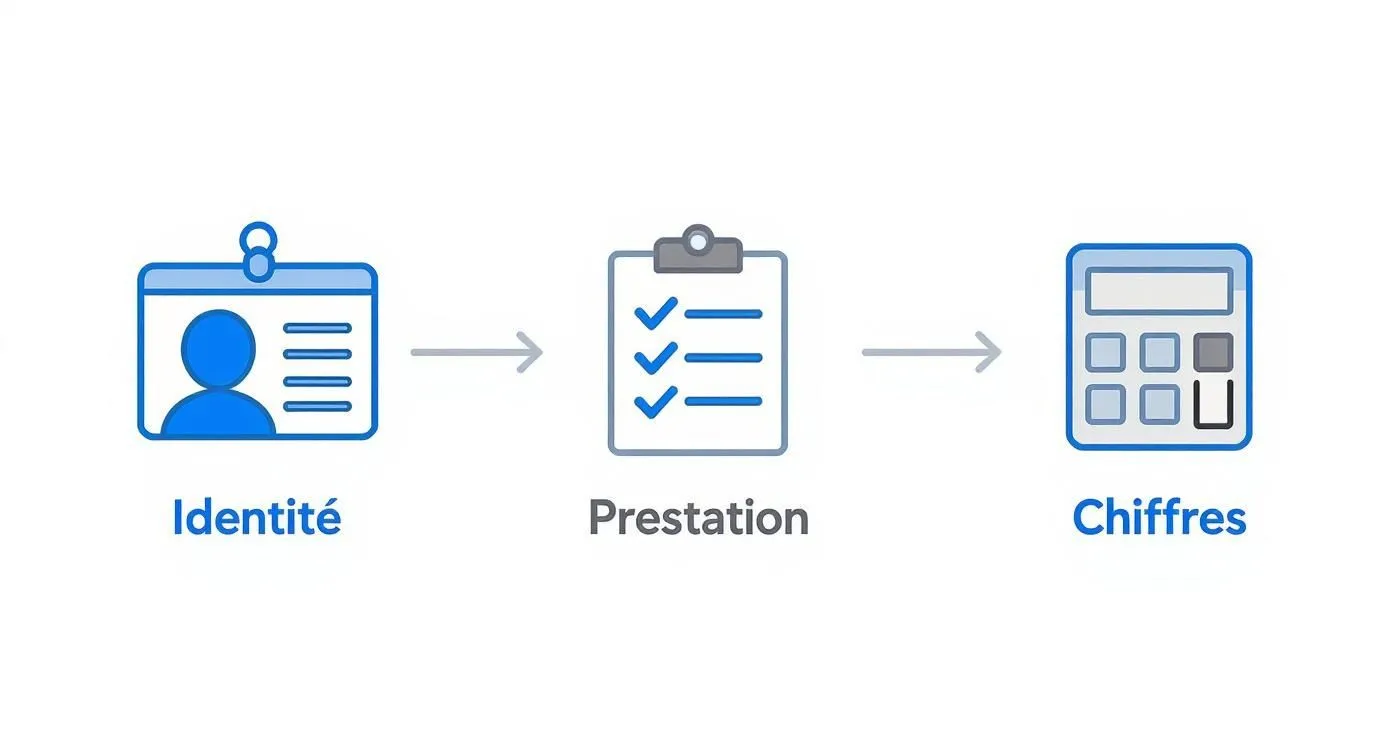
As you can see here, every step is crucial. Approximate identity information or a vague service description, and your entire pricing loses credibility and legal weight.
The VAT puzzle for sole traders
Managing VAT can quickly become a real headache, especially when you’re just starting out as a micro-entrepreneur. Fortunately, most sole traders benefit from the VAT exemption scheme (franchise en base). In practical terms, that means you don’t charge it to your clients. The upside? Often more attractive prices.
As long as your annual revenue stays below certain thresholds, VAT doesn’t apply to you. But be careful, this requires you to include a very specific statement on all your quotes and invoices.
VAT not applicable, art. 293 B of the French Tax Code
Forgetting this small phrase can lead to complications with the tax authorities. So make it a habit to include it systematically in your document templates. To understand the topic fully, our dedicated article on VAT calculation is here to help.
Presenting your prices and requesting a deposit: best practices
The presentation of your rates must be absolutely clear. Your quote should always clearly show these three amounts:
- Total excl. VAT
- VAT amount (or €0 if you’re under the exemption scheme)
- Total incl. VAT
This simple structure removes any ambiguity and reinforces your image as a serious professional.
Finally, a piece of advice: never be afraid to ask for a deposit. A deposit of 30% of the total amount is a perfectly normal and healthy practice in business. It secures your cash flow, helps you cover upfront costs (such as purchasing materials), and above all, it materializes your client’s firm commitment. Simply present it as a standard step for launching the project.
Solid terms and conditions, your best protection
A quote isn’t just a list of tasks with a price at the end. The famous “fine print” at the bottom of the page, your general terms and conditions of sale, are much more than that: they’re your legal safety net. This is where you set the rules of the game to cover yourself in case of a hiccup, a disagreement, or, let’s be honest, a late payment.
Skipping this section is a bit like building a house without foundations. At the slightest problem, everything can collapse. Clear, well-thought-out terms reassure your client and establish your professionalism from the outset.
Don’t leave your offers open indefinitely
This is an essential point, especially if your own costs (materials, subcontractors) can rise. By setting a validity period for your quote, you protect yourself from a client who might come back months later, forcing you to work at a loss.
- Why is it critical? To stay in control of your margins. Imagine your paint supplier raises prices by 15% and a client accepts your old quote six months after it was issued. The difference will come straight out of your pocket.
- What duration should you set? A validity period of 30 days is an excellent standard. It’s long enough for the client to make up their mind, but short enough to protect you from market fluctuations.
A simple sentence is enough: “This offer is valid for 30 days from the date the quote is issued.” It’s clear, concise, and it protects you.
Set clear payment terms to secure your cash flow
Payment is the lifeblood of any business. If your terms are vague, you open the door to delays, misunderstandings, and disputes that will cost you precious time.
It’s entirely within your rights to set the rules of the game. Don’t be afraid to be perfectly clear about deadlines, accepted payment methods (bank transfer, check…), and above all, the consequences of a late payment. The law is on your side.
Here’s what you absolutely need to specify:
- The deposit: We’ve already covered this, but asking for 30% upon signing is a golden practice. It firmly commits your client and lets you cover your initial expenses without touching your cash flow.
- The balance: When should it be paid? At the end of the job? 30 days after delivery? Spell it out in writing.
- Late payment penalties: This is non-negotiable. Include the legal statement about the flat-rate compensation for collection costs of €40 and the applicable late payment penalties.
Define the scope of the job and the importance of the signature
This final section describes how the service will actually take place. You can include the completion timeline, of course, but also each party’s responsibilities. For example, does the client need to provide you with specific access? Do they need to deliver content (text, images) by a deadline for you to proceed?
And finally, the finishing touch, but the most important one: the space for the signature. The handwritten note “Approved, good for agreement,” along with the date and your client’s signature, is the act that turns your quote into a contract. It’s this gesture that seals the agreement and launches your collaboration on solid, secure footing for everyone.
Take it to the next level with quoting software
We’ve all started out that way: juggling Excel spreadsheets to cobble together quotes. It’s a solution that seems simple at first, but quickly becomes a real headache. Between calculation errors slipping in, forgotten legal statements, and the sheer amount of time it takes, you end up exhausted by tasks that should be simple.
Fortunately, there’s a much more professional and reliable alternative: adopting a specialized tool. Quoting and invoicing software isn’t just a gadget. It’s a genuine ally for your business that automates low-value tasks and secures your entire sales process.
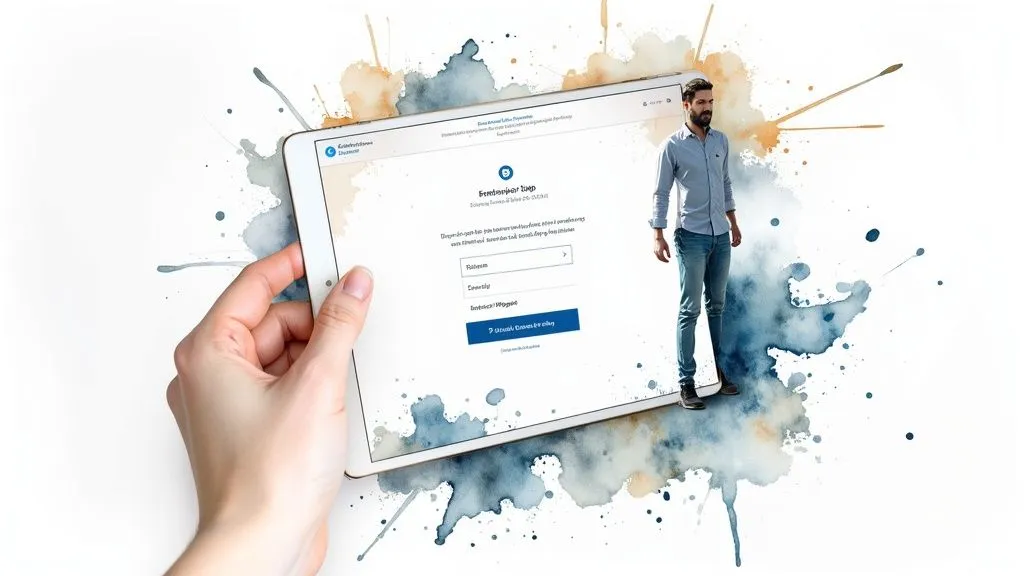
Take a look at a typical interface of management software like Bizyness. You get an instant, clear overview of your activity, far removed from the clutter of a spreadsheet.
The concrete benefits of a dedicated tool
Switching to specialized software brings immediate benefits. These tools are truly designed for freelancers and small businesses, the driving force of our economy.
- Quotes ready in minutes. No more rough copy-pasting. You simply pick your clients and services from ready-made lists. Calculations happen automatically, with no risk of error.
- Your centralized catalog. All your services and products are stored in one place with their prices. This ensures perfect consistency across all your documents.
- Bulletproof numbering. The software takes care of generating sequential quote numbers without gaps, a legal requirement that causes cold sweats in Excel.
The biggest gain, ultimately, is peace of mind. Knowing that every quote you send out is flawless, compliant, and error-free frees you up to focus on what matters most: winning the contract.
This shift to digital is particularly crucial in sectors like construction. In 2023, out of the 381,000 businesses in the sector, 365,000 were small craft businesses with fewer than 10 employees. For these professionals who constantly have to juggle changing material prices and tight schedules, a digital tool for creating quotes is no longer optional, it’s a necessity.
From quote to invoice in a single click
The ideal scenario: your client says “yes” to your quote. With a tool like Bizyness, there’s no need to start over. A single click, and the accepted quote turns into a fully compliant invoice, carrying over all the information exactly as it was.
This time savings is simply enormous over the course of a year. And on top of that, it strengthens your professional image. You show that you’re responsive and organized, and clients love that. To go further, you can check out our guide to finding the best invoicing software for sole traders that truly fits your business.
Answering your questions about quotes
Even with the basics firmly in mind, certain questions about creating quotes come up again and again. That’s completely normal. The idea here is to clear up any remaining doubts with clear, concrete answers, so you can send your commercial proposals with complete peace of mind.
Let’s dive straight into the most frequent questions among freelancers and small business owners.
Does a signed quote really count as a contract?
Yes, and it’s a crucial point to fully understand. As soon as your client signs the quote, with a handwritten “Approved, good for agreement” or a clear electronic validation, this simple document legally becomes a contract.
This is no small matter, because this act firmly commits both parties:
- On your side, you commit to providing the service or product as described, at the agreed price and within the agreed timeframe.
- On your client’s side, they commit to paying you the total amount according to the agreed terms.
That’s precisely why every detail of the quote must be crystal clear before any signature is applied.
Can I charge for a quote?
Generally, no. Custom dictates that a quote is a commercial gesture, and therefore free. That’s the norm in most sectors.
That said, the law allows you to charge for a quote if preparing it requires significant preliminary work.
For example:
- An in-depth, detailed study.
- A trip to a remote site solely to assess the project.
- The creation of plans, mockups, or prototypes.
The golden rule: If you intend to charge for a quote, you must inform the client before starting any work and get their clear agreement on the amount. A good practice is to offer to deduct this cost from the final invoice if they decide to work with you. It’s good business practice and much appreciated.
My client wants me to start right away, without signing the quote. What should I do?
The answer is simple and firm: you never start. A verbal agreement is fine for building trust, but in case of a problem, it’s not worth much legally. Your only real protection is a written agreement.
If a client puts pressure on you, calmly explain that a signed quote is a guarantee for everyone. It’s what secures the collaboration, for them as much as for you.
If a handwritten signature is a logistical hassle, there’s an acceptable alternative: agreement by email, but it must be explicit. A message such as “I confirm my agreement to the terms of your quote No. 2024-058. You may begin the service” will do the trick. Keep this email safely, even though a signature remains the best option.
How do I modify a quote I’ve already sent?
It all depends on its status: signed or not yet signed.
If it’s not yet signed, it’s easy. You simply create a new version of the document. Be sure to number it properly (for example, QUOTE-001-V2) and add the note “cancels and replaces the previous version” to avoid any confusion.
However, if it’s already signed, things change. You can no longer modify it as you please. For any adjustment (an added service, a changed deadline…), you need to draft an amendment to the quote. This supplementary document must list the changes, specify their impact on price and schedule, and of course, be dated and signed by both you and your client.
Ready to take it to the next level? With Bizyness, you can automate creating your quotes, track their acceptance, and turn them into invoices in a single click. Free yourself from paperwork to focus on your real job. Try Bizyness for free today!
