

 Français
Direct and indirect costs: the practical guide
Master direct and indirect costs to optimize your expenses and profitability. A practical guide with concrete examples for your business.

Understanding the difference between direct and indirect costs is more than just a line on a balance sheet. It’s a real management tool for your company’s profitability. Knowing exactly what it costs you to make a product or deliver a service is the foundation for setting fair prices and making sound strategic decisions.
Why mastering your costs is the cornerstone of your profitability

Let’s dive straight into the heart of your financial management. Imagine for a moment that every expense your business incurs isn’t just money going out, but valuable information waiting to be decoded. That’s exactly what the distinction between direct and indirect costs allows you to do.
A direct cost is simple and clear. It’s a cost you can attribute, without a shadow of a doubt, to a specific product or service. Think of the raw materials needed to build a piece of furniture, or the wages of the cabinetmaker who spent hours on it. The allocation is immediate.
By contrast, an indirect cost is more diffuse. It’s essential to the smooth running of the business, but can’t be tied to a single product. Your workshop’s rent, the overall electricity bill, or marketing expenses to promote your entire range are all perfect examples.
The foundation of a pricing strategy that works
Knowing how to juggle these two types of costs is fundamental for several strategic reasons. Without this mastery, you risk flying blind.
- Calculating an accurate cost price: Without a complete picture of all the costs, direct and indirect alike, absorbed by a product, how can you know whether it’s profitable? It’s impossible.
- Setting relevant selling prices: A well-calibrated selling price must not only cover all your costs but also generate a margin. Get the estimate wrong, and you could be selling at a loss without even realizing it.
- Assessing the real profitability of your offers: By breaking down the cost structure of each product, service, or project, you quickly identify your “champions” and the ones dragging down your results. That’s the information you need to decide what to optimize, or sometimes, what to drop.
And don’t think this only matters for big companies! For a freelancer or a small business, it’s the surest way to guarantee that every project is not only a creative success, but also a financial one.
To help you see things more clearly, here’s a handy summary table. A simple cheat sheet so you never have to hesitate again.
Direct vs indirect costs at a glance
A simple table to visualize the key differences between the two types of costs and never mix them up again.
| Criterion | Direct Costs | Indirect Costs |
|---|---|---|
| Allocation | Directly and unambiguously to a single product/service. | Concerns several products, services, or the whole company. |
| Calculation | Simple, the attribution is immediate. | Requires a calculation, an allocation key to be distributed. |
| Concrete example | The wood used to build a table. | The accountant’s salary. |
| Decision-making | Helps set the minimum selling price. | Essential for calculating overall profitability. |
With these fundamentals in mind, you’ve already made great progress. The goal of this guide is simple: to give you the keys to turn this sometimes abstract concept into a concrete, powerful decision-making tool that will boost your company’s performance, whatever its size.
Easily identifying your direct costs

Let’s start with the simplest part: direct costs. These are, in a sense, the visible tip of your cost iceberg. Concretely, they’re all the expenses you can attribute without the slightest hesitation to a specific product or service. The link is so obvious that no clever calculations are needed to make the connection.
Take the example of a cabinetmaker building a custom bookshelf for a client. The wood they buy specifically for this project, the screws, the glue, the varnish… all of that makes up direct costs. The link between these raw materials and the finished bookshelf is beyond dispute.
The same goes for working time. The hours the craftsman spends sawing, assembling, and finishing the piece are a direct cost. If an employee is paid specifically to make this bookshelf, their wages for those specific hours go directly into the cost price of the piece. Learning to spot these costs is the essential first step toward calculating reliable profitability.
Concrete examples by industry
To make everything perfectly clear, nothing beats diving into practical cases. Direct costs obviously vary from one trade to another, but the logic always stays the same: a direct, measurable link to what you sell.
- For a bicycle manufacturer (industry): the steel of the frame, the tires, the pedals, but also the wages of the worker who assembles that bicycle on the production line.
- For a web agency (services): buying a premium WordPress theme for a specific client’s site, or the fees of a freelance developer hired solely for that project.
- For a clothing store (retail): this is the simplest case — it’s the purchase price of the dresses you put on the shelf. Each item has its own purchase cost.
The foolproof trick for recognizing a direct cost? Ask yourself this simple question: “If I weren’t making this product or performing this service, would I still have incurred this expense?” If the answer is no, bingo, it’s almost certainly a direct cost.
The special case of direct labor
Labor is often a heavyweight among direct costs, but be careful, it can also be indirect. Telling the difference is absolutely crucial.
Only hours of work directly spent on production or delivering a service count as direct. What about the administrative assistant’s salary for managing invoices across the whole company? That’s an indirect cost, because their work benefits the business as a whole, not a single project.
The balance between direct and indirect labor changes radically from one sector to another. For example, an INSEE analysis revealed that in non-market services, the cost of direct labor represented 57.4% of total labor costs, compared to only 8.3% for indirect labor. Conversely, in construction, the two are nearly equal. This proves it’s vital to analyze your own cost structure. Feel free to check the INSEE data on labor cost structure to see where you stand.
Fair and accurate allocation of these costs is the foundation of any credible profitability analysis. By mastering this step, you make sure you don’t set prices too low, which would eat into your margin and jeopardize your business’s health.
The challenge of allocating indirect costs

Unlike direct costs, which are obviously tied to a product, indirect costs are a real headache. Picture them as the cement holding your whole company together: essential, but shared across the entire structure. Here we’re talking about your factory’s rent, the overall electricity bill, or your administrative team’s salaries.
These costs benefit your entire business, not just one specific product or service. They’re just as useful for the table you’re making as for the chair you’re assembling right next to it. The real challenge is distributing them fairly. How do you attribute a fair share of these common expenses to each product to calculate a cost price that’s both complete and realistic?
This is a critical step. Get it wrong, and your entire profitability analysis collapses.
Pitfalls to absolutely avoid
Poorly allocating indirect costs — or worse, ignoring them — is like flying a plane without instruments, in thick fog. Entrepreneurs often fall into two major traps, sometimes with dramatic consequences.
-
Burying your head in the sand and ignoring indirect costs: Some people calculate their costs based solely on raw materials and direct labor. The result? They show a gross margin that looks great on paper, but which, in reality, doesn’t even cover overhead.
-
Allocating expenses on a whim: The famous “let’s put 10 € of overhead on each product and see how it goes” method. This is just as risky. This rough-guess approach risks overvaluing the cost of a simple item and, conversely, undervaluing that of a complex product that consumes far more shared resources (machine time, supervision, etc.).
Both mistakes lead to the same conclusion: you could be selling products at a loss while thinking they’re profitable.
Calculating full cost isn’t just an accounting exercise. It’s a strategic management tool. It tells you the truth about each product’s performance and keeps you from setting prices that put your business at risk.
Why a rigorous method makes all the difference
By adopting a clear allocation method, you turn this complexity into a real advantage. Precise allocation of direct and indirect costs gives you the power to:
- Identify your star products: You finally discover which offers are driving your growth and which ones are dragging down your finances.
- Set your prices with confidence: No more guesswork. You determine rates that cover all your costs and protect your margin.
- Optimize your operations: By seeing exactly where your indirect resources go, you can spot savings opportunities (energy consumption, unnecessary administrative costs, etc.).
Without this rigor, you risk making decisions based on distorted figures. For example, dropping a product you think is unprofitable, when in reality it was simply carrying a disproportionate share of overhead. Now let’s look at how to set up a reliable allocation method.
How to allocate your indirect costs without getting it wrong
Imagine for a moment. How do you attribute a share of your workshop’s rent to a simple chair, and another share to the table made right next to it? That’s the whole challenge of allocating indirect costs. This step can seem complex, but it’s absolutely crucial.
If your allocation is off, the cost price of your products will be distorted. And inaccurate cost prices inevitably lead to poor strategic decisions. That’s the role of cost accounting: making sure each product bears its fair share of shared costs.
Fortunately, there are proven techniques to bring clarity. The most recognized and robust is undoubtedly the cost center method.
This diagram perfectly illustrates the path to follow to break down your indirect costs in a logical and structured way.
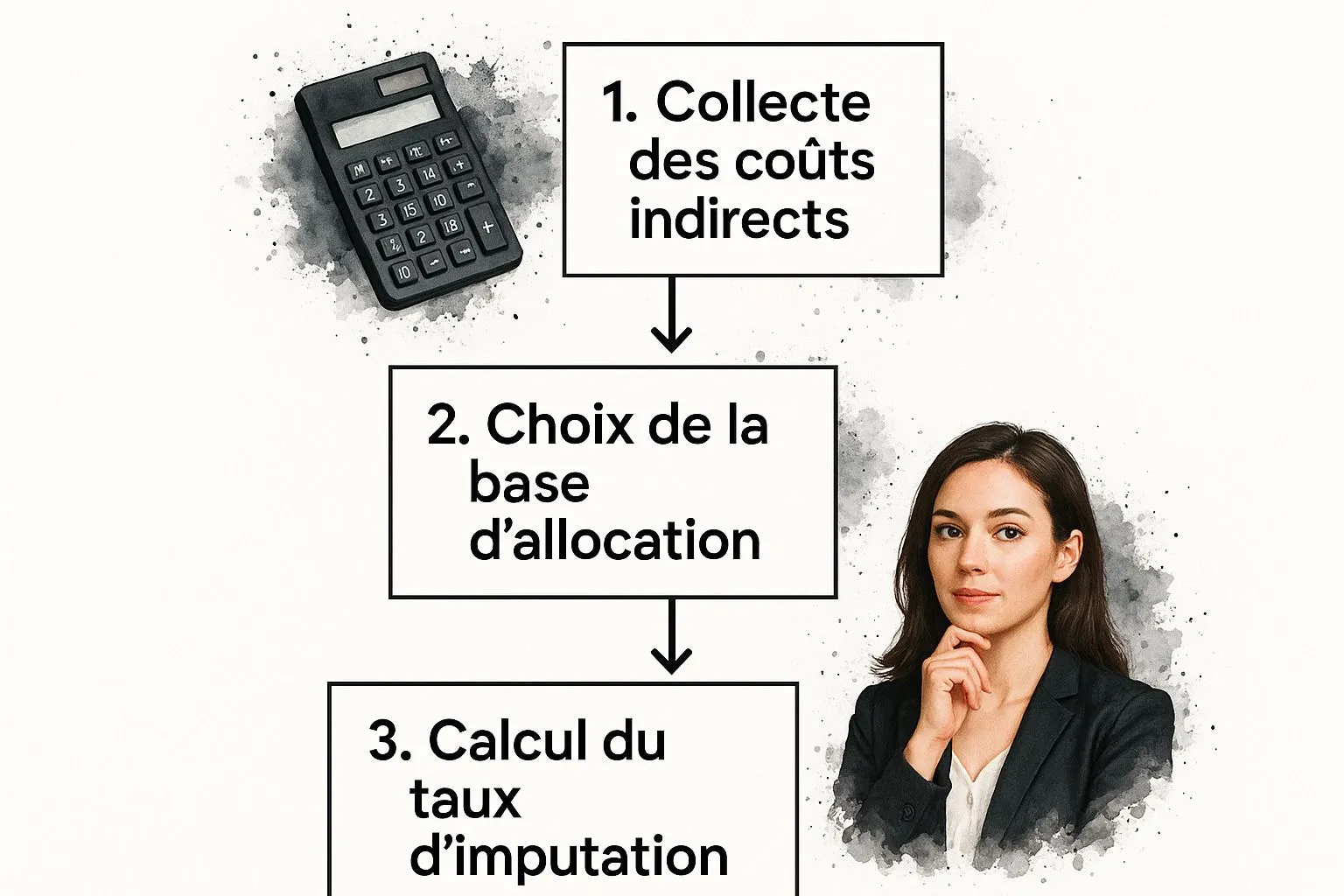
As you can see, everything starts with collecting the costs. Next comes choosing a relevant allocation key, which will let you calculate an allocation rate for each product.
How does the cost center method work?
The idea behind this method is to break the company down into logical sections, called “cost centers.” Think of them as departments or business units: the production workshop, the administrative department, the maintenance team, etc. Each center groups together the indirect costs that belong to it.
Once these centers are defined, each is assigned a “cost driver.” This is simply a unit of measurement that reflects the center’s activity. This will be our famous allocation key.
Concretely, the process unfolds in 5 steps:
- Identify the cost centers: Start by mapping out the company’s different functions. A distinction is often made between primary centers (directly linked to production, like the workshop) and support centers that back them up (administration, HR, maintenance).
- Assign the indirect costs: Each invoice (rent, electricity, support staff wages…) is then dispatched to the relevant center(s).
- Choose the cost driver: For each center, pick the indicator most representative of its activity. For a workshop, this is often machine-hours or labor-hours. For administration, you might base it on the number of invoices processed.
- Calculate the cost per unit: This is a simple calculation. Divide the total cost of the center by the total number of units of the cost driver. For example: Total workshop cost / Total machine-hours.
- Allocate the costs to products: Finally, assign each product its share. If making a table required 3 machine-hours, it’s charged 3 times the cost of the “machine-hour” driver.
This approach is particularly powerful in the industrial sector. The French full-cost method, enshrined in the Plan Comptable Général (General Chart of Accounts), is in fact built on this very principle. And for good reason: in industry, indirect costs can represent up to 60% of a product’s total cost. Precision, then, is not optional.
Are there other methods?
The cost center method is very reliable, but it can be cumbersome to set up for a small business. Other, more direct approaches exist.
The simplest alternative is to allocate indirect costs in proportion to revenue. If a product accounts for 30% of your sales, it’s assigned 30% of total indirect costs. Simple, right?
This approach has the merit of being fast. Its big drawback? It sorely lacks precision. It assumes all products consume resources the same way, which is rarely true. A complex product requiring a lot of administrative support will be assigned the same costs as a simple one if their revenue is identical.
To help you see things more clearly, here’s a comparison table of the different approaches.
Which allocation method should you choose?
This comparison will help you weigh the pros and cons of each approach to choose the one that best matches your company’s reality.
| Method | Principle | Ideal For | Pitfalls to avoid |
|---|---|---|---|
| Cost centers | Group costs by function (centers) and allocate them via a measure of the center’s activity (cost driver). | Industrial or service companies with varied processes and high indirect costs. | The complexity of setting it up and choosing irrelevant cost drivers, which would distort the calculations. |
| Percentage of revenue | Allocate costs in proportion to the revenue generated by each product/service. | Small businesses or companies with a very homogeneous product range that consume resources similarly. | Lack of precision. This method can mask the unprofitability of a product that consumes a lot of resources but generates little margin. |
| Direct cost basis | Use an allocation key based on a direct cost, such as direct labor cost or raw material cost. | Companies where a direct cost is clearly the main driver of indirect costs (e.g. supervision tied to hours worked). | The risk that the correlation between the chosen direct cost and indirect costs isn’t actually that strong. |
| ABC method | Identify activities (rather than functions) and allocate their costs based on the resources (cost drivers) consumed by products. | Companies with a wide diversity of products and customers, where complexity is a major cost factor. | Its high complexity and implementation cost, often reserved for large organizations. |
The choice of method is not trivial. It has a direct impact on how you see performance.
Ultimately, properly allocating all your costs, whether direct or indirect, is the foundation of sound management. It’s what lets you know the real profitability of each product — vital information to better understand how to calculate your break-even point. By choosing the right method, you give yourself the means to run your business based on reliable data, not guesswork.
Automating the calculation with the right tools
Let’s be honest, calculating and allocating your direct and indirect costs by hand is a tedious, repetitive task… and an open door to errors. A simple typo in a spreadsheet, and your whole profitability calculation is thrown off. The risk? Making strategic decisions based on data that’s completely off. Fortunately, technology can turn this chore into a real asset.
Modern management tools, like Bizyness, are designed precisely to take over these calculations and ensure their reliability. Forget the hours lost juggling numbers. The goal is clear: give you back time to focus on what matters — analyzing this data and steering your growth intelligently.
Specifically, how does software make your life easier?
A good management tool doesn’t just line up numbers in columns. It turns your raw expenses into strategic information. As soon as you record an invoice, for example, you can tag it as a direct or indirect cost, and even link it directly to a project, a client, or a product line.
This automation completely changes the game in several ways:
- Data reliability: Less manual entry means mathematically fewer human errors. Your figures are finally trustworthy.
- Massive time savings: Tasks that used to take hours (sorting expenses, generating reports…) are now done in minutes.
- A clear, real-time view: You have dashboards in front of you that instantly show your cost breakdown. Managing your business becomes much more intuitive.
This approach is a breath of fresh air, especially for entrepreneurs juggling a thousand hats, from invoicing to tax filings. In fact, if you want to see how much automation can help with other complex topics, take a look at our guide on managing VAT as a sole trader.
With Bizyness’s analytical management dashboard, for example, you can instantly see where your money is going.
This kind of overview lets you spot the heaviest cost items at a glance and track how they evolve.
The real advantage is that you can set your own allocation keys directly in the tool. Once that’s done, the software automatically handles assigning indirect costs to each product or service. In just a few clicks, you get an ultra-precise per-product profitability report, without ever having to open a single spreadsheet.
The origins of this accounting distinction
To really grasp the difference between direct and indirect costs, it helps to understand where it comes from. It’s far from a modern accountant’s whim. Its roots run much deeper, reaching into the heart of French fiscal history, well before the rise of cost accounting.
Let’s take a little trip through time. This separation we apply today to a company’s costs directly echoes how taxes were organized under the Ancien Régime. Even back then, royal power drew a very clear line between two major tax families.
The legacy of taxation past
On one side, there were direct taxes. The best known is undoubtedly the “taille,” a personal tax that targeted specific individuals or property, based on their estimated ability to pay. It was a clear, direct assignment.
On the other side were indirect taxes. The perfect example is the famous “gabelle,” a tax on salt. This tax didn’t target anyone in particular; it touched everyone anonymously, simply through the consumption of an essential good.
This fundamental distinction between what is directly attributable and what is shared by everyone shaped the management of state finances for centuries. To learn more, feel free to explore the history of taxation in France.
In short, cost accounting simply transposed an old fiscal principle into business management: what is directly attributable (the taille) and what is shared by everyone (the gabelle).
This historical lineage explains why the distinction between direct and indirect costs is so deeply rooted in our financial logic. It’s not an arbitrary classification, but the legacy of an allocation method that has proven itself over the centuries.
Frequently asked questions about your business’s costs
To go even further, let’s review some of the questions that come up most often among entrepreneurs. These are practical points that will help you better manage your business day to day.
Is a salesperson’s salary a direct or indirect cost?
Now that’s an excellent question, a real textbook case! The answer isn’t so simple, because it all depends on how their pay is structured.
The fixed portion of their salary is an indirect cost. Why? Because you pay it every month, regardless of sales volume. This cost supports the company’s sales effort as a whole; it isn’t tied to a specific product.
Conversely, their sales commissions are direct costs. They’re directly tied to the sale of a specific product or service, and their amount varies accordingly. It’s a perfect example of a mixed cost, which shows just how much a detailed analysis is needed.
How can I start allocating my indirect costs simply?
For a small business or a sole trader, there’s no need to bring out the heavy artillery. By far the simplest and fastest method is allocation in proportion to revenue.
Imagine one of your products accounts for 20% of your total sales for the month. With this method, you simply assign it 20% of your indirect costs (rent, electricity, etc.). It’s certainly not as precise as more complex calculations, but it’s an excellent starting point for getting a first sense of your full costs.
Why is rent almost always considered an indirect cost?
Rent is really the textbook example of an indirect cost. It covers the entire space you need to work: whether that’s the production workshop, the administrative offices, or the storage area.
Even if you physically dedicate a corner of the workshop to a single product, the overall cost of the lease benefits your entire business. It’s therefore essential to allocate it across all products so each one bears its fair share of overhead. Forgetting this would completely distort the profitability calculation for each product.
Managing your costs well is a pillar of your success, just as much as a good tax strategy. To dig deeper into this topic, check out our advice on tax optimization for sole traders, the perfect complement to this guide.
Don’t let administrative complexity hold back your growth any longer. With Bizyness, automate your bookkeeping, track your costs in real time, and make truly informed decisions. Try Bizyness for free and focus on what really matters: your business.
