

 Français
Boost your operations with an electronic document management solution
Adopt an electronic document management solution to automate your accounting and secure the growth of your e-commerce business.

An electronic document management solution (EDM) is much more than a simple digital filing tool. For an online seller, it’s the central nervous system that turns the chaos of invoices, purchase orders and receipts into an organized, intelligent flow of information. The goal? Put an end to errors and give you back precious time.
Why manual document management is holding back your e-commerce business
Imagine for a moment that your accounting were a completely disorganized library. Every sale you make on Shopify or Amazon is a new book dumped onto a pile that’s already on the verge of collapse. Unfortunately, that’s the daily reality for many online sellers who still handle their invoices, purchase orders and payment receipts by hand.
This somewhat “artisanal” approach can work in the very beginning. But it quickly becomes a massive brake on your growth. Each document has to be downloaded one by one, renamed, meticulously filed, then entered into a spreadsheet or your accounting software. This repetitive work isn’t just a monumental waste of time — it’s also an open door to a multitude of errors.
A simple typo on an amount, the wrong VAT rate applied, and trouble begins: tax complications that can be costly, plus hours spent correcting everything. For those selling internationally, the complexity ramps up a notch with the management of OSS/IOSS schemes, where every transaction demands constant attention.
The hidden costs of document chaos
Lost time is obviously the first cost that jumps out. It’s estimated that employees can spend up to 40% of their day manually searching for information. For an entrepreneur, that’s time not spent on marketing, customer service or new product development. But the real costs — the most insidious ones — lie elsewhere:
- Tax compliance risks: With manual tracking, it’s nearly impossible to guarantee that every VAT return is accurate, especially when juggling complex marketplace flows.
- Lack of financial visibility: Without centralized, constantly up-to-date data, it’s impossible to get a clear, real-time view of your profitability. You’re flying blind.
- Inefficient collaboration: Sending piles of documents in bulk to your accountant? That’s the best way to drive up their fees and slow down the delivery of your financial statements.
Manual management isn’t a saving, it’s technical debt that piles up. Every day without automation makes the eventual transition more complex and more costly, actively holding back your ability to scale.
Switching to an electronic document management solution is therefore not a luxury, but a genuine strategic lever. It’s also a deep-rooted trend: the French EDM market reached 9.5 billion euros, growing 5.3% annually. This clearly shows how important digitization has become for online businesses.
In short, abandoning manual processing is the best way to prepare calmly for your business’s growth. To go further, check out our complete guide on the fundamentals of document management for businesses.
How an EDM solution really works
To truly grasp how an electronic document management solution works, forget the image of a simple online hard drive. Think instead of a brilliant digital assistant, available 24/7 for your business. Its mission goes well beyond simple storage: it processes your documents intelligently to free up precious time for you.
Where a tool like Google Drive merely keeps your files, an EDM analyzes them, understands them, and automates the tasks that follow. It turns the chaos of paper invoices and scattered PDFs into clean, structured data ready to use for your accounting. It’s a multi-step process, where every link in the chain is designed to streamline your administrative management.
The diagram below perfectly illustrates what EDM aims to eliminate: a manual process that’s a source of wasted time, costly errors and administrative complexity.
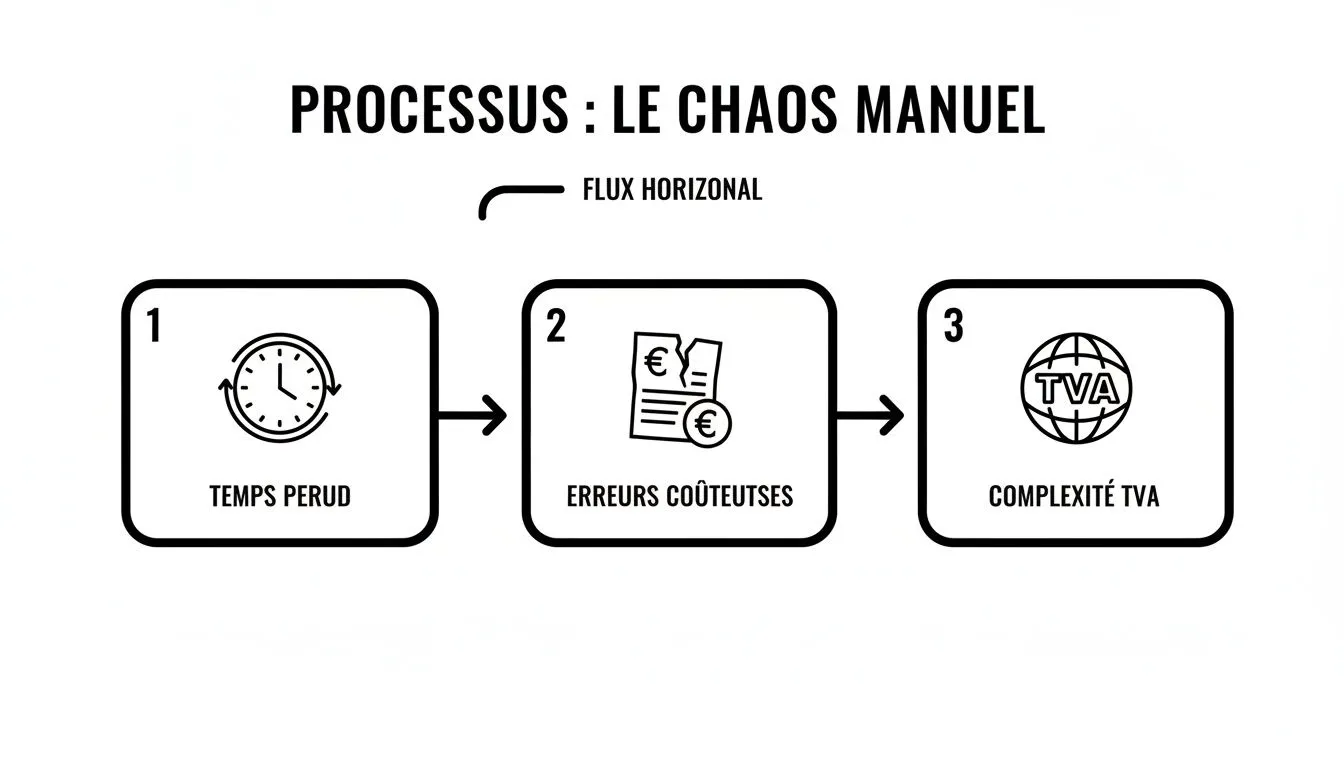
This visual makes it clear: without automation, every step becomes a bottleneck that slows your growth and multiplies risk.
1. Collect and centralize all documents
Everything starts with gathering the paperwork. A good EDM solution won’t leave you drowning in manual downloads. It plugs directly into your various sources:
- Dedicated mailboxes: Automatically forward invoices received by email to a specific address, and the EDM handles the rest.
- E-commerce connectors: It fetches sales invoices directly from your Shopify or WooCommerce stores.
- Payment platforms: It syncs with Stripe or PayPal to retrieve transaction receipts.
- Mobile scanning: Simply take a photo of a receipt or expense note with your smartphone to bring it into the system.
The idea is simple but powerful: create a single entry point for all your documents, whether they were born digital or started life on paper.
2. Read and extract data intelligently
Once the document is in the system, the magic happens thanks to OCR (Optical Character Recognition). The software doesn’t just see an image; it reads it, deciphers it, and understands its content.
Think of OCR as a translator capable of converting the visual language of a PDF invoice into structured data, like an Excel table. It identifies and isolates the key information: the supplier’s name, the date, the pre-tax amount, the VAT, the total amount, and so on.
This technology is the key to eliminating 100% of manual data entry. No more typos and no more time wasted re-typing figures. To give you an idea, a study showed that an employee spends on average 18 minutes locating a single paper document. With an EDM, it takes a few seconds.
3. Index and file automatically
After extracting the information, the EDM uses it for indexing. It’s as if your digital assistant were sticking ultra-detailed labels on every document. Each invoice, each receipt is enriched with “metadata” (supplier, date, expense type…), which lets you find it instantly with a simple search.
No more need to remember the exact file name or the folder you filed it in. Type “Amazon invoice March 2024” and the document appears immediately. To go further, take a look at how business process automation can revolutionize your organization.
4. Automate approval workflows
A high-performing EDM doesn’t stop at filing. It becomes the conductor of your processes thanks to workflows, or approval circuits. Imagine an expense report exceeding a certain amount being automatically sent to the right manager for approval, before heading straight to accounting.
This system ensures every document follows a predefined path, fully traceable and secure. It ensures compliance, speeds up decisions, and turns a simple electronic document management solution into a genuine productivity engine for your e-commerce business.
What are the concrete benefits for online sellers?
Switching to an electronic document management solution is much more than a simple technical upgrade for an online seller. Concretely, it changes the game day to day. We’re not just talking about better filing — it’s about equipping yourself with a genuine engine to make your business smoother, more profitable and more resilient.
In the world of e-commerce, every minute counts. The line between a productive day and a race against the clock often comes down to time lost on administrative tasks with no real added value. That’s precisely where EDM makes all the difference: it gives you that time back.
Automate to free up precious time
Imagine never having to manually enter an invoice from your Shopify store again. Think of all those hours spent downloading, one by one, the receipts for your ad campaigns on Facebook Ads or Google Ads. Automation puts an end to all that.
A modern EDM plugs directly into your various sales platforms and spending channels. It fetches, reads and processes documents for you, without you lifting a finger. The numbers speak for themselves: an employee can spend up to 40% of their time manually searching for information. By automating, you get that time back to invest where it really matters: marketing, customer service or growth strategy.
Strengthen tax reliability and compliance
Taxation is often the headache for online sellers, especially when selling internationally. One small error on a VAT rate, and you risk penalties or costly corrections.
An EDM solution designed for e-commerce brings you peace of mind on this front. It ensures the correct VAT rates are applied, based on the customer’s country and the product type. It also lays the groundwork for your filings, notably for the OSS (One-Stop Shop) and IOSS (Import One-Stop Shop) schemes, greatly simplifying the process.
In the event of an audit, your accounting records file (FEC) must be flawless. With an EDM, this mandatory document is generated automatically and continuously updated. Your accounting isn’t just accurate anymore — it’s bulletproof and fully compliant with tax authority expectations.
Get real-time financial visibility
Running your business without clear figures is a bit like navigating blind through fog. Manual management, with its inevitable data-entry delays, gives you a snapshot of your situation that’s already several days or even weeks old. It’s hard to make the right decisions at the right time.
An EDM, on the other hand, centralizes all your financial data and presents it on clear, digestible dashboards. You can track in real time:
- Your revenue by sales channel (Shopify, Amazon, etc.).
- Your margins, comparing revenue against acquisition costs.
- Your cash flow, with precise tracking of inflows and outflows.
This 360° view lets you react on a dime. You spot a trend, adjust your prices, or pull the plug on an underperforming ad campaign. You no longer suffer through your accounting — you use it as a genuine steering tool.
To better visualize the impact, here’s a quick “before” vs “after” EDM comparison.
Comparison between manual document management and automated management
This table highlights the key differences between traditional manual processes and processes automated by an integrated EDM solution like Bizyness, focusing on the daily tasks of an online seller.
| Task | Manual Management (without EDM) | Automated Management (with Bizyness EDM) |
|---|---|---|
| Sales invoice entry | Manual entry of every Shopify, Amazon, etc. invoice. High risk of errors. | 100% automatic collection and entry. No manual intervention. |
| Receipt collection | Manual download of Facebook Ads, Google Ads, supplier invoices. | Automatic retrieval via connectors. Instant centralization. |
| VAT verification | Manual, complex check of VAT rates for each country. | Automatic application of VAT rules (OSS/IOSS). Reliability guaranteed. |
| Cash flow tracking | Lagging view based on entries. Hard to know your real-time position. | Live-updated dashboard. Clear, immediate visibility. |
| Accounting prep | Exporting Excel files, emailing documents to the accountant. | The accountant accesses pre-accounted data directly. |
| Document archiving | Storage on a hard drive or basic cloud (Google Drive, Dropbox). | Legally binding archiving, secure and compliant with regulations. |
This table clearly shows that automation isn’t a luxury but an essential performance lever for simplifying management and securing the business.
Secure documents and simplify collaboration
Data security is not optional. An EDM gives you legally binding archiving, meaning your digital documents carry the same legal value as their paper originals. Everything is stored on secure, encrypted servers, safe from loss or intrusion.
Finally, collaboration with your accountant becomes child’s play. No more back-and-forth emails with dozens of attachments. Your accountant logs into a single platform where all documents are already collected, filed and pre-processed. They save precious time — which can translate into better-controlled fees — and can finally focus on their real role: advising you.
How to choose the right electronic document management solution
Not all EDM solutions are created equal, especially when operating in the demanding world of e-commerce. Choosing the wrong tool is a bit like trying to sail the ocean in a boat built for a lake — you risk taking on water fast. A generic electronic document management solution can file invoices, but it will never understand the complex financial flows of Amazon, Stripe payments, or the subtleties of international VAT.
For an online seller, the choice must go well beyond basic features. It’s about finding a technology partner that speaks the same language as your business. That means examining specific criteria, tailored to the unique challenges of online selling, to make sure the tool you choose becomes a genuine growth accelerator, not just a digital filing cabinet.
Security and compliance above all
You don’t play around with the security of financial data. Before even looking at features, the very first question to ask is: where and how will my documents be stored? Favor solutions that guarantee hosting on secure servers, ideally in Europe, to align with GDPR. That’s the bare minimum.
The e-invoicing reform, which will make EDM mandatory in France, has a clear goal: reduce VAT fraud by several billion euros. Starting September 2026, receiving electronic invoices will be mandatory for all businesses. Yet 52% of small and medium businesses fear data loss. This figure shows just how vital choosing a secure EDM solution is to ensure compliance and long-term viability. To learn more, check out the France Num 2025 barometer.
Another decisive criterion is the certification of the solution, particularly if it offers legally binding archiving. This ensures your digital invoices and receipts carry exactly the same legal value as paper in the event of a tax audit. Think of it as essential insurance for the longevity of your business.
Native integration with your e-commerce ecosystem
A good EDM for online sellers should be a hub, not a desert island. Its ability to plug natively into your everyday tools is arguably the most important criterion for automation to work seamlessly.
Make sure the tool connects directly with:
- Your sales platforms: Shopify, WooCommerce, Amazon, Etsy… The solution must be able to pull the details of every order without you lifting a finger.
- Your payment processors: Stripe, PayPal… This is crucial for reconciling sales with real money flows and managing fees without tearing your hair out.
- Your marketing tools: Google Ads, Facebook Ads… Imagine never having to chase down your ad campaign invoices again! That’s what good integration delivers.
A connection via robust APIs guarantees that data flows smoothly and reliably, putting an end to entry errors and endless manual exports.
OCR accuracy and workflow flexibility
Optical character recognition (OCR) is the true engine of your automation. An electronic document management solution worthy of the name must have ultra-high-performing OCR, capable of accurately reading invoices of every shape, even the most unusual ones. The best way to find out? Ask for a demo and test it with your own documents.
But reading is one thing. Acting is better. Workflow flexibility is what will make all the difference. The software should let you design your own automation rules. For example, a classic scenario might look like:
- Collect a supplier invoice automatically from a mailbox.
- Extract key information (amount, VAT, date) using OCR.
- Assign the expense to the right accounting category, with no intervention.
- Send the invoice for approval if it exceeds a certain threshold.
- Archive everything securely once the workflow is complete.
This ability to shape your internal processes is what turns a simple storage tool into a genuine financial automation platform, ready to evolve at the same pace as your business.
How Bizyness automates your accounting from A to Z
Now that we’ve seen how to choose an electronic document management solution, let’s get practical. How does a platform like Bizyness actually turn everyday chaos into a clear financial flow? The answer comes down to one word: automation. Bizyness doesn’t just file your documents; it acts as the central brain of your accounting.
Imagine a perfectly oiled assembly line where every part arrives at the right time, with no manual intervention. That’s exactly what Bizyness sets up for your financial data, from the sale on your store all the way to your accountant preparing the financial statements. Let’s follow a transaction’s journey to see how it all fits together.
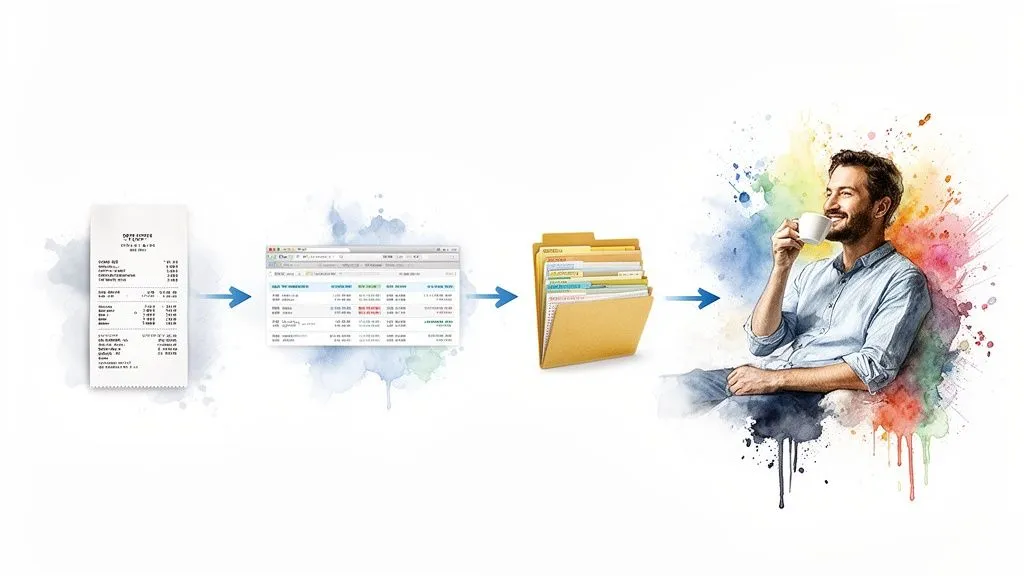
From the click of a purchase to a compliant invoice
It all starts with a sale. A customer orders a product from your WooCommerce or Shopify store. Normally, that’s the start of a series of tasks: generate an invoice, check the correct VAT rate, record the payment, file the document…
With Bizyness, this process is instant and completely invisible. Connected to your store, the platform detects the sale in real time. It automatically generates a 100% compliant invoice, with the correct legal wording, and immediately links it to the order.
Take a concrete example: a sale to a customer in Germany. Bizyness identifies the destination country and applies the correct German VAT rate, in line with the OSS one-stop-shop rules. The accounting entry is generated right away, without you having to think about it.
Smart collection of expense receipts
Of course, your business isn’t just about sales. It also generates a multitude of expenses: Facebook ads, software subscriptions, raw material purchases… and every expense requires a receipt.
Bizyness automates this often-tedious collection. You can connect your mailboxes so that supplier invoices are pulled in and processed as soon as they arrive. For paper receipts, a simple photo from the mobile app is enough.
The goal is simple: create a single entry point for all your accounting records. No more chasing receipts or logging into ten different platforms every month-end. Bizyness centralizes everything for you.
This centralization is the first step toward flawless accounting. It sets the stage for the next step, an even more crucial one: reconciliation.
Bank reconciliation becomes child’s play
The real magic happens when Bizyness reconciles the documents it has collected with your bank transactions. The platform syncs with your bank accounts and payment processors like Stripe or PayPal.
Thanks to its powerful OCR, Bizyness reads expense invoices and extracts the amounts, dates and suppliers. Then its smart algorithm links them to the matching lines on your bank statement. A €150 Google Ads invoice is automatically reconciled with the €150 debit on your account.
The case of PayPal payments, often a nightmare for online sellers, illustrates this power well. Bizyness is able to untangle the complex web of transactions, fees and grouped transfers to reconcile each individual sale with the funds actually received.
The e-invoicing mandate is approaching fast, and it’s essential to prepare properly. With 70% of French small and medium businesses not ready for the September 2026 deadline, a solution like Bizyness offers a decisive head start. It turns a regulatory constraint into an opportunity to optimize your entire financial cycle. To learn more, you can read this article on DAF-Mag.
Smooth collaboration with your accountant
The result of all this automation? Clean, structured accounting data, ready to use. No more chasing your accountant for missing receipts or hours spent deciphering your Excel files.
They simply log into Bizyness to access an environment where:
- All sales are recorded with the correct accounting entries.
- Every expense is documented and reconciled with its bank transaction.
- VAT returns are pre-filled and reliable.
- The accounting records file (FEC) is generated with one click.
In short, Bizyness doesn’t just store documents. It orchestrates your entire financial flow to turn raw data into flawless accounting, freeing up precious time so you can focus on what really matters: the growth of your e-commerce business.
Frequently asked questions about EDM for e-commerce
Getting started with electronic document management can raise quite a few practical questions. To help you out, we’ve gathered here the answers to the questions online sellers ask most often.
Is EDM already mandatory for my online store?
Not yet, at least not for issuing invoices between businesses (B2B). But watch out — the e-invoicing reform is coming fast, and it’s best to prepare.
The first milestone is set for September 1, 2026. From that date, all businesses in France, regardless of size, will need to be equipped to receive invoices in electronic format. The obligation to issue these invoices will then follow gradually.
What does this mean in practice? Even if you’re not yet required to send dematerialized invoices, your suppliers will start doing so. You’ll therefore need to be able to accept and process them correctly. Thinking about EDM today isn’t a burden — it’s a strategic head start to be ready on day one.
What’s the difference between regular cloud storage and a real EDM solution?
That’s an excellent question, and the confusion is quite common. Think of a cloud service like Google Drive or Dropbox as a simple digital filing cabinet. You drop files in, sort them by hand into folders… and that’s about it.
A genuine electronic document management solution is much more than that. Imagine a cabinet that reads, understands and works for you.
Here’s what fundamentally sets them apart:
- Built-in intelligence: EDM, thanks to OCR, reads the content of your documents (amounts, dates, VAT) and extracts the key information. A cloud service just stores the file.
- Task automation: It can trigger actions on its own, like sending an invoice to the right department for approval or reconciling it with a payment.
- Powerful search: You no longer search only by file name, but also by content. For example: “find me all invoices over €500 from this supplier.”
- Security and compliance: An EDM ensures legally binding archiving. This means your documents retain their legal value, an essential point for complying with applicable rules. If this topic interests you, our article on document retention periods has more.
To put it simply: the cloud stores, the EDM thinks and acts.
How long does it take to set up Bizyness?
We know an online seller’s time is precious. That’s why we designed Bizyness for near-instant onboarding. Forget about setup projects that drag on for weeks.
The process couldn’t be simpler. In a few clicks, you connect your stores (Shopify, WooCommerce, etc.) and your payment accounts like Stripe or PayPal. Once that’s done, the platform gets to work retrieving and processing your documents.
Automation kicks in instantly, without you having to configure complicated rules. You’ll see the first results, like the automatic creation of sales invoices, within the first hours of use.
Ready to take your financial management to the next level? With Bizyness, accounting is no longer a chore that follows your sales, but their logical, automatic extension. Discover how our platform can save you a huge amount of time and secure your growth. Try Bizyness today.
