

 Français
Employee Survey Questionnaire: An Effective Guide
Discover how to build a successful employee survey questionnaire with our practical tips. Optimize your HR survey right now!

Why your business needs an employee survey questionnaire that actually works
Think you know your employees? Let me have my doubts. After years working with French companies, I’ve noticed that many are flying blind when it comes to their teams. A well-crafted employee survey questionnaire can truly change the game for HR. The real question isn’t whether you should use one, but how to do it intelligently to extract valuable insights. I’ve seen companies gather incredibly useful data, and others drown in a sea of useless information. Why?
It all comes down to relevance and purpose. Take the example of an IT services company that used a questionnaire to pinpoint its employees’ training needs. No more guesswork, just hard data! They were able to precisely identify skill gaps and adjust their training plan accordingly, boosting team performance. I also worked with a retail company that used a questionnaire to assess customer satisfaction. The result: identifying weak points in the purchase journey and adjusting their commercial strategy.
These concrete examples clearly show the impact of a well-designed questionnaire. Skills assessment, satisfaction analysis… the possibilities are vast. In France, rolling out an employee survey questionnaire can also foster more constructive social dialogue, by giving employees a voice on their working conditions and aspirations. In fact, the 2025 Labor Needs Survey (BMO) from France Travail collected no fewer than 446,000 responses on companies’ hiring needs. A figure that speaks volumes about the importance of data collection for understanding the labor market.
A well-designed questionnaire lets you make informed decisions, improve performance, and create a more positive work environment. This isn’t just about ticking boxes — it’s about building a powerful tool that serves your company and your employees. In the rest of this article, we’ll look together at how to create a truly effective questionnaire, tailored to the French context and its regulations.
Setting objectives that truly transform your organization
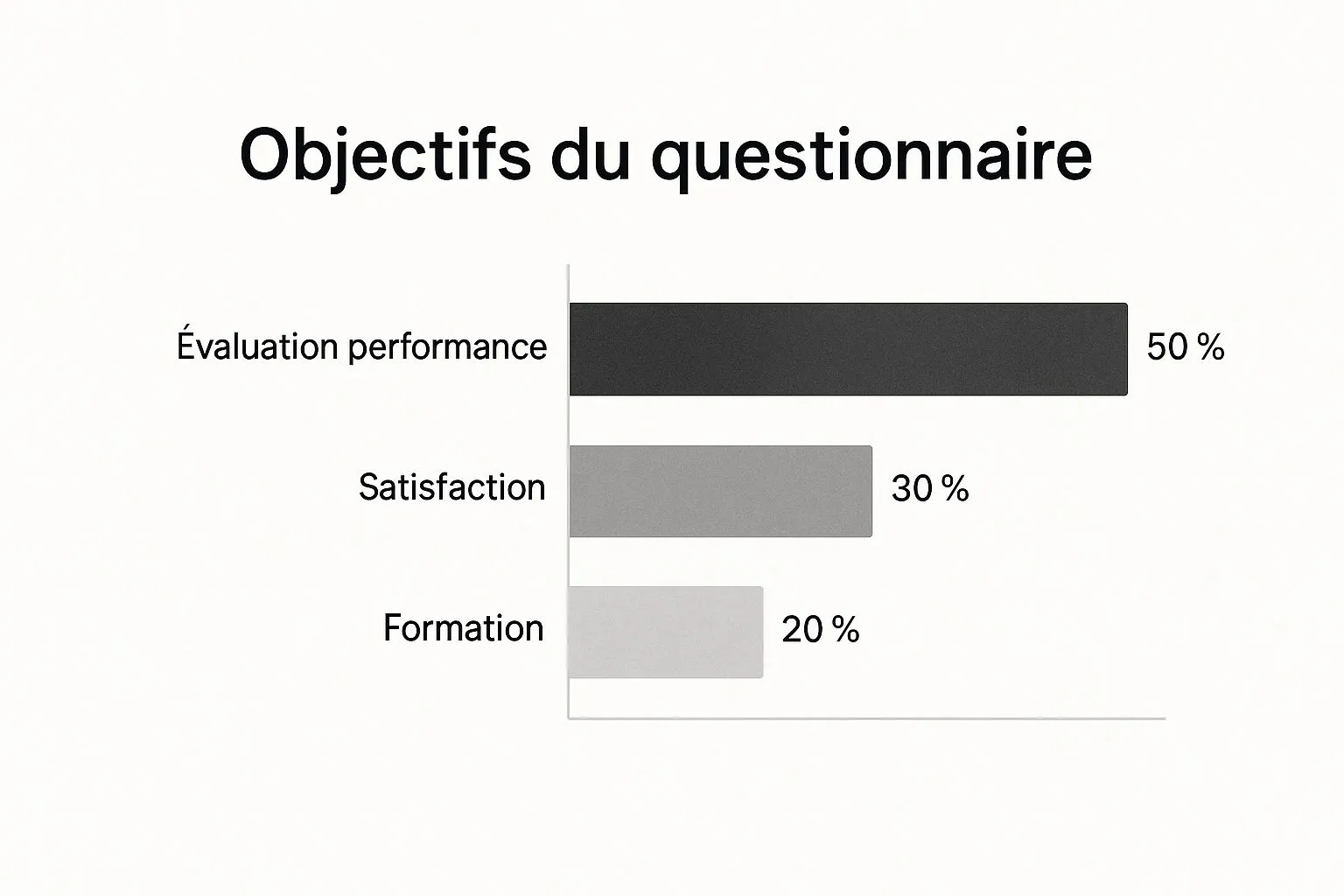
Look at the infographic above: it clearly shows how the objectives of a professional questionnaire are typically distributed. Performance evaluation takes up a large slice of the pie (50%), followed by satisfaction (30%), and finally training (20%). That makes sense — performance is often priority number one. But be careful, neglecting satisfaction and training can quickly backfire! Balance is key.
I saw this firsthand: a company I was advising wanted to focus exclusively on performance evaluation. We discussed it, and eventually added a few questions on satisfaction and training needs. The result? The questionnaire revealed a very specific training gap that was directly impacting… performance! A small change, a big impact.
Another example: an SME was struggling to understand why employees were leaving so quickly. Their initial questionnaire focused on working conditions. Digging a bit deeper, we uncovered the real problem: a lack of career advancement opportunities. As a result, they completely overhauled their career management policy.
Setting measurable objectives
Setting clear objectives is the foundation. Ask yourself “Are my employees satisfied?” OK, but how do you measure it? “Increase the satisfaction rate by 15% within 6 months” — now that’s a quantifiable objective. As a result, your questionnaire needs to include precise questions to measure this satisfaction and identify concrete areas for improvement. A good questionnaire is a powerful tool for moving from questions to action.
To help you, here’s a comparison table:
Types of objectives and corresponding questions
Comparison table of the different possible objectives with examples of tailored questions
| Objective | Type of questions | Concrete example | Measurement indicators |
|---|---|---|---|
| Evaluate performance | Closed questions, Likert scale | ”On a scale of 1 to 5, rate your proficiency with software X.” | Number of responses per level, average score |
| Measure satisfaction | Open questions, multiple choice | ”What could improve your day-to-day work?” / “Among the following proposals, which interest you the most?” | Satisfaction rate, number of suggestions, percentage of choice per proposal |
| Identify training needs | Open questions, multiple choice | ”Which skills would you like to develop?” / “Among the following training programs, which seems most useful to you?” | Number of requests per skill, percentage of interest per training program |
This table gives you a few concrete examples for tailoring your questions to your objectives. What matters most is thinking carefully about what you really want to know and how you’ll use that information.
Moving to action
Once you have your objectives and key indicators, you can build a questionnaire that will give you actionable answers. And that’s the whole point: moving from questions to action, and transforming your organization through concrete data.
Crafting questions that get honest answers

Creating a professional questionnaire is a bit like preparing a good dish: you need the right ingredients and the right measures. And believe me, question wording is the main ingredient! I’ve personally seen questionnaires that were well designed on paper fail miserably because of poorly worded questions. Vague, biased, or overly long questions are the best way to discourage participants and collect unusable data.
So how do you ask the right questions? It all starts with the type of question: open or closed. Closed questions, with predefined answers, are perfect for collecting numerical data that’s easy to analyze. Think of satisfaction surveys with multiple-choice options or Likert scales. On the other hand, open questions give respondents more freedom of expression. They allow you to gather more detailed and nuanced information, ideal for exploring a topic in depth.
Take Likert scales, for example. Very practical, but watch out for the pitfalls! Each level needs to be clearly defined, and you need to make sure the intervals between them are well understood by everyone. “Strongly disagree,” “Somewhat disagree,” “Neutral,” “Somewhat agree,” “Strongly agree”: clear and concise wording is essential. Interesting statistic, by the way: in France, in 2021, 46.3% of working people were managers or held intermediate professions (source: Insee). This clearly shows how important it is to know your target audience in order to tailor your questionnaire. More information on the structure of employment in France.
Avoiding bias and loaded questions
Another crucial point: neutrality. A leading question, even a subtle one, can influence responses. Imagine the question: “Don’t you think training X is essential?” The respondent feels pushed in one direction. It’s better to use a neutral phrasing like “What is your opinion on training X?” The goal is to gather sincere opinions. And for sensitive questions, you need to build an atmosphere of trust and clearly explain why you’re asking. A topic that might interest you: tax optimization for sole traders.
Finally, don’t forget the logical progression of questions. Start with easy, introductory questions, then gradually move on to more complex topics. A well-structured, easy-to-follow questionnaire guarantees a better experience for the respondent and a higher participation rate.
Designing a user experience that encourages participation

The image above, taken from the Wikipedia page on questionnaires, clearly shows the structure of an article on the subject. You immediately see the richness and complexity that what seems like a simple tool can represent. A questionnaire is much more than a list of questions — it’s a genuine communication tool.
A professional questionnaire, even a technically flawless one, can fail if the user experience is neglected. The difference between a participation rate of 30% and 80%? Often, it comes down to how the questionnaire is presented and perceived. No more endless, boring questionnaires! You need to create an engaging experience that makes people want to see it through to the end.
The importance of a good introduction
The introduction is the first impression. You need to reassure, motivate, and clearly explain the purpose of the questionnaire. A friendly tone and clear information on data confidentiality and how results will be used are essential. For example, instead of “Please respond to the questionnaire below,” you’d be better off with “Your opinion matters! This questionnaire will help us improve your day-to-day work. Your answers will remain confidential and will only be used to…”.
Imagine receiving a message like that — it makes you want to participate, doesn’t it?
Structuring to maintain attention
A questionnaire with no clear structure, with questions going off in all directions… It’s hard to stay focused! A logical structure, with well-defined sections and clear headings, makes it easier to read and holds attention. Grouping questions by theme and using transitions like “Let’s now move on to…” creates a smooth, natural flow. It’s like telling a story — you need a common thread.
The art of visual elements
Images, icons… Visual elements make a questionnaire more appealing and easier to understand. Be careful not to overdo it! Too many images can distract and clutter the questionnaire. Use them sparingly, to illustrate key points or break up the content. A bit like illustrations in a book.
Adapting the format to the context
Paper or digital format? It all depends on the context and the target audience. An online questionnaire is more convenient for collecting and analyzing data. A paper format may be better suited to certain audiences less comfortable with digital tools. Length matters too! A short questionnaire is more likely to be completed. Sometimes, splitting a long questionnaire into several shorter parts can be a good solution. The key is to adapt.
Testing your questionnaire before the big launch

We all tend to want to rush ahead and send out our employee survey questionnaire as quickly as possible. Except… skipping the testing step is a bit like jumping out of a plane without a parachute. You’re taking unnecessary risks! A quick test, even a brief one, can save you weeks of wasted work and useless data. Imagine hundreds of responses to a questionnaire… with ambiguous questions. Headache guaranteed!
From informal testing to a structured pilot
To avoid this kind of disaster scenario, you have several options. Start with an informal test. Ask a few colleagues or friends to take a look and answer the questionnaire. The idea is to catch typos, awkward phrasing, and questions that trip people up. A quick and effective first filter.
Next, step things up with a more structured test. The trick? Choose a representative sample of your target audience. If your questionnaire targets sales staff, test it with sales staff! This will help you validate the relevance of the questions and the clarity of the instructions.
Identifying weak points and optimizing the experience
During these tests, pay attention to a few key points. Understanding of the questions, first. Is there technical jargon? Ambiguous wording? Then, response time. Is your questionnaire too long, too short? Finding the right balance is key to encouraging participation without wearing out your respondents. On that note, this article might interest you: Employee survey questionnaire.
Speaking of data and professional activity, the Dares quarterly survey on labor activity and employment conditions, which tracks indicators such as base monthly salary, is a goldmine of information. It clearly shows the importance of data for understanding how the French labor market is evolving. More information on the DARES survey here. And this ties back to the importance of a well-built questionnaire for obtaining reliable data.
Gathering constructive feedback and improving your questionnaire
Finally, one last piece of advice, and not the least important: ask for feedback! Ask your testers what they thought of the questionnaire. What was clear? What was confusing? What would they improve? This valuable feedback will let you refine your questionnaire and optimize its effectiveness. Keep in mind that a well-tested questionnaire is a questionnaire that achieves its objectives.
Launching your survey and turning data into action
Is your employee survey questionnaire ready to go? Great! Now let’s move on to an equally important step: launching and analyzing the results. From the first communication to turning data into concrete actions, every detail matters. A successful launch guarantees a high participation rate and relevant data.
Communicating effectively to maximize participation
To get the maximum number of responses, communication is essential. The idea isn’t to bombard your employees, but to motivate them to participate sincerely. Clearly explain the purpose of the survey, why their opinion matters, and how the results will be used. Transparent, engaging communication changes everything.
For example, instead of a simple “Please respond to the questionnaire,” try “Your opinion is valuable! This questionnaire will help us improve our work environment together.” Adapt your message to your industry. A formal tone will sometimes be necessary, while elsewhere, a more casual approach will work better.
Timing is also crucial. Avoid busy periods or holidays. Choose a calm moment when your employees will have time to respond thoughtfully.
Following up without being too pushy
Not enough responses? Don’t panic! Well-crafted follow-ups can help. Send friendly, personalized reminders. Thank those who have already responded and encourage others to do so. But be careful not to push too hard — that could be counterproductive.
Analyzing the data to find the key points
Once the responses are collected, it’s time to analyze! The goal? Not to drown in numbers, but to spot the important trends for concretely improving your organization. You need to go beyond basic statistics, cross-reference the data, and uncover hidden insights.
For example, if satisfaction is low in a particular department, you need to understand why. Workload? Relationships between colleagues? Lack of recognition? Analyzing open-ended responses and cross-referencing data will help you see things more clearly.
Presenting results clearly and effectively
To convince management and secure the resources to act, you need to present your results clearly, concisely, and compellingly. Use charts, tables, and concrete examples to illustrate your points.
Before diving into the analysis, here’s a summary table of possible analysis methods based on the type of data collected:
Analysis methods by data type
Practical guide to analysis techniques suited to different types of collected responses
| Data type | Analysis method | Recommended tools | Possible insights |
|---|---|---|---|
| Multiple-choice responses | Descriptive analysis (frequencies, percentages), statistical tests (chi-square) | Excel, Google Sheets, SPSS | General trends, correlations between variables |
| Open-ended responses (free text) | Content analysis (categorization, thematic analysis) | NVivo, Atlas.ti | Perceptions, opinions, improvement suggestions |
| Numerical data (scales, scores) | Statistical analysis (mean, median, standard deviation, correlations) | Excel, R, Python | Satisfaction level, importance of factors |
This table gives you an idea of the tools and analyses you can use. Feel free to adapt these methods to your needs and your data.
Turning data into concrete actions
The most important step, and often the most complex, is moving to action. Communicate the results to your teams transparently. Clearly explain the actions put in place based on their feedback. It’s the best way to show that their participation was valued and to encourage them to get involved in future surveys. A good questionnaire isn’t an end point, but the beginning of continuous improvement.
Choose concrete, measurable actions. If the survey reveals a need for training on a piece of software, organize sessions and assess their impact on productivity. It’s by turning data into actions that you’ll prove the value of the process and motivate your employees.
The keys to making your questionnaire a true success
Having looked at the different steps involved in creating a professional questionnaire, let’s talk about what turns a simple form into a powerful tool for your business. Forget magic — here we’re talking about method and attention to detail.
The importance of clarity and conciseness
An effective questionnaire is above all clear and concise. No more technical jargon and ambiguous questions! Imagine a questionnaire full of terms only experts understand… the response rate is likely to be close to zero. Choose simple, direct language, accessible to everyone. Just like in a conversation, everyone needs to understand!
For example, instead of asking “What is your level of adherence to the new workflow optimization strategy?”, opt for “Do you agree with the new work organization?” Simple, direct, and just as relevant.
Engagement: the key to a high response rate
To maximize responses, you need to engage your employees. Clearly explain the purpose of the questionnaire, why their participation matters, and how their answers will be used. Transparency and trust are essential. Guaranteeing anonymity and data confidentiality is the foundation for honest responses.
One good tip? Show the positive impact of previous questionnaires. Concrete examples of improvements achieved thanks to team feedback are motivating! And don’t forget the layout: a well-spaced, pleasant-to-read questionnaire encourages participation.
Adapting the questionnaire to your audience
A questionnaire for managers won’t look like a questionnaire for production teams. Adapt the language, tone, and even the format to your target audience. A questionnaire that’s too long for a busy audience? To be avoided at all costs. Consider breaking it down into several shorter parts. If you’re managing several projects at once, this article on managing multiple projects could help you get organized for this step.
Measuring success and building on the results
A successful questionnaire isn’t the end — it’s the beginning of a continuous improvement process. Define key indicators: participation rate, quality of responses, actions implemented as a result of the findings…
Analyze the data collected, identify strengths and weaknesses, and above all, turn this information into concrete actions. Communicate the results to your teams and explain the decisions made following the survey. This is essential for engaging them and keeping them invested in future questionnaires. Ongoing dialogue with your teams is the key to effective HR management.
Want to simplify running your business? Bizyness, the all-in-one solution for sole traders and small businesses, might be exactly what you need.
