

 Français
Sole trader invoice example: a complete guide
Need a sole trader invoice example? Discover a compliant template and the mandatory details for error-free invoicing.
As a sole trader, an invoice is much more than a simple piece of paper or a PDF. It’s the finishing touch on your work, the document that turns your service into revenue. A flawless invoice is simply essential to get paid on time, stay on the right side of the law and, above all, build a trusting relationship with your clients.
Why perfect invoicing is your best ally
Let’s be clear: beyond the legal obligation, every invoice you issue is a showcase of your professionalism. It reflects your seriousness and your attention to detail. The smallest mistake can sow doubt, delay payment and put your cash flow at risk.
Take the very real example of Sophie, an ultra-creative freelance graphic designer who’s a bit scatterbrained when it comes to admin. Between a missing SIRET number here and an incorrect VAT mention there, she not only saw her payments delayed by several weeks, but also ended up annoying an important client. The result? A recurring contract slipped through her fingers, putting her whole quarter at risk.
A matter of credibility first and foremost
Sophie’s story is the story of many freelancers. Every detail on your invoice matters. Today, with the growing number of micro-businesses, rigorous administrative management is no longer optional — it’s a genuine competitive advantage. A clean, error-free sole trader invoice example instantly inspires confidence.
Your client doesn’t see the sleepless nights spent on their project, but they do see the invoice. If it’s flawless, they’ll unconsciously associate that quality with the whole of your work. It’s a decisive touchpoint that reinforces your brand image.
Secure your payments and your compliance
Beyond image, well-run invoicing has very concrete impacts on your business:
- Get paid faster: A clear invoice, with all the information and unambiguous payment terms, avoids questions and back-and-forth. Your client knows what to pay, when and how. The transfer goes out faster.
- Stay compliant: The tax authorities don’t take mandatory details lightly. A non-compliant invoice exposes you to a fine of €15 per missing or incorrect item, capped at 25% of the invoice’s total amount. That can add up fast.
- Avoid disputes: By precisely detailing your services and amounts, you remove any ambiguity. It’s a protection for both you and your client in case of a dispute.
Managing invoices by hand multiplies the risk of oversight or carelessness. That’s why more and more freelancers are turning to dedicated solutions. A tool like Bizyness, for example, lets you generate compliant invoices in a few clicks and automate the whole process. It’s the guarantee of peace of mind.
This guide will show you how to turn this administrative chore into a real strength for your micro-business.
The mandatory details for a rock-solid invoice
An invoice isn’t just a piece of paper to claim what’s owed to you. It’s an official document that carries your legal responsibility. It’s legal proof, an accounting record, and a showcase of your seriousness in the eyes of both the tax authorities and your clients. Let’s set aside the administrative jargon for a moment and understand the logic behind each piece of information you need to include.
Who’s billing whom? The basics of it all.
The first thing an invoice must do is clearly identify both parties. That’s the foundation of trust and legality.
On one side, that’s you. Your invoice must speak on your behalf. State your first and last name plainly, followed by “EI” or “Entrepreneur Individuel” (mandatory since 2022). Don’t forget the address of your registered office (often your home address) and, above all, your SIRET number. That’s your registration number, the undeniable proof that your business legally exists.
On the other side, that’s your client. Their identification must be just as precise. For an individual, their full name is enough. For a business, you must state its legal (company) name. In both cases, their address is essential to prove who you sold your product or service to.
Dates and numbers: the backbone of your bookkeeping
Traceability is the key to sound management. For this, three elements are non-negotiable:
- The invoice issue date: This is the day you create the document. It starts the countdown for payment.
- The date of the sale or the completion of the service: This is the moment the work is actually finished or the goods delivered. This is what justifies the invoice.
- The invoice number: It must be unique and follow an unbreakable logic. Think of a chronological sequence that never stops (e.g. 2024-001, 2024-002, 2024-003…). The slightest “gap” in the sequence can raise a red flag during a tax audit.
Think of your numbering as the DNA of your invoicing. It must be logical, continuous and tamper-proof. For a tax inspector, it’s the first sign of how reliable your bookkeeping is.
The heart of the matter: the detail of your services
This is where everything is decided. You need to explain, in black and white, why you’re asking for money. Each product or service must have its own line, detailing:
- The description: Be precise. “Consulting service” is vague. “2-hour digital strategy consulting session” is clear and avoids misunderstandings.
- The quantity: Hours, days, number of items, etc.
- The unit price excluding tax (net): How much one unit of what you’re selling costs.
- The total net amount of the line.
This level of detail protects you as much as it reassures your client. Everything is clear, precise and unambiguous.
The infographic below sums up this idea well: rigorous invoicing is the bridge between the trust you build with your client and receiving your money.
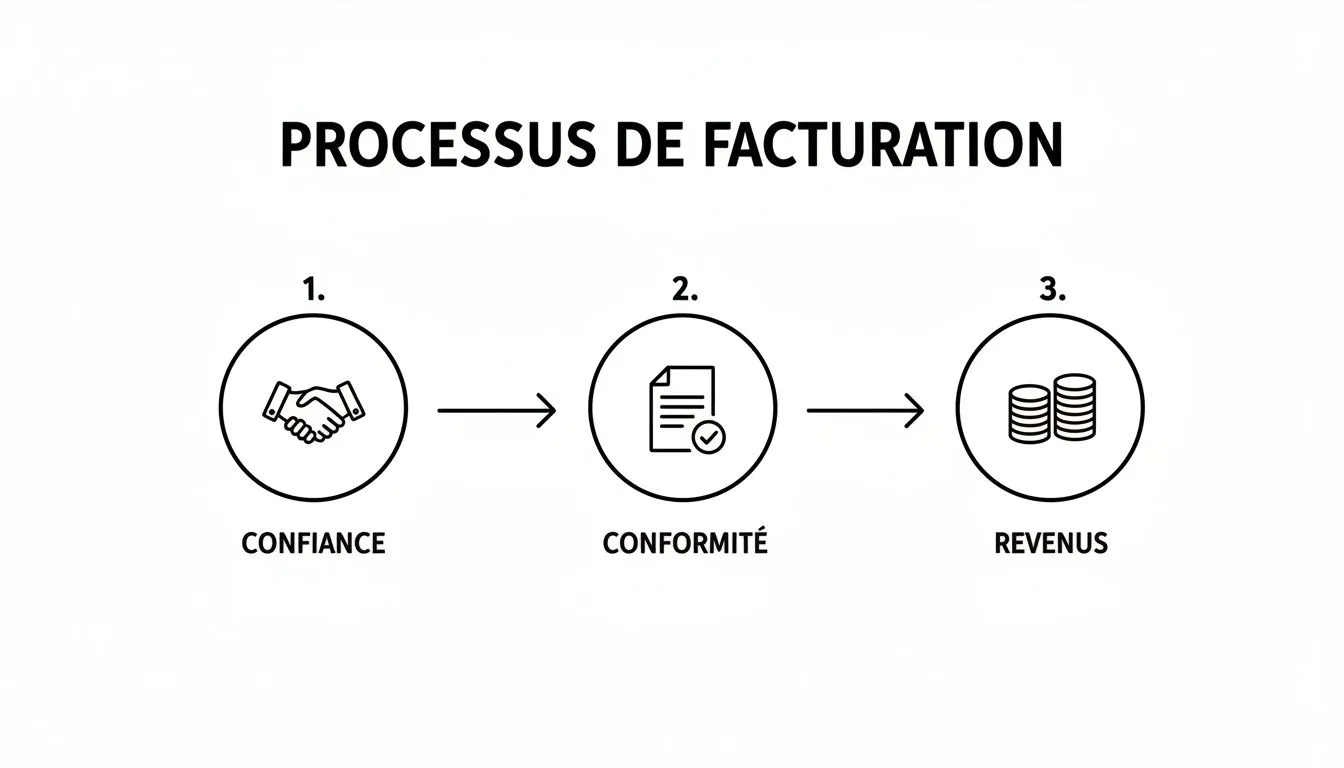
Compliance is therefore not a mere constraint — it’s what secures your revenue.
VAT: the small line that changes everything
As a micro-entrepreneur, you most often operate under the VAT exemption scheme (franchise en base). In practice, you don’t collect VAT, so you don’t charge it. For this to be official, one mention is absolutely mandatory on all your invoices: “TVA non applicable, art. 293 B du CGI” (“VAT not applicable, art. 293 B of the French Tax Code”).
Forgetting this mention opens the door to confusion. The authorities could think you owe VAT that you never collected. Be careful: if you exceed the exemption thresholds (€91,900 for sales, €39,100 for services in 2025), you switch to charging VAT. This mention must then disappear, and you’ll need to charge the tax.
For a full overview, feel free to check out our detailed guide on the mandatory details for a sole trader invoice.
To help you not forget anything, here’s a summary table to keep handy. It’s your safety net for every new invoice.
Checklist of mandatory details on your invoices
| Mandatory detail | Why is it essential? | Concrete example | Tip to never forget it |
|---|---|---|---|
| Your full contact details | Legal identification of your micro-business. | Jean Dupont EI, 10 rue de la Paix 75001 Paris, SIRET 123 456 789 00012 | Create an invoice template with this information pre-filled. |
| Unique invoice number | Ensures the traceability and integrity of your bookkeeping. | Invoice no. 2025-042 | Use a Year-Month-Number format (e.g. 2025-05-001) to never lose track. |
| Issue date | The legal starting point for the payment term. | 15 May 2025 | Always use the date you send the invoice, not the date you started drafting it. |
| Client’s contact details | Proof of the identity of the recipient of the sale/service. | ABC Company, 25 avenue des Champs-Élysées 75008 Paris | Copy and paste the information from the approved quote to avoid any typing errors. |
| Detail of the services | Justifies the total amount and prevents disputes. | Logo design (3 proposals, 2 revisions) - 1 flat fee - €500.00 net | Be as precise as on your quote. It’s a sign of transparency. |
| VAT mention | Mandatory to justify the absence of VAT on your rates. | ”TVA non applicable, art. 293 B du CGI” | Add this mention to the footer of your invoice template. |
| Payment deadline and penalties | Protects you against late payments and sets a legal framework. | ”Payment due on receipt. Late payment penalty: 10%. Fixed recovery fee: €40.” | Set your terms once and for all and apply them consistently. |
This checklist is your best ally. Use it systematically before hitting “send” so you can rest easy.
Finally, never forget to specify the payment terms: the payment deadline, the applicable late-payment penalties, and the flat-rate €40 recovery fee (mandatory for business clients). This is what gives you leverage in case of non-payment and encourages your clients to meet deadlines.
Invoice templates designed for your business
Now that we’ve covered the theory of mandatory details, let’s get practical. To help you avoid trial and error and beginner’s mistakes, I’ve prepared a few invoice templates covering the most common cases. Every sole trader invoice example you’ll find here isn’t just a file to fill in; it’s a genuine guide based on real-world situations.
Of course, these templates are an excellent starting point. But keep in mind that a spreadsheet or a simple text document is an open door to small manual errors: a skipped number, a forgotten mention… That’s why, in the long run, automation remains your best ally for peace of mind.
The template for a service
This format is perfect if you’re a consultant, developer, copywriter, coach… basically, if you bill for your time or a flat-fee project. It’s designed to keep everything crystal clear for your client.
In this example, you’ll learn how to:
- Describe your assignment precisely. Instead of a vague “SEO Consulting”, write “Technical SEO audit of XYZ.com” or “Writing 5 blog articles of 1,000 words”. This clarity prevents misunderstandings and disputes.
- Apply an hourly or daily rate. The template shows how to clearly present the number of hours or days worked and the unit price excluding tax.
- Present a flat fee. If you work on a project basis, a single line is enough, with a description of the assignment and the agreed total amount.
Good layout is the key to justifying your rate and showing your client they’re getting their money’s worth.
The template for selling goods
Are you an artisan, a maker, or do you run an online shop? This invoice template is made for you. Selling physical products has its own quirks, and this document accounts for all of them.
It’s designed to help you:
- List the products sold. Each product gets its own line with its reference (SKU if you have one), description, quantity and unit price excluding tax. Simple and effective.
- Manage quantities. This is an essential detail, both for tracking your stock and for letting your client check their order at a glance.
- Add extra charges. The document includes a dedicated line for shipping or packaging costs, keeping them clearly separate from the cost of the products.
With a well-structured invoice, you simplify not only your client’s life, but also your own when it’s time to do your bookkeeping.
Clearly, adapting your invoice to your business is a mark of clarity and professionalism.
The practical case of an invoice with a deposit
Requesting a deposit is a very common practice to secure a large order or a project spread over several weeks. But beware, it must be done by the book to remain compliant.
This slightly more complex template shows you exactly how to include a deposit on your final invoice:
- Reference the deposit invoice. It’s good practice to mention the number of the original deposit invoice for perfect traceability.
- Show the total amount. The invoice first presents the total net cost of the service or sale, like any other invoice.
- Deduct the deposit. Then add a clearly visible negative line, such as “Deposit paid on [date]”.
- Calculate the balance due. The final amount to be paid by your client (the famous “net amount due”) is simply the result of this subtraction.
Managing a deposit manually is a very common source of errors. Believe me, forgetting to deduct it on the final invoice can create a really awkward situation with your client and throw off your cash-flow tracking.
For each scenario, I offer you a pre-filled version for inspiration and a blank version, ready to be adapted. If you’d like to grab them, head over to our article offering a complete downloadable sole trader invoice template.
These templates are an excellent starting point, but they don’t replace the peace of mind that comes with a real invoicing tool. Software like Bizyness automates numbering, ensures all legal mentions are up to date, and handles complex cases like deposits without you having to think about it. You save time, gain peace of mind, and project an even more professional image.
Invoicing mistakes that can cost you dearly
A small invoicing error may seem harmless, but believe me, some can quickly turn into a nightmare. Beyond a simple oversight, poorly managed invoicing can lead to financial penalties, complications with the tax authorities, and put your entire business at risk. Let’s go over the most common pitfalls to help you avoid them.
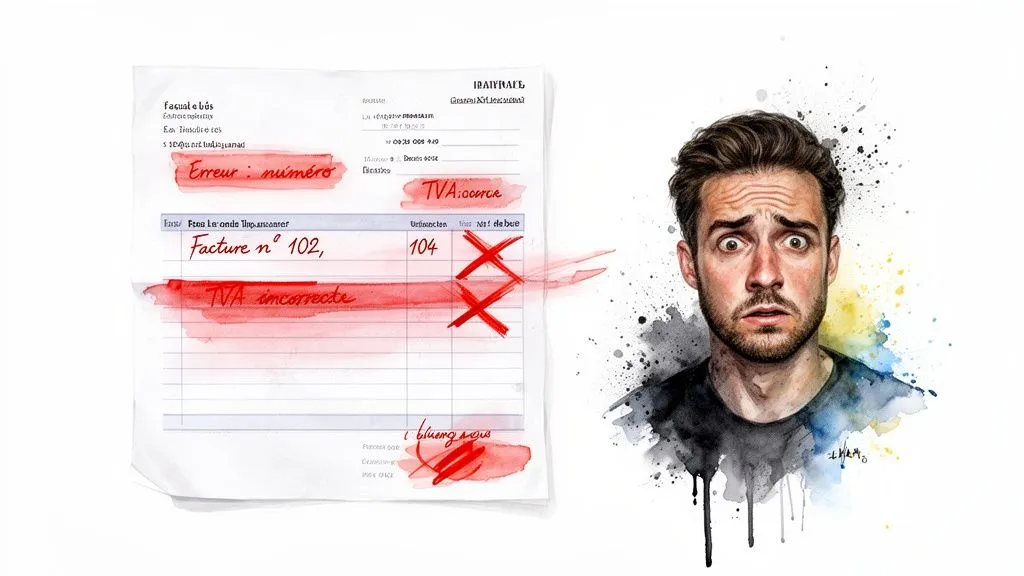
Think of the invoice as a mini-contract, the cornerstone of your business management. The smallest flaw can come back to bite you. A compliant invoice must include a date, a unique sequential number, a precise description of the service, the amounts, and the late-payment penalties (art. L441-10 of the French Commercial Code).
Solutions like Bizyness radically simplify the life of freelancers and consultants by automating the creation of a flawless sole trader invoice example every time. And it’s no coincidence that good administrative management is often cited among the key factors of success in micro-businesses.
Gaps in invoice numbering
This is mistake number one, the one the tax authorities spot in the blink of an eye. Your invoices must follow one another without the slightest gap. No skips, no oversights. Jumping from invoice FA-2025-015 to FA-2025-017 is an instant red flag.
Why such rigor? A gap in the sequence suggests that an invoice was concealed, even if it’s just a simple oversight. This immediately casts doubt on the seriousness of your bookkeeping and can trigger an in-depth audit.
Paul the IT consultant’s storyOverwhelmed, Paul accidentally deleted invoice
2025-034from his Excel file. During an audit a few months later, the inspector immediately spotted the anomaly. He had to spend a huge amount of time providing explanations, issuing credit notes and realigning his books. A huge amount of stress and wasted time that a tool like Bizyness would have spared him, since the software handles numbering automatically and makes it impossible to delete a validated invoice.
Overly generic service descriptions
A line on your invoice that simply says “Service provided” or “Consulting assignment”? That’s a wide-open door to disputes. Your client could easily contest the invoice, arguing that the work done doesn’t match what they expected.
You need to be surgical in your descriptions.
- Avoid: “Content creation”
- Prefer: “Writing 4 blog articles of 1,200 words on digital marketing, including keyword research and 2 rounds of revisions.”
This precision protects you. It sets in stone the exact nature of your work, making any dispute almost impossible. It’s your best legal insurance.
Poorly worded late-payment penalties
Stating late-payment penalties is a legal obligation for invoices addressed to businesses. Be careful: a vague phrase like “penalties applicable in case of delay” has absolutely no legal value.
To be valid, your mention must be clear and complete:
- The penalty rate: It cannot be lower than three times the legal interest rate. In practice, to keep things simple, many set a clear rate such as 10%.
- The flat-rate compensation: Mentioning the €40 fixed recovery fee is also mandatory (article L441-10 of the French Commercial Code).
A correct wording looks like this: “In case of late payment, a penalty equal to 10% of the total amount will be applied, along with a flat-rate compensation of €40 for recovery costs.” Without this clarity, you’ll have a hard time claiming what’s owed to you.
Ignoring the VAT thresholds
Here’s the mistake that can really hurt your wallet. As a sole trader, you invoice without VAT thanks to the exemption scheme, but only up to a certain revenue threshold.
The trap closes when you exceed these thresholds (for example, €39,100 for services) but keep invoicing as if nothing happened, leaving the “VAT not applicable” mention in place. If the authorities notice, they will claim the full amount of VAT you should have collected since you crossed the threshold. You’ll then have to pay it out of your own pocket, which can amount to huge sums and wipe out your margin. Monitoring your revenue is therefore essential.
Stop wasting time: automate your invoicing to focus on your growth
After reviewing the mistakes that can cost you dearly and the stress of manual invoicing, one conclusion stands out: spending hours on repetitive administrative tasks directly holds back your growth. The simplest and most effective solution? Automation. A modern invoicing tool doesn’t just fill in boxes — it completely changes your day-to-day management.
Picture this scenario: a client approves your quote online. With one click, that quote turns into a perfectly compliant invoice, carrying over all the information without you having to retype anything. The invoice is then sent by email, with a link to track it. You’re even notified as soon as your client has opened it.
But it doesn’t stop there. Once payment is received, the software automatically matches it with the transaction on your linked bank account. No more endless manual reconciliation between your statements and your outstanding invoices. The time saved is simply enormous.
Features that match the reality of today’s freelancers
A good invoicing tool needs to meet the real challenges facing sole traders, which are far more complex than they were a few years ago. You’re no longer limited to the local market.
For those working with clients abroad, multi-currency support is a crucial feature. A capable tool lets you invoice in dollars or Swiss francs just as easily as in euros, applying the correct exchange rates and ensuring everything stays legally compliant. It’s a real advantage for expanding your client base without complicating your life.
Same goes if you sell products or services online. Integrations with platforms like Shopify are almost essential. They let you centralize everything: sales from your website, sales from other channels, and automatically generate the corresponding invoices.
Clara the digital content creator’s testimonial”Before, I used to spend almost 5 hours a month juggling invoices for French clients, American clients, and sales of my templates from my shop. Since I started using a tool that centralizes everything, that time has been cut by three. That’s time I now reinvest directly into creating and prospecting.”
More than a time saver, real peace of mind
One of the benefits often overlooked with automation is peace of mind. Knowing that every sole trader invoice you create is up to date with the latest laws, that numbering can’t have any gaps, and that all mandatory mentions are present takes a huge weight off your shoulders.
Think about your URSSAF declarations. A good software tool produces clear, precise revenue reports in seconds. All you have to do is report the amounts, with no risk of calculation errors. It’s the guarantee of always being compliant and avoiding the stress spike before every deadline. To dig deeper into the topic, our guide on choosing invoicing software for sole traders covers the important criteria to look at.
Faced with these challenges, tools like Bizyness become true allies. Built for sole traders, this platform automates the creation of compliant invoices, VAT management and bank reconciliation, freeing up valuable time to grow your business. With a free plan to get started and e-commerce integrations, Bizyness helps freelancers centralize their sales, reduce errors and optimize their finances.
Ultimately, investing in a tool like Bizyness isn’t just buying software. It’s choosing a strategic partner that secures your compliance, gives your business a more professional image and, above all, gives you back your most precious resource: time. Time to focus on what you do best — your core business.
Invoicing as a micro-entrepreneur: your questions answered
Invoicing is a bit of a make-or-break issue when you’re self-employed. And naturally, it raises quite a few questions. I’ve gathered here the most frequently asked questions to give you clear, directly applicable answers.
Can I edit an invoice I’ve already sent?
The temptation is strong, but the answer is a categorical no. Once an invoice has been sent to your client, it’s set in stone in your bookkeeping. Editing it afterward is simply illegal and could get you into serious trouble in the event of an audit.
So what should you do? The one and only good practice is to issue a credit note. This document cancels out the original invoice, either in full or in part. Then, and only then, do you create a new invoice, this time correct, with a new number. It takes a bit longer, but it’s what guarantees your books stay flawless and traceable.
Think of your invoicing as a chain: each invoice is a unique, numbered link. You can’t go back and edit one. The credit note is the tool that lets you create a new link to correct a mistake, while keeping a perfect chronology. It’s a safeguard for you and a sign of seriousness for the authorities.
How do I invoice a client abroad?
Growing your business internationally is great news! But when it comes to invoicing, there are a few subtleties to know so you don’t make a misstep. It all depends on where your client is located.
- Is your client a business within the European Union? Simple — you must absolutely show their intra-EU VAT number on the invoice. In most cases, you’ll invoice net of tax. This is known as the reverse-charge mechanism: your client handles VAT in their own country.
- Is your client outside the European Union? The general rule is also to invoice net of tax. The most important thing is to look into the tax agreements between France and your client’s country to make sure you’re compliant.
Either way, always remember to specify the payment currency (EUR, USD, CHF, etc.). It’s a small detail that avoids a lot of misunderstandings. A sole trader invoice example for a foreign client should be crystal clear on this point.
Do I really need to issue an invoice for an individual client?
Yes, absolutely. This isn’t optional — it’s a legal obligation in several situations.
An invoice becomes mandatory as soon as:
- The amount of your service exceeds €25 including tax.
- The client asks for one, even for a single euro.
- You’re making a distance sale.
Even if none of these situations apply, get into the habit of always issuing an invoice. It’s proof of the transaction that protects both of you in case of disagreement, and it helps you keep tidy books. It’s a professional reflex.
Juggling all these rules by hand can quickly become a headache and a source of errors. To rest easy and save a lot of time, a tool like Bizyness can automate your entire invoicing process. You generate flawless invoices in a few clicks and can finally focus on your core business.
