

 Français
Disbursement Note: The Complete Guide to Optimizing Your Accounting
Master the disbursement note with our complete guide. Learn how to use it effectively to improve your financial management and build client trust.

A disbursement note is an accounting document that lets a professional get reimbursed for expenses incurred on behalf of and in the name of their client. It’s a simple cash advance, repaid to the exact euro, with no markup whatsoever. This mechanism instantly clarifies what belongs to you and what belongs to your client’s wallet.
Understanding the disbursement note in one minute
Imagine you’re running errands for a friend: they ask you to buy an item for €50, you pay with your own card and carefully keep the receipt in their name. When you get back, you hand over the item and the receipt, and they give you back exactly €50. You haven’t earned or lost a single cent — you’ve just done them a favor.
Translating that into a business context:
- you incur the expense directly on behalf of your client
- you keep the supporting document (invoice or receipt)
- you issue the disbursement note and receive a strict reimbursement
This transparency guarantees that your revenue stays net of these flows.
Why it isn’t income
Reimbursements received via a disbursement note do not appear in your revenue. In other words, you pay neither social contributions nor tax on these amounts.
In practice, a disbursement is neutral for your accounting: treating it as income would mean paying charges on an amount that never actually entered your cash flow.
Disbursement, expense, or rebilling
It’s never easy to tell them apart, yet each document serves a specific purpose:
- a disbursement note is used to bill expenses in the client’s name
- an expense report lists internal costs (travel, meals…) charged to you
- rebilling expenses often includes a markup and is included in your revenue
For more details on expense reports, check out our guide on the definition of an expense report.
A quick comparison so you never mix them up again
This table highlights the key differences between the disbursement note and other expense rebilling methods.
| Criterion | Disbursement note | Expense report | Rebilling of expenses |
|---|---|---|---|
| Beneficiary of the expense | The end client | The company or employee | The end client |
| Name on the invoice | In the client’s name | In the company’s or employee’s name | In the company’s or employee’s name |
| Impact on revenue | Excluded from revenue | None (deductible expense) | Included in revenue |
| VAT treatment | None (VAT recovered by the client) | VAT recoverable by the company | VAT applied on the amount |
| Markup allowed | Forbidden, reimbursed to the exact euro | Not applicable | Possible and common |
Keeping this comparison in mind, you’ll never again confuse a disbursement, an expense report, and rebilling. Every transaction will find its rightful place in your accounting, with complete clarity.
The legal framework for securing your reimbursements
A disbursement note isn’t just an informal arrangement. For it to hold up, it must rest on a precise legal framework. The tax authorities set the rules of the game, and for good reason: these advanced expenses have a direct impact on your revenue and VAT management.
If these rules aren’t followed, the risk is straightforward: the reimbursed amounts can be reclassified as income. And the financial consequences can be serious.

The basic principle is fairly simple. You act as an agent for your client. In practical terms, you become a mere financial intermediary. Imagine your client hands you their credit card to settle a specific expense on their behalf. That’s exactly what’s happening.
For this arrangement to be beyond reproach, this intermediary role must be clearly established and proven.
The mandate: the cornerstone of the system
To act “in the name of and on behalf of” your client, you need authorization. This is called a mandate. Don’t worry — we’re not necessarily talking about a ten-page contract drafted by a lawyer.
This mandate can take several forms:
- Explicit: The simplest and safest. A written agreement, even a simple email, where your client gives you the green light. For example: “That works for me, go ahead and buy that license for the project.”
- Tacit: It can be built directly into your terms and conditions of sale. A short clause specifying that you may need to advance certain costs necessary for the assignment, with the client’s consent, of course.
The essential thing is to have proof. In the event of an audit, you must be able to show that the client was informed and approved the expense before you incurred it. A well-archived email exchange does the job perfectly.
This prior authorization is the foundation of your disbursement note. Without it, the whole structure is shaky. While you’re at it, also make sure to properly frame your payment terms. Good cash flow management starts there, as explained in our guide on payment terms.
The conditions you must follow to the letter
For an expense to be a genuine disbursement and not simple expense rebilling, there are golden rules. These are cumulative conditions, meaning all of them must be met. If even one is missing, the whole arrangement falls apart.
- The invoice in the client’s name: This is non-negotiable. The supplier’s invoice (the plugin website, the transport service, etc.) must be issued in your client’s name. If your name appears on it, it’s disqualified.
- Reimbursement to the exact euro: You must be reimbursed the exact amount you paid, tax included. Not a single cent more. Even the slightest markup, even just to round up, would turn the disbursement into a paid service.
- A dedicated accounting entry: From an accounting standpoint, these money movements must not land in your sales accounts (class 7 accounts). They pass through a third-party account (class 4), such as account 467 “Sundry debtors and creditors.”
- Providing the original supporting document: You must forward the original invoice to your client along with your disbursement note. It serves as their proof of purchase.
By scrupulously following these four pillars, you’re in full compliance. Your business is protected, and you remain transparent with your client.
The tax and accounting benefits
When disbursements are managed correctly, the benefits are genuinely significant, especially for freelancers. It’s no coincidence that in 2023, roughly 35% of French micro-entrepreneurs providing services used this method. It’s a very practical tool for managing advanced expenses without weighing down your bookkeeping. To dig deeper into the topic, you can find additional information on the disbursement note on helloworkplace.fr.
Here’s why it’s so advantageous:
- It doesn’t count toward revenue: Amounts reimbursed via a disbursement note are not considered income. The big upside? It prevents your revenue from being artificially inflated and risking a breach of the micro-entrepreneur thresholds.
- No social contributions on it: Makes sense. Since it isn’t revenue, you pay no social contributions on these amounts. That’s a net saving.
- VAT stays neutral for you: You don’t have to charge VAT on disbursements. Your client handles that on their end. If they’re liable for VAT, they can recover it directly, since the original invoice is in their name.
In short, mastering the legal framework of the disbursement note means protecting yourself. You secure your reimbursements, optimize your tax position, and play the card of full transparency with your clients. It’s all upside.
What you actually gain day to day
Managing your disbursements well isn’t just a matter of paperwork or accounting compliance. It’s a genuine strategic choice with direct repercussions on your business’s financial health, your profitability, and even the relationship you build with your clients. Think about it: every euro you advance for a client is a euro that temporarily leaves your cash flow. Managing it properly is therefore vital.
In practice, sloppy management of advances can quickly hurt your working capital. If you rack up small expenses across different projects without a solid reimbursement system, the total can add up fast and strain your cash flow. That’s where the disbursement note becomes your best ally.
Protect your cash flow and margins
Your working capital is the fuel that keeps your business running. Every time you pay for something on a client’s behalf, you draw from that reserve. The disbursement note then acts as a shield, ensuring these outflows are only ever temporary and don’t eat into your profits.
Take the example of a marketing consultant who advances €500 to launch an ad campaign for a client. Without a disbursement note, this amount could be seen as a business expense, directly reducing their margin on the assignment. With a properly structured disbursement, this €500 is clearly an advance to be reimbursed, keeping their profitability intact.
By treating these advances as simple money transfers, you ensure your revenue reflects only the value of your work, not intermediary costs. Your view of your business’s performance instantly becomes much more accurate.
Setting up rigorous tracking for every disbursement note lets you keep an eye on these movements. You always know exactly how much money is “out” and when it’s due back, preventing simple advances from turning into forgotten receivables that weigh on your finances.
Realize real, tangible savings
One of the most direct benefits of the disbursement note shows up on the tax and social contributions front. Since reimbursed amounts don’t count toward your revenue, the savings are immediate and easy to calculate.
In plain terms, that means you pay neither social contributions nor tax on these amounts. For a micro-entrepreneur, whose charges are a direct percentage of revenue, the gain is instant.
Let’s look at what that means in numbers:
- Lower social contributions: If your contribution rate is 21.2%, every €100 disbursement saves you €21.20 in charges. That’s money you would have paid had you billed it as regular revenue.
- No impact on income tax: Disbursements don’t increase your taxable income, so no unpleasant surprise when it’s time to file.
- VAT-neutral: You don’t have to collect VAT on disbursement amounts. This simplifies your filings and saves you from advancing VAT on sums that aren’t yours to begin with.
Build trust with your clients
We think about it less often, but the transparency a well-managed disbursement process brings is a fantastic asset for building a strong relationship with your clients.
When you present a clear disbursement note, with original invoices in the client’s name, you demonstrate exemplary professionalism. Every euro spent is accounted for, leaving no room for doubt.
This approach prevents misunderstandings and disputes over costs. Your client sees exactly what they’re paying for, down to the cent, and knows you’re not taking any hidden markup on these expenses. This honesty is a genuine mark of trust that strengthens your reputation and builds long-term client loyalty.
How to create a disbursement note step by step
Drafting a disbursement note might seem intimidating. In reality, it’s a sequence of simple steps once you’ve got the essentials down. With a rigorous method, reimbursing your advances happens without tax pitfalls or accounting headaches.
This practical guide walks you through four clear steps. The goal: give you a reliable roadmap for putting together an effective disbursement note, avoiding pitfalls, and ensuring compliance. From the initial agreement with the client to the final send-off, every stage matters.
Step 1: Get clear client approval
Before you pull out your card, secure your client’s sign-off. A simple phone call isn’t enough — you need it in writing.
- A confirmation email where the client states plainly: “Yes, I approve the purchase of…”
- A clause built into your quote, listing the advanced expenses and specifying who covers them
- A message archived in a project management tool
Without this formal proof, you risk a dispute over the legitimacy of your expenses.
Step 2: Check the supplier’s invoice
This is where many people stumble. To stay compliant, the invoice must absolutely be issued in your client’s name, not yours.
If your company appears on the document, the tax authorities will reject the disbursement note. You’ll be forced to rebill the amount, turning it into revenue. So make it a habit to provide beforehand:
- your client’s billing name and address
- their intra-community VAT number, if applicable
Step 3: Pay the expense and keep the supporting document
With the agreement secured and the billing verified, you advance the funds. Act as a mere financial intermediary.
As soon as payment is made, carefully keep:
- the original invoice (in the client’s name)
- proof of payment (bank receipt or transfer confirmation)
A digital copy in your archives is essential to ensure traceability.
Step 4: Draft and send your disbursement note
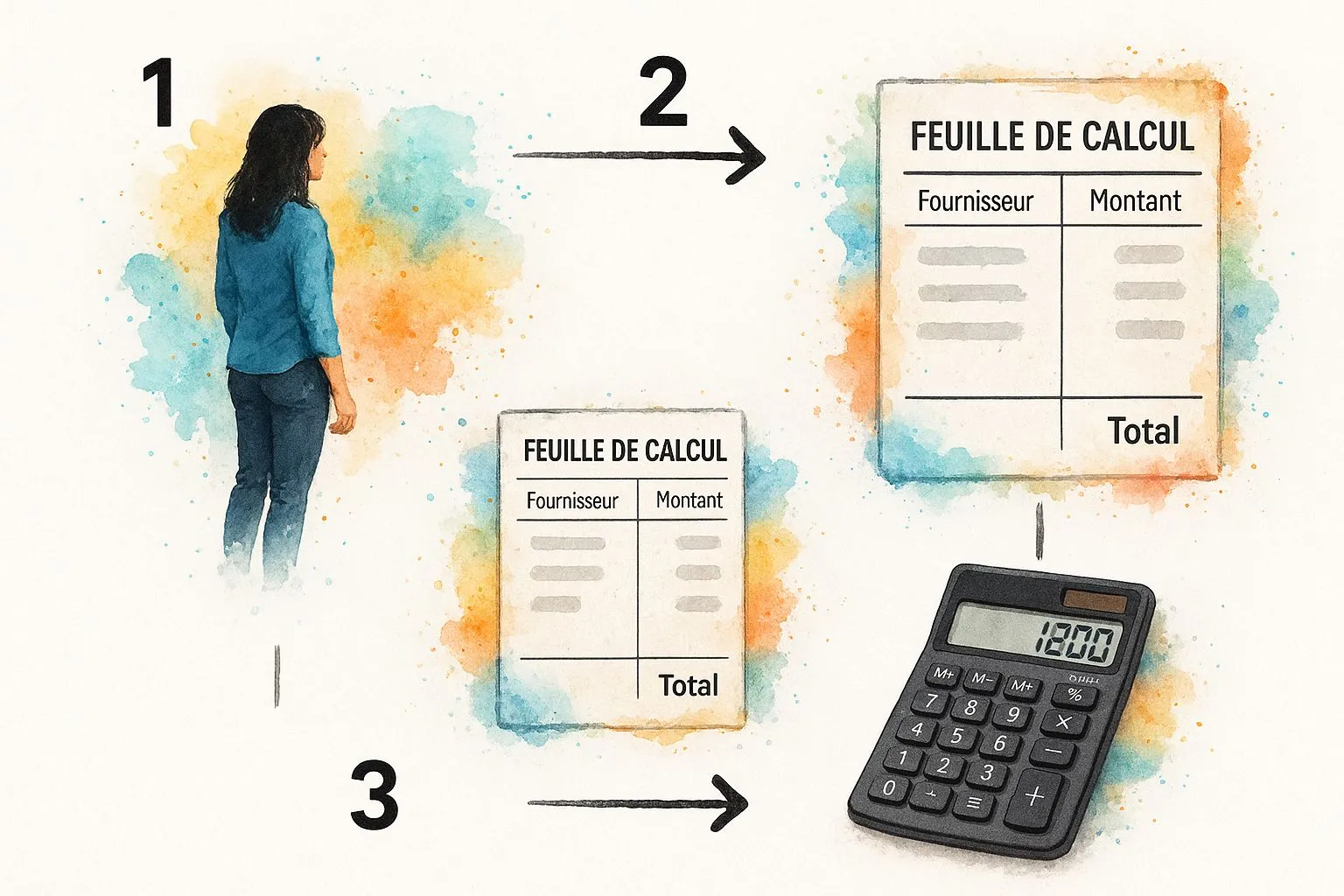
You now have everything you need to put together your disbursement note. This concise document formalizes your reimbursement request. It should be clear and include:
- The title “Disbursement Note” prominently displayed
- Your full details: name, address, business registration number
- Your client’s details
- The date and a unique number
- A breakdown of each expense: supplier, nature of the purchase, total amount
- The total amount to be reimbursed, matching exactly the sum of the invoices
Attach the original invoices and send everything to the client. You can include the disbursement note on your service invoice, provided it’s clearly separated and no VAT is applied to it.
The disbursement note in your line of work
In theory, it’s clear. In practice, it’s even clearer. To naturally integrate the disbursement note into your workflow, nothing beats concrete real-world scenarios.
In every profession, the mechanics stay the same: you advance expenses in the name of and on behalf of the client, then bill them the exact amount. Simple, transparent, and reassuring.
Scenarios for digital and consulting professions
Here’s how the disbursement note plays out in practice for different professionals:
-
Web developer You install a premium plugin costing €99 for a client site. After written approval, you buy the plugin, making sure the invoice is issued in the client’s name. This €99 then shows up as a disbursement, without affecting your fees.
-
Marketing consultant You manage a social media campaign with a budget of €500. You pay the ad platform with your card, but everything is billed to the client. This €500 is kept separate from your service fee thanks to the disbursement note.
-
Interior designer For a renovation project, you order samples costing €150. With the client’s go-ahead, you require invoices in their name. The reimbursement goes through the disbursement note, and your revenue stays unaffected.
These examples show that, whatever your field, the goal remains the same: guaranteeing expense traceability and building trust.
A heavily regulated example: notary fees
Notaries perfectly illustrate the disbursement in “dedicated wallet” mode. During a property sale, the buyer pays the notary fees, but only part of that corresponds to the professional’s own fees. The rest consists of disbursements.
In notarial jargon, a disbursement is an amount advanced by the notary to pay third parties or taxes. They act as a simple intermediary.
These costs break down as follows:
- Transfer duties: tax paid to the State and local authorities.
- Administrative fees: costs of documents (land registry extracts, plans, etc.).
- Property security contribution: land registration tax.
Each line item is justified, paid “in the name of and on behalf of” the client, then reimbursed separately. Disbursements can represent between 7% and 12% of total fees. For more details, see the details on notary fees under French law.
In short, whether you advance €99 for a plugin or several thousand euros in transfer duties, the logic stays the same: the client’s money passes through without ever mixing with your own income.
Automating the management of your disbursement notes
Collecting every receipt, re-entering amounts, filing documents… Before you know it, you’re buried under a mountain of paperwork. Without the right tool, errors pile up and processing time spirals.
- Common errors: duplicates, omissions, or incorrect entries
- Complex archiving: a legal requirement to keep records for 10 years
- Hidden costs: around €50 on average per paper note

Switching to digitization
To eliminate this friction, it’s time to go digital! In just a few clicks, your process becomes smooth and secure. No more misfiled photocopies and piles of lost receipts.
Thanks to the law (Article L123-22 of the French Commercial Code), digitizing supporting documents is fully legal. Studies show it can cut costs by 30% to 50% and reduce processing times by up to 70%. To learn more, see francenum.gouv.fr.
According to several studies, digitization reduces processing times by up to 70%.
Automating note creation
With Bizyness, turning a receipt into a disbursement note is child’s play. The app automatically detects and extracts the key information. You gain speed and accuracy in the process.
- Scan or import your receipt from the mobile app
- Verify the data extracted by OCR
- Send the note to your client in one click
Everything syncs instantly to your secure workspace.
To go further, discover how to automate your administrative tasks in our dedicated article.
Track reimbursements in real time
Forget endless follow-ups and scattered spreadsheets. The dashboard shows you at a glance the status of each note: pending, validated, or reimbursed.
- Time savings: elimination of manual processes
- Cost reduction: zero printing, zero postage
- Compliance: guaranteed digital archiving for 10 years
Freelancers save on average 15 hours a month by automating their disbursements.
Adopt this solution today and focus on what truly matters: your core business.
Answers to your questions about disbursement notes
Even with the best explanations, moving into practice always raises a few questions. That’s completely normal. Let’s untangle the most frequent questions together so that managing your disbursement notes becomes child’s play.
The goal here is to give you clear, direct answers that get straight to the point.
What’s the fundamental difference between a disbursement note and an expense report?
Now THAT is the essential question. The distinction is simple, but crucial. An expense report is for you. It lets you get reimbursed for expenses you incurred for your business, like a train ticket or a business lunch. The invoice is therefore issued in your own name.
The disbursement note, on the other hand, is for your client. It’s used to get you reimbursed for costs you advanced on their behalf. The key point, the non-negotiable condition, is that the original invoice must be in the client’s name.
Can I add a markup to a disbursement note?
The answer is a firm and definitive no. The very principle of a disbursement is reimbursement to the exact euro, without the slightest markup. It’s a simple accounting entry.
If you add a markup, even a small one, the nature of the transaction changes completely. It’s no longer a disbursement but a standard paid service. That amount must then be included in your revenue and will be subject to social contributions and VAT.
This rule exists to guarantee the transparency and accounting neutrality of the transaction.
What should I do if the invoice is in my name instead of the client’s?
This is the most common mistake, and the one that can complicate everything. If the supplier’s invoice is in your name, the expense can no longer legally be treated as a disbursement. It’s as simple as that.
In this situation, you have only one option: include this expense in your own invoice. This is known as rebilling of expenses. This amount then joins your revenue and is treated as such for tax and social contribution purposes.
Simplify the creation and tracking of every disbursement note in just a few clicks. With Bizyness, automate your administrative tasks so you can focus on what really matters. Try our solution at https://www.bizyness.fr.
