

 Français
The complete guide to the final invoice
Master the final invoice. Our guide explains how to create it, when to send it and the mistakes to avoid for flawless accounting.

Imagine you’ve just completed a service or a sale. Your client has already paid one or more deposits to get the project started. The final invoice (also called a balance invoice) is simply the closing document you send to wrap up the deal. It formalizes the end of your collaboration and requests payment of the remaining amount owed.
The final invoice: far more than a formality

Don’t think of the final invoice as just a piece of paper. It’s the closing act that seals a business relationship. For your company’s management, it’s fundamental: it ensures clarity, transparency and provides legal security for the transaction.
Think of it as the final scene of a play. The deposits laid the groundwork for the story, and the final invoice brings the conclusion, definitively settling the accounts between you and your client. It’s an essential document for keeping your accounting sound and your cash flow under control. It’s not just about requesting payment, but about providing a complete record of the exchange, from the quote to the final settlement.
Its strategic importance day to day
For any entrepreneur, knowing how to issue a clear, compliant final invoice isn’t just an administrative chore. It’s above all a mark of professionalism that reassures your client and strengthens their trust.
In France, this step is crucial for properly closing out a contract. In fact, nearly 85% of French businesses use it to finalize their transactions. This is especially true in sectors like construction, where the final amount can represent more than 40% of the total value of the project.
When it comes to invoicing, clarity is king. A well-built final invoice is your best ally against misunderstandings and late payments, because it leaves no room for doubt.
Accurate invoicing is also the best way to avoid disputes. Did you know that 67% of commercial disputes are linked to invoicing errors? The final invoice, which summarizes everything, plays a central role in preventing these issues. To dig deeper into best practices, you can read this detailed article on the balance invoice.
The different roles of the final invoice
This document serves several essential functions, regardless of your company’s size. Understanding them well will help you optimize your management.
- Accounting closure: It officially marks the end of the transaction. This lets you settle your client’s account and record the corresponding revenue definitively.
- Legal proof: In the event of a dispute or non-payment, a properly drawn-up final invoice constitutes solid proof of the amount your client owes you.
- Transparency for the client: It provides a clear, complete summary. Your client sees at a glance the total cost of the service and the amounts already paid via deposits.
In short, mastering the issuance and management of the final invoice is an essential skill for any entrepreneur who wants to secure their revenue and maintain sound business relationships. It’s truly the cornerstone of rigorous financial management.
Distinguishing the final invoice from other documents
Over the course of a project, several financial documents come into play. Knowing how to tell them apart is crucial for sound management and for avoiding misunderstandings. The deposit invoice, the standard invoice and the final invoice are three distinct documents. They complement each other, but must never be confused.
Picture your project as a train journey. The deposit invoice is the ticket you buy to board and start the trip. The final invoice is the final check as you get off, once you’ve reached your destination. It confirms that the journey is indeed over and that everything has been settled.
The deposit invoice to launch the project
The deposit invoice kicks off a collaboration financially. It’s issued before or during the delivery of a service or goods. Its primary purpose is to seal a mutual commitment.
For the entrepreneur, it covers initial expenses (buying raw materials, for example) and confirms the client’s commitment. For the client, it’s what officially marks the start of the work.
- Concrete example: A landscaper proposes a €5,000 quote to redesign a garden. They request a 30% deposit, i.e. €1,500, to order plants and materials. They will therefore issue a deposit invoice for that amount.
The standard invoice for one-off transactions
The standard invoice, or regular invoice, is by far the most common. It corresponds to a simple, direct transaction. The service is performed, the product is sold, and payment is due all at once.
It never references a prior payment, simply because there hasn’t been one. It’s the typical document you receive after a one-off purchase.
- Concrete example: You buy a computer in a store for €900. The seller hands you a standard invoice for the full amount at the time of payment. The transaction is complete, instantly.
The final invoice to close out the collaboration
The final invoice always comes last, once the assignment is fully completed or the goods entirely delivered. Its role is to close the books. It requests the remaining amount owed, after deducting all deposits already paid.
It’s the logical conclusion of any project that required one or more interim payments. It’s a summary document that provides full transparency on the final cost and the amounts already paid.
A final invoice is the accounting proof that all contractual obligations have been fulfilled and that final payment is due. It turns an ongoing project into recognized revenue.
This chart clearly illustrates the difference that can exist between the amount initially estimated and the final amount invoiced. It’s precisely this gap that the final invoice comes to clarify.
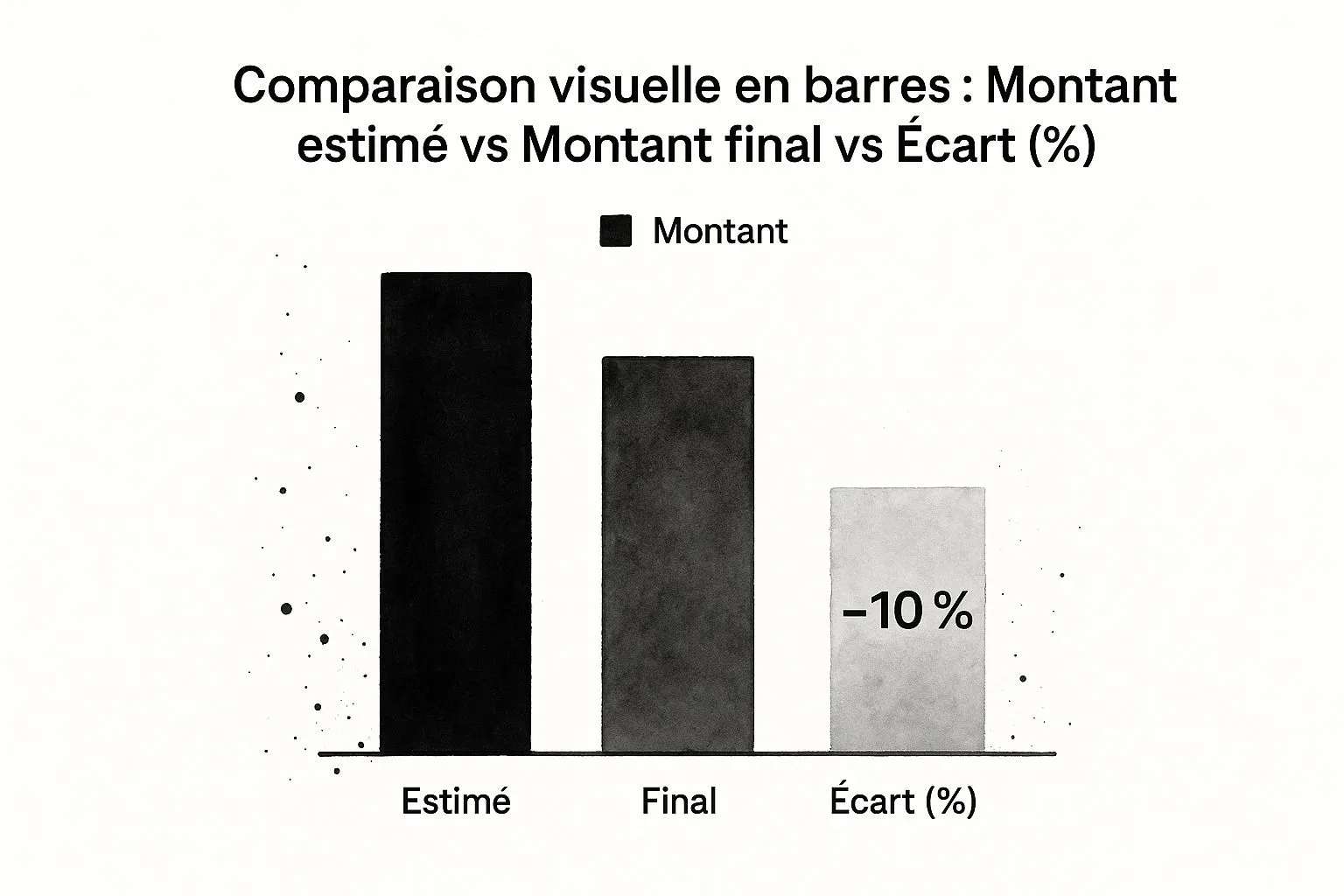
This visualization shows just how important this closing document is for adjusting the accounts and accurately reflecting the value of the service actually completed.
For a clearer picture, here’s a table summarizing the key differences between the deposit invoice, the standard invoice and the final invoice.
Comparison of the different types of invoices
| Criterion | Deposit invoice | Standard invoice | Final invoice |
|---|---|---|---|
| Timing of issuance | Before or during the service | At the end of a one-off transaction | After full completion |
| Main purpose | Secure a partial payment | Invoice 100% of a direct sale | Close out and request the remaining balance |
| Amount invoiced | A fraction of the total | The full amount of the service | The total amount minus the deposits |
| Use case | Long projects, large orders | Immediate sales, one-off services | Projects with staggered payments |
By clearly distinguishing these documents, you ensure rigorous accounting and transparent business relationships. Each invoice has its place and its moment, ensuring that every financial step of your projects is properly tracked and documented.
The legal requirements you must never forget
For a final invoice to be legally rock-solid, it must tick certain mandatory boxes. A single omission and the whole thing can crumble: the document may be deemed invalid, which seriously complicates debt collection and can even earn you a fine in the event of an audit.
Think of this invoice as the final act of your assignment, the irrefutable proof that the work is finished and that final payment is due. It’s not just another piece of paper, but a document that must be perfectly clear and complete.
There’s no need to reinvent the wheel. The French Commercial Code is very clear about what must appear on any invoice. But the final invoice has its own particularities, the small details that turn it into genuine accounting proof of closure.
The basic information common to all invoices
Before tackling the specifics, let’s go back to the fundamentals. Every invoice, whether a deposit or a final one, must include a core set of essential information. It’s the baseline, the bare minimum for compliance.
These elements make it possible to identify, without any ambiguity, who is selling, who is buying, and for which service. Missing even one can cost you dearly.
Here’s the essential checklist:
- Your business identity: Company name, registered address, SIREN/SIRET numbers, as well as your legal status (SAS, SARL, etc.) and share capital amount.
- Your client’s identity: Their name or company name, and their billing address (which isn’t always the same as the delivery address!).
- A unique invoice number: It must fit into a logical, gap-free sequence. No random numbers!
- The issue date: The day you create and send the document.
- Details of the assignment: A clear description of the products sold or services rendered, with quantity and unit price excluding VAT.
For a full list and detailed explanations, our guide on mandatory invoice information has you covered.
The three pillars specific to the final invoice
Now let’s move on to what really sets a final invoice apart. These are three elements that absolutely must appear on it for it to fulfill its closing role.
Their presence is non-negotiable. It’s what signals to the tax authorities — and above all to your client — that this document closes the financial loop of your project.
A final invoice is not just another invoice. It’s the closing summary that must, in a single glance, tell the whole financial story of the project, from the deposits to the final payment.
Let’s break down these three crucial details.
-
The explicit title “Final invoice” It may seem obvious, but it’s fundamental. Clearly titling the document “Final invoice” at the top of the page removes any ambiguity. Your client knows immediately that this is the last step, not a new payment request.
-
A clear reference to previous deposits This is the heart of the matter. Your invoice must precisely list every deposit invoice already paid. For each one, restate its invoice number and its issue date. This traceability is the proof that justifies the calculation of the remaining amount due.
-
A detailed calculation of the final amount Transparency is your best friend. The calculation must be completely clear to avoid any question or dispute. Present it in a simple, logical way:
- The total amount excluding VAT of the service.
- The total VAT amount.
- The total amount including VAT of the project.
- The total sum of the deposits (including VAT) already paid.
- And finally, in bold and clearly visible, the “Net amount due” or “Remaining balance”, which is simply the difference between the total including VAT and the sum of the deposits.
By following these rules to the letter, your final invoice becomes a solid document that secures your cash flow, simplifies your accounting and maintains a healthy, transparent relationship with your clients.
Knowing when and how to issue your final invoice
Timing is everything. When it comes to invoicing, sending your final invoice at the right moment isn’t just a formality. It’s a strategic move that has a direct impact on your cash flow and on the professional image you project.
The golden rule is disarmingly simple: the final invoice goes out as soon as the assignment is complete or the last goods have been delivered. Waiting sends the wrong signal and risks needlessly delaying funds reaching your account.
The step-by-step issuance process
For everything to go smoothly, it’s best to have a well-oiled little routine. Good organization will save you tedious back-and-forth with your client and, above all, speed up payment.
Every step counts, from final project sign-off to tracking the bank transfer. It’s a process that, when handled well, strengthens trust and clarity in your business relationship.
Here are the reflexes to adopt:
- Get the client’s green light: Before you even think about the invoice, make sure your client has confirmed the service is complete or the products properly received. A simple confirmation email works perfectly and provides a written record.
- Gather your documents: Pull together every deposit invoice already sent, the signed initial quote and any other useful document. This little bit of prep will save you a huge amount of time.
- Create the final invoice: Draft the document, including all mandatory information. Don’t forget the most important part: a clear, detailed calculation of the remaining amount due.
- Send it without delay: Don’t let things drag on until the end of the month. As soon as it’s ready, send the invoice along with a friendly note that officially closes out your collaboration.
- Track the payment: Note the due date in your calendar. If payment is slow to arrive, a prompt, courteous reminder will be far more effective.
The perfect time to send the final invoice? Right when your client is most satisfied, just after receiving flawless work. The perceived value of your service is at its peak, which encourages fast, enthusiastic payment.
Automation for greater efficiency
Managing this whole process manually, especially when juggling several projects at once, can quickly become a headache and a source of errors. This is where invoicing software, like Bizyness, changes the game.
These tools handle the creation and sending of your invoices automatically. A repetitive administrative task becomes a simple, fast process. This frees up valuable time for you to focus on what you do best: your craft. To go further, the impact of artificial intelligence on accounting is a fascinating topic showing how these new technologies are redefining business management.
A concrete example that speaks for itself
Imagine a digital marketing agency that has just wrapped up a three-month ad campaign. A 40% deposit was paid at kickoff.
The day after the final report is presented and approved by the client, the agency uses its software to generate the final invoice. The system already knows the total project amount, deducts the deposit received, and sends the final document by email in just a few clicks. This responsiveness is the hallmark of flawless organization. It encourages the client to pay quickly and closes out the assignment on a positive, efficient note.
Download a final invoice template for greater efficiency
Nothing beats practice for really understanding something. To help you create perfect final invoices, the simplest approach is to start from a solid base you can adapt. Using a ready-made template is an excellent strategy for never forgetting a legal requirement and making sure everything is in order.
It’s a valuable time saver that also limits the risk of error, particularly in the final calculation, which is the most critical step. Think of this template as a kind of checklist that guides you step by step.
The ingredients of a good final invoice template
An effective template is far more than just a form to fill in. It should be designed to present information clearly, both for you and for your client.
Here’s what you should find in it:
- A clearly visible header: Unambiguously stating that this is a “Final invoice”.
- Distinct sections: One for your details, one for the client’s, and one for the details of the assignment.
- A clear summary table: It should highlight the total amount, the deposits already paid and, of course, the balance due.
- Fields for customization: To easily note the numbers and dates of the corresponding deposit invoices.
For those just starting out, particularly sole traders, these fundamentals are crucial. If you want to dig deeper, we strongly recommend our complete guide to creating an invoice as a sole trader. It covers every aspect of invoicing for this status.
To give you a concrete idea, here’s what a well-designed final invoice can look like.

In this example, you can clearly make out the total cost of the service, the deposit that was deducted, and the final amount to pay. The calculation is obvious at a glance for the client.
Case study 1: Marc, the freelance developer
Let’s take the example of Marc, a web developer. He landed a contract for an e-commerce site worth a total of €5,000 excluding VAT. The client agreed to pay a 40% deposit to launch the project.
- Deposit invoice: At the start, Marc sends a first invoice for €2,000 excluding VAT (40% of €5,000). With 20% VAT (€400), the client pays €2,400 including VAT.
- Final invoice: The site is live, the client is satisfied. It’s time for Marc to prepare his final invoice.
The calculation on the final invoice must be completely clear. It’s the financial summary that closes out weeks, or even months, of work. Every line must be accurate and justified.
Here’s how he presents it:
- Total amount of the service: €5,000 excluding VAT
- VAT (20%) on the total: €1,000
- Total amount including VAT: €6,000
- Deposit paid (ref. invoice FA-001): - €2,400 including VAT
- Remaining balance due: €3,600 including VAT
This structure, both simple and detailed, avoids any confusion and encourages prompt payment.
Case study 2: The construction company
Now imagine a renovation company working on a €30,000 excluding VAT job. The project spans several months, with staggered payments as work progresses.
- 1st deposit (at order): 30%, i.e. €9,000 excluding VAT. The deposit invoice is €10,800 including VAT.
- 2nd deposit (end of structural work): 40%, i.e. €12,000 excluding VAT. The deposit invoice is €14,400 including VAT.
Once the site is signed off, the company draws up its final invoice.
The final calculation breaks down as follows:
- Total amount of the work: €30,000 excluding VAT
- VAT (20%): €6,000
- Total amount including VAT: €36,000
- Total deposits already paid (10,800 + 14,400): - €25,200 including VAT
- Remaining balance due: €10,800 including VAT
For this type of project, it’s essential that the final invoice precisely lists the references of the two previous deposit invoices. This traceability is key to keeping everyone on the same page, especially on long, complex assignments.
Your frequently asked questions about the final invoice
Even with the best explanations, real-world situations always raise a few more questions. To clear up any remaining doubts about the final invoice, we’ve gathered the questions that come up most often. Here are clear, concrete answers to help you see things more clearly.
This section tackles very specific scenarios, the kind you encounter day to day and that call for a directly applicable answer.
Can you issue a final invoice without a deposit invoice?
The answer is a firm no. It would even be a fundamental accounting error. The very principle of a final invoice is to close out a transaction for which one or more partial payments have already been made.
Without a prior deposit, there’s simply nothing to “settle.” The very word implies that there’s an initial amount from which what has already been received is subtracted.
Thinking of a final invoice without a deposit is like trying to calculate the change from an addition that never started. Accounting logic requires a sequence: the deposit first, then the balance.
If your client needs to pay for the entire service in one go, the right document is simply a standard invoice, covering 100% of the amount. For a final invoice to be valid, it must necessarily reference the deposit invoice(s) that preceded it and clearly deduct the amounts already received.
What should I do if my client refuses to pay the final invoice?
A refusal to pay is always a stressful situation. The key is to stay calm and act methodically. A structured approach is your best ally for resolving the conflict and recovering what you’re owed.
Don’t jump straight to legal threats. Very often, a simple misunderstanding or oversight is behind the problem.
Here are the steps to follow to handle the situation professionally:
- Friendly contact: Your first move? Pick up the phone or send a courteous email. Try to understand the reason for the refusal. Is it dissatisfaction? An oversight? This first conversation is often enough to unblock the situation.
- A simple reminder: If the conversation doesn’t resolve things, move on to a simple reminder letter. Politely restate the invoice details (number, amount, due date) and ask for payment.
- A formal notice: Still nothing? It’s time to step things up. Send a formal notice to pay by registered letter with acknowledgment of receipt. This document carries real legal weight and sets a final deadline before legal action.
- Debt collection procedure: As an absolute last resort, if the client goes silent, you can turn to a debt collection agency or start a payment order procedure with the commercial court.
Throughout all these steps, a properly drawn-up final invoice, with all its legal requirements and references to the deposits, will be your best asset in proving that your claim is genuine.
How should VAT be handled on a final invoice?
Managing Value Added Tax (VAT) on a final invoice can seem daunting, but it follows an unshakeable logic. VAT is collected in two stages, simply because payment happens in two stages.
First, you must collect VAT on the deposit at the time you receive it. This is a legal requirement for services.
Then, on the final invoice, the calculation must be crystal clear to avoid charging the tax twice. Here’s how to proceed:
- State the total amount excluding VAT of the service.
- Calculate the total VAT amount on that basis.
- Show the total amount including VAT of the project.
- Then clearly deduct the amount including VAT of the deposit already paid.
- The final amount due will correspond to the remaining balance including VAT.
Your accounting should therefore reflect this two-stage VAT collection: part on the deposit, the rest on the balance. This is a crucial point of vigilance for staying compliant with the tax authorities. For freelancers, mastering these subtleties is essential; to learn more, see our article on invoicing for sole traders, which covers many useful aspects.
Is it possible to modify a final invoice that has already been sent?
Absolutely not. Once an invoice has been issued and sent, it’s set in stone. It cannot be modified or deleted. This is a fundamental accounting principle that guarantees the integrity and traceability of documents.
If you notice an error after sending it, whether a typo or a calculation mistake, the only correct procedure is to cancel the faulty invoice.
To do this, you must issue a credit note. This new document must explicitly mention the number of the final invoice it is cancelling. The cancellation can be total or partial. Once the credit note has been created, you can finally issue a new, correct final invoice, bearing a unique number different from the previous one.
To radically simplify the creation of your final invoices and avoid errors, Bizyness automates the entire process. The tool generates compliant documents in a few clicks, automatically deducts deposits, and gives you peace of mind on the accounting front. Discover how Bizyness can lighten your administrative workload.
