

 Français
How to find your NAF code for your online business
Discover how to find your NAF code easily and correctly, with our INSEE, Kbis and SIREN methods for freelancers and e-commerce sellers.

Want to get your hands on your NAF code? The simplest and fastest solution is to check your status notice on INSEE’s SIRENE directory. With your SIREN number, it only takes a few clicks. It’s really the safest method for finding this essential code, which you’ll need on a daily basis.
So what exactly is this NAF code for?
Let’s get straight to the point. The NAF code (for “Nomenclature d’Activités Française”, i.e. the French Activity Classification), also known as the APE code (Activité Principale Exercée, or Main Activity Code), is far more than a simple administrative formality. For INSEE and all French administrations, it’s the identity card of your business.
This code is a combination of four digits and one letter assigned to you when your company is created. Officially, its purpose is purely statistical. But in practice, its impact on your day-to-day management is very real and very concrete.
A key role on the social and legal front
Did you know your NAF code determines the collective bargaining agreement that applies to your employees? A small coding error, and your entire payroll system can be thrown off: leave calculations, salary scales, and so on. This can quickly turn into a legal headache.
That’s not all. It also affects the calculation of some of your social security contributions, particularly those related to workplace accidents and occupational illnesses (AT/MP). A poorly chosen code could make you pay more than necessary, or conversely, cause you to miss out on more favorable rates.
Tax and regulatory consequences you shouldn’t overlook
For an entrepreneur, and even more so in e-commerce, the right NAF code ensures you’re in the correct category in the eyes of the tax authorities. This is crucial. For example, it guides the administration on which VAT regime applies to you, a particularly sensitive topic if you sell internationally under the OSS/IOSS rules.
Never take your APE code lightly. It can determine your eligibility for certain public grants, sector-specific subsidies, or even public tenders. It’s a genuine administrative passport.
Understanding its role is the first step to avoiding mistakes that can be costly. It guarantees calmer, more compliant management, an essential foundation for growing your business. In fact, to go further, make sure you’re on top of the accounting obligations of a micro-entreprise, because good management always starts on solid ground.
Methods for finding a NAF code with certainty
Identifying the right NAF code can seem a bit murky, but several reliable paths are available to you, whether your business is already up and running or still just a project. Each method has its own quirks, but they all lead to the same goal: getting the code that fits your business perfectly.
For an existing business, the best route is to turn to public databases. It’s quick, free, and above all, it puts an end to any debate.
Digging through your administrative documents
Your NAF code (or APE, it’s the same thing!) is often hiding in plain sight, on documents you handle regularly. It’s legally required information that must appear on them.
Take a look at:
- Your Kbis extract: this is your company’s identity card. The APE code is clearly listed there. You can’t get more official than that.
- Payslips: if you have employees, the establishment’s APE code is listed there, notably to identify the applicable collective bargaining agreement.
- Your URSSAF filings or tax documents: these administrative papers contain a summary of your company’s key information, including its activity code.
Checking official online sources
The most direct and unimpeachable source is the SIRENE directory, managed by INSEE. Just type in the company’s SIREN number (the 9 digits) to access its public identity record within seconds. The APE code is displayed in black and white.
This approach lets you not only check your own code, but also that of your competitors or partners. It’s a handy trick for a bit of market research!
Of course, private platforms like Pappers or Societe.com relay this same information. It’s sometimes more user-friendly, but keep in mind that for 100% official data, the INSEE website remains the ultimate reference.
Which source to use to find your NAF code
To help you see things more clearly, this small table will help you choose the method best suited to your situation at a glance.
| Method | Ideal for | Information needed | Reliability |
|---|---|---|---|
| Official documents | A quick check if you have your paperwork on hand. | Kbis extract, payslip, SIRENE notice | Maximum. It’s legal proof. |
| SIRENE directory | Everyone: finding your own code or someone else’s. | SIREN number | Maximum. It’s the source database. |
| INSEE tool | Business founders looking for the perfect code. | A clear description of your future activity | Indicative. The final code is assigned by INSEE. |
Each source has its use, but for a company already registered, the SIRENE status notice remains the simplest reference document to obtain and share.
Anticipating the code for a new activity
And what if your business hasn’t been created yet? No need to panic. INSEE has thought of you and offers a search tool directly within the NAF classification. It helps you identify the code that will best match your project.
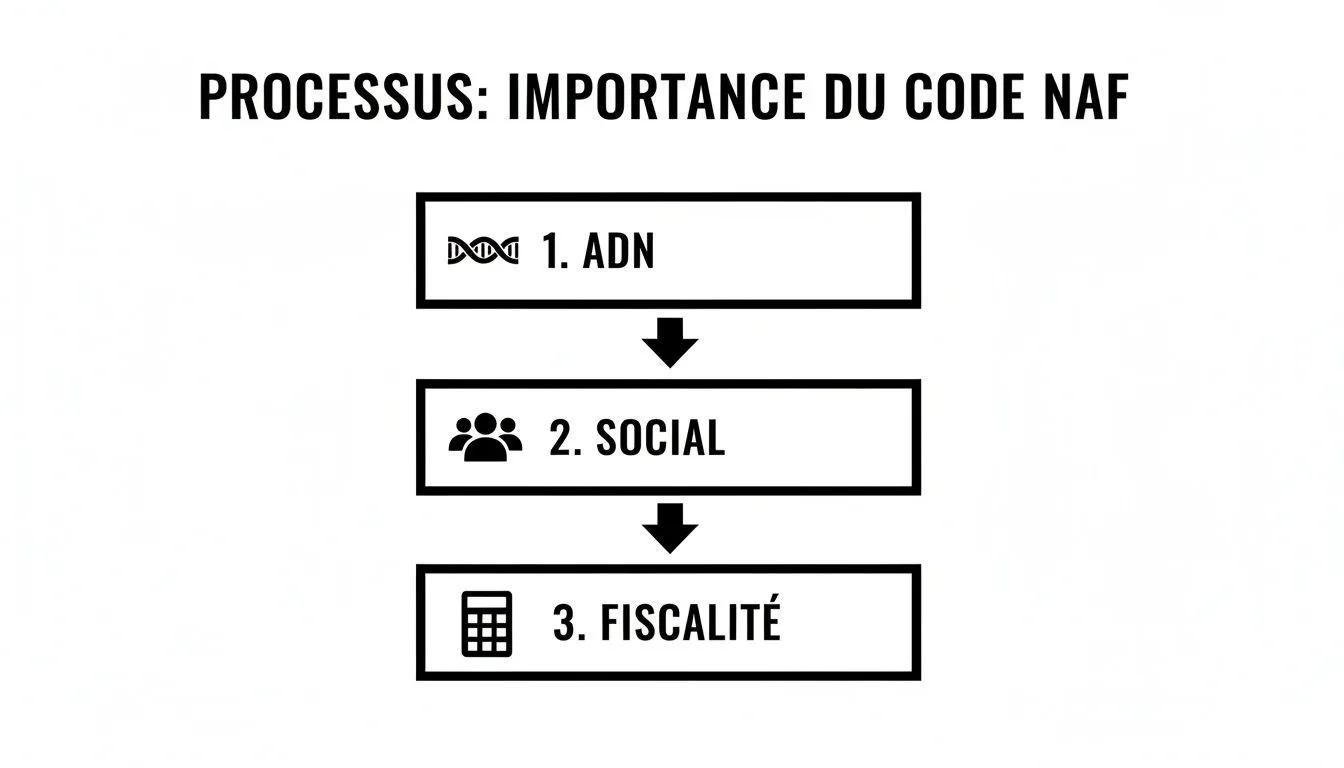
This process really shows how much of a cornerstone the NAF code is. It’s not just an administrative number; it’s the starting point that connects the DNA of your business to all of its social and tax obligations.
To make the best use of this tool, be as precise as possible when describing your future activity. For example, instead of simply typing “online sales”, try “distance sales via a specialized catalog” if you’re targeting a niche. The precision of your wording during registration is key to getting INSEE to assign you the most accurate code.
For independent entrepreneurs just starting out, getting a good grasp of how the APE code works for a sole trader is also a fundamental step for starting off on the right foot.
Choosing the right NAF code for an e-commerce business
The world of e-commerce is far more varied than it appears. This diversity inevitably shows up in the complexity of finding the NAF code that truly fits your business. An imprecise code can quickly lead to complications, particularly around VAT or customs declarations, topics that are especially sensitive for any online seller.
The classic mistake is thinking that a single NAF code covers every form of online selling. In reality, the devil is in the details.

For sellers of physical products
If you run a Shopify store or sell via a marketplace like Amazon, your core business remains selling goods. The most commonly used code in this case is 47.91A - Distance sales via general catalog. It’s fairly versatile and covers most typical online stores.
However, the nuance lies in the very nature of your products. Imagine you sell only sports gear. In that case, the code 47.91B - Distance sales via specialized catalog would likely be more relevant. What matters is that the description of your business during registration is as precise as possible to properly steer INSEE.
For creators of digital products and SaaS
The case of dematerialized products is even more different. A creator of online courses, for example, isn’t a simple merchant. Their activity is closer to teaching or content publishing.
Here are a few pointers to help you see things more clearly:
- Online course creators: the code 85.59A - Continuing adult education is often the best fit.
- SaaS software publishers: your business is tied to designing and distributing software. The code 62.01Z - Computer programming is an option, but 58.29C - Other software publishing is often more accurate, since it emphasizes the finished product you’re selling.
- Selling e-books or templates: here, you’re moving closer to the publishing business. The code 58.11Z - Book publishing could well apply.
The key is to describe what you actually do, not just what you sell. Focus on the activity that generates the bulk of your revenue. This is the criterion the administration will prioritize.
To dig deeper into the financial management specifics of your store, our guide on e-commerce accounting will give you valuable insights. After all, a well-chosen NAF code is the first step toward sound, compliant accounting.
Your NAF code day to day: far more than just a number
Congratulations, you’ve got your hands on your NAF code! But watch out, the most important part starts now. This code isn’t just an administrative formality to file away. It’s a genuine steering tool that you’ll need to actively use to make sure your business stays on track, in full compliance.
Think of it as a compass: it should always point toward the reality of your business.

Build this code into your administrative processes
The first, and simplest, step is to plug it in everywhere it’s needed. Share it promptly with your key partners. Your accountant, for example, will use it for your tax filings. Your payroll manager will use it to identify the national collective bargaining agreement code (IDCC) that applies to your employees, which directly affects payslips, leave entitlements, and their rights overall.
Don’t make the mistake of treating your NAF code as just a piece of information to file away. It’s a dynamic piece of data that governs your social and tax obligations. An oversight or inconsistency can quickly turn into hefty back-payments on contributions or disputes at the labor tribunal.
Your business evolves? So should your NAF code!
The classic trap is letting a NAF code become outdated. Your business lives, pivots, transforms. A code that was perfect at launch may no longer match your main activity a year later.
Here are a few very concrete scenarios:
- You shift from services to selling products. A consultant who starts selling online courses or physical goods changes trade in the eyes of the administration.
- You move from a classic e-commerce model to a SaaS model. A seller who used to build Shopify themes for their own site and starts selling them as software is no longer a simple merchant, but a software publisher.
If you recognize yourself in one of these situations, it’s crucial to act. You’ll need to start a modification procedure via the business one-stop shop. It’s a simple process that involves declaring a change in main activity. INSEE will then assign you a new code, aligned with your new economic reality. Failing to do so means taking on a significant legal and tax risk.
Toward NAF 2025: what’s going to change for you
The economic world is on the move, and so is the activity classification. A major update is in the pipeline: NAF 2025. The idea is to better reflect today’s realities, particularly the ecological transition and, above all, the digital economy that is your playing field.
For many web entrepreneurs, this revision is excellent news. It promises a finally fairer and more precise classification of their activity. Think, for example, of the new professions in artificial intelligence, the creator economy, or collaborative platforms, which often feel cramped within the current codes.
The timeline to keep in mind
Rest assured, the transition won’t happen abruptly. It’s been designed to be gradual, giving you plenty of time to get organized.
Specifically, the new APE code is set to take effect on January 1, 2027. All of 2026 will serve as a transition period: the Sirene directory will display both your old and future codes. This should greatly ease the switchover across all your systems. For the curious, you can take a look at the official NAF 2025 timeline.
The main challenge? Making sure your tools are ready. You’ll need to check that your payroll and accounting software, like Bizyness for example, can support these new codes without disrupting your day-to-day management.
My advice is simple: start talking about it with the people around you, especially your accountant. Anticipating this deadline is the best way to go through this transition smoothly and ensure your business stays fully compliant, without unnecessary stress.
Answering your last questions about the NAF code
Still have a few questions? That’s completely normal. Here are clear, direct answers to the most frequently asked questions, to give you clarity in no time.
Is it possible to have several NAF codes?
No, it’s quite simple: one company = one single NAF code.
This code must necessarily represent your main activity. In other words, specifically, the one that brings in the largest share of your revenue. If you’re juggling several activities, you’ll need to determine which one is financially most significant in order to choose the right code.
What should I do if my NAF code doesn’t match my activity?
Have you noticed an error in the code assigned to you by INSEE? No need to panic, but you do need to act. You must request a modification so the code accurately reflects your actual trade.
This process is done online, directly through the business one-stop shop website. It’s an essential correction to stay compliant and avoid complications.
A quick tip: don’t wait to make this change. An incorrect code can have very real consequences, such as skewing the calculation of your social security contributions or preventing you from accessing grants specific to your sector.
Now that the NAF code holds no more secrets for you, how about simplifying the rest of your management? Discover Bizyness. Our platform automates your accounting, from invoice creation to VAT filing. Free up time to focus on what really matters: growing your business. Simplify your daily routine at https://www.bizyness.fr.
