

 Français
 E-commerce Accounting: A Guide to Effective Management
Simplify your e-commerce accounting with our guide. Master VAT, inventory and payments for better compliance and profitability.

Let’s be honest, accounting for an e-commerce site isn’t quite the same as for the shop around the corner. It’s a world of its own, with its own rules. Forget simply keeping a ledger of income and expenses. Here, we’re talking about far more sophisticated financial and tax management, tailored to the specifics of online selling.
The main challenge? A transaction volume that’s often very high, a multitude of payment methods (Stripe, PayPal, etc.) and VAT management that can quickly become a real headache. Thinking it’s the same as a physical store is a classic mistake, and it can be costly.
Why is e-commerce accounting so different?

Imagine you’re running an air traffic control tower rather than standing behind a simple counter. That’s a bit what accounting for an online shop is like. Every sale triggers a series of financial operations that need to be tracked closely: the customer’s payment, the marketplace commission, the payment gateway fees, and finally, the money that arrives (at last!) in your bank account. This complex chain is at the heart of e-commerce accounting.
In a traditional shop, a sale is one transaction. Simple. Online, it’s a different story. Between the customer’s click and the funds landing in your account, intermediaries like Stripe, PayPal or Amazon take their cut along the way. If you don’t account for these fees, your view of profitability will be completely skewed.
Growth that changes everything
The e-commerce sector keeps growing. To give you an idea, the French market is expected to pass the 200 billion euro mark in 2025, with annual growth exceeding 10%. This boom translates into a soaring number of transactions, making manual management not just tedious, but genuinely risky.
Faced with such volume, a methodical and rigorous approach becomes essential. Here’s why:
- Having reliable data. To steer your business, you need to know your margins, your acquisition costs and the profitability of each customer inside out.
- Staying compliant with tax authorities. A VAT mistake or an incorrect revenue declaration can quickly turn into steep penalties.
- Managing your cash flow. It’s vital to know exactly when and how much you’ll receive to ensure your company’s financial health.
Seeing accounting as a mere constraint is a mistake. It’s actually your best strategic tool. It turns raw numbers into informed decisions to improve your margins, fine-tune your pricing and drive sustainable growth.
Taking control of these aspects from the start is therefore crucial. To dig deeper, feel free to read our practical tips to optimize your e-commerce accounting and turn this legal obligation into a real asset for your business.
Navigating legal and tax obligations

Diving into e-commerce accounting without a good grasp of the legal framework is a bit like setting sail without a map or compass. Your obligations aren’t universal; they depend directly on the legal structure you chose for your online shop. This choice, made right at the start, will shape your entire management going forward.
For example, a micro-entrepreneur (sole trader) benefits from very flexible accounting rules, where a simple income ledger can suffice. On the other hand, a company (such as an SASU, EURL, SAS or SARL) must comply with much stricter requirements: accrual accounting, filing annual accounts, a full balance sheet…
So this is not a minor detail. Your legal status has a direct impact on the complexity of your day-to-day financial and tax tracking.
Your legal status, the starting point for everything
The form of your business determines the scope of your accounting responsibilities. It’s therefore essential to understand the implications of each status before you even process your first sale.
-
The micro-entreprise (sole trader): This is the simplicity option. You simply declare your collected revenue each month or quarter. Your main constraint is keeping an up-to-date income ledger. But beware, this simplicity comes at a cost: you cannot deduct business expenses or reclaim VAT below certain thresholds.
-
The sole proprietorship (EI) under the actual expenses regime: A step up. This status lets you deduct your actual costs (stock purchases, advertising fees, etc.) from your revenue. The accounting gets a bit more complex, but it gives a much more accurate picture of your real profitability.
-
The company (SASU/EURL, SAS/SARL): Here, you move up a gear with so-called “double-entry” accounting. Your business becomes a legal entity, separate from you personally. This means keeping full accounts, filing annual statements and setting up much more rigorous management, which almost always means bringing in a chartered accountant.
For micro-entrepreneurs who want to go further, mastering the specifics of their regime is key. Feel free to check out our guide to micro-entreprise taxation to understand all the nuances.
Invoicing: an often underestimated obligation
Every sale you make must result in an invoice. Yes, even for an individual customer! Many online sellers skip this step, but rigorous invoicing is not only a legal obligation, it’s also the backbone of sound accounting.
Your invoices must include very specific mandatory details: invoice number, date, your identity, the customer’s identity, and of course, itemized products with pre-tax and tax-inclusive amounts.
An invoice isn’t just a piece of paper for your customer. It’s an official accounting document. In the event of an audit, missing or non-compliant invoices can cost you dearly.
Using invoicing software then becomes almost essential. Not only does it ensure your documents are compliant, it also guarantees continuous, gap-free invoice numbering, a requirement of the tax authorities.
Demystifying VAT for e-commerce
VAT management is probably the biggest headache in e-commerce accounting, especially if you sell outside France. Understanding how it works is vital to avoid costly mistakes.
The basic principle is fairly simple: you collect VAT on your sales to pay it back to the government, after deducting the VAT you yourself paid on your business purchases. But in practice, as an online seller, the questions pile up: which rate applies? From what point do I need to charge it?
The One-Stop Shop VAT scheme (OSS)
If you sell to individuals in other European Union countries, the rules have changed. As soon as the total amount of these sales exceeds the €10,000 threshold over a calendar year, you must charge VAT at the rate of your customer’s country.
Imagine the administrative nightmare: registering for VAT in every country where you have a customer… It’s precisely to avoid this that the One-Stop Shop VAT scheme (OSS) was created.
This system radically simplifies things:
- You register just once with the One-Stop Shop, via your account on the French tax authority website.
- You keep applying the destination country’s VAT rate to your European customers.
- You file a single quarterly declaration in France, covering all VAT collected across the EU.
- You make a single payment to the French tax authority, which then handles redistributing the amounts to the other member states.
The OSS turns tax management that could be incredibly complex and time-consuming into a centralized, much simpler process. For any online seller targeting the European market, adopting it isn’t optional, it’s a necessity for growing with peace of mind.
Mastering e-commerce-specific financial flows
Accounting for an online shop is a world of its own. Forget the apparent simplicity of a physical store’s cash register. Here, every sale triggers a real cascade of small financial operations. Several intermediaries come into play before the money finally lands in your bank account.
Think of your accounting not as a simple ledger, but as the logbook of a financial journey. Between your customer’s click on “Pay” and the final transfer, the starting amount has been nibbled away by various commissions. Ignoring these steps is a bit like planning a travel budget while forgetting the tolls: your view of profitability will be completely distorted.
The real challenge is connecting three elements: the total amount paid by the customer, the fees taken by payment platforms like Stripe or PayPal and marketplaces (Amazon, Etsy), and the net amount that lands in your account. This reconciliation is the cornerstone of sound, accurate e-commerce accounting.
This diagram perfectly illustrates the journey of a transaction, from payment methods to bank reconciliation, passing through the inevitable fees.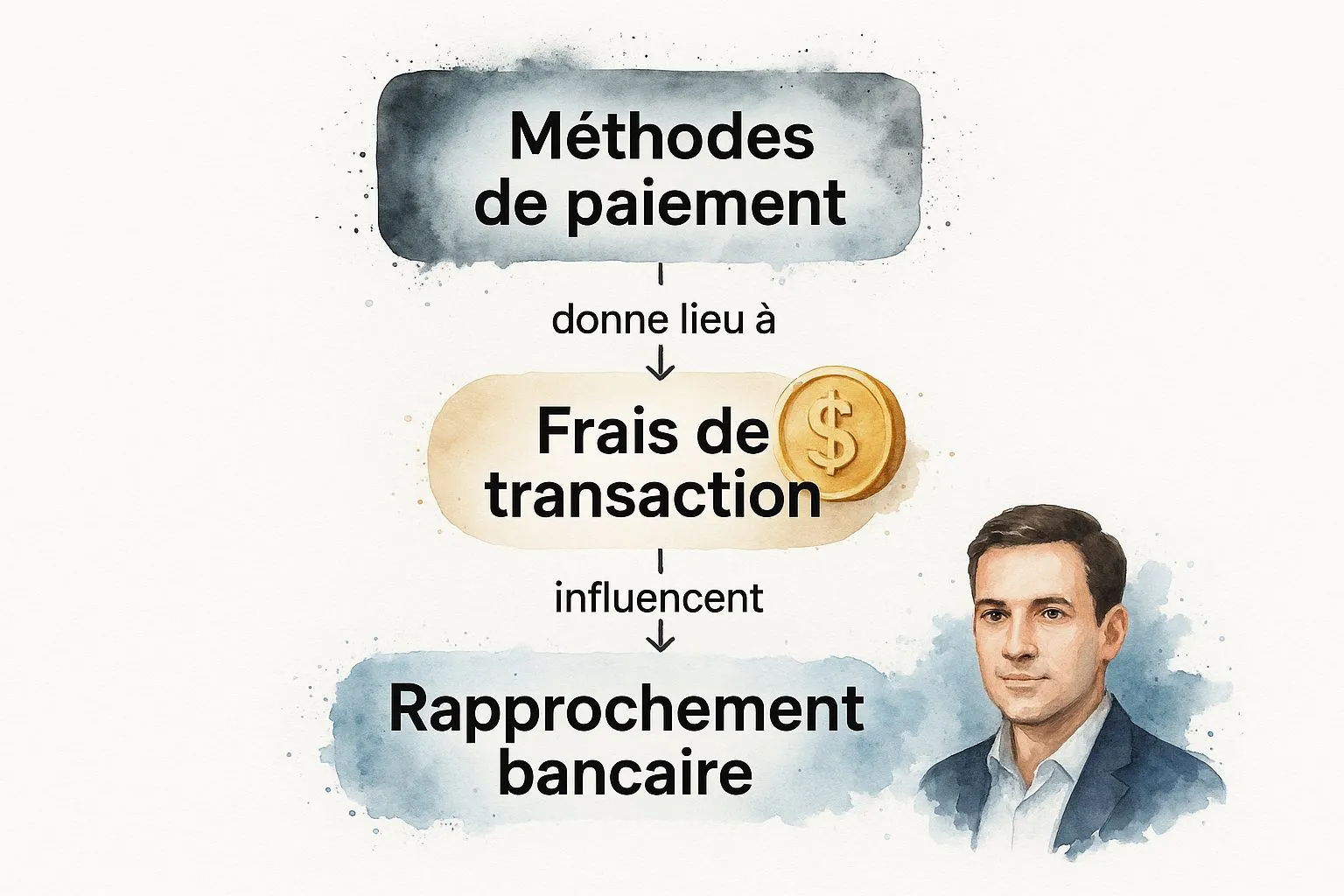 It’s clear that bank reconciliation isn’t a simple comparison. It’s the final step of a process that absolutely must account for all intermediate fees to be accurate.
Managing payment breakdowns
One of the most classic mistakes is treating the Stripe or PayPal transfer as your revenue. It’s a common but dangerous misconception. This amount is actually your revenue minus the platform’s commissions. The correct method is to record the full sale amount as revenue, then the transaction fees as an expense.
Let’s take a simple example to clarify:
- A customer buys a product from you for €100. That’s your revenue.
- The payment platform takes its commission, say €2.50.
- What lands in your account is therefore €97.50.
If you record €97.50 as revenue, you’re underestimating your sales and hiding your real costs. Best practice is to record €100 as revenue (class 7 account) and €2.50 as an expense (account 627 - Fees on deeds and litigation, in the French chart of accounts). The difference is huge for steering your profitability.
The bank reconciliation headache
In e-commerce, bank reconciliation gets tricky because the transfers you receive are often lump sums. A single PayPal payout can bundle together dozens, even hundreds of separate sales, each with its own fees. That’s where the real work begins.
To complicate matters further, these bundled transfers rarely come with a breakdown that would let you match them to each order in your Shopify or WooCommerce back office. The goal, then, is to “decode” these transfers to tie them back to each original transaction.
Bank reconciliation in e-commerce is real detective work. You have to piece together the financial puzzle of each sale, from transaction fees to potential refunds, to make sure every cent is accounted for and properly recorded.
With 2.35 billion online transactions in France in 2023, up 6.5%, manual accounting quickly becomes a nightmare. Automated, responsive management is no longer a luxury. It’s a necessity to process these flows in near real time and stay in control of your business. To grasp the scale of the phenomenon, feel free to check out the latest commerce statistics.
Recording returns and refunds
Managing returns is another quirk that gives e-commerce accounting a hard time. A return isn’t just a cancelled sale. It triggers a reverse financial flow that demands just as much rigor as the original sale.
When a customer sends a product back to you, several actions follow:
- Cancelling the sale: This results in an accounting entry that reduces your revenue. Without it, your income would be artificially inflated.
- Handling VAT: Did you collect VAT on the sale? The refund means you also have to “give back” that VAT. Your declaration must absolutely reflect this correction.
- Restocking inventory: If the product is in good condition, it must go back into your accounting and physical inventory, which directly impacts the value of your assets.
Partial refunds add another layer of complexity. Imagine a customer returns just one item from an order that had three. You then need to precisely calculate the amount to refund, the VAT tied to that specific item, and adjust your inventory accordingly.
The impact on inventory management
In e-commerce, inventory management and accounting are inseparable. Every product in your warehouse represents a value, an asset for your business. Accurate management is therefore crucial for several reasons:
- Knowing your cost of goods sold (COGS): To calculate your gross margin, you need to know exactly how much the inventory you sold cost you.
- Valuing your business: The value of your inventory is a pillar of your balance sheet. A poor valuation distorts your company’s financial health.
- Optimizing your cash flow: Too much inventory means money sitting idle that could be invested elsewhere. Not enough inventory means lost sales.
The most common method for valuing inventory is the Weighted Average Cost (WAC). It smooths out variations in purchase prices and gives a more stable picture of your inventory’s value. Tracking these flows precisely keeps you from flying blind and gives you the tools to make decisions based on reliable financial data.
Choosing the right tools to automate your accounting
Handling e-commerce accounting by hand is a bit like trying to cross a busy highway blindfolded during rush hour. It’s not just exhausting, it’s also the surest way to make costly mistakes. Fortunately, technology is here to turn this headache into a smooth, secure process, letting you focus on what really matters: growing your shop.
Let’s be clear: automation is no longer optional, it’s a strategic necessity. It puts an end to data-entry errors, saves you a huge amount of time and, above all, gives you a clear, real-time financial view of your business. To get there, you need to build an ecosystem of tools that work well together.
This technology choice rests on two essential pillars: good accounting software and specialized connectors.
All-in-one accounting software
Modern accounting software has been designed for today’s entrepreneurs. Forget old, complex spreadsheets, these platforms centralize everything. Solutions like Pennylane or Indy let you handle invoicing, track expenses and sync with your bank, all from a single interface.
Their major strength? They connect directly to your bank accounts to automatically retrieve all transactions. Add a few well-designed automation rules, and most of your income and expenses get categorized without you lifting a finger. It’s magic.
For many freelancers, these tools are more than enough to get started. If you’re a sole trader, our guide to choosing the right accounting software will help you find the perfect fit for your needs.
Specialized connectors for e-commerce
But where general-purpose software shows its limits, specialized connectors come into play. These tools are true translators: they bridge the gap between your sales platforms (Shopify, WooCommerce, Amazon…) and your accounting software. Their job is to turn the often chaotic language of e-commerce platforms into clean, accurate accounting entries.
Concretely, a good connector will:
- Break down sales in detail: It doesn’t just see a lump-sum transfer. It breaks down each sale, the VAT collected, transaction fees (Stripe, PayPal), refunds and even promo codes used.
- Sync inventory: After each sale, it can update your inventory value in your accounting. Your balance sheet then reflects the true value of your assets.
- Manage multi-channel selling: Selling on several platforms? The connector centralizes all the data and sends it consistently to your accountant.
Without a connector, your accounting will remain an approximation. You’ll record lump-sum transfers without being able to justify them, which will completely distort your real revenue and margins.
This technology ecosystem is all the more crucial as e-commerce keeps growing at a pace four times faster than physical retail. The volume of card transactions is exploding. These numbers don’t lie: it’s urgent to adopt solid e-commerce accounting, capable of reliably handling this avalanche of micro-transactions. To better understand these trends, you can discover the keys to payment success in France.
By combining strong accounting software with a specialized connector, you create a perfectly well-oiled machine. Sales data is collected, sorted, enriched, then sent to your accounts without you having to lift a finger. The result? Financial management that keeps you compliant, but above all becomes a real dashboard for making the right decisions.
Finding the right chartered accountant, an e-commerce specialist
Working with a chartered accountant isn’t just another line item in your expenses to stay compliant. Think of it instead as a strategic investment, a true partnership that can actively drive your shop’s growth. But be careful, when it comes to online selling, not all accountants play in the same league.
Handing your e-commerce accounting to a general-practice firm is a bit like asking your family doctor to perform open-heart surgery. The intent is good, the foundations are solid, but they lack the highly specific expertise for the situations you deal with every day. The subtleties of Shopify or WooCommerce financial flows, the intricacies of international VAT or the specifics of industry tools are very likely to go right over their head.
A specialist, on the other hand, has already seen hundreds of cases like yours. They don’t discover the problems, they anticipate them.
The skills that change everything
A chartered accountant who knows e-commerce inside and out stands out through mastery of subjects others only skim. This expertise is what will secure your business and help you optimize your profitability.
Here are the absolutely essential skills you should demand:
- A perfect command of payment flows: They must instinctively understand how payouts from Stripe, PayPal or other gateways work. They know that the amount transferred to your account is NOT your revenue, and will know how to accurately break down sales, commissions, fees and refunds.
- Marketplace expertise: Selling on Amazon, Etsy or ManoMano has its own accounting rules. Your accountant must know how to decipher and reconcile these platforms’ complex sales reports, which are a massive source of errors for the uninitiated.
- In-depth knowledge of European VAT: They must be fully comfortable with VAT thresholds, how the One-Stop Shop (OSS) works and all the reporting obligations that come with your international sales. This is a crucial point to help you avoid a painful tax reassessment.
- A genuine affinity for technology: A good e-commerce accountant speaks the same language as your tools. They know modern accounting software and, above all, are familiar with the connectors that automate synchronization between your sales site and their accounting.
Believing that any chartered accountant can handle an online shop is a mistake that can cost you dearly. A specialist doesn’t just validate your numbers; they help you build a robust financial system that supports your growth, alerts you to risks and identifies opportunities you’d never have spotted on your own.
Questions to ask before committing
To find out if a firm is truly cut out for your business, you need to dig a bit deeper than surface-level questions. The interview is the perfect moment to test their field knowledge. Prepare a list of specific questions to push them to show what they’re really made of.
Here are some examples of targeted questions to ask:
- Concretely, how do you handle reconciling lump-sum payouts from Amazon or Stripe?
- What’s your experience with shops running on Shopify (or whichever platform you use)?
- What tools or connectors would you recommend to automate the recording of my sales?
- Have you already helped online sellers set up the One-Stop Shop VAT scheme (OSS)?
- How do you handle the accounting treatment of product returns and partial refunds?
- What kind of reporting can you provide to help me better manage my day-to-day profitability?
The answers they give you will be very telling. A specialist will give you clear, precise answers, often illustrated with examples. A generalist will likely remain vague.
Choosing the right partner means buying yourself invaluable peace of mind and high-value advice to turn your e-commerce accounting into a real decision-making tool.
Using your accounting as a steering tool

Too many online sellers see their accounting as a mere chore, a legal obligation to wrap up once a year. That’s a mistake. Think of it instead as your car’s dashboard. It gives you crucial real-time information to steer your business, adjust your speed and avoid running off the road. Without this data, you’re flying blind.
In reality, your e-commerce accounting is a goldmine. It’s what turns rows of raw numbers into real performance indicators, giving you the keys to make strategic decisions. It helps you optimize your margins, fine-tune your marketing campaigns and manage your inventory with clockwork precision.
Decoding your key performance indicators (KPIs)
For this dashboard to be effective, you need to know which gauges to watch. In e-commerce, a few indicators are absolutely essential for taking the pulse of your business and measuring its performance.
Here are the KPIs you absolutely must pull from your accounting:
- Gross margin: This is the net profit you make on each sale, once the direct cost of the product (purchase or manufacturing) is deducted. This indicator tells you whether your pricing strategy holds up.
- Customer acquisition cost (CAC): How much do you actually spend on advertising and marketing to convince a new person to buy from you? A soaring CAC can quickly eat into your profits.
- Customer lifetime value (LTV): This indicator projects the total revenue a customer will generate over the course of their relationship with your shop. It’s fundamental for knowing how much you can reasonably invest to acquire them.
- Return rate: This is the percentage of products sent back by customers. An abnormally high rate is often a symptom of a quality issue, an inaccurate product description or a logistics problem.
Turning numbers into action to drive your growth
Calculating these indicators is good. But their real power shows when you interpret them and use them to guide your decisions.
Accounting isn’t just for looking in the rearview mirror. It provides the data needed to adjust your course and speed up your development. Every number tells a story about your customers, your products and your operations.
Let’s imagine a concrete case: you notice that your gross margin is very low on one of your bestsellers. The accounting analysis will immediately push you to renegotiate rates with your supplier or adjust your selling price. If your customer acquisition cost is skyrocketing, it’s high time to revisit your ad campaigns to target more qualified, and therefore more profitable, audiences.
The relationship between LTV and CAC is just as telling. Generally, you want an LTV at least three times your CAC. If you’re below that, you’re probably spending too much to attract customers who won’t be profitable enough in the long run.
Finally, a return rate that starts climbing should set off alarm bells. By digging into the reasons behind the returns, you can improve your product pages or the quality of your items. The result: lower costs and happier customers. Your accounting thus becomes the engine of a virtuous cycle of continuous improvement.
FAQ on e-commerce accounting
Diving into e-commerce accounting can feel dizzying. There’s always a very specific question that pops up at the worst possible moment. Here are some direct answers to clarify the essential points and help you secure your business from the start.
Do I absolutely need a chartered accountant for my online shop?
From a purely legal standpoint, no, it’s not always mandatory. This is especially true if you’re a micro-entrepreneur. But let’s be clear: it’s very, very strongly recommended.
Accounting for an e-commerce site is far more complex than it appears. Between managing VAT on foreign sales, the various financial flows and accounting for returns, a specialist’s help quickly becomes essential. Entrusting your accounting to a specialist means buying peace of mind, avoiding costly mistakes and, above all, getting valuable advice to improve your profitability. Think of it as an investment, not just an expense.
How do I handle Stripe or PayPal fees in my accounts?
The commissions charged by platforms like Stripe or PayPal are expenses for your business. They must be recorded as such, most often under accounting account 627, labeled “Fees on deeds and litigation” in the French chart of accounts.
The classic mistake, and one you absolutely must avoid, is recording only the net amount that lands in your bank account.
Never forget: your revenue is the total amount paid by your customer, before any deductions. Payment commissions are a separate expense in their own right. The best way to never get it wrong is to automate this processing to make sure your revenue declaration is always accurate.
From what point do I need to charge VAT to European customers?
As soon as the total of your sales of goods to individuals within the European Union exceeds the €10,000 threshold over a calendar year, things change. You then need to start applying the VAT rate of your customer’s country, rather than French VAT.
To make life easier, there’s a great tool: the One-Stop Shop VAT scheme (OSS). By registering, you can declare and pay all the VAT collected across Europe through a single portal in France. It’s the simplest way to avoid registering for VAT in every country where you sell.
Don’t let paperwork hold back your growth. With Bizyness, automate your invoicing and accounting so you can focus on what really matters. Discover how Bizyness can simplify your daily life.
