

 Français
The complete guide to deductible VAT on fuel
Optimize your finances. Our complete guide to deductible VAT on fuel shows you how to recover the maximum amount while staying fully compliant.
Deductible VAT on fuel is simply a tax mechanism that allows your business to get “reimbursed” for part of the VAT you pay at the pump. The idea is simple: prevent businesses from bearing the final cost of this tax, which is normally meant to be paid by the end consumer.
How does VAT recovery on fuel work?
Think of this mechanism as a kind of credit the government grants you on your professional fuel expenses. Every time you fill up for business purposes, you advance the VAT. Later, you can deduct part or all of that amount from the VAT you owe the government. It’s a genuinely effective management lever for reducing your costs and preserving your cash flow.
It’s worth knowing that the rules haven’t always been the same for all fuel types. For a long time, diesel was the favored fuel, with largely deductible VAT, while petrol was left out. Fortunately, a reform gradually changed things starting in 2017 to align the petrol regime with that of diesel, creating a fairer system.
What are the current recovery rates?
Specifically, how much can you recover? It all depends on the type of vehicle you use. That’s the main criterion today, far more than the type of fuel.
Here’s the logic: the tax authorities assume that a commercial vehicle is entirely dedicated to business use. A passenger vehicle, on the other hand, may have mixed use, both professional and personal. The deduction is therefore adjusted based on this distinction.
Of course, there are specific situations where the tax isn’t recoverable at all. To dig deeper into this topic, our guide on non-recoverable VAT will give you all the answers.
To make things clearer, here’s a summary table of the VAT rates you can recover on the most common fuels.
Recoverable VAT rates on main fuel types
This table summarizes the VAT percentages you can recover depending on the type of vehicle and fuel.
| Vehicle type | Petrol | Diesel |
|---|---|---|
| Passenger Vehicle (PV) | 80% | 80% |
| Commercial Vehicle (CV) | 100% | 100% |
As you can see, the distinction between commercial vehicle (CV) and passenger vehicle (PV) is essential. Mastering this nuance is what will let you optimize your VAT returns and significantly reduce your fuel costs.
The rules of the game for recovering VAT on fuel
Recovering VAT on fuel isn’t automatic. There are rules to follow, a bit like a game. To win against the tax authorities, it’s best to know the rules inside out.
There are three basic, non-negotiable conditions your business must scrupulously respect. Even an unintentional oversight can put you at risk of a tax reassessment. Best to build these reflexes into your daily management to protect your cash flow.
The nature of your business
The very first thing to check is your business’s status. To be able to deduct VAT, you first need to collect it. In short, your business must be VAT-registered.
If you’re under the VAT exemption scheme, as is the case for many micro-entrepreneurs, you don’t charge VAT to your customers. The logic is unforgiving: if you don’t collect it, you can’t recover it on your expenses. Fuel is no exception.
The professional nature of the expense
Next, the tax authorities want to make sure the fuel was actually used for your business. The expense must be strictly incurred in the interest of the business. The link must be direct and obvious.
To make things clearer, here are a few concrete examples:
- Yes, it’s deductible: Filling up to visit a client, make a delivery, or travel to a job site.
- No, it doesn’t qualify: Petrol for the daily commute between home and work, or for a weekend getaway. These trips are considered personal.
By the way, to optimize the management of your business trips, it’s also worth looking into mileage allowances for professional travel. It’s another approach that can be very useful, especially if you use your personal vehicle for work.
The compliant supporting document
This is often where things go wrong. To prove your expense, a simple card payment receipt or till receipt isn’t enough. The tax authorities require a properly formatted document.
What you need is a full invoice. It must clearly show the amount excluding tax (net), the VAT rate, and the VAT amount. And of course, your company’s name must appear on it.
Without this valuable invoice, you won’t be able to justify your deduction in the event of an audit. So make it a habit to ask for one every time you fill up. Knowing how VAT calculation works will help you check at a glance whether your invoices are correct. This discipline is your best ally for avoiding unpleasant surprises.
The impact of vehicle type on VAT deduction
The ability to recover VAT on fuel isn’t the same for everyone. It all depends on your main work tool: your vehicle. In the eyes of the tax authorities, a delivery van and a company sedan don’t play in the same category, and this difference is crucial for properly managing your deductible VAT on fuel.
This logic is actually quite easy to understand. A vehicle can either be a purely professional tool, or an asset that can be used for both professional and personal purposes. It’s this presumption of use that directly influences the percentage of VAT you’re entitled to recover.
For the tax authorities, there are two broad vehicle families:
- Commercial vehicles (CV): These are the true “workhorses” of the business. Think vans, small trucks, or pickups, all designed primarily to transport equipment or goods.
- Passenger vehicles (PV): These vehicles, such as sedans, SUVs, and hatchbacks, are built for transporting people. The tax authorities therefore consider they have a much higher potential for private use.
M1 versus N1 classification: the detail that changes everything
The official distinction between these two types of vehicles isn’t pulled out of thin air. It’s written in black and white on your vehicle registration document, under field (J.1). This little code makes all the difference.
A commercial vehicle, classified under category N1, is regarded by the government as being exclusively dedicated to your business. The conclusion follows logically: VAT on fuel is recoverable at 100%.
Conversely, a passenger vehicle, marked M1, is treated differently. The tax authorities assume part of its use is private. A flat 20% reduction is therefore applied, which caps your VAT recovery at 80% of the amount paid.
This infographic perfectly summarizes the direct link between vehicle type, its presumed use by the tax authorities, and the VAT rate you can recover on your fuel expenses.
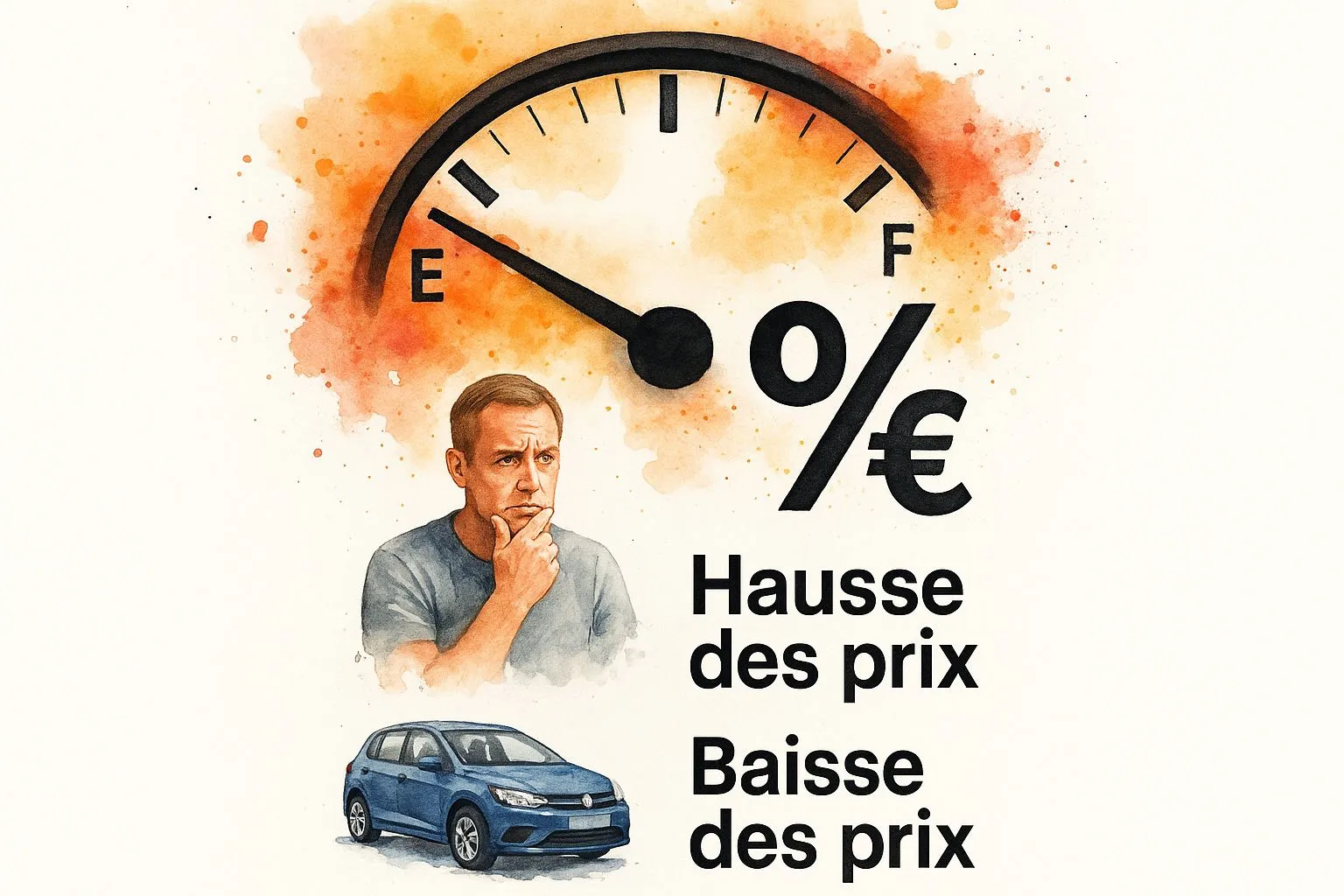
It’s clear that vehicle classification is the cornerstone of the whole system. It’s what determines whether you recover all of the VAT or only part of it.
Why this distinction matters so much day to day
Grasping this nuance is fundamental, especially when you’re planning to expand your fleet. If your business allows it, choosing a commercial vehicle (N1) is the most direct way to optimize your fuel expenses.
Good news: since 2022, the rules have been simplified and apply in the same way to petrol and diesel. For commercial vehicles (N1), VAT is deductible at 100%. For passenger vehicles (M1), the cap remains 80%.
The reflex to adopt: Before any purchase or calculation, check field (J.1) on the registration document. The simple mention of “N1” or “M1” has a direct impact on your cash flow and radically changes the amount of VAT you can recover.
Don’t forget that this distinction also affects other aspects of your taxation, such as vehicle depreciation. It’s therefore crucial to carefully analyze your needs to make the right choice. In fact, weighing the choice between a company vehicle or mileage allowances is an integral part of this strategic thinking.
The calculation and reporting process
Alright, enough theory, let’s get practical. Knowing the rules is good, but knowing how to precisely calculate deductible VAT on fuel and where to report it on your return is even better. Rest assured, the process is more methodical than magical.
The goal is to turn this administrative task into a simple, error-free reflex. We’ll break down the calculation together, step by step, with clear examples. Then I’ll walk you through filling in the right box on your VAT return.

The calculation method explained
The formula for calculating what you can recover is actually quite straightforward. There are two steps: first, you isolate the total VAT amount you paid on your fill-up, then you apply the deduction rate that corresponds to your vehicle.
Here’s the formula to remember:
Recoverable VAT = (Fill-up amount incl. tax / 1.20) * 0.20 * Deduction rate (%)
In France, the VAT rate on fuel is 20%. The “deduction rate” varies depending on your vehicle: 80% for a passenger vehicle, 100% for a commercial vehicle.
Example 1: Passenger Vehicle (PV)
- Let’s say a petrol fill-up costs you €100 including tax.
- First, calculate the total VAT paid: (100 / 1.20) * 0.20 = €16.67.
- The deduction rate for a PV is 80%.
- Recoverable VAT: €16.67 * 80% = €13.34.
In practical terms, on this €100 fill-up, you can recover €13.34 of the VAT you owe the government. Not bad, right?
Example 2: Commercial Vehicle (CV)
- This time, you fill up with diesel for €150 including tax.
- Total VAT paid: (150 / 1.20) * 0.20 = €25.
- The deduction rate for a CV is 100%.
- Recoverable VAT: €25 * 100% = €25.
Here it’s simple: the entire VAT paid on the fuel is refunded to you.
Reporting the amount on your VAT return
Once you have the total amount of your deductible VAT for the period (whether you file monthly or quarterly), you need to enter it in the right place. This amount should be added to the total of your “VAT deductible on other goods and services.”
On the CA3 return form, this amount goes on line 20. It simply adds to the VAT you’re already deducting on your other business expenses (supplies, subscriptions, etc.).
For those under the simplified regime who file the annual CA12 return, the principle is the same. You total up all the deductible VAT for the year and enter it in the box provided for that purpose.
Tips for rigorous, effortless tracking
An accurate calculation depends above all on impeccable expense tracking. Waiting until the end of the month to sort through a pile of crumpled receipts is the best way to make mistakes or, worse, miss deductions entirely.
Here are a few best practices to make your life easier:
- Use a professional fuel card: This is ideal. It centralizes all expenses and provides detailed statements where VAT is already clearly identified.
- Adopt accounting software: Tools like Bizyness let you scan your invoices in the blink of an eye. The software automatically extracts the accounting information, including VAT.
- Create a dedicated expense account: In accounting terms, allocating all fuel expenses to a specific account (account 6061, for example) makes the final calculation much simpler.
By automating collection and calculation a bit, you not only save valuable time, but you’re also certain to recover every cent of VAT you’re entitled to.
Beyond petrol and diesel, what are the options for your fleet?
While petrol and diesel often dominate conversations about deductible VAT on fuel, the world of company fleets is undergoing major change. Choosing alternative energy sources is no longer just a gesture for the planet, it has become a particularly smart financial strategy, widely encouraged by the tax authorities.
The message from public authorities is clear: cleaner energy sources unlock much more generous VAT deduction rules. For a business looking to both control its expenses and modernize its vehicle fleet, this is a path full of promise.
https://www.youtube.com/embed/-vopbMxbjEQ
LPG, CNG and E85: tax advantages that make a difference
Liquefied Petroleum Gas (LPG), Compressed Natural Gas (CNG), and E85 superethanol truly stand out from the pack. Their VAT recovery rules are so advantageous that they radically simplify life for accountants.
For these fuels, the headache of distinguishing between commercial and passenger vehicles disappears. The rule is as simple as it is effective:
- Passenger vehicles (PV): VAT is deductible at 100%.
- Commercial vehicles (CV): VAT is also deductible at 100%.
This full deductibility, regardless of vehicle type, turns these fuels into a powerful optimization tool. Forget the complex calculations tied to potential private use.
Put simply, choosing a vehicle that runs on LPG or CNG lets you recover all of the VAT on fuel. Passenger vehicles are treated the same as commercial vehicles. It’s a very direct tax incentive to encourage the switch to other types of engines.
Electricity: a special case, but in a good way
The shift to electric also benefits from a huge tax boost. For businesses making the switch, the VAT deductibility rule on electricity is the simplest of all.
VAT paid on electricity used to charge batteries is 100% recoverable. And again, there’s no difference between a passenger car and a commercial vehicle. This applies equally to electricity consumed via the company’s own charging stations and to charging done at public charging points.
To make things clearer, here’s a table summarizing the situation.
Comparison of VAT deductibility by fuel and vehicle type
This table compares at a glance the VAT recovery rates for traditional fuels and alternative energy sources.
| Fuel Type | Passenger Vehicle (M1) | Commercial Vehicle (N1) |
|---|---|---|
| Diesel | 80% | 100% |
| Petrol | 80% | 100% |
| LPG, CNG, E85 | 100% | 100% |
| Electricity | 100% | 100% |
This comparison leaves no doubt: the tax advantage clearly favors alternative energy sources. By making this choice, a business doesn’t just reduce its environmental impact. It also maximizes its VAT recovery, turning a mandatory expense into a genuine financial opportunity.
Your questions, our answers on fuel VAT
Even when you think you’ve mastered the rules, practice always raises new questions. That’s perfectly normal. I’ve gathered here the most frequently asked questions about deductible VAT on fuel to clear up any remaining doubts.
The idea is simple: give you clear, concrete answers you can apply starting tomorrow in your day-to-day management. So you can approach your fuel expense reports with more peace of mind.
Is a till receipt enough for VAT purposes?
The answer is no, and it’s probably the most common mistake. For the tax authorities to accept your deduction, a simple card payment slip or petrol station receipt is worthless.
You absolutely need a properly formatted invoice. This is non-negotiable.
Make sure it clearly states:
- Your company’s name (not your own)
- The amount excluding tax (net)
- The VAT rate (generally 20%)
- The corresponding VAT amount
The right habit? Systematically ask for a “real” invoice every time you fill up. It’s a habit that can save you a lot of money.
I use my personal car for work, how does that work?
This is a very common scenario. If you use your own car, recovering VAT on petrol or diesel is impossible. Why? Simply because the fuel invoice will be issued in your personal name, not the company’s.
The solution in this case is the mileage allowance system. Your company pays you an allowance based on an official scale. This amount is meant to cover all costs: wear and tear, insurance, maintenance and, of course, fuel. For the business, this allowance is a deductible expense, which reduces its tax bill. But be careful, VAT on fuel itself remains non-recoverable.
What to remember: For a personal vehicle, you don’t recover VAT. Instead, expenses are offset through mileage allowances, which are a deductible expense for the business.
What about rental vehicles?
Whether you rent a vehicle for a day or for three years, the rules don’t change. VAT on fuel is deducted in exactly the same way as for a vehicle you own.
The only criterion that matters is the nature of the rented vehicle. If it’s a commercial vehicle (CV), you can recover 100% of the VAT on fuel. For a passenger vehicle (PV), it will be 80%. It’s as simple as that.
Oops, I made a mistake on my return… What should I do?
Don’t panic, it happens to the best of us. If you notice an error on a VAT return you’ve already filed, the most important thing is not to bury your head in the sand.
You need to take the initiative and file an amended return to fix things. It’s the only proper way to regularize your situation.
Letting an error slide, even a small one, can cost you dearly in the event of a tax audit: late penalties, surcharges… It’s better to correct it yourself as soon as you notice it.
To never have to ask yourself these questions again and automate your VAT tracking, Bizyness offers a management solution designed for you. Generate compliant invoices in just a few clicks, track your expenses, and keep control of your accounting, effortlessly. Discover how to simplify your business management.
